

Orchid Varieties: The Different Genera and How to Choose the Right One for You

The easiest orchids to grow at home are Phalaenopsis, Paphiopedilum, Cattleya and, in a cool room, Cymbidium. All belong to the Orchidaceae family, which includes nearly 30,000 known species according to the MNHN (Muséum national d'Histoire naturelle).
This guide presents the main types of indoor orchids, with for each its light, its temperatures according to the American Orchid Society, its flowering and its difficulty level. It helps you choose yours, then links to our care guides and our collection of orchids (Orchidaceae).
🌟 What is an orchid? The Orchidaceae family in brief
An orchid is a flowering plant from the Orchidaceae family, one of the largest in the plant world, with nearly 30,000 known species and new discoveries every year, according to the MNHN. The POWO (Plants of the World Online) database, the botanical database of the Royal Botanic Gardens, Kew lists 691 accepted genera.
Its flower is recognizable by its labellum, a highly modified floral part, and its column (or gynostemium), which combines the male and female organs, according to the Department of Botany at the University of Hawai'i at Mānoa. The same source states that orchids are terrestrial, epiphytic (they grow on other plants), or saprophytic.
The Muséum states that 95% of orchids are tropical and subtropical, and that selection has produced tens of thousands of horticultural varieties. When we talk about orchid varieties in stores, we are therefore mainly talking about genera and cultivated hybrids, not wild species.
| Key point | What to remember |
|---|---|
| An immense family | Nearly 30,000 known species (MNHN) and 691 accepted genera (POWO) |
| Mostly tropical | 95% of species are tropical and subtropical (MNHN), hence their success indoors |
| Thousands of hybrids | Tens of thousands of varieties obtained through selection (MNHN) |
| Long-lasting flowers | Cattleya, Phalaenopsis and Cymbidium stay in bloom for a long time, according to the Muséum |
📊 The main types of indoor orchids: the comparison
The main types of indoor orchids are distinguished mainly by their light requirements and the temperature they need at night. The table compares ten common genera. The temperatures come from the American Orchid Society care sheets, converted to °C, and the flowering from the Missouri Botanical Garden and Clemson University. The difficulty is our expert opinion for growing indoors.
| Genus | Light | Nights and days | Flowering | Difficulty and for whom |
|---|---|---|---|---|
| Phalaenopsis (moth orchid) | Thrives without direct sunlight, an east window is ideal (the Missouri Botanical Garden) | Nights above 16 °C, days from 24 to 29 °C (the AOS (American Orchid Society)) | In winter, flowers that last for months (MBG) | Easy: the first choice, even for beginners |
| Cambria and Oncidium (dancing orchid) | 1 to 5 hours of sunlight per day (AOS) | Nights from 13 to 16 °C, days from 27 to 29 °C (AOS) | Branched spikes of small flowers, often yellow and brown (MBG) | Intermediate: for a bright room and a little cool at night |
| Dendrobium | Strong light, without noon sun (the Clemson Cooperative Extension) | Nights from 13 to 18 °C, days from 21 to 29 °C (AOS) | Autumn and winter, flowers for 3 to 4 weeks (Clemson) | Intermediate: drier rest in late autumn for the nobile type |
| Cattleya | Twice as much light as a Phalaenopsis (Clemson) | Difference of 5.5 to 8.3 °C between day and night (AOS) | Once a year (Clemson), fragrant flowers for about one month (MBG) | Intermediate: for a very bright window |
| Paphiopedilum (Venus slipper) | Moderate light, 2 to 3 hours of filtered sunlight (AOS) | Nights from 16 to 18 °C for marbled leaves, from 10 to 16 °C for green ones (MBG) | A large slipper flower, striped or spotted | Easy to intermediate: for a less bright room |
| Vanda | From 50 to 100% of full sun light, in a greenhouse (AOS) | Nights from 13 to 22 °C, days from 21 to 35 °C (AOS) | Large flowers, can be grown without a substrate (AOS) | Demanding: for a greenhouse, conservatory or collector |
| Cymbidium | Lots of light, 4 hours of direct sunlight and more (AOS) | Nights from 10 to 14 °C in autumn to flower (AOS) | Long-lasting flowers, good as cut flowers (MBG) | Easy in cool conditions, difficult in a heated living room |
| Miltoniopsis (pansy orchid) | East window, north or west, 1 to 5 hours of sunlight (AOS) | Nights from 13 to 22 °C, days from 21 to 29 °C (AOS) | Large flat and colorful flowers | Demanding: at least 70% humidity (AOS) |
| Zygopetalum | Fairly bright light, without direct sun (MBG) | Nights about 5 to 6 °C cooler than days (MBG) | From late autumn to early spring, very fragrant (MBG) | Intermediate: for those who love fragrance |
| jewel orchid (Ludisia) | Medium light, good air circulation (MBG) | Heat and humidity all year round (MBG) | Small white flowers in a spike, grown for its foliage | Easy: a foliage orchid |
📋 Quick fact sheet
Common features of indoor orchids, according to the MNHN, POWO, AOS, RHS and ASPCA.
| Key point | The rule |
|---|---|
| Family | Orchidaceae |
| Species | Nearly 30,000 known species (MNHN) |
| Genera | 691 accepted genera (POWO) |
| Origin | 95% tropical and subtropical species (MNHN) |
| Light | Bright and filtered for most, never the burning noon sun |
| Nights | From 10 to 22 °C depending on the genus, with a nighttime drop that helps flowering (AOS) |
| Air humidity | From 30 to 80% depending on the genus, 50 to 80% for Phalaenopsis (AOS) |
| Substrate | Bark-based mix, never universal potting soil (RHS) |
| Watering | By soaking, when the substrate is dry to the touch, without leaving roots in water |
| Toxicity | Phalaenopsis, Oncidium flexuosum and Cattleya trianaei classified as non-toxic for dogs, cats and horses (ASPCA) |
How to choose an orchid in 6 steps
To choose an orchid, start with your room and not the flower: look at the light from the window and the temperature of your nights, then choose the genus that likes it there, and finally the color. Then check the condition of the plant, in the store as well as upon receipt of a package. A healthy orchid will recover quickly, while a tired plant will require months of patience.
| Step | The right move |
|---|---|
| 1. Measure the light | East or west window for a Phalaenopsis or Paphiopedilum; very bright south window for a Cattleya, which requires more than 4 hours of direct sunlight indoors (AOS) |
| 2. Note the night temperature | Living room heated all year: Phalaenopsis; cool room, frost-free conservatory: Cymbidium or Dendrobium |
| 3. Choose the genus, then the color | Read the label: the genus name tells you how to grow the plant, the color changes nothing about its needs |
| 4. Inspect the leaves | Firm, shiny, without soft spots or deep creases; a yellow-leaved orchid often indicates overwatering |
| 5. Look at the roots | In a clear pot, they must be firm, green or silver, never brown and soft |
| 6. Prefer unopened buds | A spike with a few open flowers and buds to come will give you the longest bloom |
columns: 4
columns_mobile: 2
-

 Livraison offerte
White Phalaenopsis Orchid (Phalaenopsis amabilis) – 9 cm pot
Regular price From 44,95 €Regular price44,95 €From 35,96 €Livraison offerte -

 Livraison offerte
Red Phalaenopsis orchid 'Congo' (Phalaenopsis) – 9 cm pot
Regular price From 44,95 €Regular price44,95 €From 35,96 €Livraison offerte -

 Livraison offerte
Pink Phalaenopsis orchid 'Niagara Falls' (Phalaenopsis) – 12 cm pot
Regular price From 49,95 €Regular price49,95 €From 39,96 €Livraison offerte -

 Livraison offerte
Orange Phalaenopsis orchid 'Spider' (Phalaenopsis) – 9 cm pot
Regular price 44,95 €Regular price44,95 €35,96 €Livraison offerte -

 Livraison offerte
Fragrant Orange Phalaenopsis 'Bolgheri' Orchid (Phalaenopsis) - 9 cm Pot
Regular price 44,95 €Regular price44,95 €35,96 €Livraison offerte -

 Livraison offerte
Surprise box of 4 Phalaenopsis orchids – 12 cm pot
Regular price 169,95 €Regular price169,95 €135,96 €Livraison offerte -
Premium Orchid Potting Soil, Orchid Substrate, Potting Soil for All Orchids 4L
Regular price 11,99 €Regular price10,95 €Sale price 11,99 €11,99 €9,60 € -
Orchid Fertilizer - Phalaenopsis Fertilizer - 250ml Liquid Fertilizer - Root and Foliar Fertilizer + Free Graduated Pipette!
Regular price 18,00 €Regular price20,00 €Sale price 18,00 €18,00 €14,40 €Sale



🧭 Which orchid to choose according to your home
The right type of orchid depends first on the room that will welcome it: light, night warmth and air humidity. Here are our correspondences, supported by the AOS and Missouri Botanical Garden sheets.
To know where to place an orchid in the house on a daily basis, our orchid care guide details the location and light.
| Your situation | The orchid that likes it there |
|---|---|
| Bright living room, east or west window | Phalaenopsis: the Clemson University describes it as one of the most adaptable to indoor light |
| Slightly less bright room | Paphiopedilum, which prefers lower light according to the Missouri Botanical Garden, or Phalaenopsis |
| Full south window, very bright | Cattleya, Dendrobium or Cambria, filtering the noon sun |
| Cool conservatory or poorly heated bedroom | Cymbidium, to bring inside when nights drop to 4.4 °C according to the AOS |
| Bright and humid bathroom | Miltoniopsis, which requires at least 70% humidity (AOS); also see how to increase air humidity |
| You love fragrant flowers | Zygopetalum, with very fragrant flowers, or Cattleya, also fragrant (MBG) |
| You prefer foliage | The Jewel orchid (Ludisia), grown for its veined leaves |
| Cat or dog at home | Phalaenopsis, classified as non-toxic for dogs, cats and horses by the ASPCA (American Society for the Prevention of Cruelty to Animals); see our list of non-toxic plants for cat and our plants suitable for animals |
👍 What are the easiest orchids to grow
The easiest orchids to grow are Phalaenopsis, Paphiopedilum, Cattleya and, in a cool room, Cymbidium. The University of Wisconsin extension ranks Cattleya, Paphiopedilum and Phalaenopsis among the best indoor orchids. The MNHN cites Cattleya, Phalaenopsis and Cymbidium among the easy-to-grow orchids, whose flowers stay in bloom for a long time.
Phalaenopsis remains the simplest indoors: according to Clemson, it is satisfied with low light, from 1,500 to 1,700 foot-candles (about 16,000 to 18,000 lux), with nights of at least 18 °C (16 °C minimum according to the AOS), the temperature of a heated home. Its flowers stay fresh for several months.
Our Phalaenopsis sheet details its culture and reblooming. Conversely, the University of Wisconsin considers Dendrobium and Oncidium more difficult to grow indoors. Start with a Phalaenopsis, then expand your collection when you master watering.
💎 Rare orchids: what "rare" really means
A rare orchid, in the botanical sense, is a species threatened in the wild; in a plant shop, the word rather designates an uncommon variety, which has nothing to do with it.
All orchid species are listed by CITES, and they make up the vast majority of listed species, according to a document by the IUCN (International Union for Conservation of Nature) orchid specialist group presented to CITES (Convention on International Trade in Endangered Species). The entire Paphiopedilum genus is even listed in Appendix I, the strictest. However, Phalaenopsis hybrids propagated in culture and labeled for retail sale, like ours, are exempt from CITES formalities.
The same document cites the case of Paphiopedilum canhii, which lost 99.5% of its population due to commercial harvesting shortly after its discovery. It also notes 347 orchid species collected from the wild and sold in Thailand. The MNHN reminds us that CITES regulates the collection, possession, sale, import, and export of specimens.
If you are looking for an original orchid, choose plants grown in culture, with a clear genus or hybrid name, and never a plant collected from the wild.
🏡 Hardy Garden Orchids
A few orchids can be grown outdoors in the garden: the simplest is Bletilla striata, which the RHS (Royal Horticultural Society) classifies as H4, hardy from -10 to -5 °C. It forms clumps of 10 to 50 cm and bears fragrant pink flowers in spring and early summer, in partial shade, in cool but well-drained soil.
According to the RHS page dedicated to outdoor orchids, Dactylorhiza hybrids produce pink or purple spikes, thrive in moist soil, and do not tolerate drought; Cypripedium, or slipper orchids, and most hardy orchids like freely draining soil.
These hardy orchids disappear in winter and bloom again from late spring to mid-summer. The RHS specifies that they dislike waterlogged soil in winter and drought in summer.
🗓️ Orchid Flowering Calendar
An orchid does not bloom continuously all year round, but by combining several genera you can have flowers almost continuously. Phalaenopsis blooms mainly in winter, and its flowers last for months according to the Missouri Botanical Garden.
Dendrobium blooms in autumn and winter according to Clemson, Zygopetalum from late autumn to early spring, and most Cattleyas in winter and early spring. To keep your plants in shape during the cold season, also see our guide to indoor plants in winter.
📅 Seasonal Care Calendar
| Season | Key Action |
|---|---|
| 🌸 Spring | Repotting orchids that have finished blooming into a bark-based mix; resume fertilizing with new growth |
| ☀️ Summer | Move Cymbidium to partial shade; water by touch, when the substrate is dry, and be more attentive in high heat |
| 🍂 Autumn | Cooler nights to trigger Phalaenopsis and Cymbidium flower spikes; reduced watering for dormant Dendrobium nobile |
| ❄️ Winter | Full bloom for Phalaenopsis, Zygopetalum, and Dendrobium; keep orchids away from radiators and cold windows |
🐛 Mistakes to Avoid When Choosing an Orchid
The most common mistakes come from a genus ill-suited to the room, much more than a lack of care. Here is how to avoid them.
| Mistake | Why it's a problem | The solution |
|---|---|---|
| Choosing based on color alone | Color says nothing about the plant's needs | Choose the genus first, then the color |
| Putting a Cymbidium in a heated living room | It needs nights of 10 to 14 °C in autumn to bloom (AOS) | Keep it in a cool conservatory or bring it out in summer |
| Placing a Vanda in front of a north window | It requires 50 to 100% of full sun light, in a greenhouse (AOS) | Choose a Phalaenopsis or Paphiopedilum for this room |
| Repotting in universal potting soil | The RHS recommends a bark-based mix for indoor orchids | Use a special orchid substrate and repot an orchid |
| Watering at a fixed time | Roots rot if they stay in water | Water by touch, when the substrate is dry, and water an orchid by soaking |
| Buying an orchid collected from the wild | All species are listed by CITES | Choose plants grown in culture, properly labeled |


🌿 Our Orchids and Guides to Go Further
Our orchid catalog is now focused on Phalaenopsis, the easiest genus, available in many colors and shapes. Each guide below then details a specific action or genus.
| Our selection | Why choose it |
|---|---|
| Phalaenopsis orchid | The ideal genus to start with: our White Phalaenopsis (amabilis type hybrid), the 'Congo' red, the 'Niagara Falls' pink, the 'Spider' orange with narrow petals or the 'Fragrance' fragrant orange |
| By color | Our white orchids, pink, purple, yellow or orange, or a surprise box of 4 orchids |
| Orchid care | Light, temperature, watering, and re-flowering: the complete guide |
| Watering an orchid | The soaking method, by touch |
| Repotting an orchid | When and how to repot, with our premium orchid potting soil or our maritime pine bark |
| Making an orchid bloom again | Restarting a flower spike, with our special liquid orchid fertilizer and our fertilizers and care |
| Jewel orchid | Ludisia, Macodes, and Anoectochilus, the foliage orchids |
| Meaning of orchids | What the language of flowers says, color by color, before giving |
🔑 Recognizing the main orchid genera at a glance
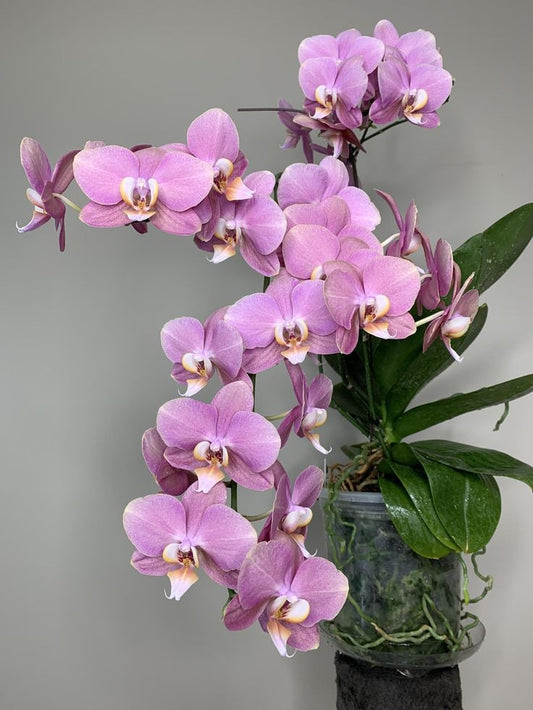
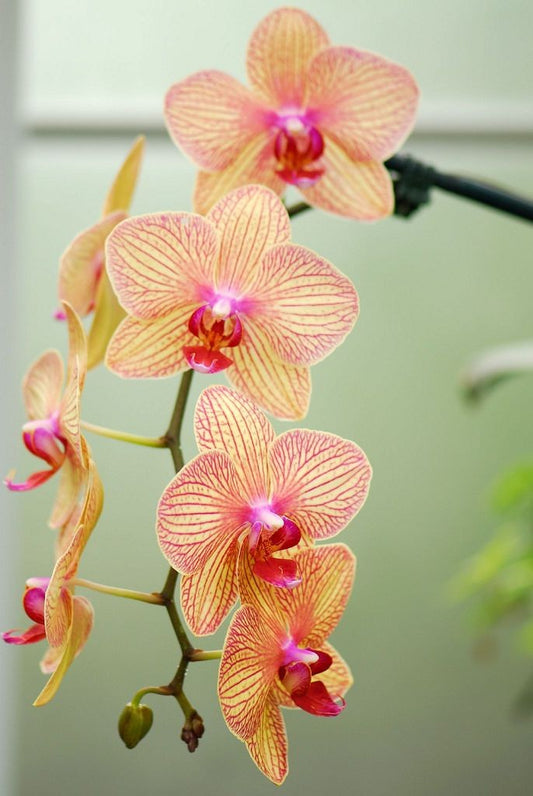
The main orchid genera can be recognized by their flower and growth habit, without being a botanist. Phalaenopsis has large leaves at the base and flat butterfly-shaped flowers, aligned on an arched spike.
Cambria and Oncidium bear pseudobulbs, swollen reserves at the base of the leaves, and many small flowers, often less than 2.5 cm according to the Missouri Botanical Garden. Dendrobium grows in upright canes, Paphiopedilum is distinguished by its slipper-shaped flower, and Vanda by its long aerial roots.
Cymbidium forms long ribbon-like leaves and tall spikes of waxy flowers. Good to know: Cambria is not a natural genus; the EPPO (European and Mediterranean Plant Protection Organisation) base describes it as an intergeneric hybrid name combining notably Oncidium, Odontoglossum, Miltonia, Cochlioda, and Brassia.
✅ Our tips for choosing your orchid properly
To choose an orchid properly, remember a simple rule: genus first, adapted to your light and your nights' temperature, color next. Start with a Phalaenopsis, add a Paphiopedilum for a less bright room or a Cymbidium for a cool conservatory, and leave the Vanda and Miltoniopsis for very bright or very humid interiors.
If you are giving it as a gift, our guide on what plant to give and our page on the meaning of orchids and their colors will help you. Finally, find all our indoor flowering plants and our orchid collection.
For a first orchid, I always recommend a Phalaenopsis: it forgives a lot and rewards with months of flowers. I find that you progress better by observing a single plant than by buying five at once. Then, let yourself be tempted by a Paphiopedilum: its slipper flower always surprises, and it likes where other orchids lack light.

Laura Bruneau
Jardinière et autrice


