Draining Pots Without Drainage Holes: Practical Solutions

A pot without a drainage hole can be managed with one simple principle: control every drop, since the water has nowhere to go. The rule fits in one sentence: double-potting (using a cachepot) is still the best solution; otherwise, water sparingly and slowly, using a very well-draining potting mix. Find our containers in our collection of pots and cachepots.
This guide explains why a pot without a drainage hole is risky, what the best solution is, how to set up a sealed pot if you’re set on using one, which plants to choose, and how to spot overwatering.
⚠️ Why is a pot without a drainage hole risky?
Without a drainage hole, excess water collects at the bottom of the pot and saturates the potting mix, depriving the roots of oxygen and leading to rot in as little as 24 to 48 hours. This is the main danger of these containers.
According to the University of Florida IFAS Extension, containers without drainage holes create saturated conditions that severely limit oxygen around the roots and cause root rot. Contrary to what you might think, roots need a constant supply of oxygen to function.
This is especially important because overwatering is the leading cause of death for houseplants. A sealed pot makes this risk even greater, since any extra water you add stays trapped around the roots. Horticultural extension services, such as the Clemson University HGIC, remind us that most damage to houseplants comes from too much water rather than too little, and that effective drainage is the best protection against root rot.
| Consequence of trapped water | Effect on the plant |
|---|---|
| Saturated potting mix | Roots deprived of oxygen |
| Anaerobic conditions | Rot develops |
| Salt buildup | No way to flush it out; potential toxicity |
🪴 The best solution: double-potting
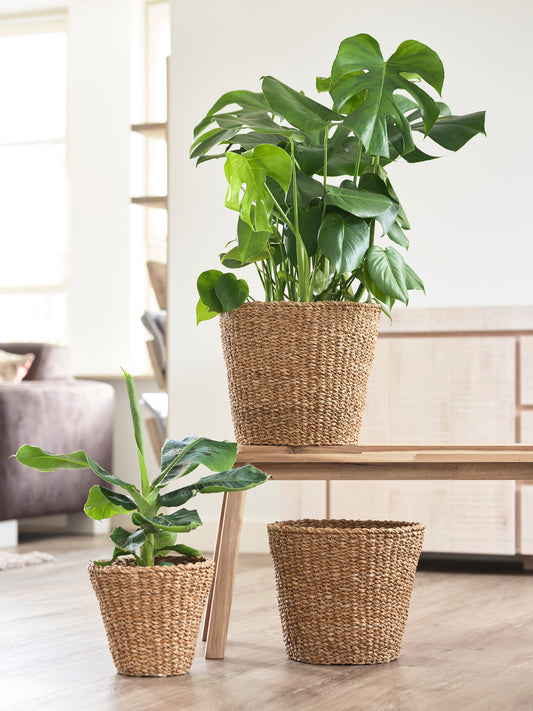
The safest solution is not to plant directly in the sealed pot, but to place a nursery pot with drainage holes inside it. This is double-potting, also known as using a cachepot. That way, you get the look of a beautiful planter and the drainage of a functional pot.
In practice, the plant stays in its perforated plastic nursery pot, which is placed inside the decorative pot. When it’s time to water, take the nursery pot out, water it over the sink, let all the excess drain away (allow 10 to 15 minutes), then put the plant back in its cachepot, raising it by 1 to 2 cm on a handful of clay pebbles so it doesn’t sit in any residual water. This method combines beauty with healthy roots.
| Double-potting step | What to do |
|---|---|
| Nursery pot | Has drainage holes and holds the plant |
| Watering | Take the pot out and water it over the sink |
| Draining | Let all excess water drain away |
| Putting it back | Return it to the cachepot |
Whenever a customer falls for a gorgeous pot without a drainage hole, I always give them the same advice: don’t plant directly in it; use it as a cachepot. Keep the plant in its perforated nursery pot, and you’re all set. It’s the simplest and safest solution. Over the years, I’ve seen too many beautiful plants drown in lovely sealed pots, when simple double-potting would have saved them.
🏺 Setting up a pot without a drainage hole if you’re set on using one
If you’re determined to plant directly in a sealed pot, you need to make up for the lack of drainage with careful preparation: a drainage layer at the bottom, a very airy potting mix, and controlled watering. Nothing can replace a proper drainage hole, but you can reduce the risks.
Add a 2 to 3 cm layer of coarse material (clay pebbles, gravel, or terracotta shards) at the bottom, equivalent to about 10 to 15% of the pot’s height, ideally topped with a thin layer of horticultural charcoal to absorb excess water and limit odors. Then use a very well-draining potting mix (around 30% perlite), amended with perlite and bark to keep air around the roots. A word of caution, though: many horticulturists point out that this drainage layer is far from a miracle solution. Water doesn’t flow down into the gravel until the potting mix above it is saturated, so a layer of clay pebbles mostly creates a reservoir of water at the bottom. It can still be useful as a buffer, but it never removes the need for careful, measured watering.
columns: 4
columns_mobile: 2
-
Transparent Plant Pot - Clear Pot with Perforated Growing Holes
Regular price From 1,95 €Regular price3,25 €Sale price From 1,95 €1,95 €From 1,56 €Sale -
Transparent Araceae Pot - Transparent growing pot for plants
Regular price From 1,95 €Regular price1,95 €Sale price From 1,95 €1,95 €From 1,56 € -
Set of Transparent Araceae Pots - Transparent Growing Pots for Plants
Regular price From 8,97 €Regular price9,75 €Sale price From 8,97 €8,97 €From 7,18 €Sale -
Transparent plant saucers - Rigid saucers - Plant cups
Regular price From 3,00 €Regular price3,50 €Sale price From 3,00 €3,00 €From 2,40 €Sale


🪜 How do you water a pot without a drainage hole?
Watering is an art in this case: every drop stays in the pot, so water sparingly and slowly. In practice, pour in about a quarter (25%) of the amount you’d give a pot with drainage holes, then wait until the top 2 to 3 cm of potting mix is dry before watering again. It’s better to add a little water frequently than to saturate the potting mix all at once.
Pour slowly so the water spreads without collecting at the bottom, check the potting mix’s moisture before each watering (using your finger or a moisture meter), and wait until the surface is dry for a few centimeters down. If in doubt, wait: in a sealed pot, potting mix that’s a little dry is always better than soggy mix.
| Watering rule | Why |
|---|---|
| Use a little water at a time | It all stays in the pot |
| Pour slowly | Distributes water without pooling at the bottom |
| Check before watering | Avoid overwatering |
| If in doubt, wait | Dry is less risky than soggy |
📋 Quick reference (for experienced gardeners)
Key pointers for managing a pot without a drainage hole, at a glance.
| Factor | Guideline |
|---|---|
| Main risk | Standing water, suffocation, rot |
| Best solution | Double-potting (cachepot) |
| Bottom layer | Clay pebbles + horticultural charcoal |
| Potting mix | Very well-draining (perlite, bark) |
| Watering | Water sparingly and slowly, after checking |
| Suitable plants | Hardy plants with low water needs |
| Alternative | Drill a hole in the pot if possible |
| Avoid | Leaving roots in water |
🌵 Which plants can tolerate a pot without a drainage hole?
Not all plants react the same way: hardy species with low water needs, or those accustomed to humid conditions, cope better. Avoid plants that are very sensitive to overwatering.
Hardy plants such as pothos, philodendrons, and some aroids are more forgiving when water management isn’t perfect. Cacti and succulents, on the other hand, are very sensitive to excess moisture and are most at risk in a sealed pot; for them, double-potting is almost essential. So match the plant to the container, and repot every 1 to 2 years to refresh potting mix that becomes depleted and compacted more quickly in a sealed pot. Species that like consistently slightly moist potting mix, such as some ferns, also cope better in a sealed pot than plants accustomed to drying out completely between waterings. If in doubt, reserve pots without drainage holes for the most forgiving plants.
| Plant | Tolerance for pots without drainage holes |
|---|---|
| Pothos, philodendron | Good; forgiving plants |
| Hardy aroids | Fair, with measured watering |
| Ferns (moisture-loving) | Moderate; watch for excess water |
| Cacti, succulents | Low: double-potting is preferable |


🛠️ Drilling a hole in the pot: an option to consider
Before giving up on a beautiful pot, know that you can often drill a hole yourself: this turns a risky container into a perfectly suitable plant pot. It all depends on the material.
Plastic pots are easy to drill with a power drill or even a heated tool. Ceramic and stoneware require a special bit (for tile or glass) to drill one or two 6 to 10 mm holes, as well as patience: drill slowly and keep the area wet to prevent breakage. Once you’ve made the hole, you have an ideal pot to place on a saucer. When it’s feasible, this is almost always the best option.
| Material | Drilling |
|---|---|
| Plastic | Easy: use a drill or heated tool |
| Terracotta | Possible with a suitable drill bit |
| Ceramic / stoneware | Use a special bit; drill slowly and keep it wet |
| Glass | Tricky: high risk of breakage |
🩺 Diagnosis: how to spot overwatering
In a sealed pot, overwatering causes some fairly clear signs. Here’s how to read them.
| Symptom | Likely cause and solution |
|---|---|
| Yellow, limp leaves | Overwatering: let the mix dry out and reduce watering |
| Brown, mushy roots | Rot: trim them back and repot in a pot with drainage holes |
| Musty, stagnant-soil smell | Water at the bottom: empty it out and aerate the potting mix |
| Fungus gnats in the potting mix | Mix too wet: water less often |
To create a healthy growing environment, our range of nursery pots and well-draining potting mixes helps protect your roots.
💚 Healthy roots with Plant and Stories
A pot without a drainage hole isn’t a lost cause, but it does call for care: double-potting is still the best solution, and if that’s not an option, a well-draining potting mix and careful watering can limit the risks. The key is to never let the roots sit in water.
For a combination of style and plant health, explore our pots and cachepots and our potting mixes, carefully selected in France. With the right method, you can enjoy your most beautiful containers without ever putting your plants at risk, while keeping a close eye on watering.