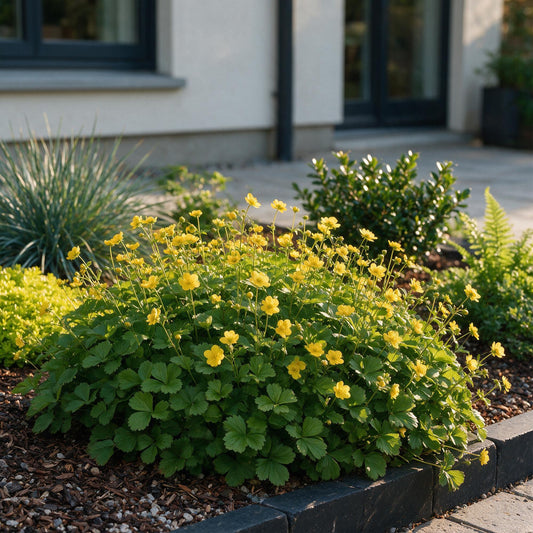
Muehlenbeckia complexa (wire vine): planting and care

To grow Muehlenbeckia successfully, plant it in spring in sun or partial shade, in moist but well-drained soil and sheltered from cold winds. Water regularly during the first year, then simply prune it to keep its vigorous growth in check. Behind this difficult name is mainly Muehlenbeckia complexa, nicknamed wire vine for its very fine, reddish-brown stems.
It works equally well as ground cover, a climbing vine, a balcony planter or a hanging plant. This guide brings together information verified with Kew, the RHS and American universities: its true hardiness, leaf loss, growing it in pots, propagation from cuttings, and the contentious question of whether it is invasive.
🌿 Why plant Muehlenbeckia
Muehlenbeckia has a distinctive silhouette: a tangle of fine, dark, wiry stems dotted with small, round leaves that create a lace-like effect. According to the Jepson eFlora, its stems can reach 5 m and form dense tangles, with leaves measuring 0.5 to 2 cm.
In the garden, it covers a bank, low wall, wire fence or lightweight pergola; in a pot, it spills over a planter or hangs from a basket. It also lends itself to topiary grown on a wire frame, which its flexible stems readily follow. Its vigorous growth, however, calls for some monitoring.
| Benefit | What it means for you |
|---|---|
| Two uses in one plant | Trailing ground cover or climbing vine, depending on what you provide |
| Wire-like texture | Tiny leaves and reddish-brown stems that add a light touch to a planting scheme |
| Undemanding | Tolerates many soil types, from chalky to sandy, and needs no treatments |
| Ideal for containers | Planters, hanging baskets or balcony pots, where its vigorous growth is easy to manage |
🔎 Muehlenbeckia at a glance
According to Plants of the World Online (POWO) from the Royal Botanic Gardens, Kew, the accepted name is Muehlenbeckia complexa (A.Cunn.) Meisn., published in 1841, in the Polygonaceae family. Its natural range extends from Lord Howe Island to New Zealand, including Norfolk Island, in a temperate biome; it is a climbing and trailing shrub.
Kew lists it as introduced in several countries, including France, Great Britain, Ireland, Portugal and California. According to the RHS (Royal Horticultural Society), it reaches 2.5 to 4 m in height and spreads 1.5 to 2.5 m over 5 to 10 years.
Muehlenbeckia axillaris is a distinct, lower-growing species, covered separately by the RHS in its Muehlenbeckia axillaris profile.
| Feature | Verified details |
|---|---|
| 🏷️ Botanical name | Muehlenbeckia complexa (A.Cunn.) Meisn. |
| 🧬 Family | Polygonaceae |
| 🌳 Type | Climbing or trailing shrub, vine or ground cover |
| 🌍 Origin | New Zealand, Lord Howe Island and Norfolk Island |
| ❄️ Hardiness | H3 according to the RHS, or -5 to 1°C; mild, sheltered regions |
| 🍃 Foliage | Small leaves up to 2 cm, rounded, heart-shaped or oblong (RHS); deciduous according to the RHS |
| 🌸 Flowering | Small, inconspicuous greenish spikes from late summer to autumn |
| 📏 Mature size | 2.5 to 4 m tall as a climber, spreading 1.5 to 2.5 m (RHS) |
📋 Quick care guide
Essential growing information, all at a glance.
| Factor | Guideline |
|---|---|
| Exposure | Sun or partial shade, south- or west-facing, in a sheltered spot |
| Soil | Moist but drained or well-drained: chalky, loamy or sandy, any pH |
| Hardiness | M. complexa: H3, -5 to 1°C (RHS); M. axillaris: USDA zone 6 |
| Watering | Regularly in the first year and in pots; less often once established |
| Planting | In spring after the last frosts, or early autumn in mild climates |
| Pruning | Cut back in late winter to contain growth; light trimming in summer |
| Foliage | Fine and dense in season; partial or complete leaf drop in winter |
| Care/difficulty | Easy; the only real task is keeping it from spreading too far |
| Toxicity | No toxicity reported by the sources consulted, but safety has not been proven |
📍 Where and when to plant Muehlenbeckia?
Plant your Muehlenbeckia in sun or partial shade, in a spot sheltered from cold winds: the RHS profile recommends a south- or west-facing aspect, a sheltered location and moist but well-drained soil, whether chalky, loamy or sandy, acidic or alkaline.
Spring, once the frosts have passed, is still the best time: the plant has the whole growing season to establish its roots before its first winter. In regions with mild winters, planting in early autumn is also possible. Choose its position with its vigorous growth in mind: keep it away from delicate shrubs and neighbouring hedges.
☀️ Ideal: A bank, low wall or wire fence in a sunny, south- or west-facing spot, sheltered from northerly winds
🌥️ Acceptable: Bright partial shade; on a balcony, any aspect except due north
🚫 Avoid: Waterlogged soil in winter, icy wind tunnels, and the base of a shrub it could smother
🪴 Planting Muehlenbeckia in the ground or in a pot
Planting is straightforward, provided you ensure good drainage and provide a support if you want it to climb: the RHS specifies that it needs moist, well-drained soil, shelter from cold winds and a support to climb on. As ground cover, it spreads on its own, and its stems root where they touch the soil.
In a pot, choose a container with drainage holes and good-quality outdoor potting mix; it looks wonderful in a hanging basket or planter, on its own or at the base of a shrub in a tub.
| Step | What to do |
|---|---|
| 1. Prepare the hole | Dig a wide hole and loosen the soil around the root ball; use a container with drainage holes for pot planting |
| 2. Ensure good drainage | Improve heavy soil with sand or gravel; use free-draining potting mix in a planter |
| 3. Set the root ball in place | Keep it at the same depth as in its nursery pot; tease out any circling roots |
| 4. Train or spread it | Direct the stems towards the wire fence or trellis, or spread them over the ground as cover |
| 5. Water | Water thoroughly after planting, then keep the soil moist throughout the first year |
columns: 4
columns_mobile: 2
-


Ivy 'Glacier' (Hedera helix) - evergreen climber - 11 cm pot - Height 40 cm - Pack of 2
Regular price 39,95 €Regular price -

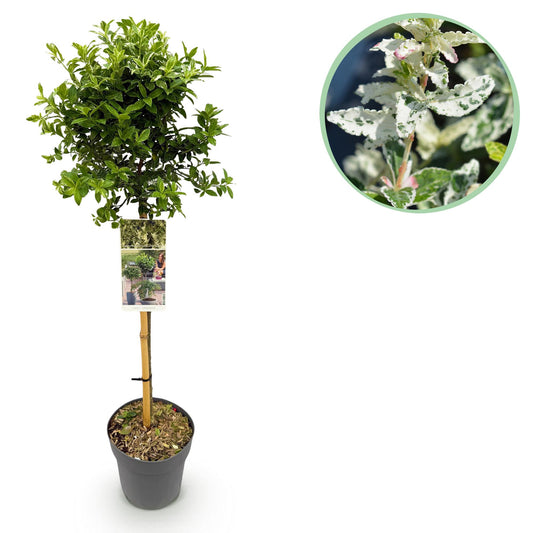
'Harlequin' Creeping Spindle (Euonymus fortunei) - spindle with decorative foliage - 19 cm pot - Height 90 cm
Regular price 69,95 €Regular price -


Isotoma (Isotoma fluviatilis) - flowering groundcover perennial - 11 cm pot - Height 25 cm
Regular price From 64,95 €Regular price -

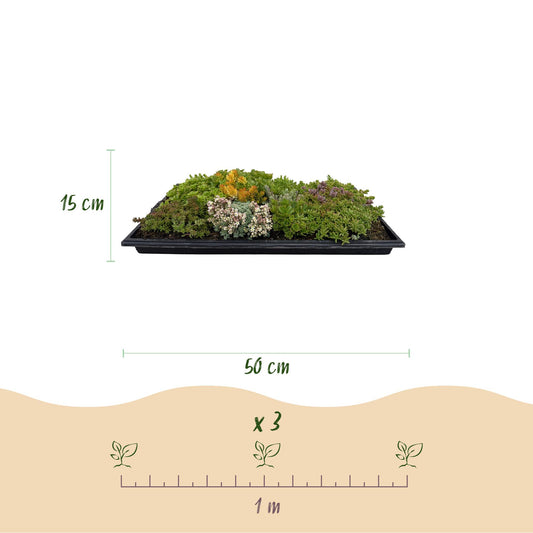
Sedum Mat (10 species) – Perennial succulent ground cover – Pack of 2 – Height: 20 cm
Regular price 69,95 €Regular price


✂️ Caring for Muehlenbeckia: watering, pruning and control
Caring for Muehlenbeckia comes down to two tasks: watering while it establishes, then pruning to keep it in check. In the ground, once rooted, it often gets by on rainfall alone; its relative M. axillaris is even described as drought-tolerant by Oregon State University.
In pots, the growing medium dries out much faster: water as soon as the surface feels dry to the touch, especially in summer. The RHS describes it as generally free of pests and diseases, so no treatments are needed.
💧 Watering: Regularly in the first year and in pots; thereafter, only during prolonged dry spells
✂️ Pruning: Cut back in late winter, then shorten any stems that stray in summer
🔹 Control: Cut off stems that root outside the intended area or grow into a hedge
🌱 Fertiliser: Rarely needed in the ground; apply a houseplant fertiliser to potted plants in spring
🍂 Mulching: Mulch around young plants to keep the soil cool in summer
🍂 Muehlenbeckia in winter: hardiness and leaf loss
Yes, Muehlenbeckia can tolerate some frost, but not severe cold: the RHS rates M. complexa H3, meaning hardy from -5 to 1°C, suitable for mild and coastal regions. Some sellers claim it can withstand lower temperatures; we prefer to stick to this cautious rating.
Its relative M. axillaris is listed as hardy to USDA zone 6 by Oregon State University (approximately -23 to -18°C), a US rating to treat with caution in wet soil. If your Muehlenbeckia loses its leaves in winter, don't panic: the RHS classifies it as deciduous. Scratch a stem: if it is green underneath, the plant will regrow in spring.
By contrast, Oregon State University describes M. axillaris as evergreen; the RHS also notes that it is sometimes sold under the name Muehlenbeckia complexa 'Nana'.
📅 Seasonal care calendar
| Season | Key task |
|---|---|
| 🌸 Spring | Planting, cutting back dry or overlong stems, resuming watering for potted plants |
| ☀️ Summer | Regular watering in pots, checking for wandering stems, taking semi-ripe cuttings |
| 🍂 Autumn | Inconspicuous flowers, waxy white fruits on female plants, planting in mild climates |
| ❄️ Winter | Normal leaf loss, protecting pots from frost, no pruning during severe cold |
🌱 Propagating Muehlenbeckia from cuttings
Muehlenbeckia is easy to propagate from cuttings in summer: the RHS recommends semi-ripe cuttings placed on bottom heat. Take sections of the current year's stems, with a slightly hardened base, remove the lower leaves and insert them into a light mix kept just moist, out of direct sunlight.
Even easier, the plant roots along its stems in much the same way as ivy, as noted by the California Master Gardeners: simply sever a rooted stem and replant it. The plant is dioecious: according to the RHS, only female plants bear the waxy white fruits containing a shiny black seed.
🐛 Common problems: causes and solutions
Muehlenbeckia is robust, and most problems stem from its location or winter conditions rather than disease. In the garden, the real problem is often the opposite of weakness: a plant that takes up too much space. Here are the most common situations and how to deal with them.
| Symptom | Likely cause | Solution |
|---|---|---|
| Plant looks bare or leafless in winter | ❄️ Deciduous foliage according to the RHS, exacerbated by cold | Wait until spring and check that the stems are green under the bark |
| Dry, brittle stems in spring | ❄️ Frost colder than its H3 hardiness rating | Prune back to green wood; in cold regions, grow it in a sheltered pot |
| Leaves dry out and fall in summer, in a pot | 🌬️ Dried-out root ball, pot too small or exposed to strong winds | Water as soon as the surface dries; repot into a larger container |
| Plant declines indoors | ☀️ Hot, dry air and insufficient light for a temperate-climate plant | Move it outside or to a cool, very bright room, such as an unheated conservatory |
| Neighbouring shrub smothered by stems | ⚠️ Vigorous growth; the vine climbs on any support | Clear the shrub, prune back hard and install a dedicated support |
| Stems root far from the plant's base | 🌱 Natural layering as stems touch the ground | Pull up rooted stems and contain the plant with an edging or a pot |
-

Cover the ground with ease: our outdoor ground cover plants blanket slopes,...
-

Clematis, wisteria, passionflowers, climbing roses and star jasmine to adorn walls, pergolas...


🌿 Our picks to explore further
Muehlenbeckia is not currently available in our shop; here are our guides and collections to help you find a climber or ground cover suited to your garden.
| Our pick | Why choose it |
|---|---|
| evergreen climbers | Our selection of vines that keep their leaves in winter, if you want year-round screening |
| perennial ground covers | More manageable ground covers for carpeting a bed without the risk of spreading too far |
| climbing plants | Our collection of climbers for covering a wall, pergola or wire fence |
| ground cover plants | Our collection of ground covers for banks, rock gardens and the bases of shrubs |
🎨 Which plants pair well with Muehlenbeckia?
In a planter, Muehlenbeckia works as a trailing plant around a more structured centerpiece: a small evergreen shrub, ornamental grasses, or bulbs in pots that emerge through its carpet in spring; our guide to plants for balconies and patios will help you put together a combination.
In the garden, growing on a trellis, it pairs well with more evergreen climbers: compare it with English ivy (Hedera) or other evergreen climbers.
To choose from all the climbing plants, see our complete guide to climbing plants and our climbing plant comparison.
Just avoid planting it at the base of delicate shrubs it could overrun; choose vigorous companions such as carex, or browse our plants for balconies and patios and our outdoor plants.
⚠️ Is Muehlenbeckia invasive or toxic?
It can become invasive, yes. According to the Jepson eFlora of California (University of California, Berkeley), Muehlenbeckia complexa has become naturalized along the north and central coasts of California, in disturbed areas, coastal bluffs, and sandy or rocky habitats below 500 m in elevation.
In gardens, an article from the University of California Master Gardeners (UC ANR) (identifying the plant as M. axillaris or M. complexa) cites the Australian National Botanic Gardens: it spreads relentlessly and can quickly smother other plants; in one Californian gardener's garden, it eventually killed two apple trees.
In France, POWO (Kew) lists it as introduced; we have not been able to verify whether it appears on any regional list of invasive alien species. As a precaution, do not plant it near natural areas, especially along the coast, and never dump pruned material in the wild.
As for toxicity, none of the sources consulted (RHS, Jepson eFlora, Oregon State University) report any danger, and the ASPCA does not have a profile for it; however, in the absence of a source, we cannot declare it safe for cats and dogs.
✅ Our expert tips for success
To grow Muehlenbeckia successfully, plant it in sun or partial shade, in well-drained soil and sheltered from cold winds; water it during the first year, then simply prune it as needed. Bear in mind its actual hardiness according to the RHS: H3 for M. complexa. And don't worry if it loses its leaves in winter.
In a planter or hanging basket, it is one of the balcony's most striking trailing plants; in the ground, keep an eye on it so it remains an ornamental feature rather than becoming an invader.
Muehlenbeckia is a plant I love in planters: its airy, fine stems add movement to any arrangement. However, I don't recommend it as a houseplant—it rarely lasts long indoors, while it's so easy to grow outside. In the garden, I keep it to a trellis or a slope where I can cut it back without hesitation at the end of each winter. And when someone tells me it's died in February, I always advise waiting until spring before making a decision.

Laura Bruneau
Jardinière & autrice