Potted lemon tree (Citrus limon): growing, overwintering and care

To grow a lemon tree successfully in a pot, give it full sun outdoors from late spring to autumn, a pot only slightly larger than its root ball filled with a free-draining potting mix, specialist citrus fertilizer, and a very bright winter location above 5 °C. The lemon tree, Citrus limon, is sensitive to frost: according to UF/IFAS, its flowers and young fruit are damaged at around -2 °C.
This guide covers watering, repotting, overwintering, pruning and scale insects, then explains why a lemon tree may not bear fruit. Orange trees, calamondins and kumquats, relatives in the Citrus genus, follow the same guidelines, with different winter temperature thresholds noted below. To see how citrus fit in among other sun-loving plants, read our complete guide to Mediterranean plants.
🌿 Why grow a lemon tree in a pot
A potted lemon tree brings a combination few trees can offer to a patio: glossy evergreen foliage, fragrant flowers and fruit that ripens slowly, often at the same time as the next flush of flowers. The RHS (Royal Horticultural Society) notes that citrus trees are self-fertile, so a single tree is enough to produce fruit.
A pot is also the only practical way to grow one across most of France, since it needs to be brought under cover every winter. Like a potted olive tree, it can be moved and pruned, and kept for many years in the same container.
| Benefit | What it means for you |
|---|---|
| Evergreen foliage | A green tree all year round, decorative on the patio and then indoors |
| Fragrant flowers | A scented bloom, sometimes several times a year, depending on the variety |
| Self-fertile | A single lemon tree can produce lemons, without a second pollinating tree |
| Container growing | Manageable size, outdoors in summer, brought in for winter: suitable for almost anywhere in France |
🔎 Lemon tree at a glance
According to the University of Florida extension service (UF/IFAS), Citrus limon is a citrus hybrid of citron and bitter orange, probably originating on the lower slopes of the Himalayas in eastern India. Grown in the ground in a subtropical climate, it reaches 3 to 6 metres (10 to 20 feet).
The 'Meyer' lemon, widely sold as a potted plant, is a hybrid of lemon and mandarin, according to the same source. For winter temperature thresholds when growing under cover, we follow the RHS.
| Feature | Verified details |
|---|---|
| 🏷️ Botanical name | Citrus limon (name used by UF/IFAS) |
| 🧬 Family | Rutaceae, like orange trees and kumquats |
| 🌳 Type | Small evergreen tree or shrub, often thorny, grown in a pot |
| 🌍 Origin | Himalayan foothills, eastern India (UF/IFAS) |
| ❄️ Hardiness | Not hardy: minimum 5 °C in winter (RHS); flowers damaged at around -2 °C, defoliation at around -4.5 to -5.5 °C (UF/IFAS) |
| 🍃 Foliage | Evergreen, glossy green |
| 🌸 Flowers | Fragrant white flowers, sometimes several flushes a year |
| 📏 Mature size | 3 to 6 m in the ground in a warm climate; considerably smaller in a pot |
📋 Quick growing guide
Essential growing guidelines, all in one place.
| Factor | Guideline |
|---|---|
| Position | Full sun outdoors in summer; at least 6 hours of direct sunlight, ideally 8 to 12 |
| Soil | Citrus potting mix or soil-based potting mix with about 20% coarse sand |
| Hardiness | Not hardy: minimum 5 °C in winter according to the RHS |
| Watering | Keep the potting mix just moist in summer; in winter, let the surface dry between waterings |
| Planting | Repot in spring, when roots emerge through the drainage holes |
| Pruning | In February: thin out the canopy and cut bare stems back by up to two-thirds |
| Flowering | Fragrant flowers; fruit ripens in 9 to 12 months according to the RHS |
| Care | Moderate: citrus fertilizer in summer and winter, and watch for scale insects |
| Toxicity | Toxic to dogs, cats and horses according to the ASPCA; the fruit is edible |
📍 Where and when to place a potted lemon tree?
Place the lemon tree in the sunniest spot on the patio, sheltered from the wind: the University of Maryland Extension recommends at least 6 hours of direct sunlight, and preferably 8 to 12 hours.
Only move it outdoors once the frosts have passed and the nights are mild; the RHS advises monitoring nighttime temperatures and gradually acclimating the plant to outdoor conditions. The University of Maryland recommends transitioning it over two weeks, gradually increasing its exposure to light to prevent scorching. Bring it indoors before the first autumn frosts.
☀️ Ideal: A south-facing patio or balcony, sheltered from the wind, from late spring to autumn
🏠 Winter: A conservatory, bright room or unheated greenhouse that stays above 5 °C
🚫 Avoid: Cold drafts, a radiator right beside it, a dark corner, a saucer full of water
🪴 Repotting a lemon tree: pot, potting mix and steps
Repot in spring, when roots appear through the drainage holes: the RHS recommends using a pot only slightly larger than the root ball, as an oversized pot can cause problems.
It recommends peat-free specialist citrus potting mix, or a rich soil-based potting mix amended with about 20% coarse sand or grit to improve drainage. The Clemson University Extension recommends repotting every three to five years into a pot about 5 cm wider, with drainage holes, and never leaving it in a saucer full of water.
When choosing a container, consider terracotta or plastic: a heavy pot is less likely to be blown over.
| Step | What to do |
|---|---|
| 1. Choose the right time | In spring, when roots emerge through the bottom of the pot |
| 2. Choose a pot | About 5 cm wider than the old one, with drainage holes and a stable base |
| 3. Prepare the potting mix | Citrus potting mix, or soil-based potting mix with about 20% coarse sand |
| 4. Set the root ball in place | At the same level as before, without burying the graft union; firm the mix lightly |
| 5. Water | Water thoroughly with lukewarm water, then empty the saucer |
columns: 4
columns_mobile: 2
-

 Livraison offerte
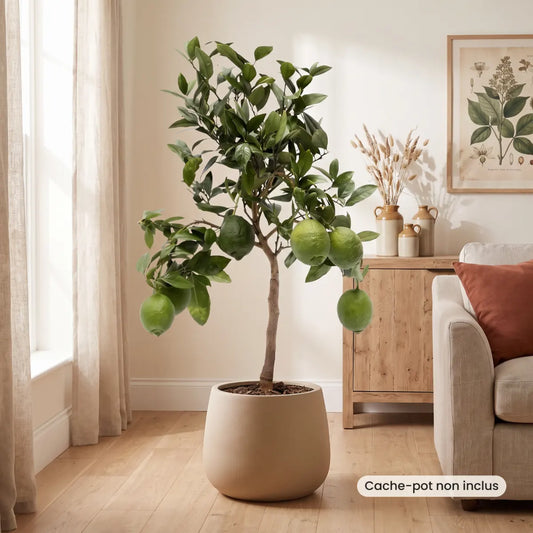
Citrus limon - Potted indoor lemon tree - 22cm pot - Height 80cm
Regular price 109,95 €Regular price109,95 €87,96 €Livraison offerte -

 Livraison offerte
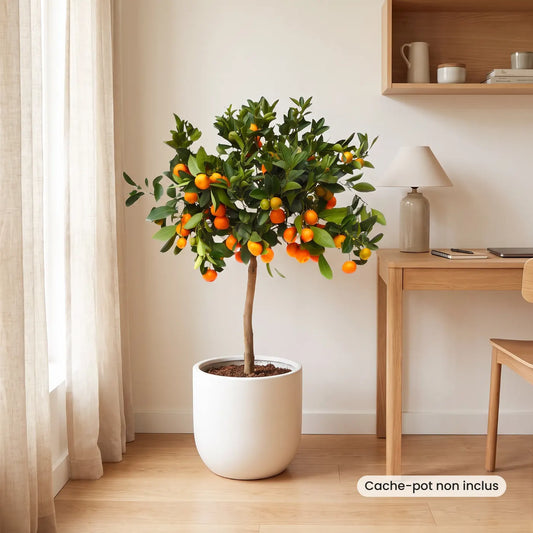
Citrus × microcarpa - Calamondin house orange
Regular price From 69,95 €Regular price69,95 €From 55,96 €Livraison offerte -
Olive (Olea europaea), Mediterranean ornamental shrub, 19 cm pot, Height 90 cm
Regular price 69,95 €Regular price69,95 €55,96 €Livraison offerte -
Bay Laurel (Laurus nobilis) - aromatic patio plant - 19 cm pot - Height 90 cm
Regular price 69,95 €Regular price69,95 €55,96 €Livraison offerte


✂️ Caring for a potted lemon tree: watering and citrus fertilizer
Caring for a potted lemon tree means watering carefully and using the right fertilizer. In summer, the RHS recommends watering regularly, ideally with rainwater, to keep the potting mix just moist; in winter, allow the surface to dry partially, then water thoroughly with lukewarm rainwater.
To decide when to water, the University of Maryland suggests pushing a finger about 5 cm into the potting mix once or twice a week. If your tap water is hard, consider watering with rainwater.
For fertilizer, the RHS recommends a nitrogen-rich summer citrus feed from late March to October, and a more balanced winter citrus feed from November to mid-March.
💧 Summer watering: Water regularly to keep the potting mix just moist; rainwater is preferable
💧 Winter watering: Let the surface dry, then water thoroughly with lukewarm water
🌱 Summer fertilizer: Nitrogen-rich summer citrus feed, from late March to October (RHS)
🌱 Winter fertilizer: Balanced citrus feed, from November to mid-March
💧 Humidity: Stand the pot on a tray of damp gravel, with the water level below the surface of the gravel
🍂 Overwintering and pruning a lemon tree
For winter, the RHS recommends keeping a lemon tree above 5 °C, with plenty of light, sufficient humidity, and some watering and fertilizer so it retains its leaves. For a heated indoor space, the University of Maryland recommends around 18 to 24 °C during the day and 13 to 18 °C at night, near the brightest window.
As for frost, UF/IFAS reports that flowers and young fruit are damaged at around -2 °C (29 °F), defoliation occurs at around -4.5 to -5.5 °C, and the wood sustains severe damage at around -6.5 °C, for trees grown in the ground in Florida; a potted tree freezes much faster.
Prune in February, according to the RHS: thin out overcrowded branches and cut bare stems back by up to two-thirds, wearing thick gloves to protect against thorns. The University of California Integrated Pest Management Program (UC IPM) advises against late pruning, which encourages tender new shoots that are vulnerable to cold.
📅 Seasonal care calendar
| Season | Key task |
|---|---|
| 🌸 Spring | Prune in February, repot if needed, resume summer fertilizer in late March, move outdoors gradually after the frosts |
| ☀️ Summer | Full sun, regular watering with rainwater, summer citrus fertilizer, check for scale insects |
| 🍂 Autumn | Acclimate gradually, bring indoors before the first frosts, switch to winter fertilizer in November |
| ❄️ Winter | Maximum light, keep above 5 °C, water less often with lukewarm water, use a tray of damp gravel |
🌱 Propagating a lemon tree and getting lemons
The RHS considers semi-ripe cuttings the easiest method: the new plant is a clone of the parent and produces fruit of the same quality. Growing from seed is not recommended: seed-grown citrus trees take several years to fruit, and their fruit may be inferior.
Most citrus trees sold are grafted to encourage early fruiting, whereas an ungrafted tree may take up to ten years. UF/IFAS confirms that lemon trees are mainly propagated by grafting or budding onto rootstock, and that young trees generally begin producing from their third year. Why isn't a lemon tree producing lemons?
Most often, because it was grown from seed, is too young, or is in the shade. Some fruit drop is normal: UC IPM notes that pea-sized fruit may drop about a month after flowering, and the University of Maryland says that as much as 75% of the fruit may be lost after a sudden temperature change.
Indoors, it recommends moving a dry paintbrush from flower to flower to aid pollination.
🐛 Common problems: causes and solutions
Problems with potted lemon trees are mostly related to growing conditions. The RHS explains that cool or fluctuating temperatures, dry air and cold drafts can cause leaf drop; yellowing or leaf drop can indicate overwatering; and a lack of nutrients can yellow leaves and prevent flowers and fruit from developing.
It lists scale insects, mealybugs and spider mites as pests, especially indoors. For cottony clusters, our guide to natural mealybug treatments explains what to do.
| Symptom | Likely cause | Solution |
|---|---|---|
| Leaves suddenly drop when brought indoors | ⚠️ Sudden temperature change, dry air, draft | Acclimate gradually; keep in a bright, draft-free room; use a tray of damp gravel |
| Yellow leaves, waterlogged potting mix | 💧 Overwatering or a saucer full of water | Let the surface dry, empty the saucer, check the drainage holes |
| Yellow leaves, pale new growth, no flowers | ⚠️ Lack of nutrients | Use summer and then winter citrus fertilizer according to the season |
| Small brown shells and sticky honeydew on stems | 🐛 Scale insects | Remove with a cotton swab dipped in alcohol, horticultural oil or insecticidal soap |
| White, cottony clusters in leaf axils | 🐛 Mealybugs | Clean with alcohol, isolate the plant, repeat until they are gone |
| Fine webbing, dull leaves with stippling | 🕷️ Spider mites, encouraged by dry air | Shower the foliage and increase ambient humidity |
-

Raspberry bushes, blueberry bushes, blackcurrant bushes, kiwis and other small fruits to...


🌸 Compare our potted citrus varieties
Orange trees, calamondins and kumquats can be grown like lemon trees: the same sun, the same free-draining potting mix, the same citrus fertilizer. Only their winter temperature thresholds differ, according to the RHS for growing under cover and UF/IFAS for trees grown in the ground in Florida. This comparison will help you choose the citrus best suited to your overwintering space.
| Variety | What makes it special |
|---|---|
| Lemon tree (Citrus limon) | RHS minimum winter temperature: 5°C; UF/IFAS cites the 'Eureka' and 'Lisbon' varieties, the latter being very thorny |
| 'Meyer' lemon tree | A lemon and mandarin hybrid (UF/IFAS), listed by the University of Maryland among dwarf citrus trees suitable for pots |
| Four-season lemon tree | Commercial name for a lemon tree that flowers repeatedly; the RHS notes that some varieties flower year-round |
| Orange tree | Grown in the same way as a lemon tree; our sources give no specific minimum temperature, so keep it at least 5°C |
| Calamondin | The RHS recommends at least 13°C in winter under cover; UF/IFAS says it can withstand temperatures down to around -5.5°C in the ground in Florida |
| Kumquat | The RHS often recommends 7°C or more in winter; UF/IFAS says it can withstand temperatures down to around -9°C in the ground in Florida |
🎨 Which plants to pair with a potted lemon tree
Pair your lemon tree with other sun-loving plants grown in containers that share its need for good drainage.
A potted olive tree and a potted bay laurel make for a cohesive Mediterranean terrace; an oleander adds summer blooms, but it is highly toxic.
At the base of large containers, lavender adds lasting fragrance. For more ideas, browse our Mediterranean plants to pair with citrus trees and the guide Mediterranean garden: designing a flower bed.
⚠️ Is the lemon tree toxic to cats and dogs?
Yes, the plant is toxic to pets. The ASPCA's “Lemon” profile, listed under the name Citrus limonia, declares the lemon tree toxic to dogs, cats and horses because of its essential oils and psoralens. Symptoms listed include vomiting, diarrhea, lethargy and possible dermatitis.
The ASPCA specifies that the fruit is edible, but the peel and the rest of the plant may cause problems. Keep the pot out of reach of pets that chew leaves and, if ingested, contact your veterinarian. For people, only the fruit is edible, according to the ASPCA.
✅ Our expert tips for success
Four rules are key to growing a successful potted lemon tree: give it as much sun as possible, use a free-draining potting mix in a pot only slightly larger than the root ball, apply a citrus fertilizer suited to the season, and keep it in a bright place over winter where temperatures never fall below 5°C. Avoid sudden changes, water with rainwater, prune in February and inspect the stems regularly to spot scale insects early.
To protect the other plants on your terrace over winter, read our guide to protecting plants from frost and our guide to overwintering an olive tree.
For me, the key moment is the start of autumn: a lemon tree moved suddenly from outdoors to a heated living room will often lose its leaves. I recommend bringing it inside before you have to and placing it by the brightest window, away from the radiator. I water mine with rainwater and leave it on a tray of damp gravel all winter. And I never prune it without gloves: its thorns are unforgiving.

Laura Bruneau
Jardinière et autrice