

Rosemary: The Complete Guide to Growing, Pruning, and Caring for It

🌿 Rosemary, the quintessential Mediterranean aromatic
Rosemary (Rosmarinus officinalis) is an evergreen aromatic subshrub native to the Mediterranean region. Hardy, ornamental and fragrant all year round, it appeals to cooks and gardeners alike, especially those looking for a generous plant that needs very little maintenance.
Its reputation as an almost indestructible plant is largely deserved: it tolerates drought, thrives in poor soil and loves full sun. However, it does have its requirements, and most failures are caused by overwatering or pruning in the wrong place. This guide gives you everything you need to grow it successfully for years to come.
Beyond its culinary uses, rosemary is a valuable plant for pollinators: its blue flowers open as early as late winter, when bees can still find few food sources. Planting it therefore helps support biodiversity in your garden while keeping a fresh herb close at hand.
🪪 Rosemary at a glance
Before planting, it is useful to know rosemary’s main botanical and growing characteristics. The table below summarizes the key points to remember.
| Botanical name | Rosmarinus officinalis |
| Family | Lamiaceae |
| Type | Evergreen aromatic subshrub |
| Mature height | 0.6 to 1.5 m |
| Exposure | Full sun |
| Soil | Poor, dry, very well-drained |
| Hardiness | -10 to -12 °C |
| Flowering | Blue flowers from late winter |
| Uses | Culinary and pollinator-friendly |
Contrary to popular belief, rosemary is a little more tender than lavender: it tolerates temperatures down to around -10 to -12 °C, provided its roots never sit in water during winter. This combination of cold and damp is what proves fatal to it.
☀️ Where and how to plant rosemary
Above all, rosemary needs sunshine: give it the brightest, warmest spot in the garden. In the shade, it becomes spindly, flowers sparsely and is more susceptible to disease. A south-facing wall or a sunny rock garden are ideal locations.
The second essential requirement is good drainage. Rosemary dislikes heavy, waterlogged soil. Poor, stony, sandy or chalky soil suits it perfectly. If your soil is clay, mix in coarse sand and gravel, and plant it on a raised mound to keep water away from the roots.
It is best to plant in spring or fall, outside periods of frost. Space plants 60 to 80 cm apart if planting several, giving each enough room to grow and allowing air to circulate. Adding gravel to the bottom of the planting hole further improves drainage.
| Factor | Recommendation |
| Exposure | Full sun, warm and sheltered |
| Ideal soil | Poor, dry, very well-drained, preferably chalky |
| Soil to avoid | Heavy, clay, wet in winter |
| Planting time | Spring or fall, outside periods of frost |
| Spacing | 60 to 80 cm |
💧 Watering: rosemary hates excess water
This is the most important aspect of rosemary care: it is far more afraid of excess water than drought. Once established, a plant growing in the ground needs almost nothing beyond natural rainfall, even in the height of summer.
During the first year, water moderately while the root system establishes, then gradually water less often. Always let the soil dry out completely between waterings. A thirsty rosemary plant recovers quickly; one that is waterlogged will rot and eventually die.
columns: 4
columns_mobile: 2
-


Ceanothus Repens (Ceanothus), flowering Mediterranean shrub, light blue flowers, 19 cm pot, Height 90 cm
Regular price 69,95 €Regular price -


Ceanothus Victoria (Ceanothus), flowering Mediterranean shrub, purple flowers, 19 cm pot, Height 90 cm
Regular price 69,95 €Regular price -


Eucalyptus Azura (Eucalyptus gunnii), Mediterranean ornamental shrub, 19 cm pot, Height 70-90 cm
Regular price 74,95 €Regular price -


Hidcote Lavender (Lavandula angustifolia), Mediterranean perennial, 17 cm pot, Height 30 cm - Pack of 6
Regular price 84,95 €Regular price -
Olive (Olea europaea), Mediterranean ornamental shrub, 19 cm pot, Height 90 cm
Regular price 69,95 €Regular price -


Rosemary (Rosmarinus officinalis), Mediterranean perennial, purple flowers, 19 cm pot, Height 90 cm
Regular price 69,95 €Regular price -

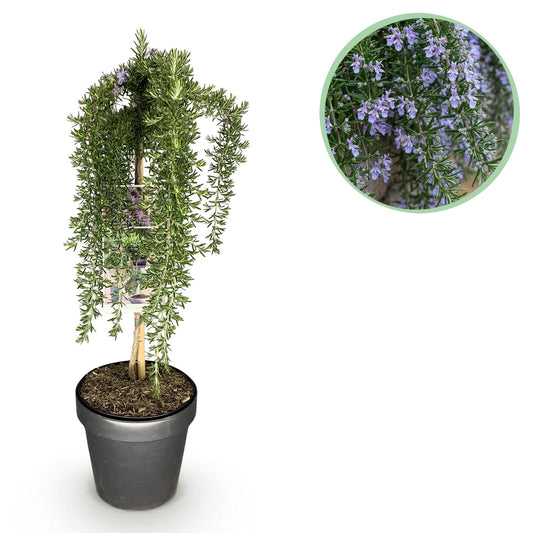
Prostrate Rosemary (Rosmarinus officinalis), Mediterranean perennial, purple flowers, 19 cm pot, Height 70–90 cm
Regular price 69,95 €Regular price


✂️ Pruning rosemary the right way
Pruning rosemary follows one golden rule: never cut into old wood. Older branches, which are brown and bare, no longer produce new shoots. If you cut them back, they will stay bare permanently and throw the plant out of balance.
Always prune lightly, and only the current year’s shoots, which are still flexible and well-leafed. The aim is to maintain a compact shape and prevent the plant from becoming bare and sprawling as it ages.
The best time to prune is just after flowering, in late spring. This lets you enjoy the flowers, which are valuable to pollinators, before reshaping the plant. One pruning a year is enough to keep rosemary dense and well-shaped.
🌱 Propagating rosemary from cuttings
Rosemary is one of the easiest aromatic plants to propagate. Taking cuttings is free and quick, and produces plants identical to the original. The best time is late summer, in August or September, using semi-ripe stems.
Take healthy stems 8 to 10 cm long, remove the leaves from the lower half, then plant them in a light mixture of potting soil and sand. Keep the growing medium just moist and place it in a bright spot, out of strong direct sunlight.
Roots will form within a few weeks. You can then transplant the young plants into small pots, and later into the ground or larger pots the following spring. The table below summarizes the key steps for successful propagation from cuttings.
| Step | What to do |
| 1. Take cuttings | Cut 8 to 10 cm stems in late summer |
| 2. Prepare | Remove the leaves from the lower part of the stem |
| 3. Plant | Insert into a mixture of potting soil and sand |
| 4. Care for cuttings | Keep moist and bright, out of direct sunlight |
| 5. Transplant | Pot up after rooting, then plant in the garden |
🪴 Growing rosemary in pots
Rosemary grows very well in pots on a sunny balcony or patio. The key to success is the same as when growing it in the ground: excellent drainage and careful watering. Choose a large container with drainage holes, at least 30 cm in diameter.
Put a layer of clay pebbles or gravel at the bottom, then add a light, sandy potting mix. Avoid potting mixes that are too rich or retain too much water. Place the pot in full sun and water only when the surface of the potting mix is thoroughly dry.
In a pot, rosemary is more exposed to cold because its roots are less protected. In winter, cut back sharply on watering and shelter the container from rain and hard frosts. The table below summarizes the essentials of container growing.
| Container | Large pot with drainage holes, at least 30 cm |
| Drainage | Layer of clay pebbles or gravel at the bottom |
| Potting mix | Sandy, light, low in nutrients |
| Watering | Infrequent; let the soil dry between waterings |
| Winter | Reduce watering and protect from frost |
🩺 Common problems and solutions
Most problems with rosemary have the same cause: too much water. Yellowing leaves, a plant drying out from the center, or stems turning black at the base are all signs of excess moisture or poor drainage.
If a plant is declining, always check the drainage first rather than watering more. Lighten the soil with sand, remove dead branches without cutting into the old wood, and water less often. As a last resort, take cuttings from healthy stems to save the variety.
| Symptom | Likely cause and solution |
| Yellow leaves | Too much water: water less often and improve drainage |
| Plant drying out | Roots suffocating: lighten the soil and prune dead wood |
| Blackening at the base | Rot: reduce moisture and raise the planting area |
| Bare plant | Pruning too harshly: never cut into old wood |
| Few flowers | Not enough sun: move it to a bright, sunny spot |
📅 Rosemary care through the seasons
To make sure you don’t forget anything, here is a concise calendar of the main tasks to carry out throughout the year. Rosemary needs little attention, but it is important to do the right things at the right time.
📅 Seasonal care calendar
| Spring | Planting, repotting, light pruning after flowering |
| Summer | Minimal watering, take cuttings late in the season |
| Fall | Planting is possible, gradually stop watering |
| Winter | Protect pots, water very little, first flowers appear |
Follow these simple guidelines and you’ll enjoy vigorous, fragrant rosemary in bloom year after year, both for cooking and for the pleasure it brings to the eye and to bees.
There are actually two main types of rosemary to distinguish before planting. Upright varieties, which grow to 1.20 or even 1.50 m, are perfect for a low aromatic hedge or a sunny flower bed. Trailing or prostrate varieties spread as ground cover and cascade beautifully over a low wall or the edge of a large planter, rarely growing taller than 30 to 40 cm.
Rosemary is also one of the most useful plants in a productive garden. Its blue flowers, which bloom from late winter through spring and sometimes into fall in southern France, are extremely attractive to pollinators: they feed bees and other pollinators at a time when few flowers are available. This is a strong reason to plant it near a vegetable garden, where it also attracts beneficial insects.
Finally, hardiness varies between varieties, which is worth checking outside the Mediterranean region. Common rosemary generally tolerates frost down to around ‑10 to ‑12 °C if planted in perfectly well-drained soil; it is stagnant winter moisture, far more than dry cold, that kills it. In heavy, wet soil, growing it in a pot and bringing it under cover for the winter remains the safest option.
-

Our flowering outdoor shrubs: buddleias, dogwoods, deutzias, hibiscus, mock oranges and more...


Mediterranean plants guide · Lavender · Aromatic plants (lavender, rosemary)

Laura Bruneau
Jardinière & autrice


