Yarrow (Achillea millefolium): growing and care

To grow yarrow successfully, plant it in spring in full sun, in well-drained soil that you should definitely not enrich. Water it only during the first year, deadhead to prolong flowering and limit self-seeding, then divide the clump every 3 to 5 years.
Yarrow (Achillea millefolium) is a perennial of banks and dry meadows, with finely divided, aromatic foliage and broad, flat flower heads that attract bees all summer.
It belongs in a pollinator-friendly perennial border, our go-to guide for pollinators, as well as in a dry garden. Here, we bring together guidance verified against sources from the RHS, Kew, three US universities, and the ASPCA.
This guide covers garden care only: we offer no advice on yarrow’s health uses.
🌿 Why plant yarrow in the garden
Yarrow ticks all the boxes for an easy-care perennial. According to the RHS (Royal Horticultural Society) profile for Achillea millefolium, it is a wildflower native to the UK, rated H7, that grows in chalk, clay, loam, or sandy soil, whether acidic or alkaline, and in any aspect as long as it gets full sun.
The RHS awards it its “Plants for Pollinators” label, notes that it feeds more than 100 insect species, and recommends it for cottage and informal gardens, gravel gardens, flower meadows, and wildlife gardens.
As for bees, Oregon State University Extension reports that Oregon Bee Atlas participants observed more than 15 bee genera on yarrow, including all short-tongued bee genera, because nectar is easy to reach on its flat flowers. Its flowers also work well in fresh and dried bouquets.
| Benefit | What it means for your garden |
|---|---|
| Pollinator magnet | Feeds more than 100 insect species, according to the RHS; carries the “Plants for Pollinators” label |
| Low water needs | Tolerates drought, heat, and salt once established (NC State) |
| Very hardy | Rated H7 by the RHS, the highest rating on its scale |
| Flowers for bouquets | Flower heads cut and dry well, and come in many colors |
🔎 Yarrow at a glance
According to Plants of the World Online (POWO), the database of the Royal Botanic Gardens, Kew, Achillea millefolium L. was published by Linnaeus in Species Plantarum in 1753; it is a perennial of temperate regions, native to Greenland and subarctic and temperate Eurasia, including France.
Kew records it as introduced in, among other places, South America, Australia, New Zealand, and five US states (Massachusetts, New Jersey, New York, Pennsylvania, and Texas), and recognizes 4 subspecies. According to POWO, the genus Achillea has 141 accepted species.
For cultivation, NC State Extension places it in USDA hardiness zones 3a to 9b and gives its height and spread as 30 to 90 cm.
| Feature | Verified details |
|---|---|
| 🏷️ Botanical name | Achillea millefolium L. (yarrow) |
| 🧬 Family | Asteraceae, like daisies and coneflowers |
| 🌳 Type | Herbaceous perennial with deciduous foliage; rhizomatous |
| 🌍 Native range | Greenland, subarctic and temperate Eurasia; native to France (Kew) |
| ❄️ Hardiness | H7 (RHS), below -20°C; USDA zones 3a to 9b (NC State) |
| 🍃 Foliage | Narrow, aromatic, and finely divided, hence the name “thousand-leaf” |
| 🌸 Flowering | Flat flower heads in white, cream, or pink, from June to September |
| 📏 Mature size | 0.5 to 1 m tall, spreading 0.1 to 0.5 m over 2 to 5 years (RHS) |
📋 Quick growing guide
Essential growing guidance, at a glance.
| Factor | Guidance |
|---|---|
| Position | Full sun, at least 6 hours a day (NC State); any aspect |
| Soil | Well-drained, even poor and dry; chalk, clay, loam, or sand, pH 6 to 8 |
| Hardiness | H7 according to the RHS, below -20°C |
| Watering | During dry spells in the first year, then unnecessary in the ground |
| Planting | In spring once the soil has warmed; fall is also possible if the soil is not waterlogged |
| Pruning | Deadhead through summer; cut back to ground level in early spring |
| Flowering | June to September, extended into fall by deadheading |
| Care | Easy; divide every 3 to 5 years and keep an eye on the clump’s spread |
| Toxicity | Toxic to dogs, cats, and horses (ASPCA); gloves recommended (NC State) |
📍 Where and when to plant yarrow
Plant yarrow in full sun, in soil that drains well: according to the RHS guide to growing Achillea, it likes well-drained soil, even if poor or dry, and dislikes heavy, waterlogged soil and deep shade.
The RHS recommends planting in spring once the soil has warmed; fall and winter are also suitable as long as the ground is not waterlogged, while summer planting requires watering. It adapts to dry borders, banks, rock gardens, prairie-style borders, or pots on a sunny terrace. The one exception in the genus is Achillea ptarmica, which prefers moist soil and partial shade.
☀️ Ideal: Full sun, lean, well-drained soil: banks, rock gardens, gravel borders, flower meadows
🗓️ When: Spring once the soil has warmed; fall or winter if the ground is not waterlogged (RHS)
🚫 Avoid: Heavy, wet soil in winter, shade, soil enriched with compost, and neat lawns nearby
🪴 How to plant yarrow, step by step
The RHS method is simple: dig a hole just slightly larger than the root ball, set the plant at the same depth as it was in its pot, backfill, firm the soil, and water thoroughly, without amending the soil.
For spacing, Clemson University’s horticultural service (Clemson HGIC) recommends 1 to 1.5 feet between plants, or about 30 to 45 cm, and notes that the species lives longer in poor, dry soil and full sun.
For pots, the RHS recommends regular watering and applying fertilizer after 1 to 2 months, as the potting mix is quickly depleted.
| Step | What to do |
|---|---|
| 1. Choose a spot | Full sun, well-drained soil, away from a neat lawn that the clump could invade |
| 2. Dig | A hole just slightly larger than the root ball, with no compost or fertilizer (RHS) |
| 3. Plant | Keep the crown at the same level as it was in the pot, then backfill and firm the soil |
| 4. Space | About 30 to 45 cm between plants (Clemson HGIC) |
| 5. Water | Water thoroughly at planting, then during dry spells in the first year |
columns: 4
columns_mobile: 2
-

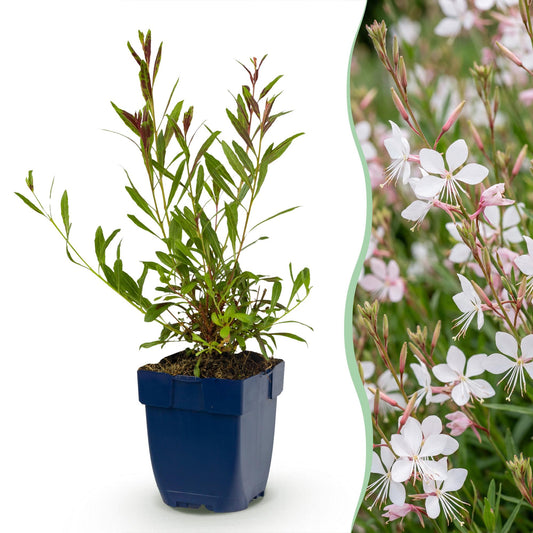 Livraison offerte Sold out
Gaura 'Whirling Butterflies' (Gaura lindheimeri) - melliferous perennial - 11 cm pot - Height 25 cm
Regular price From 39,95 €Regular price39,95 €From 31,96 €Livraison offerte Sold out -


Coneflower 'Magnus' (Echinacea purpurea) - melliferous perennial - 11 cm pot - Height 25 cm
Regular price From 39,95 €Regular price39,95 €From 31,96 €Livraison offerte -


Ornamental sage 'Schneehügel' (Salvia nemorosa) – nectar-rich perennial – 11 cm pot – height 25 cm
Regular price From 39,95 €Regular price39,95 €From 31,96 €Livraison offerte -


‘Six Hills Giant’ Catmint (Nepeta faassenii) – bee-friendly perennial – 11 cm pot – Height: 25 cm
Regular price From 39,95 €Regular price39,95 €From 31,96 €Livraison offerte -

 Livraison offerte Sold out
‘Butterfly Blue’ Pincushion Flower (Scabiosa columbaria) – nectar-rich perennial – 11 cm pot – height 25 cm
Regular price From 39,95 €Regular price39,95 €From 31,96 €Livraison offerte Sold out -


Buenos Aires verbena ‘Lollipop’ (Verbena bonariensis) – nectar-rich perennial – 11 cm pot – height 25 cm
Regular price From 39,95 €Regular price39,95 €From 31,96 €Livraison offerte -


‘Goldsturm’ Black-Eyed Susan (Rudbeckia fulgida) – nectar-rich perennial – 11 cm pot – height 25 cm
Regular price From 39,95 €Regular price39,95 €From 31,96 €Livraison offerte -


Lavender 'Hidcote' (Lavandula angustifolia) - fragrant honey-producing perennial - 11 cm pot - Height 25 cm
Regular price From 39,95 €Regular price39,95 €From 31,96 €Livraison offerte


✂️ Yarrow care: deadheading, the Chelsea chop, and division
Once established, yarrow needs very little care. The RHS says that no fertilizer is needed when it’s grown in the ground and that established plants tolerate drought. Deadhead regularly: plants will then flower again into fall, and NC State adds that this also limits self-seeding.
For shorter, sturdier stems, the RHS suggests the “Chelsea chop”: in late May, cut the flowering stems back by up to half, which delays flowering slightly. Leave the last dry flower heads over winter for wildlife, cut everything back to ground level in early spring, and divide the clump every 3 to 5 years to keep it vigorous.
🔹 Deadheading: Cut off spent flowers all summer to prolong flowering and reduce self-seeding (RHS, NC State)
🔹 Chelsea chop: In late May, cut flowering stems back by up to half (RHS)
✂️ Cutting back: Cut to ground level in early spring; leave dry flower heads over winter
🍴 Division: Every 3 to 5 years in spring, removing the woody center (RHS)
💧 Water and fertilizer: No fertilizer in the ground; water only in the first year
🍂 Yarrow through the seasons
In spring, the clump of feathery foliage regrows from the base: this is the time to cut back dry stems, plant, and divide. According to NC State, flowering lasts from June to September; the RHS places it in summer and, for ‘Cerise Queen,’ in summer and fall. In summer, deadhead as flowers fade and cut stems for bouquets.
In fall, leave a few flower heads in place: they remain decorative and provide shelter for insects. The plant rests in winter; it is not troubled by cold, but the RHS notes that it suffers in winters that are both very cold and very wet.
📅 Seasonal care calendar
| Season | Key task |
|---|---|
| 🌸 Spring | Cut back to ground level; plant and divide every 3 to 5 years; sow seeds (germination in 5 to 10 days) |
| ☀️ Summer | Chelsea chop in late May; flowering from June to September; deadhead, make bouquets, and dry flowers |
| 🍂 Fall | Last flowers; leave dry flower heads for wildlife; planting is possible if the soil is not waterlogged |
| ❄️ Winter | Dormant; no protection needed (H7); watch for excess standing water |
🌱 How to propagate yarrow
The RHS describes three methods. Division, the simplest, is done in spring: dig up the clump, separate sections with roots, and discard any woody or dead central parts. Basal shoot cuttings can be taken from young spring stems.
Sow in spring in moist, peat-free seed compost: germination takes 5 to 10 days, prick out into pots once true leaves appear, and plants often flower in their first year. To reliably preserve a particular cultivar, division is the most straightforward method.
🐛 Common problems: causes and solutions
Yarrow has few pests or diseases, and almost all problems come from excess moisture or overly rich soil. The RHS lists powdery mildew in dry weather, root rot in wet soil, and aphids, and notes that the plant declines in soil that is too wet. NC State adds stem rot and points out that the species spreads vigorously through its rhizomes and seeds.
Clemson HGIC also notes that yarrow has a short lifespan in wet ground and is deer-resistant thanks to its aromatic foliage.
| Symptom | Likely cause | Solution |
|---|---|---|
| Clump rots or disappears after winter | 🌱 Heavy, wet soil or an extremely rainy winter (RHS) | Replant in well-drained soil, on a mound or in a rock garden; don’t water in winter |
| Floppy stems | 🌱 Soil that is too rich or fertilizer (RHS) | Stop fertilizing, use the Chelsea chop in late May, and discreetly stake if needed |
| White coating on the leaves | 🍄 Powdery mildew, especially in dry weather (RHS) | Thin the clump to improve airflow, water at the base during drought, and remove affected leaves |
| Shoots covered in small insects | 🐛 Aphids (RHS) | Tolerate a light infestation; remove heavily affected stems |
| Plant spreading into the lawn or border | ⚠️ Rhizomes and self-seeding (NC State) | Deadhead, pull up runners, or choose a sterile cultivar |
| Bare center in the clump | ⚠️ Aging clump | Divide every 3 to 5 years and replant vigorous sections (RHS) |
-

Nectar-producing plants & pollinators
Provide food for bees, bumblebees, and butterflies: our selection of outdoor nectar-rich...


🌸 Yarrow varieties for the garden
For borders, NC State prefers cultivars to the species, which spreads more aggressively. The RHS describes 'Cerise Queen' as magenta pink with a white center. Yellow yarrow, Achillea filipendulina, is a different species: its Achillea filipendulina profile says it is native to Central and Southwest Asia and grows in clumps that do not spread, while the RHS profile for 'Gold Plate' awards it the Award of Garden Merit. Table sources: RHS and NC State, noted in parentheses.
| Variety | What makes it stand out |
|---|---|
| Achillea millefolium (species) | White, cream, or pink; 0.5 to 1 m; H7; spreading; ideal for meadows and wildlife gardens (RHS) |
| A. millefolium 'Cerise Queen' | Magenta pink with a white center; flowers in summer and fall; 0.5 to 1 m; H7 (RHS) |
| A. millefolium 'Red Velvet' | Scarlet red; recommended in the RHS growing guide |
| A. millefolium 'Paprika' and 'Summer Pastels' | Bright red or pastel mix, listed among cultivars by NC State |
| Achillea 'Moonshine' | Lemon yellow, recommended in the RHS growing guide |
| A. filipendulina 'Gold Plate' and 'Cloth of Gold' | Golden yellow, clump-forming; 1 to 1.5 m for 'Gold Plate' (RHS), about 5 feet (1.5 m) for 'Cloth of Gold' (NC State) |
🎨 What to pair with yarrow in a flower bed
Its flat-topped flower clusters contrast with spires and rounded flowers.
In a dry, sunny spot, pair it with woodland sage and catmint for blue-violet spires, with coneflower and black-eyed Susan for large daisy-like flowers in late summer, and gaura for an airy touch.
In a gravel garden, lamb's ears (Stachys byzantina) and Russian sage extend the silvery, aromatic theme, while prairie grasses create a meadow-like feel.
White varieties are right at home in a white garden.
To bring it all together, follow our guide to creating an easy-care perennial flower bed and browse our pollinator-friendly plants to pair with Achillea, our perennials for flower beds or our full-sun plants.
⚠️ Is yarrow toxic or dangerous?
For pets, the ASPCA (American Society for the Prevention of Cruelty to Animals) classifies Achillea millefolium as toxic to dogs, cats and horses. It lists glycoalkaloids (achilleine), monoterpenes and sesquiterpene lactones (achillin) as toxic compounds, and vomiting, diarrhea, colic, drooling, loss of appetite, dermatitis and lethargy as clinical signs.
For gardeners, NC State advises wearing gloves to prevent contact dermatitis and avoiding planting it where your pets spend time. Yarrow belongs to the Asteraceae family; for gardeners, our sources (RHS, NC State) note only this risk of contact dermatitis, hence the recommendation to wear gloves.
As for using it in herbal tea or as a supplement, that falls under health advice, which we do not provide. Finally, when foraging, ANSES (the French Agency for Food, Environmental and Occupational Health & Safety) advises against consuming any plant you have gathered if you are unsure of its identification.
✅ Our expert tips for success
Yarrow practically takes care of itself if you follow three rules: full sun, poor, well-drained soil, and no fertilizer. Deadhead to prolong flowering and limit self-seeding, cut it back in spring, and divide every 3 to 5 years. Choose a cultivar if you are concerned about its spread, leave the species as it is for a meadow, and give the bees one of their favorite perennials.
To learn more, discover the other plants in our pollinator-friendly perennial bed.
To me, yarrow is the perennial that proves poor soil isn't a problem but an opportunity: the less I disturb it, the better it blooms. I always plant it beside a gravel path, well away from the lawn, because I've seen it spread there before. I like to cut a few flower clusters in summer for dried bouquets and leave the last ones for insects over winter. I use it only as a gardener; for everything else, I refer people to healthcare professionals.

Laura Bruneau
Jardinière et autrice