Daily care and tips for Pilea

How do you care for a Pilea day to day?

The Pilea needs moderate watering once the soil has dried out thoroughly, usually every 7 to 10 days depending on the season. It thrives in bright, indirect light and temperatures between 18 and 24°C. It also benefits from having its pot turned regularly to prevent its stems from all leaning toward the same light source.'orient in the same direction toward the light.

What kind of light is best for a Pilea?

Bright, indirect light, about a metre from a'east- or west-facing window, is ideal for the Pilea. Direct sunlight should be avoided during the hottest hours, as it can burn the plant's round, delicate leaves. In low-light interiors, its stems tend to stretch in search of light.

Why are my Pilea’s leaves wilting?

Wilting leaves most often indicate a lack of water or, conversely, overwatering that has weakened the roots. Before adjusting your watering frequency, check that the substrate is neither completely dry nor waterlogged at depth. A well-draining substrate helps prevent this imbalance over time.

Can you put a Pilea outdoors in summer?

The Pilea can spend the 'summer on a shaded terrace or balcony, provided nighttime temperatures remain above 15°C. It must be protected from direct sunlight and draughts that are too cool. A partially shaded spot near a wall or under a pergola is ideal.'

How do you repot a Pilea?

Repotting is best done in spring, in a pot only slightly larger than the previous one to avoid excess substrate around the roots. A well-draining container combined with an airy substrate promotes healthy root development. After receiving the plant, allow it to acclimate for 2 to 3 weeks before considering repotting.

Everything you need to know about Pilea

What are the most popular varieties of Pilea?

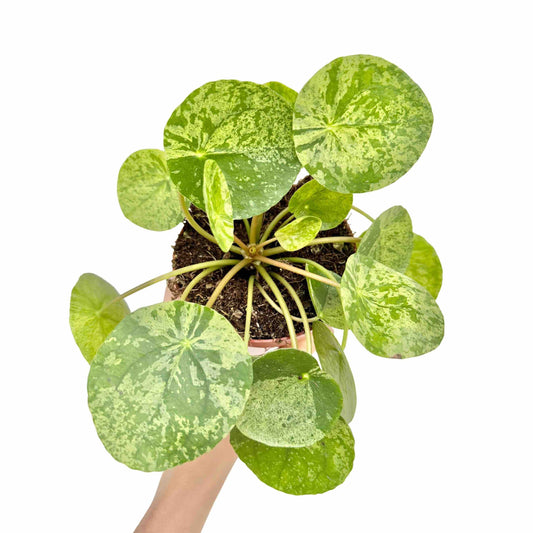
The Pilea Peperomioides, also known as the Chinese money plant, stands out for its round, flat leaves on long, slender stems. The Pilea Mojito charms with its light green marbled foliage, while the Pilea Sugar has a silvery, almost frosted texture. All three varieties grow quickly and are very easy to propagate from cuttings.

Is the Pilea toxic to cats and dogs?

No, Pilea is n'ot listed as toxic by the'ASPCA for cats or dogs. So it can be kept in a home with pets without any particular risk. Mild digestive irritation is still possible if a large amount is'ingested, as with most plants.

Which Pilea should I choose for a low-light apartment?

The Pilea peperomioides tolerates moderate indirect light quite well, making it a good choice for an apartment with limited natural light. However, avoid rooms that are too dark, as its stems may become leggy and grow abnormally long. Placing it one to two metres from a bright window is ideal.

Can you put a pilea in an office?

Yes, the Pilea adapts well to an office environment, thanks in particular to its tolerance of artificial light and compact size. It thrives in sufficient indirect light, such as that provided by a nearby window or bright office lighting. Its striking foliage also makes it an excellent decorative addition to a workspace.

Where can I buy a high-quality Pilea?

Plant and Stories offers a selection of Pileas from French and European growers, chosen for the quality of their foliage. Each plant benefits from'fast, secure delivery, with packaging suited to the fragility of its stems. You’ll find Pilea Peperomioides, Pilea Mojito and Pilea Sugar in our catalog.

Pilea

Pilea likes bright, indirect light, away from direct sunlight that can burn its delicate foliage. Moderate watering is enough, allowing the soil to dry out completely between waterings.

The essentials at a glance:

  • ☀️ Light: Bright, indirect light, no direct sun
  • 💧 Watering: Moderate, with the soil drying out between waterings
  • 🌍 Origin: Mountainous regions of Yunnan, China
  • 🍃 Foliage: Round leaves, Chinese money plant
  • 🎯 Best feature: Easy to share and give as a gift

Pilea: the beloved plant that keeps on giving

There’s one plant people love to give to friends as much as they love to keep for themselves: the Pilea. Native to the mountainous regions of Yunnan in China, this genus became popular thanks to Pilea Peperomioides, nicknamed the Chinese money plant for its round leaves growing on slender stems. Varieties such as Pilea Mojito and Pilea Sugar each offer their own distinctive texture, from marbled foliage to frosted-looking leaves.

Caring for Pilea: soft light and well-draining soil

Pilea likes bright, indirect light, away from direct sunlight that can burn its delicate foliage. Moderate watering is enough, allowing the soil to dry out completely between waterings. Choose our universal potting mix enriched with biostimulants, which ensures good drainage and helps prevent excess moisture around the roots.

Buy your Pilea from Plant and Stories

Our Pilea plants are sourced from French and European growers to ensure dense foliage and a well-acclimated plant on arrival. Every order comes with fast, secure delivery and packaging designed to protect the delicate foliage during transit. Whether you’re buying it as a gift or adding to your collection, Pilea will easily find a place in your home.

For more information, see our complete guide: Pilea peperomioides: care, watering and propagation.

Show moreShow less