Skip to product information
1 of 2
Tradescantia Unicorn

Tradescantia Unicorn

Tradescantia Unicorn

Unusual iridescent foliage

Regular price 8,00 €
Regular price Sale price 8,00 €
BLACK FRIDAY -20 % Sale Sold out
Taxes included. Shipping calculated at checkout.
8,00 € 6,40 €
Black Friday -20%
Pot diameter
Quantity

Pay in 2, 3 or 4 interest-free installments from €50 with Klarna

Out of stock

  • Careful delivery with optimal protection
  • Plant health guaranteed for 30 days
Tradescantia Unicorn
Une question ? Nos experts vous répondent 01 89 48 03 62

About

Tradescantia Unicorn, the plant with pearly reflections that illuminates every space

Tradescantia Unicorn is a tropical plant belonging to the Commelinaceae family, native to the warm regions of Central America and Mexico. Naturally creeping or trailing, it develops flexible, branching stems that can reach 40 to 60 cm in length, with rapid and vigorous growth that makes it a particularly dynamic houseplant.

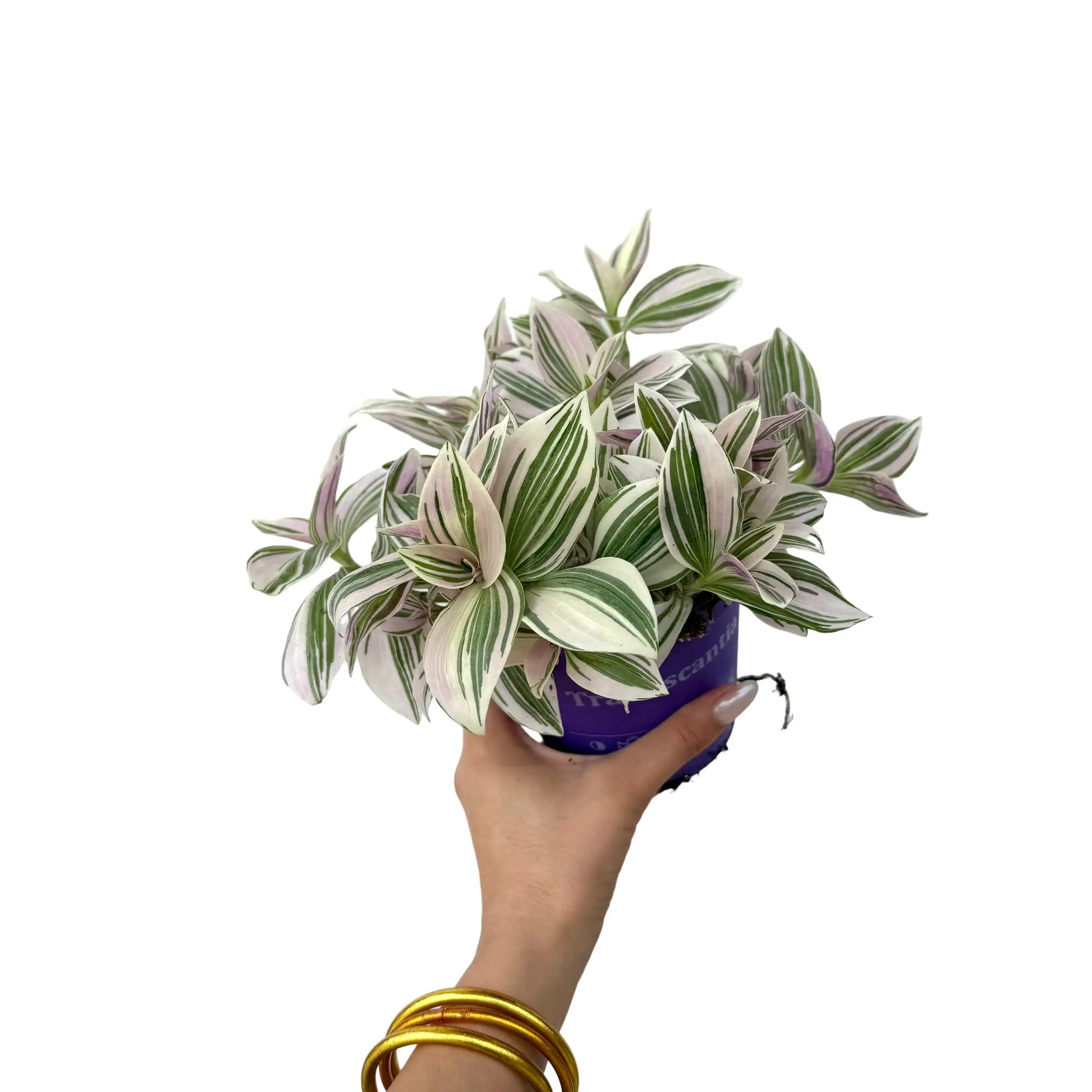
Its foliage is a true botanical signature: lanceolate leaves striped with soft green, creamy white, and pale pink create a unique , pearly, two-tone effect . The leaf surface has a slightly velvety texture, soft to the touch, which captures the light and gives it shimmering reflections that change depending on the angle of view. What is most striking about this Tradescantia is its ability to continuously produce new, colorful shoots, maintaining dense and vibrant, graphic foliage in all seasons.

Adopt the Tradescantia Unicorn today and give your interior an iridescent and characterful botanical touch.

Description

Maintenance tips

Guarantee

Commandez en toute sérénité 💚

Nos plantes d'intérieur, nos plantes d'extérieur et nos bulbes sont garantis 30 jours à compter de la réception.
Nos plantes sont rigoureusement sélectionnées, en pleine santé, acclimatées et expédiées dans un emballage pensé pour leur protection. Si un aléa survient pendant le transport, notre équipe est là pour vous accompagner.

  1. 💌 Comment bénéficier de la garantie ?
    1. À la réception, sous 48 h : envoyez une photo de votre plante entière à sav@plantandstories.com, avec votre numéro de commande. Même si elle est en parfait état, cette photo est obligatoire : elle active votre garantie de 30 jours et nous permet de vous conseiller dès l'arrivée. Si la plante est abîmée, ajoutez une photo du dégât.
    2. Pendant 30 jours : si votre plante dépérit, écrivez-nous à la même adresse avec des photos et votre numéro de commande.
    3. Nous étudions votre situation et convenons avec vous d'une solution : plante équivalente, avoir, remboursement partiel ou total 💚

Conditions : la plante n'a pas été rempotée et se trouve dans son pot d'origine ; son exposition et son arrosage ont respecté sa fiche d'entretien. Les plantes livrées dans une consigne ou un casier automatique ne sont pas couvertes.

Plantes d'extérieur et bulbes : la garantie s'applique jusqu'à leur plantation. Une fois plantés en pleine terre ou dans un autre contenant, ils ne sont plus couverts. Envoyez-nous votre photo de réception avant de planter.

🧺 Un accessoire défectueux ou non conforme ?
Envoyez une photo et votre numéro de commande à la même adresse. Vous choisissez le remplacement ou la réparation ; si ce n'est pas possible, nous vous remboursons. Tous les frais sont à notre charge.

Cette garantie s'ajoute aux garanties légales. Tous les détails sont dans notre politique « Garantie, retours et remboursements ».

Shipping

Vos plantes et accessoires livrés avec soin 🌿

📦 Quand votre commande part-elle ?
Plantes : expédiées du lundi au mercredi, pour ne pas rester bloquées en transit le week-end.
Accessoires : expédiés du lundi au vendredi.
Plantes et accessoires commandés ensemble : un seul colis, expédié du lundi au mercredi.
Par grand froid ou forte chaleur, nous pouvons décaler l'envoi des plantes de quelques jours pour les protéger. Nous vous prévenons alors par e-mail.

🚚 Qui livre votre colis ?
Commandes préparées par notre équipe : UPS.
Produits « direct producteur » : DPD, puis livraison chez vous par Chronopost, qui vous propose la veille plusieurs options (dont le point relais). Pour une plante, évitez les consignes automatiques (Pickup Station), où notre garantie de 30 jours ne s'applique pas.
Votre numéro de suivi vous est envoyé par e-mail. Vous le retrouvez aussi dans votre espace client, sur la page de votre commande.

⏱ En combien de temps ?
Une fois le colis remis au transporteur :
France continentale : 1 à 2 jours ouvrés
Corse : 3 à 5 jours ouvrés
Union européenne : 24 à 48 h à domicile, 24 à 72 h en point relais
Suisse : 3 à 5 jours ouvrés

💶 Combien ça coûte ?
France continentale : point relais 7,50 €, offert dès 100 € d'achat ; domicile 9,99 €.
Produits « direct producteur » : livraison offerte, à domicile, en France continentale (hors Corse), en Belgique, en Allemagne et aux Pays-Bas.
Autres destinations : tous les tarifs sont dans notre politique d'expédition. Le montant exact s'affiche au moment du paiement.

📸 À la réception
Envoyez sous 48 h une photo de votre plante à sav@plantandstories.com, avec votre numéro de commande : elle active votre garantie.

🌱 Plantes calées sur mesure, emballages recyclables.

🤝 Une question ?
sav@plantandstories.com ou 01 89 48 03 62, du lundi au vendredi de 9 h à 17 h.

View full details
  • Order prepared with love

  • Optimal protection

  • Quality plants

  • A team that is always attentive

Simple & reassuring

From the greenhouse to your living room

Ordering plants online is completely risk-free with us. Here is your worry-free journey.

1

You are ordering

100% secure payment, in full or in 3 interest-free installments with Klarna.

Risk-free
2

We prepare it by hand

Each plant is selected, inspected, and secured in suitable packaging.

Expert treatment
3

Ships within 24–48 hours

Ship at the beginning of the week to avoid having it stuck in transit over the weekend.

Fast delivery
4

Arrival guarantee

A problem with your delivery? Photos are all we need: we’ll replace it or refund you.

No stress
★★★★★9.99/10 from over 2,880 verified reviews

Already over 87,000 plants delivered with a smile

Tradescantia Unicorn

Propriétés des plantes

Tradescantia Unicorn


Luminosité
Bright indirect light
Arrosage
Let the surface dry between waterings.
Difficulté de culture
Very easy
Toxicité animaux
Toxic (cats, dogs)
Température idéale
18 to 24°C
Hauteur à maturité
20 to 40 cm
Emplacement conseillé
Suspension or illuminated shelf
Humidité
Normal
Substrat
Well-draining potting soil for indoor plants
Rempotage
Every 2 years
Fertilisation
Fertilize every 2–3 weeks
Croissance
Fast
Nom latin
Tradescantia 'Unicorn'
Noms communs
Poor thing, Tradescantia.
Famille botanique
Commelinaceae
Origine
Horticultural hybrid (subgenus Austrotradescantia)
Port
Erect or Trailing
Forme du feuillage
Oval
Couleur du feuillage
Variegated, pale pink to cream margin
Couleur de floraison
White
Feuillage
Persistent
Parfumé
No
Dépolluante
No

Your satisfaction is our priority

If you have any questions about the delivery of your package, or if anything is wrong upon its arrival, our team is here for you.

Feel free to contact us Monday through Friday, from 9 a.m. to 5 p.m., by phone at 01 89 48 03 62 or by email at sav@plantandstories.com.

We will do our utmost to find a solution quickly. 🌱

Help and solutions:

Everything you need to know Tradescantia Unicorn

What light exposure is best for my Tradescantia Unicorn?

Tradescantia Unicorn thrives in bright, indirect light, ideally placed 50 to 100 cm from an east or west facing window.

In its natural habitat in Central America, this Commelinaceae plant grows under the canopy of other plants and benefits from light filtered through the surrounding foliage. Indoors, it needs sufficient light to maintain its beautiful, characteristic pink and white variegation. Insufficient light gradually causes the foliage to turn green again and lose its unique pastel hues.

In summer, move it slightly away from south-facing windows to avoid leaf burn. In winter, place it as close as possible to the light source to compensate for the reduced sunlight.

Important tip 🌿Avoid direct midday sun in summer, which quickly dries out the leaves and dulls the colors. Rotate the pot a quarter turn every two weeks so that all the stems receive even light and develop a regular shape.For dark interiors, ourhorticultural lamp suitable for indoor plantswill allow your Tradescantia Unicorn to retain all the brilliance of its variegated foliage.

Is Tradescantia Unicorn toxic to animals and children?

Tradescantia Unicorn is moderately toxic to cats, dogs, and young children.

Plants of the genus Tradescantia contain irritant substances present in their sap and on the surface of their leaves. These compounds primarily cause skin irritation and contact reactions, including redness and itching, particularly in individuals with sensitive skin or in animals that chew the leaves.

If ingested by an animal, the most common symptoms are mild nausea, excessive salivation, and temporary vomiting. These symptoms are usually benign and resolve on their own, but it is advisable to contact a veterinarian if you have any concerns.

What precautions should be taken on a daily basis?

Place your Tradescantia Unicorn in a high spot, on a shelf or hanging shelf, out of reach of cats and young children. Also, avoid handling the leaves with bare hands for extended periods if you have sensitive skin.

With a few simple placement precautions, the Tradescantia Unicorn can absolutely find its place in a home with pets or children, while remaining an elegant and reassuring decorative companion.

Why are the leaves of my Tradescantia Unicorn turning yellow?

Tradescantia Unicorn leaves most often turn yellow due to overwatering, insufficient light, or a nutrient deficiency.

  • If the leaves turn yellow and become limp, the problem usually stems from excess water causing the beginning of root rot.
  • If the leaves gradually turn yellow while remaining firm and dry, the plant often lacks light or fertilizer.
  • If the yellowing is accompanied by small light spots, a dull appearance or fine webbing, it may be a mite infestation, common indoors, especially in dry atmospheres.

In Tradescantia Unicorn, the loss of pink and white variegation in favor of entirely green foliage often precedes yellowing: this is an early signal that light conditions are insufficient to maintain the characteristic pigmentation of this variety.

Important tip 🌿One or two old leaves turning yellow from time to time is perfectly normal: it is part of the plant's natural cycle.On the other hand, there is cause for concern if several leaves turn yellow rapidly, if the phenomenon spreads to young leaves, or if growth slows down significantly.

In case of a mite infestation, prioritize ourplant-friendly biological treatmentseffective and without damaging the delicate foliage of the Tradescantia Unicorn.

When and how should I repot my Tradescantia Unicorn?

Tradescantia Unicorn is ideally repotted in the spring, between March and May, when growth actively resumes.

Repotting is necessary when:

  • The roots emerge through the drainage holes.
  • Growth is slowing down.
  • or that the substrate compacts too quickly after watering.

As a general rule, repotting every 2 years is sufficient for an adult plant.

Tradescantia Unicorn develops a dense and relatively shallow root system, which means it fills its pot faster than other plants of comparable growth: check the condition of the roots every spring so you don't miss the right time.

Choose a pot 2 to 3 cm wider than the old one, and make sure it has drainage holes. Ourtransparent pots to monitor recoveryare ideal: their transparency allows you to easily monitor root recovery and the condition of the roots after repotting, without having to disturb the plant.

Prepare a well-draining and aerated substrate, specially designed for houseplants. We recommend ourwell-draining substrates enriched with biostimulantsDesigned to promote drainage, root oxygenation, and healthy long-term growth. Use ourour balanced mix for houseplants, particularly suited to the needs of the Tradescantia Unicorn.

  1. Carefully remove the plant from its pot, tapping the pot if necessary to loosen the root ball without pulling on the stems.
  2. Gently loosen the roots if they are very compacted, without breaking them.
  3. Place a layer of substrate at the bottom of the pot, position the plant upright, then fill with substrate without burying the crown.

Important tip 🌿After repotting, water the plant to help the potting mix settle around the roots and eliminate any air pockets. However, ensure that excess water can drain freely through the drainage holes.Keep in mind that repotting is always a source of stress for the plant. Repotting every two years is sufficient to ensure healthy and balanced growth.

When and how should I fertilize my Tradescantia Unicorn?

Tradescantia Unicorn should be fertilized every 2 to 3 weeks from March to October, with a liquid fertilizer diluted in the watering water.

During autumn and winter, from November to February, significantly reduce or stop fertilizing. This is a period of dormancy during which the plant produces few or no new leaves.

Due to its particularly rapid growth in spring and summer, Tradescantia Unicorn consumes available nutrients in the substrate faster than many other houseplants: regular fertilization is essential to maintain the intensity of its colorful variegation and support the continuous production of new stems.

A well-balanced intake promotes:

  • denser, more colorful foliage
  • steady growth,
  • and improved plant resistance.

👉 For best results, we recommend ourconcentrated fertilizer for houseplantsEasy to dose, with fast visible results. Practical tips are printed directly on the back of the label and on the product information sheet, for simple and hassle-free use.

Important tip 🌿Never fertilize a plant in a dry substrate: this could burn the roots.Water normally first, then apply diluted fertilizer 2 to 3 days later, when the soil is slightly moist. Excess fertilizer can cause leaf burn. Regular but moderate fertilization will keep your Tradescantia Unicorn vigorous and healthy 💚

How do I properly water my Tradescantia Unicorn?

Water the Tradescantia Unicorn when the substrate has dried out completely, approximately every 7 to 10 days in summer and every 12 to 15 days in winter. Use room temperature water.

How do I know when to water?

The finger test remains the most reliable method: insert your index finger into the substrate to a depth of 2 to 3 cm. If the substrate is dry, it's time to water. If it's still damp, wait a few more days.

Tradescantia Unicorn is particularly sensitive to hard water, which can cause whitish spots on the foliage and progressive yellowing of the youngest leaves: opt for filtered water or water left to stand for a few hours before watering to preserve the brilliance of its variegation.

Important advice:When in doubt, it's always better to wait a little longer than to overwater. Plants adapt better to underwatering than to overwatering, which quickly causes root rot.

How do I propagate my Tradescantia Unicorn?

Tradescantia Unicorn is propagated by stem cuttings in water or substrate, ideally in spring or early summer when the plant is in full growth.

Stem cutting methodSelect a healthy, vigorous stem with at least 2 to 3 nodes and several well-colored leaves. Using ourStainless steel blade pruning shears for taking cuttings without damaging the plantMake a clean cut just below a node. Remove the lower leaves, leaving only the top ones, to prevent them from rotting due to contact with water or the substrate.

  1. Prepare your 8-12 cm cutting with a clean cut below the last lower node.
  2. Place the cutting in ourtransparent pots for cuttingsfilled with clean water or a slightly moist substrate, in order to visually monitor root development without disturbing the cutting.
  3. Install it in a bright location but out of direct sunlight, at a temperature between 18 and 24 °C.

For rooting in substrate, use ourversatile substrate made in FranceSlightly moistened, which provides the ideal airy structure for Tradescantia Unicorn to root. You can also root it directly in ourlive sphagnum moss to maintain root moisture, particularly effective for this fast-rooting species.

Important tip 🌿Tradescantia Unicorn roots typically appear in 7 to 14 days in room-temperature water, making it one of the fastest plants to propagate indoors. When the roots reach 2 to 3 cm in length, transplant the cutting into its final potting mix. A light growth of new leaves confirms that the cutting has taken root.

Tradescantia Unicorn avec feuillage strié vert clair, crème et rose pâle, plantée dans un pot rose pastel

The essentials regarding Tradescantia Unicorn

Tradescantia Unicorn: identity and origin

The Tradescantia Unicorn, from its Latin nameTradescantia fluminensis'Unicorn' is a trailing plant with two-toned leaves of a soft green streaked with creamy white, sometimes tinged with pink on new growth. Native to South America, this selected variety is prized for its particularly dense variegated foliage and rapid growth, capable of producing new internodes in just a few days under good conditions.

Tradescantia care: light, watering and substrate

Tradescantia Unicorn thrives in bright, indirect light, less than a meter from a well-oriented window, to maintain the intensity of its variegation. Watering should be done while waiting for the top third of the potting mix to dry out between waterings, generally every 7 to 10 days depending on the season.universal substrate enriched with biostimulantsensures optimal drainage while providing a complete nutrient balance for growth and foliage.

Where should you place your Tradescantia for vibrant variegated foliage?

This trailing plant reveals its full beauty when it benefits from stable light and a gentle atmosphere. Here are the conditions to ensure optimal results:

  • Window is:Soft morning light, ideal for variegation
  • West window:late afternoon light, contrasting and dense foliage
  • Temperature :between 16 and 24°C, without cold drafts
  • Humidity :A minimum of 50% humidity is required to limit the drying out of the tips.
  • Dark room:OURfull spectrum horticultural lampmaintains the active variegation
  • Dry air:OURCare pack with spraycompensates for the lack of ambient humidity

Frequently asked questions: Why are the leaves of my Tradescantia turning green and losing their variegation?

Insufficient light is the most common cause of variegation loss in Tradescantia Unicorn: the leaves revert to a completely green color to maximize photosynthesis. The solution is simple: move the plant closer to a bright, natural light source or add a grow light. If the potting mix remains too wet for too long, the roots will suffocate and the foliage will quickly yellow. After 2 to 3 weeks of acclimatization, repotting in ourtransparent pots with drainageallows you to easily monitor root conditions and adjust watering precisely.

Buy the Tradescantia Unicorn at Plant and Stories

Tradescantia Unicorn is in stock and carefully shipped from our partner greenhouses, packaged for safe transport. Plant and Stories selects each plant for the quality of its variegation and its dense growth habit, with phytosanitary checks at every stage. To nourish this trailing plant over time, ourliquid fertilizer for houseplantssupports the growth and vibrancy of the colors of the Tradescantia Unicorn throughout the active season.

Show moreShow less
👉 To learn more