Deutzia: planting, pruning, and compact varieties

To grow deutzia successfully, plant it in sun or partial shade in soil that is moist but well drained. Water it during dry spells for the first few years, then prune it just after flowering, never in winter.
Deutzia (genus Deutzia, family Hydrangeaceae, like hydrangeas) is one of the easiest flowering shrubs to grow: depending on the variety, it is covered in white or pink star-shaped flowers between May and July.
Here are the growing guidelines, verified against the RHS, Kew Gardens and North Carolina State University, for planting and pruning deutzia, choosing a compact variety for a pot or small garden, and using it to create a flowering hedge.
🌿 Why deutzia belongs in a small garden
Deutzia flowers between lilac and roses, at the turn of spring and summer. According to the RHS (Royal Horticultural Society), these are deciduous shrubs, often with peeling bark, opposite leaves and star- or cup-shaped flowers in white or pink, sometimes fragrant, borne in clusters.
Its great advantage is its range of sizes: according to the RHS, several deutzias reach just 0.5 to 1 m at maturity, making them flowering shrubs for the front of a border, an edging or a large container. NC State Extension also lists Deutzia gracilis as suitable for containers, hedges and borders, describing it as undemanding and rarely damaged by deer.
It tolerates chalky, clay, loamy or sandy soils, with a pH ranging from acidic to alkaline.
| Benefit | What it means for your garden |
|---|---|
| Profuse flowering | Clusters of small white or pink star-shaped flowers from late spring to early summer |
| Compact sizes | Varieties 0.5 to 1 m tall for a pot, border or small garden (RHS) |
| Undemanding | Chalk, clay, loam or sand; acidic to alkaline pH; sun or partial shade |
| Easy to prune | Just one pruning a year, immediately after flowering, and easy propagation from cuttings |
🔎 Deutzia at a glance
According to Plants of the World Online (POWO) from the Royal Botanic Gardens, Kew, Deutzia Thunb. is a genus of 69 accepted species in the Hydrangeaceae family, native from the Himalayas to the Russian Far East and the Philippines, with species also found in Mexico.
Deutzia gracilis Siebold & Zucc., the slender deutzia grown in gardens, is native to central and southern Japan, notes the POWO entry for Deutzia gracilis.
According to the RHS entry for Deutzia gracilis, it is an upright, bushy shrub with bright green leaves up to 6 cm long, bearing small upright clusters of fragrant white flowers in spring and early summer. Many pink varieties are garden hybrids, such as Deutzia × hybrida 'Mont Rose' or 'Strawberry Fields'.
| Characteristic | Verified details |
|---|---|
| 🏷️ Botanical name | Deutzia Thunb. (1781); most widely sold compact species: Deutzia gracilis Siebold & Zucc. |
| 🧬 Family | Hydrangeaceae, the family of hydrangeas and mock oranges |
| 🌳 Type | Deciduous, bushy shrub, often with peeling bark |
| 🌍 Origin | Genus: from the Himalayas to the Russian Far East and the Philippines, as well as Mexico; D. gracilis: central and southern Japan (POWO) |
| ❄️ Hardiness | H5 according to the RHS (-15 to -10°C) for gracilis, × rosea, 'Mont Rose', 'Strawberry Fields' and scabra; USDA zones 5a to 8b for D. gracilis (NC State) |
| 🍃 Foliage | Deciduous, with opposite leaves; dark purple in autumn for 'Nikko' (RHS) |
| 🌸 Flowering | Late spring to early summer, with white or pink star-shaped flowers, sometimes fragrant |
| 📏 Mature size | 0.5 to 1 m for D. gracilis (RHS); 0.5 to 4 m, depending on the variety |
📋 Quick growing guide
Essential growing information at a glance.
| Factor | Guideline |
|---|---|
| Position | Sun or partial shade; D. gracilis needs shelter and some afternoon shade in hot climates |
| Soil | Fertile, moist but well drained; chalk, clay, loam or sand; acidic to alkaline pH |
| Hardiness | H5 (RHS): -15 to -10°C; USDA zones 5a to 8b for D. gracilis (NC State) |
| Watering | During dry spells for the first few years; regularly in pots, keeping the compost moist but never waterlogged |
| Planting | Container-grown plants can be planted year-round, except during frosts; bare-root plants from October to April (RHS) |
| Pruning | Immediately after flowering: cut back flowered stems, and cut up to 20% of old stems back to the base |
| Flowering | White or pink, from May to July depending on the variety, on the previous year's wood |
| Care | Easy: mulch, water young plants, protect new growth from late frosts |
| Toxicity | D. gracilis is non-toxic to dogs, cats and horses according to NC State; no ASPCA profile available |
📍 Where and when to plant deutzia
Plant your deutzia in sun or partial shade, in fertile soil that is moist but well drained. This is the recommendation given in all the RHS variety profiles, which list chalky, clay, loamy or sandy soils as suitable. For Deutzia gracilis, the RHS recommends a sheltered position and protection from late spring frosts, which can scorch new growth and buds.
NC State Extension adds that in very hot climates, some afternoon shade is beneficial, as the leaves can bleach in full sun. As for timing, container-grown deutzia can be planted any time of year except during frosts or heatwaves, while bare-root plants can be planted from October to April, according to the RHS tree and shrub planting guide.
☀️ Ideal: Morning sun or light partial shade, moist and well-drained soil, in a position sheltered from cold spring winds
⛅ Acceptable: Full sun in a cool garden; deeper shade, though flowering may be less prolific
🚫 Avoid: Hollows where cold air settles in spring, soil that stays waterlogged all winter, and scorching afternoon sun in the south
🪴 Planting deutzia in a border, hedge or pot
Planting is straightforward, as long as you don't bury the root collar.
According to the RHS tree and shrub planting guide, dig a hole about three times the width of the root ball, but no deeper than it, position the shrub so that the point where the roots emerge is level with the soil, and don't add fertiliser or organic matter to the bottom of the hole.
Then water with 30 to 50 litres per square metre each week during dry weather in the growing season, and apply a mulch at least 5 cm deep, leaving a 10 cm gap around the stems.
For a hedge, the RHS hedge planting guide recommends spacing plants 30 to 60 cm apart in a single row, depending on their mature size.
| Step | What to do |
|---|---|
| 1. Choose a position | Sun or partial shade, sheltered from cold winds, with enough space for the variety's mature height |
| 2. Prepare the hole | Three times the width of the root ball, no deeper; loosen the soil and don't add fertiliser to the bottom (RHS) |
| 3. Position the root ball | Rehydrate the root ball and place it so the top of the roots is level with the soil; backfill and firm |
| 4. Water | 30 to 50 litres per square metre per week during dry weather in the growing season (RHS) |
| 5. Mulch | Apply at least 5 cm of mulch, leaving a 10 cm clear ring around the stems |
columns: 4
columns_mobile: 2
-
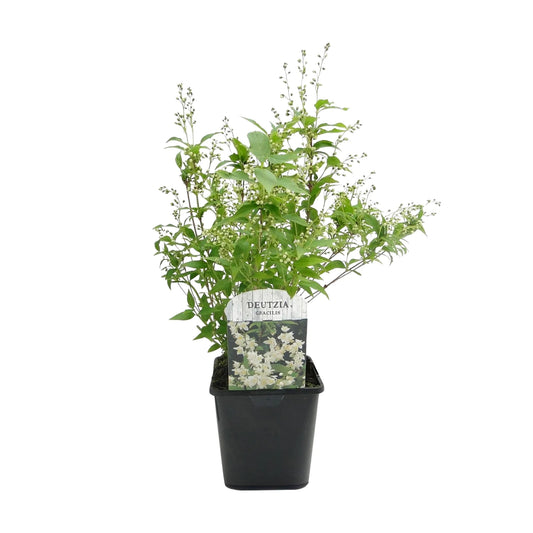
Deutzia 'Gracilis' (Deutzia) - flowering shrub - 17 cm pot - Height 45 cm
Regular price 39,95 €Regular price39,95 €31,96 €Livraison offerte -

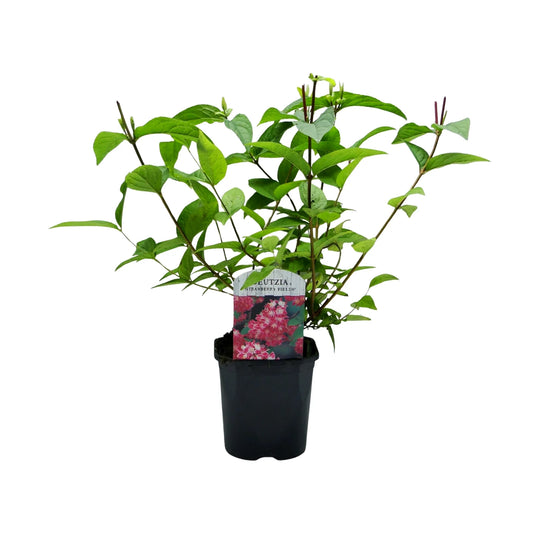
Deutzia 'Strawberry Fields' (Deutzia) - flowering shrub - 17 cm pot - Height 45 cm
Regular price 39,95 €Regular price39,95 €31,96 €Livraison offerte -
'Snowbelle' Mock Orange (Philadelphus) – Fragrant Shrub – 17 cm Pot – 45 cm Tall
Regular price 39,95 €Regular price39,95 €31,96 €Livraison offerte -
Forsythia 'Goldrausch' (Forsythia) - flowering shrub - 17 cm pot - Height 45 cm
Regular price 39,95 €Regular price39,95 €31,96 €Livraison offerte -


Dwarf Meyer Lilac 'Palibin' (Syringa meyeri) - fragrant shrub - 19 cm pot - Height 90 cm
Regular price 69,95 €Regular price69,95 €55,96 €Livraison offerte -

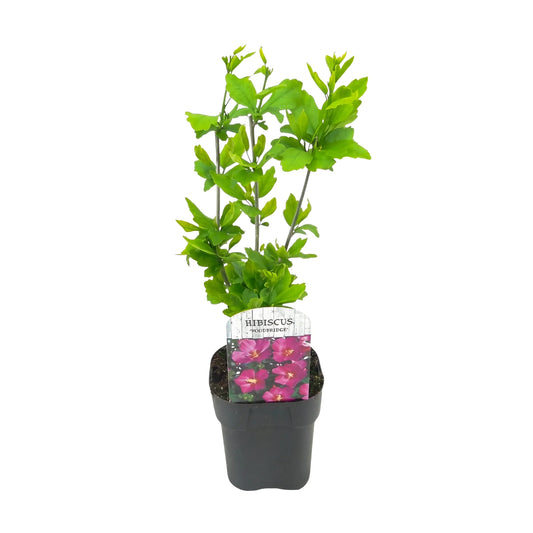
Hibiscus 'Woodbridge' (Hibiscus syriacus) - flowering shrub - 17 cm pot - Height 45 cm
Regular price From 44,95 €Regular price44,95 €From 35,96 €Livraison offerte -

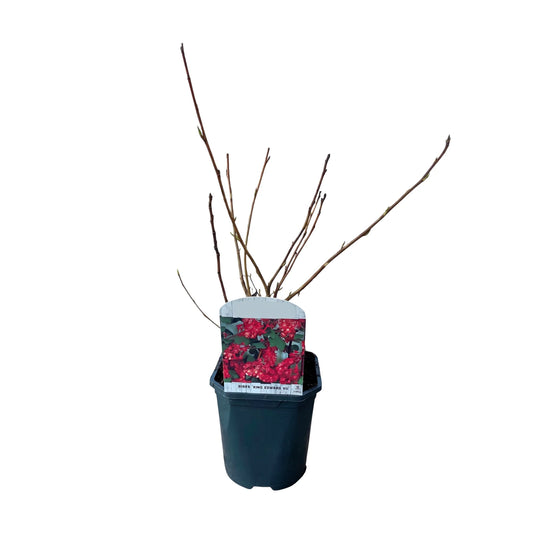
Flowering Currant 'King Edward' (Ribes sanguineum) - flowering shrub - 17 cm pot - Height 45 cm
Regular price 44,95 €Regular price44,95 €35,96 €Livraison offerte



✂️ Caring for and pruning deutzia after flowering
Prune deutzia immediately after flowering. The RHS classifies all its deutzia varieties in pruning group 2, for early-flowering shrubs, and NC State notes that it flowers on old wood: winter pruning removes the following year's buds.
According to the RHS guide to pruning early-flowering shrubs, cut back flowered stems to vigorous young shoots lower down, then each year cut up to 20% of the oldest stems close to the base, along with any dead, weak or overcrowded growth. For a young plant, simply shape it.
According to the same guide, a very old, bare shrub can be rejuvenated with hard pruning.
✂️ Annual pruning: Immediately after flowering: cut flowered stems back to a young shoot, and cut up to 20% of old stems back to the base
🔹 Young plants: Simply shape and remove dead or damaged wood
❄️ Late frost: Cover new growth on D. gracilis with horticultural fleece during spring frosts
💧 Watering: During dry spells for the first few years in the ground; in pots, keep the compost moist but never waterlogged
🪴 In pots: Top-dress with 5 cm of fresh compost each spring and apply a slow-release fertiliser (RHS)
🍂 Deutzia through the seasons
Deutzia's care calendar revolves around its flowering. The RHS notes that D. gracilis flowers in spring and early summer, 'Strawberry Fields' in May and June, and 'Mont Rose' from June to July. Prune immediately afterwards, giving the shrub the rest of the summer to produce the wood that will flower the following year.
In autumn, the foliage of 'Nikko' turns dark purple, according to the RHS. In winter, varieties rated H5 tolerate -15 to -10°C according to the RHS hardiness rating scale, which notes that they may suffer in very exposed sites.
📅 Seasonal care calendar
| Season | Key task |
|---|---|
| 🌸 Spring | Protect against late frosts; white deutzias begin flowering; plant container-grown specimens; top-dress pots |
| ☀️ Summer | Flowering ends, then prune immediately afterwards; take softwood cuttings; water young plants during dry spells |
| 🍂 Autumn | Ideal time to plant; take semi-ripe cuttings in early autumn; 'Nikko' foliage turns purple |
| ❄️ Winter | Plant bare-root specimens when the ground is not frozen; take hardwood cuttings in late autumn; do not prune, to preserve the buds |
🌱 Propagating deutzia from cuttings
Deutzia is easy to propagate from cuttings. All the RHS variety profiles mention softwood cuttings in summer, and the profile for Deutzia scabra details three timings: softwood cuttings in summer, semi-ripe cuttings in early autumn and hardwood cuttings in late autumn.
Take current-season shoots that have not flowered, remove the lower leaves and keep the compost moist, out of direct sunlight, until roots form. Hybrids such as 'Mont Rose' or 'Strawberry Fields' do not come true from seed: only cuttings preserve the variety.
🐛 Common problems: causes and solutions
Deutzia is robust: the RHS says it is generally trouble-free from pests, and NC State describes it as rarely affected by disease. The most common problems stem from pruning at the wrong time and spring frosts.
The RHS profiles note that deutzia may be susceptible to honey fungus, while NC State lists occasional aphids and leaf miners, as well as leaf spots on D. scabra.
| Symptom | Likely cause | Solution |
|---|---|---|
| Few or no flowers | ✂️ Pruning in winter or spring: buds form on the previous year's wood (RHS, NC State) | Prune only immediately after flowering |
| Blackened new growth and buds | ❄️ Late spring frost (RHS, NC State) | Plant in a sheltered spot; cover with horticultural fleece on cold April nights |
| Discoloured, bleached leaves | ☀️ Too much sun for D. gracilis in a hot climate (NC State) | Choose a position with light afternoon shade |
| Sticky shoots covered in insects | 🐛 Occasional aphids (NC State) | Tolerate a small colony, encourage ladybirds, and cut back badly affected tips |
| Pale tunnels in leaves | ⚠️ Leaf miners (NC State) | Remove affected leaves; damage is mainly cosmetic |
| Dieback, fungi at the base | ⚠️ Honey fungus, possible according to RHS profiles | Remove the plant and its roots, and do not replant in the same spot |
-

Our flowering outdoor shrubs: buddleias, dogwoods, deutzias, hibiscus, mock oranges and more...


🌸 Our deutzia varieties
Here are varieties and species whose height, flowering and hardiness are documented by the RHS, to help you choose the right one for your space: a pot, small garden or hedge.
| Variety | What makes it special |
|---|---|
| Deutzia gracilis | Fragrant white flowers in upright clusters, 0.5 to 1 m tall, H5; protect from late frosts: ideal for a pot or border (RHS) |
| 'Nikko' | Compact Deutzia gracilis, about 60 cm tall, with white flowers and dark purple foliage in autumn; awarded the RHS AGM |
| 'Mont Rose' | Fast-growing hybrid, 0.5 to 1 m tall, with purplish-pink flowers tinged with white from June to July; awarded the RHS AGM |
| Deutzia × rosea | Compact, 0.5 to 1 m tall, with pink flowers that are paler inside, from late spring to early summer; H5 (RHS) |
| 'Strawberry Fields' | Dark pink star-shaped flowers on the outside, pale pink to white inside, lightly scented, in May and June; 1.5 to 2.5 m tall: for a border or informal hedge (RHS) |
| Deutzia scabra | The tall deutzia: 2.5 to 4 m tall, with white flowers in spring and exfoliating bark; for a tall hedge (RHS) |
🎨 Deutzia in a flowering hedge: combinations and border companions
In an informal hedge, combine deutzia with other shrubs that flower in succession: our guide to creating a privacy hedge explains how to alternate flowering deciduous shrubs with evergreens, while our guide to hedge planting distances outlines the rules for planting near neighbours.
Forsythia and lilac flower before it, while mock orange flowers at almost the same time: prune all of them after flowering. Hydrangea, from the same family, takes over in summer. In pots, compact deutzias complement our guide to plants for balconies and patios.
Discover our Deutzia and other flowering shrubs, our trees and ornamental shrubs, our plants for balconies and patios, and all our outdoor plants.
⚠️ Is deutzia toxic to cats, dogs and children?
For Deutzia gracilis, the NC State Extension Deutzia gracilis profile lists the species as non-toxic to cats, dogs and horses.
However, the ASPCA (American Society for the Prevention of Cruelty to Animals) does not publish a Deutzia profile, and we have found no toxicity data for other species and hybrids, so we cannot confirm that they are safe.
As a precaution, prevent pets from chewing on the branches, teach children not to put garden plants in their mouths, and contact a veterinarian or poison control center if ingestion is followed by symptoms.
✅ Our expert tips for success
Growing deutzia successfully comes down to one rule and three steps: give it sun or light partial shade, soil that stays moist but never waterlogged, water it during dry spells for the first few years, and prune just after flowering, never in winter. If it flowers poorly, first consider when it was pruned, then whether it was hit by a spring frost.
Above all, choose the variety to suit the space: gracilis, 'Nikko', × rosea or 'Mont Rose' for a pot or small garden; 'Strawberry Fields' for a border or informal hedge; D. scabra for a tall hedge, bearing in mind that NC State Extension notes that it tends to self-seed and is reported as invasive in the United States.
Finally, note that the RHS lists 'Tourbillon Rouge' and Deutzia × magnifica 'Rubra' as synonyms of 'Strawberry Fields': they are the same plant under three names. Find more ideas in our guide to flowering shrubs for a colorful garden.
Deutzia is the shrub I recommend to people with a small garden or patio who want flowers without the fuss. When someone writes to say it hasn't flowered, I first ask when it was pruned, then whether it was hit by frost in April. I like to plant it along a path, where you can get a close look at its little stars. Above all, before buying, I check the variety's mature height, because a 2 m deutzia will never stay manageable in a pot.

Laura Bruneau
Jardinière et autrice