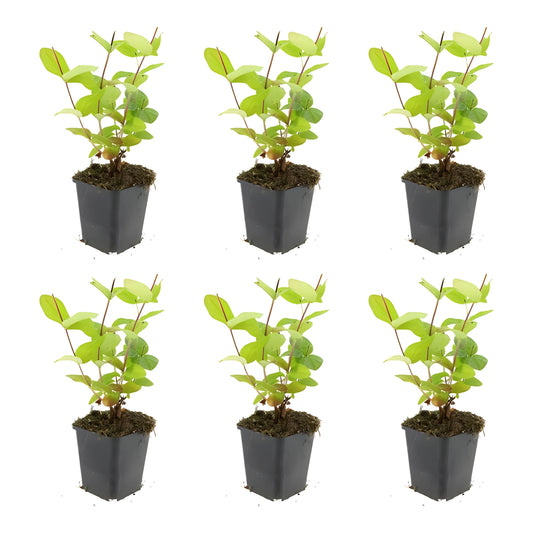
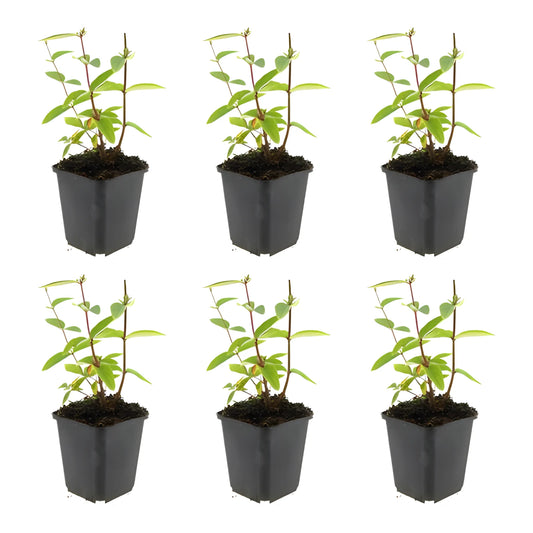
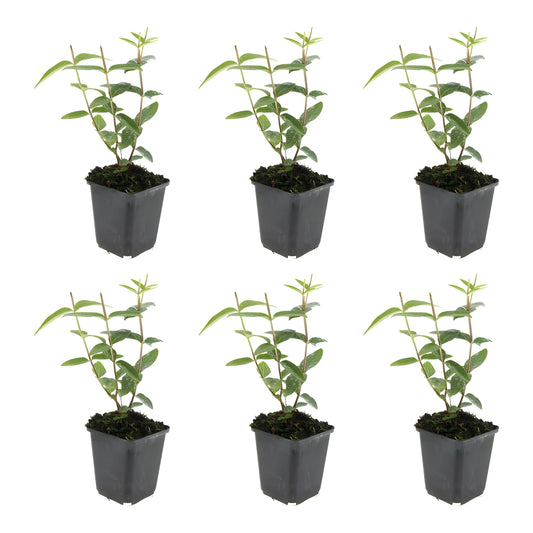
Abelia (Abelia × grandiflora): planting, pruning, and care

To grow an Abelia successfully, plant it in full sun or light partial shade, sheltered from cold winds, in moist but well-drained soil. Water it during its first two growing seasons, then simply give it a light prune in late winter: it flowers on the current year’s growth, from summer through fall.
Glossy abelia (Abelia × grandiflora) is one of the few shrubs to take over when spring blooms fade, with clusters of pinkish-white bells that attract bees and butterflies.
This profile complements our guide to flowering shrubs: it brings together information verified with the RHS, Kew, NC State, the Missouri Botanical Garden, and Trees and Shrubs Online, from choosing a cultivar to growing an informal hedge.
🌿 Why plant an Abelia in your garden
Abelia fills the late-summer flowering gap. According to the RHS (Royal Horticultural Society) profile for Abelia × grandiflora, its pale pink, lightly scented flowers appear in clusters from midsummer and continue into fall; some of the foliage remains through winter.
According to the North Carolina State University Extension profile (NC State Extension), once established it tolerates drought, pollution, and deer; it has no serious pests or diseases, and its flowers attract bees, butterflies, and, in the Americas, hummingbirds.
It grows in clay, loam, or sandy soil, whether acidic, neutral, or alkaline. According to NC State, its only weakness is that it does not tolerate salty soils.
| Benefit | What it means for you |
|---|---|
| Very long flowering season | From midsummer into fall, according to the RHS, when most shrubs have finished blooming |
| For pollinators | Its flowers attract bees and butterflies, according to NC State |
| Low-maintenance | Any soil pH, clay to sandy soil, drought-tolerant once established (NC State) |
| Seasonal foliage | Glossy green, turning reddish purple in fall; some leaves remain through winter |
🔎 Abelia at a glance
According to Plants of the World Online (POWO), the database of the Royal Botanic Gardens, Kew, the accepted name is Abelia × grandiflora (Rovelli ex André) Rehder, published in 1900. It is an artificial hybrid with the formula A. chinensis × A. uniflora.
Kew lists Linnaea × grandiflora among its synonyms, a name proposed by Christenhusz when some botanists merged the genus Abelia into Linnaea; POWO has retained Abelia as the accepted name.
According to Trees and Shrubs Online, the online dendrological encyclopedia, Édouard André described it in 1886 from a seedling at the Rovelli brothers’ nursery in Pallanza, Italy. The encyclopedia now lists several dozen cultivars.
| Category | Verified details |
|---|---|
| 🏷️ Botanical name | Abelia × grandiflora (Rovelli ex André) Rehder; synonym Linnaea × grandiflora |
| 🧬 Family | Caprifoliaceae, the honeysuckle family (NC State) |
| 🌳 Type | Semi-evergreen shrub with arching stems |
| 🌍 Origin | Horticultural hybrid developed in Italy, described in 1886 (A. chinensis × A. uniflora) |
| ❄️ Hardiness | H5, or -15 to -10 °C (RHS); H6 according to Trees and Shrubs Online |
| 🍃 Foliage | Small, oval, glossy dark green leaves, turning reddish purple in fall |
| 🌸 Flowers | Midsummer to fall, with funnel-shaped flowers ranging from white to pale pink |
| 📏 Mature size | 2.5 to 4 m tall and wide in 10 to 20 years (RHS) |
📋 Quick growing guide
Essential growing information at a glance.
| Factor | Guideline |
|---|---|
| Position | Full sun for best flowering; tolerates light partial shade; sheltered spot |
| Soil | Moist but well drained; chalky, loamy, or sandy; acidic to alkaline pH |
| Hardiness | H5 according to the RHS (-15 to -10 °C); H4 (-10 to -5 °C) for 'Francis Mason' |
| Watering | Water during the first 2 growing seasons, then only during prolonged dry spells |
| Planting | October to April, preferably in fall or winter (RHS) |
| Pruning | Light pruning in late winter or early spring; rejuvenate every 3–4 years |
| Flowers | Midsummer to fall, on the current year’s growth |
| Care | Easy; watch for frost damage to stems, honey fungus, and aphids |
| Toxicity | No ASPCA profile found; listed among plants safe for dogs (WSU) |
📍 Where and when to plant an Abelia
Plant Abelia in a sunny spot: NC State notes that it tolerates partial shade but flowers best in full sun, while the RHS recommends a south- or east-facing position. Choose a sheltered location: NC State says it is susceptible to frost and recommends a protected site, while the RHS calls for a sheltered position for 'Kaleidoscope' and 'Edward Goucher'.
As for timing, the RHS guide to planting trees and shrubs indicates that the ideal planting period is October to April. Container-grown plants can be planted year-round, but are easier to establish when planted in fall or winter.
In cold regions, aim for early fall or spring, when there is no frost.
☀️ Ideal: Full sun, against a south- or east-facing wall, sheltered from cold winds
🗓️ Timing: October to April according to the RHS, as long as the soil is not frozen or waterlogged
🚫 Avoid: Waterlogged soil in winter, salty soil (NC State), and cold hollows where frost settles
🪴 Planting Abelia in the ground or as an informal hedge
For any shrub, the RHS recommends digging a hole at least three times as wide as the root ball, but no deeper: the top of the root ball should be level with the soil, because planting too deeply deprives the roots of air and makes the base of the stems vulnerable to disease. Then apply at least 5 cm of mulch, leaving a 10 cm gap around the stems.
In dry weather, the RHS recommends applying 30 to 50 liters of water per square meter per week—about 4 to 6 watering cans—during the first two growing seasons.
For hedges, the Missouri Botanical Garden lists Abelia as suitable for an informal hedge: space plants according to the mature spread of the cultivar you choose, and follow the method in our guide to creating a privacy hedge.
| Step | What to do |
|---|---|
| 1. Choose | Select a cultivar whose mature size suits the available space (RHS profiles) |
| 2. Dig | Make a hole 3 times as wide as the root ball, but no deeper (RHS) |
| 3. Plant | Rehydrate the root ball, set its top level with the soil, and firm the soil |
| 4. Mulch | Apply at least 5 cm of mulch, leaving a 10 cm gap around the stems (RHS) |
| 5. Water | 30 to 50 L/m² per week during dry spells for 2 growing seasons (RHS) |
columns: 4
columns_mobile: 2
-

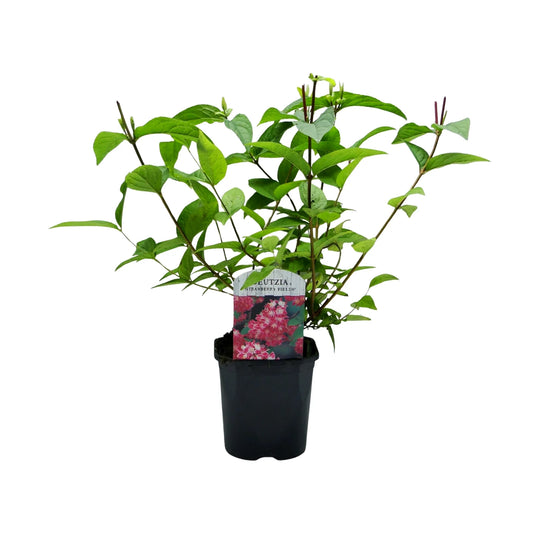
Deutzia 'Strawberry Fields' (Deutzia) - flowering shrub - 17 cm pot - Height 45 cm
Regular price 39,95 €Regular price39,95 €31,96 €Livraison offerte -
'Snowbelle' Mock Orange (Philadelphus) – Fragrant Shrub – 17 cm Pot – 45 cm Tall
Regular price 39,95 €Regular price39,95 €31,96 €Livraison offerte -
Viburnum (Viburnum) – Fragrant flowering shrub – 19 cm pot – Height: 90 cm
Regular price 69,95 €Regular price69,95 €55,96 €Livraison offerte -


Hibiscus 'Blue Bird' (Hibiscus syriacus) - flowering shrub - 17 cm pot - Height 45 cm
Regular price From 44,95 €Regular price44,95 €From 35,96 €Livraison offerte -


Butterfly Bush 'Empire Blue' (Buddleja davidii) - honey-producing shrub - 17 cm pot - Height 45 cm
Regular price From 39,95 €Regular price39,95 €From 31,96 €Livraison offerte -

 Livraison offerte Sold out
Burkwood Osmanthus (Osmanthus × burkwoodii), evergreen hedging plant, 9 cm pot, Height 25-30 cm - Pack of 8
Regular price 59,95 €Regular price59,95 €47,96 €Livraison offerte Sold out -


Ceanothus Victoria (Ceanothus), flowering Mediterranean shrub, purple flowers, 19 cm pot, Height 90 cm
Regular price 69,95 €Regular price69,95 €55,96 €Livraison offerte -

Flowering Currant 'King Edward' (Ribes sanguineum) - flowering shrub - 17 cm pot - Height 45 cm
Regular price 44,95 €Regular price44,95 €35,96 €Livraison offerte


✂️ Abelia care and pruning: when and how to prune
Abelia flowers on the current year’s shoots, so NC State and the Missouri Botanical Garden recommend pruning it, if needed, in late winter or early spring. Pruning at this time removes no flower buds; pruning in summer, on the other hand, cuts off the stems that would have flowered.
Simply remove dead or frost-damaged wood, shorten stems that spoil the shape, and remove a few old branches at the base. The RHS places Abelia × grandiflora in pruning group 8, and adds that hard pruning (group 6) may be needed every 3 to 4 years to rejuvenate a bare specimen.
To schedule this work in a mixed hedge, see our hedge-pruning calendar.
✂️ Annual pruning: Light pruning in late winter or early spring, removing dead wood and unwanted stems
🔹 Rejuvenation: Hard pruning is possible every 3 to 4 years (RHS)
💧 Watering: During the first 2 growing seasons, then only during marked drought
🍂 Mulch: At least 5 cm, replenished as needed, kept 10 cm from the stems (RHS)
🧣 Winter: Protect young plants in cold regions; wait for new growth before pruning
🍂 Abelia through the seasons
New growth emerges in spring; the RHS notes that the young shoots of 'Edward Goucher' are bronze-tinted. According to the RHS, flowering begins in midsummer (as early as late spring in North Carolina’s climate, according to NC State) and continues into fall. Trees and Shrubs Online adds that the colorful sepals persist after the flowers, extending the ornamental effect.
In fall, the foliage turns reddish purple, according to NC State, while 'Kaleidoscope' takes on orange and red tones, according to the RHS. In winter, the shrub retains all or some of its leaves: NC State describes it as semi-evergreen to evergreen in mild climates, but often deciduous where winters are harsher.
📅 Seasonal care calendar
| Season | Key task |
|---|---|
| 🌸 Spring | Light pruning in late winter or early spring, planting still possible through April, new shoots emerge |
| ☀️ Summer | Flowering begins in midsummer, water young plants in dry spells, take softwood cuttings in early summer |
| 🍂 Fall | Flowering continues, colorful sepals, reddish-purple foliage, take semi-ripe cuttings, ideal planting season |
| ❄️ Winter | Some foliage remains, depending on the cold; protect young plants; do not prune in freezing weather |
🌱 How to propagate Abelia from cuttings
Abelia is easy to propagate from stem cuttings, the method recommended by NC State. The RHS specifies two timings: take softwood cuttings in early summer from tender new growth, or semi-ripe cuttings in late summer from stems whose bases have begun to harden.
Take healthy, non-flowering stem sections, remove the lower leaves, and plant them in a light, free-draining mix. Keep them covered in bright light out of direct sun, and plant them in the garden only once they are well rooted. This is also the only way to reliably preserve the characteristics of a variegated cultivar.
🐛 Common problems: causes and solutions
Abelia is a healthy shrub: the RHS says it is generally free from pests, and NC State reports no serious pests or diseases. The main risk is cold: the RHS rates Abelia × grandiflora H5, or -15 to -10 °C, on the RHS hardiness scale.
According to the Missouri Botanical Garden Plant Finder, expect significant stem damage when temperatures approach 0 °F, or about -18 °C, and winter dieback of stems is common in harsh climates. Our guide to protecting plants from frost explains useful frost cloths and mulches.
As for disease, the RHS says it is susceptible to honey fungus, and NC State reports occasional aphids.
| Symptom | Likely cause | Solution |
|---|---|---|
| Dry, black stems in spring | ❄️ Winter dieback after a hard freeze (NC State, Missouri) | Wait for new growth, then cut back to living wood in late winter |
| Leaves dropping in winter | ❄️ Semi-evergreen or deciduous behavior depending on the cold (NC State) | Normal: leaves grow back in spring |
| Few or no flowers | 💧 Too much shade or summer pruning that removes flowering shoots | Move it to a sunny spot; prune only in late winter |
| Distorted, sticky young shoots | 🐛 Occasional aphids, according to NC State | Spray with water, encourage beneficial insects, tolerate light infestations |
| Sudden dieback, white threads beneath the bark at the root collar | 🍄 Honey fungus, to which the RHS says it is susceptible | Remove the plant and its roots; do not replant a susceptible shrub in the same spot |
| Foliage suffering near a salted road or in waterlogged soil | 💧 Salty soil, which NC State says it tolerates poorly, or waterlogged soil despite the RHS recommendation for good drainage | Improve drainage; avoid roadsides salted in winter |
-

Our flowering outdoor shrubs: buddleias, dogwoods, deutzias, hibiscus, mock oranges and more...
-

Nectar-producing plants & pollinators
Provide food for bees, bumblebees, and butterflies: our selection of outdoor nectar-rich...
-

Outdoor plants that keep their foliage all year round: evergreen privacy hedges,...


🌸 Abelia varieties for the garden
Choose an Abelia first for its mature size and hardiness. According to the RHS profile for 'Kaleidoscope', 'Kaleidoscope' grows to just 0.5–1 m tall and 1–1.5 m wide, reaching that size in 2 to 5 years. Its yellow and green foliage deepens in color, then turns orange and red in autumn. Dimensions and notes are based on RHS profiles unless otherwise indicated (NC State, Missouri, Trees and Shrubs Online).
| Variety | What makes it special |
|---|---|
| Abelia × grandiflora (species) | 2.5–4 m in 10 to 20 years, H5, lightly scented pale pink flowers, semi-evergreen |
| 'Kaleidoscope' | 0.5–1 m, H5, yellow and green foliage turning orange and red in autumn, scented white flowers tinged with pink |
| 'Edward Goucher' | 1.5–2.5 m, H5, Award of Garden Merit, scented lilac-pink flowers; hybrid with A. schumannii introduced in 1911 (Missouri) |
| 'Francis Mason' | 1–1.5 m, H4, yellow leaves marked with dark green in the center; the first variegated form (Trees and Shrubs Online) |
| 'Sherwoodii' | Dwarf form growing to around 90 cm, with smaller leaves and flowers (NC State) |
| 'Lake Maggiore' | Award of Garden Merit received in 2009, according to Trees and Shrubs Online |
🎨 What to pair with Abelia in the garden
Abelia takes over from spring-flowering shrubs: plant it next to a deutzia or a mock orange, which flower before it, for an informal flowering hedge from April through autumn.
For an evergreen, fragrant foundation, add a Mexican orange blossom; for a botanical relative with fine foliage that can be clipped into a low hedge, take a look at Lonicera nitida, another member of the Caprifoliaceae family.
For pollinators, butterfly bush and nectar-rich perennials at its base complement its summer blooms.
Colorful cultivars such as 'Kaleidoscope' pair well with shrubs with autumn color, while compact forms fit right in among our plants for balconies and patios.
To put the whole scheme together, browse our flowering shrubs to pair with Abelia, our plants for hedges and privacy screening, or our nectar-rich plants.
⚠️ Is Abelia toxic to dogs and cats?
We could not find an Abelia entry in the ASPCA (American Society for the Prevention of Cruelty to Animals) database, and the NC State profile lists no toxicity.
The only institutional document we were able to verify comes from Washington State University Extension (WSU Extension, Skagit County): its list of plants suited to the northwestern United States and safe for dogs includes Abelia as a hardy shrub that can even withstand dog urine.
This document does not mention cats or other animals. We therefore cannot say that Abelia is safe for all animals: if a pet eats a large amount or shows symptoms, contact your veterinarian. No special precautions for gardeners are noted in the sources consulted.
✅ Our expert tips for success
Growing Abelia successfully comes down to a few simple rules: choose a cultivar for its mature size, plant it in a sunny spot sheltered from cold winds, provide moist but well-drained soil, water consistently for the first two growing seasons, then prune lightly in late winter. It will reward you with months of flowers for bees and glossy foliage almost all year round.
To incorporate it into a larger design, revisit our guide to flowering shrubs.
Abelia is the shrub I recommend to anyone who finds their garden a little quiet at the end of summer: it is often still buzzing with bees in September. I always plant it in the sun, against a wall or hedge that offers shelter, because a cold winter can cause dieback. I prune it sparingly, only in late winter, to preserve its long arching stems, which are its main charm. And I prefer 'Kaleidoscope' in small spaces, so I never have to cut it back.

Laura Bruneau
Jardinière et autrice