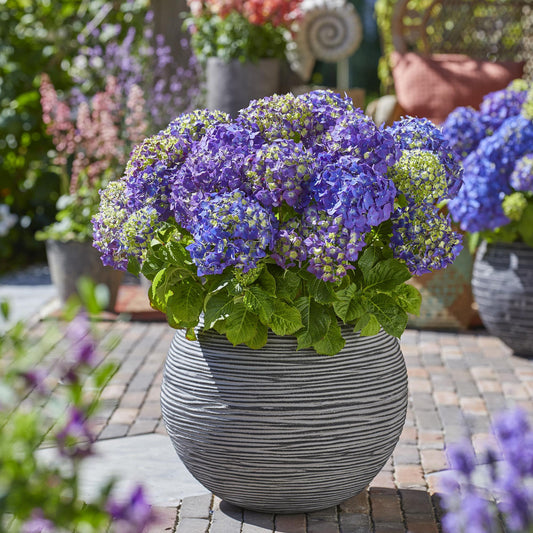
Potted hydrangeas: choosing, planting and growing them successfully on the patio

A potted hydrangea does very well on a partially shaded patio or balcony, provided you choose a compact variety, a large enough pot with drainage holes, and a potting mix that stays moist.
The Hydrangea genus includes several species with different needs: bigleaf hydrangea (Hydrangea macrophylla) is the most widely grown, but compact panicle hydrangeas and Hydrangea serrata also do well in containers.
This guide covers the species, pot, potting mix, placement, watering, overwintering, and pruning, drawing on the RHS and American universities; learn more about the plant itself in our complete hydrangea guide.
🌟 Can hydrangeas live in pots? Yes, with a few conditions
Yes, hydrangeas can live in pots for years, provided you choose a compact variety, give them a well-drained, large-enough pot, and never let the potting mix dry out.
According to the RHS (Royal Horticultural Society) guide to shrubby hydrangeas, compact Hydrangea macrophylla cultivars are suitable for containers, and container-grown hydrangeas can be planted at any time of year, except when the ground is frozen, waterlogged, or very dry. NC State Extension confirms that they can be grown in containers.
| Benefit | What it means |
|---|---|
| Controlled color | In a pot, acidic potting mix keeps the flowers blue, even if your garden soil is alkaline (RHS) |
| Mobility | Move the pot into the shade in midsummer and shelter it from late spring frosts (RHS) |
| Small spaces | Cultivars that grow 0.5 to 1 m tall at maturity, such as 'Little Blue' or 'Petite Star' (RHS) |
| Long flowering season | Groundbreaker Ruby flowers for about 100 days, from summer through fall, according to the RHS |
📊 Hydrangeas suited to pots: a species comparison
The best hydrangeas for pots are compact Hydrangea macrophylla, Hydrangea serrata, and compact Hydrangea paniculata; larger panicle hydrangeas and 'Annabelle' hydrangeas need a large planter, while climbing hydrangeas are so vigorous that they are best planted in the ground. Information is from RHS plant profiles unless otherwise noted; hardiness ratings apply to plants in the ground. To compare varieties for the garden, see our hydrangea variety comparison.
| Species or cultivar | Suitability for pots | Mature size | Hardiness (RHS) | Exposure |
|---|---|---|---|---|
| Compact Hydrangea macrophylla ('Little Blue') | Ideal for containers (RHS) | 0.5 to 1 m tall and wide | H5, -15 to -10°C | Partial shade, east-, north-, or west-facing position, sheltered site |
| Reblooming Hydrangea macrophylla (Endless Summer) | Yes; blooms again in summer on the current year's growth (NC State Extension) | Depending on the cultivar | Flower buds are sensitive to late frosts (RHS) | Partial shade, out of afternoon sun (NC State) |
| Garden Hydrangea macrophylla | Large planter only | 0.9 to 1.8 m (NC State) | Flower buds are sensitive to late frosts (RHS) | Light partial shade |
| Hydrangea serrata | Listed as a patio and container plant (RHS) | 1 to 1.5 m, often smaller | H4, -10 to -5°C | Partial shade, or sun if the potting mix stays moist |
| Compact Hydrangea paniculata ('Petite Star') | Ideal for pots (RHS) | 0.5 to 1 m tall and wide | H5, -15 to -10°C | Sun or partial shade |
| Hydrangea paniculata Groundbreaker Ruby | Recommended for pots, window boxes, and hanging baskets (RHS) | About 40 cm tall and 70 cm wide | Tolerates cold and heat once established (RHS) | Sun to partial shade |
| Hydrangea paniculata (species) | Large planter only | 2.5 to 4 m tall (RHS) | H5, -15 to -10°C | Sun or partial shade if the soil stays moist |
| Hydrangea arborescens 'Annabelle' | Large planter only | 1.5 to 2.5 m tall and wide (RHS) | H6, -20 to -15°C | Full sun or partial shade |
| Climbing hydrangea (Hydrangea anomala subsp. petiolaris) | Best planted in the ground: a single plant can cover the wall of a house (RHS) | Vigorous climber | Hardy to USDA Zone 4 (UConn) | North- or east-facing wall (RHS) |
📋 Quick reference
General guidelines for growing hydrangeas in pots, based on the RHS and the university extensions cited.
| Factor | Guideline |
|---|---|
| Recommended species | Compact Hydrangea macrophylla, H. serrata, compact H. paniculata (RHS) |
| Pot | With drainage holes; pot up in stages. For a tree in a container, the RHS recommends a final container of at least about 45 cm, a useful guideline for a large panicle hydrangea or 'Annabelle' |
| Potting mix for blue flowers | Ericaceous potting mix, target pH 4.5 to 5 (RHS) |
| Potting mix for pink or white flowers | 2 parts loam-based potting mix to 1 part peat-free multipurpose potting mix (RHS) |
| Exposure | Light partial shade; move the pot into the shade in midsummer (RHS) |
| Watering | Check by touch; water when the top 2 to 3 cm of potting mix is dry. Use rainwater for blue cultivars, according to the RHS |
| Top-dressing | Each spring, replace about 5 cm of the potting mix on the surface (RHS) |
| Winter | Raise the pot on feet, group it against a wall, and cover with fleece in severe frost (RHS) |
| Pruning | Macrophylla and serrata in mid-spring; paniculata and Annabelle in early spring (RHS) |
How to plant a hydrangea in a pot in 7 steps
To plant a hydrangea in a pot, choose a container with drainage holes that is slightly larger than the root ball, use potting mix suited to the color you want, and set the plant at the same depth as in its original pot before watering thoroughly. The RHS notes that hydrangeas are often sold in 3-liter pots.
For advice on materials, see whether a terracotta or plastic pot is the better choice.
| Step | What to do |
|---|---|
| 1. Choose the pot | Choose a pot with drainage holes that is only slightly wider than the root ball for a young plant; move up to a large planter as you repot (RHS) |
| 2. Ensure good drainage | Use a pot with clear drainage holes and an airy potting mix so water can drain freely (RHS) |
| 3. Prepare the potting mix | Use ericaceous potting mix for a blue hydrangea; otherwise, use 2 parts loam-based potting mix to 1 part peat-free multipurpose potting mix (RHS) |
| 4. Moisten the root ball | Immerse it in a bucket of water before removing it from its pot |
| 5. Position the plant | Set the root ball at the same depth as in its original pot, fill in around it, and firm gently |
| 6. Water | Water until it drains through the holes, then empty the saucer |
| 7. Mulch | A layer of mulch at least 5 cm deep helps keep the potting mix moist in summer (RHS) |
columns: 4
columns_mobile: 2
-


Hydrangea 'Endless Summer The Original Blue' (Hydrangea macrophylla) – Repeat-flowering hydrangea – 14 cm pot – Height: 20–25 cm
Regular price From 49,95 €Regular price -


Endless Summer Hydrangeas, 3-colour mix (Hydrangea macrophylla) – blue, pink and white – 14 cm pot – height 20–25 cm
Regular price 84,95 €Regular price -


Hydrangea 'Endless Summer Summer Love Red' (Hydrangea macrophylla) – repeat-flowering hydrangea – 14 cm pot – height 20–25 cm
Regular price From 49,95 €Regular price -

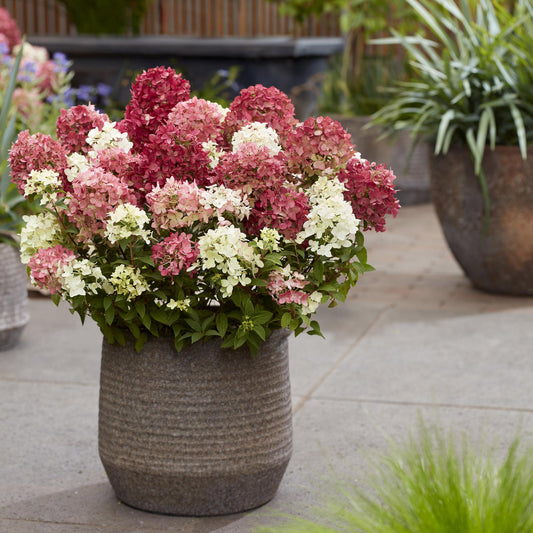
Groundbreaker Ruby Hydrangea (Hydrangea paniculata), hardy flowering shrub, 14 cm pot, Height 20–25 cm
Regular price From 44,95 €Regular price -

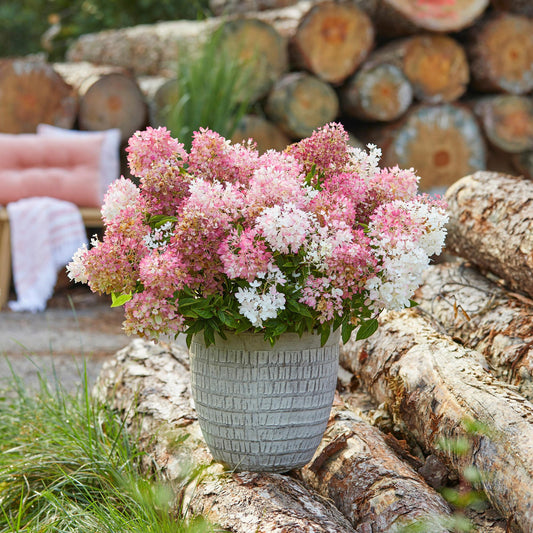
Hydrangea paniculata ‘Groundbreaker’ Blush, hardy flowering shrub, 14 cm pot, Height 20–25 cm
Regular price From 44,95 €Regular price -


‘Endless Summer The Bride’ Hydrangea (Hydrangea macrophylla) – reblooming hydrangea – 14 cm pot – height 20–25 cm
Regular price From 49,95 €Regular price -
Hydrangea (Hydrangea macrophylla) - garden hydrangea - 12 cm pot - Height 25 cm
Regular price From 34,95 €Regular price -

Universal Substrate enriched with Mycorrhizae and Bacillus - Premium Quality - Universal potting mix
Regular price From 9,50 €Regular price8,50 €Sale price From 9,50 €


🧭 Outdoor potted hydrangeas: placement, patios, and balconies
Outdoor potted hydrangeas are best placed in partial shade, with morning sun and protection from the hot afternoon sun. The RHS recommends light shade, or a sunnier spot if the potting mix does not dry out in summer, and advises moving pots into the shade in midsummer. Also avoid windy corners and frost pockets (RHS).
To complete your container garden, see our plants for balconies and patios.
| Your situation | Our advice |
|---|---|
| East-facing patio | Ideal location: morning sun, afternoon shade |
| North- or west-facing balcony | Suitable for Hydrangea macrophylla and serrata, which are recommended for partial shade (RHS) |
| South-facing patio | Choose a compact panicle hydrangea such as 'Petite Star' or Groundbreaker Ruby, which tolerate sun (RHS), and check by touch and water as soon as the potting mix dries out |
| Windy upper-floor balcony | Protect it from cold winds: the RHS classifies 'Little Blue' as suited to a sheltered position |
| Cold, continental climate | Choose 'Annabelle', rated H6 by the RHS, and shelter the pot in very cold weather |
📐 Caring for potted hydrangeas: watering and fertilizer
Caring for a potted hydrangea mostly comes down to watering: the potting mix must never dry out completely, because pots dry out much faster than the ground.
According to the RHS guide to container maintenance, in hot or windy weather you should check the moisture in pots very regularly, and even more often in extreme heat; check, but don't water automatically. Water when the top 2 to 3 cm of potting mix is dry, using rainwater for blue cultivars or tap water if necessary (RHS).
As for fertilizer, the RHS notes that too much causes soft growth: a slow-release fertilizer when repotting or top-dressing is enough, and none in winter. Also see our guide to watering plants in summer.
📐 Potting mix and color: blue, pink, or white potted hydrangeas
The color of pink or blue Hydrangea macrophylla depends on the acidity of the potting mix: flowers stay blue in acidic conditions and turn pink in neutral to alkaline conditions, while white flowers do not change color. The RHS puts blue at a pH of around 4.5 to 5 and classifies soil with a pH of 6.5 to 7 as neutral.
UConn gives similar guidelines: pH 4.0 to 5.0 for blue flowers, which makes soil aluminum available for uptake, and pH 6.0 to 7.0 for pink. According to University of Missouri Extension, aluminum is what turns flowers blue, and Oregon State University places purple shades between pH 5.5 and 6.5.
A pot is therefore the easiest way to grow blue flowers in alkaline soil, using an ericaceous mix for ericaceous plants (RHS). For pink or white flowers, the RHS recommends 2 parts loam-based potting mix to 1 part peat-free multipurpose potting mix.
📐 Potted hydrangeas in winter: protecting them from frost
Yes, potted hydrangeas are more vulnerable to frost than those planted in the ground—not because of their stems, but because of their roots and flower buds. According to UMass Amherst, roots are much less hardy than stems and, unlike plants in the ground, the roots of container-grown plants are not protected from the cold by the soil.
The RHS says wrapping the pot is unnecessary in mild regions, but recommends raising it on feet and sheltering it, for example in an unheated greenhouse, from late frosts. In an exposed site, the RHS guide to growing trees in containers recommends wrapping the container in bubble wrap or burlap.
Group pots against a wall and cover them with thick fleece, which provides about 2°C of protection (RHS). For all the methods, read our guide to protecting plants from frost.
📐 Potted hydrangeas indoors: a flowering gift, and what comes next
A flowering potted hydrangea can brighten your home for a few weeks, but it will not live indoors long-term: it is an outdoor shrub.
According to Iowa State University Extension, it needs bright but indirect light, a cool room at about 16 to 18°C, and watering as soon as the potting mix feels dry to the touch, without letting water stand in the cachepot.
University of Missouri Extension says it will look good for several weeks if kept moist, and that the flowers wilt before the leaves if it lacks water. Iowa State notes that these florist cultivars, which are not very hardy in Iowa, rarely rebloom, and recommends discarding them after flowering.
In mild regions, the University of Missouri suggests putting it outside once the risk of frost has passed, or even planting it in the garden: give it a try, but don’t count on it blooming again, as florist’s cultivars are less hardy than nursery-grown ones, according to the University of Connecticut (UConn).
For more ideas, see our guide to which plant to give as a gift.
🗓️ The potted hydrangea calendar, season by season
Potted hydrangeas need the most attention in spring, for pruning and top-dressing, and in summer, for watering. Each spring, remove about 5 cm of topsoil and replace it with fresh potting mix, as the RHS recommends for container plants. Move it to the next pot size up when the roots fill the container (RHS).
For pruning other shrubs this season, see our guide to spring pruning.
📅 Seasonal care calendar
| Season | Key task |
|---|---|
| 🌸 Spring | Prune according to species, top-dress with about 5 cm of fresh mix (RHS), repot if roots fill the pot, bring out of shelter after frosts |
| ☀️ Summer | Check soil by touch before watering, use rainwater for blue flowers, keep the pot in the shade during the hottest part of the day (RHS) |
| 🍂 Fall | Leave spent flowers in place (RHS), plant or repot when there is no risk of frost |
| ❄️ Winter | Raise the pot on feet, place it against a wall, remove the saucer, and don’t water before a frosty night (RHS) |
🐛 Mistakes to avoid with potted hydrangeas
The most common mistakes with potted hydrangeas involve choosing the wrong pot, letting the potting mix dry out, or pruning at the wrong time.
| Mistake | Why it’s a problem | Solution |
|---|---|---|
| Letting the root ball dry out in summer | Potting mix dries out quickly in a pot, and flowers droop even before the leaves do (Missouri) | Check the mix with your finger in hot weather and water as soon as the top 2 to 3 cm is dry |
| Planting a large panicle hydrangea in a small pot | This species can reach 2.5 to 4 m in height (RHS) | Choose 'Petite Star', Groundbreaker, or a large container |
| Growing a climbing hydrangea in a pot | A single plant can cover the wall of a house (RHS) | Plant it in the ground at the foot of a north- or east-facing wall |
| Trying to get blue flowers with alkaline potting mix | Blue flowers require a pH of around 4.5 to 5 (RHS) | Use ericaceous potting mix and rainwater |
| Pruning a macrophylla in fall | Its flowers grow on shoots produced from the previous year’s wood (RHS) | Wait until mid-spring and prune lightly |
-

Our flowering outdoor shrubs: buddleias, dogwoods, deutzias, hibiscus, mock oranges and more...
-

Rhododendrons and azaleas with abundant blooms for acidic soils and partially shaded...


🌿 Our potted hydrangeas and their care guides
Each species has its own complete guide; our compact varieties should be planted in a pot slightly larger than the container they come in.
| Our selection | Why choose it |
|---|---|
| Hydrangea macrophylla | The compact reblooming varieties in the Endless Summer series: 'Endless Summer The Original Blue', 'Summer Love Red', 'Summer Love Purple', 'The Bride', or a mix of three colors |
| Hydrangea paniculata | The ground-cover panicle hydrangeas in the Groundbreaker series; the RHS recommends Groundbreaker Ruby for pots: Groundbreaker Ruby, Groundbreaker Blush, or Groundbreaker Greeny |
| A small starter plant | Our 12 cm potted Hydrangea macrophylla |
| Garden Hydrangea macrophylla | Our large mopheads in 23 cm pots: Magical Ruby Tuesday, Magical Noblesse, or Forever Ever |
| Panicle hydrangea | The large panicle hydrangeas 'Limelight' and 'Vanille Fraise', for a large container |
| Hydrangea 'Annabelle' | The hardiest, rated H6 by the RHS: our 17 cm potted 'Annabelle', for a large container in colder regions |
| Potting mix and containers | Our all-purpose potting mix for pink and white hydrangeas, our pots and planters, and our saucers |
| Hydrangeas: the complete guide | All species, flower colors, and planting in the garden, with our hydrangeas |
🔑 When to prune potted hydrangeas by species
Pruning potted hydrangeas follows the same rules as pruning those in the ground: it depends on the species, because they don’t all flower on the same wood. For Hydrangea macrophylla and serrata, the RHS recommends light pruning in mid-spring, as flowers form on new shoots growing from last year’s stems; also remove one or two of the oldest stems.
Leave spent flowers in place throughout winter to protect tender young shoots from frost, then cut them off at that time. For Hydrangea paniculata and Hydrangea 'Annabelle', the RHS recommends pruning in early spring, before growth resumes, keeping a low framework, often no more than 25 cm tall.
Groundbreaker Ruby needs little or no pruning, according to the RHS. For Endless Summer rebloomers, UConn says that removing spent flowers encourages new blooms. For detailed instructions, see our panicle hydrangea guide.
🔑 Potted hydrangeas and pets: what you need to know
Hydrangeas are harmful if eaten by a dog or cat.
The ASPCA (American Society for the Prevention of Cruelty to Animals) does not have an entry for Hydrangea macrophylla: its hydrangea entry covers Hydrangea arborescens, which is classified as toxic to dogs, cats, and horses due to a cyanogenic glycoside; clinical signs include vomiting, depression, and diarrhea.
For Hydrangea macrophylla, the RHS states “Pets (dogs, cats): Harmful if eaten” and identifies it as a skin allergen: wear gloves when pruning. NC State Extension rates its toxicity as low severity. Place the pot out of reach of pets that chew on leaves.
✅ Our tips for growing potted hydrangeas successfully
For success with potted hydrangeas, choose a compact variety, such as a reblooming macrophylla or a Groundbreaker panicle hydrangea, place it in partial shade in a pot with drainage holes, and keep the potting mix cool and moist to the touch all summer.
Find our varieties among our flowering shrubs, and for other acid-loving shrubs, browse our rhododendrons and azaleas or our balcony and patio plants.
Potted hydrangeas are one of my favorite shrubs for a partially shaded patio, where many flowering plants struggle. I often recommend starting with a compact rebloomer or a Groundbreaker: you can enjoy the flowers in the very first summer without having to find space for a huge planter. My key tip is to check the potting mix with a finger before each watering, and I always leave the dried flowers in place until spring: they look lovely under frost.

Laura Bruneau
Jardinière & autrice