Asparagus plumosus (A. setaceus): care, watering, and varieties

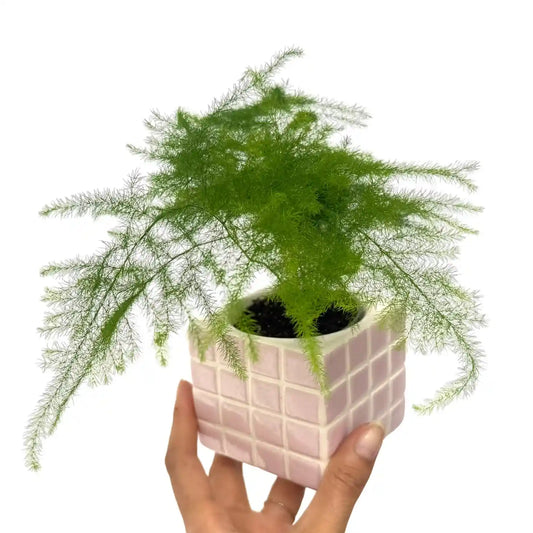
To care for an asparagus fern, place it in bright but filtered light, water when the surface of the potting mix dries out from spring to mid-autumn, water less often in winter, and keep it frost-free. Here, “asparagus” refers to the ornamental plant, especially Asparagus setaceus (long sold as A. plumosus), not the edible garden asparagus, Asparagus officinalis.
It is nicknamed “asparagus fern” or “florist’s asparagus,” but the name is misleading: it belongs to the Asparagaceae family, produces no spores, and flowers.
This guide brings together information verified with the RHS (Royal Horticultural Society), NC State Extension (North Carolina State University) and the Missouri Botanical Garden, then helps you diagnose a yellowing asparagus fern, divide it and choose between plumosus, Sprengeri and Meyersii.
🌿 Why bring an asparagus fern into your home?
The asparagus fern adds an airy volume that few houseplants can match: its branches overlap in very fine, almost feathery horizontal layers. It works equally well on a shelf or in a hanging planter, where its stems trail down before reaching upward. It tolerates indirect light and a wide range of indoor temperatures, according to the Missouri Botanical Garden, making it an easy-care plant.
Its one real demand is consistent watering: if the potting mix dries out completely, yellow needles soon appear and drop.
| Benefit | What it means for your home |
|---|---|
| Very light, feathery foliage | A green lace effect that softens a corner, bookcase or bright bathroom |
| Climbing or trailing growth habit | Can be grown in a hanging planter, on a support or in a pot on a surface, depending on the variety |
| Tolerates bright partial shade | No need for a south-facing window; filtered light is enough |
| Easy to divide | Its tuberous roots can be divided in spring to produce several potted plants |
🔎 Asparagus fern at a glance
According to Kew (Plants of the World Online, Asparagus setaceus), the accepted name is Asparagus setaceus (Kunth) Jessop, and Asparagus plumosus Baker is a synonym; the species is a climbing perennial native from central Ethiopia to South Africa and the Comoros.
The “leaves” you see are cladodes: the Missouri Botanical Garden notes that the true leaves are reduced to tiny, dry scales. NC State Extension confirms that it is not a true fern and that its stems bear sharp spines.
| Feature | Verified details |
|---|---|
| 🏷️ Botanical name | Asparagus setaceus (Kunth) Jessop, synonym Asparagus plumosus Baker |
| 🧬 Family | Asparagaceae, like edible asparagus |
| 🌳 Type | Climbing perennial with twining stems that become spiny with age |
| 🌍 Origin | From central Ethiopia to South Africa and the Comoros (POWO) |
| 🍃 Foliage | Bright green cladodes (flattened stems); true leaves reduced to scales |
| 🌸 Flowers | Small white flowers in summer, followed by dark purple to black berries |
| 📏 Size | 60 to 90 cm tall (NC State); up to 1.5 to 2.5 m when climbing (RHS) |
| ⚠️ Toxicity | Toxic to dogs and cats (NC State; ASPCA for 'Sprengeri'); berries and sap are responsible |
📋 Quick care guide
Essential growing guidelines at a glance.
| Factor | Guideline |
|---|---|
| Light | Bright and filtered, partial shade; avoid harsh direct afternoon sun |
| Watering | Generous from spring to mid-autumn, more sparingly in winter |
| Potting mix | Rich in organic matter, well-draining, slightly acidic |
| Humidity | Preferably high; use a tray of damp pebbles or a humidifier |
| Temperature | Keep frost-free; RHS H2 (down to 1 to 5 °C), with 10 °C or above preferred in winter |
| Repotting | In spring, when the tuberous roots fill the pot |
| Fertilizer | Diluted houseplant fertilizer during active growth only |
| Toxicity | Toxic to dogs and cats; gloves recommended (sap can irritate) |
| Difficulty | Easy, as long as you never let the root ball dry out |
📍 Where should you place an asparagus fern, and when should you bring it home?
The right spot for an asparagus fern is bright but free from harsh sun: the Missouri Botanical Garden recommends bright indirect light or filtered sun, avoiding hot afternoon sun. NC State Extension describes it as intolerant of high light intensity, but insufficient light can also cause the cladodes to turn yellow.
📍 Ideal location: near an east- or west-facing window, or behind a sheer curtain in a south-facing room; a bright bathroom works well thanks to its more humid air.
🕰️ Best time: spring, when growth resumes; the RHS recommends this as the time to repot and divide.
🧗 Hanging or climbing: A. setaceus develops twining stems; provide a small trellis or let them trail from a hanging planter.
🪴 How to repot an asparagus fern, step by step
Repot in spring, when the tuberous roots push up the root ball or distort the pot: the RHS guidance for Asparagus plumosus recommends repotting at this time in a loam-based, peat-free potting mix. Choose a pot only slightly wider, with drainage holes, as these fleshy storage roots do not tolerate standing water well.
Wear gloves: older stems are spiny and the sap can irritate the skin.
| Step | What to do |
|---|---|
| 1. Prepare | Water the day before so the root ball slides out without breaking the tubers. |
| 2. Choose a pot | Choose one a few centimeters wider, with an essential drainage hole. |
| 3. Prepare the potting mix | Use a rich, airy, peat-free loam-based mix. |
| 4. Pot it up | Set the root ball at the same level as before, without burying the stem bases. |
| 5. Water | Water thoroughly, let it drain, and return it to filtered light. |
columns: 4
columns_mobile: 2
-
-

 Livraison offerte
Asparagus densiflorus 'Myersii' - Foxtail fern - 27cm pot - Height 60cm
Regular price 114,95 €Regular price -

 Livraison offerte
Asplenium Crispy Wave - Crispy Wave Fern - 12cm Pot
Regular price From 39,95 €Regular price



✂️ Everyday asparagus fern care
Asparagus fern care comes down to three things: regular watering, gentle light and air that is not too dry. NC State Extension sums up the main risk: underwatering causes yellow needles to drop, while overwatering leads to root rot.
💧 Watering: Water when the surface of the potting mix feels dry to the touch; empty the saucer after watering.
💧 Humidity: Use a tray of damp pebbles, group plants together or run a humidifier, especially near a radiator.
🌱 Fertilizer: Apply diluted liquid houseplant fertilizer from spring to late summer; never in winter.
✂️ Pruning: Cut yellow or bare stems back to the base; new shoots will grow from the roots.
🧹 Cleaning: Gently shake the plant over a basin to dislodge and collect dry, fallen cladodes.
🍂 Watering an asparagus fern through the seasons
When should you water an asparagus fern? The RHS recommends watering freely from spring to mid-autumn, then more sparingly in winter. In summer, the root ball dries out faster: check it several times a week rather than watering on a fixed schedule.
In winter, heating and shorter days slow growth; keep the potting mix just moist and the temperature at least 10 °C, a guideline the Missouri Botanical Garden gives for the Meyersii form.
📅 Seasonal care calendar
| Season | Key task |
|---|---|
| 🌸 Spring | Repot or divide, resume generous watering and start applying diluted fertilizer |
| ☀️ Summer | Water frequently, maintain humidity around the foliage and protect from direct sun |
| 🍂 Autumn | Gradually reduce watering from mid-autumn and stop fertilizing |
| ❄️ Winter | Keep the potting mix just moist, place in a frost-free room ideally around 10 °C, away from radiators |
🌱 How to propagate an asparagus fern: divide rather than take cuttings
The most reliable method is to divide the tuberous roots in early spring, as recommended by both the RHS and the Missouri Botanical Garden. Remove the plant from its pot, tease apart the root ball and separate it into sections, each with tubers and a few stems, using a clean knife if needed. Pot up each section separately and keep it in light shade while it gets established.
Sowing seed is also possible: the RHS recommends sowing in autumn or early spring at 16 °C. Stem cuttings, however, are not mentioned by these sources; division remains the most reliable way to produce new plants.
🐛 Common problems: causes and solutions
A yellowing asparagus fern is almost always a sign of a watering or light issue, and rarely a disease. Here are the most common symptoms, their likely causes and what to do; yellowing due to insufficient water or light is documented by NC State Extension.
| Symptom | Likely cause | Solution |
|---|---|---|
| Yellow needles dropping in large numbers | ☀️ Dry root ball or insufficient light | Water thoroughly and move the plant closer to a window without direct sun |
| Yellow stems and a soft base | 🍄 Overwatering and root rot | Remove the plant from its pot, discard soft tubers and repot in dry mix in a pot with drainage |
| Grayish cladodes and fine webbing | 🕷️ Spider mites, encouraged by dry air | Rinse the foliage, increase humidity and isolate the plant |
| Sticky, distorted shoots | 🐛 Aphids or mealybugs | Remove them with a cotton pad soaked in alcohol, then check the plant weekly |
| Brown spots on the stems | 🍄 Leaf spot and poor air circulation | Cut off affected stems, ventilate the room and avoid wetting the foliage in the evening |
| Scorched, bleached layers | ☀️ Overly hot direct sunlight | Place behind a sheer curtain or move farther from the window |


🌸 Asparagus fern varieties
Here are the most widely grown ornamental asparagus ferns, with botanical names verified against POWO (Kew), as older names are still used in the trade.
| Variety | What makes it special |
|---|---|
| Asparagus setaceus (plumosus) | The classic “asparagus fern,” with very fine, feathery layers; climbs with age |
| Asparagus setaceus 'Nanus' | Dwarf form (A. plumosus nanus, classified under A. setaceus by POWO), ideal for a shelf |
| Asparagus setaceus 'Pyramidalis' | Upright, pyramid-shaped cultivar (1 to 1.5 m), rated H1c by the RHS: minimum 5 to 10 °C |
| Asparagus 'Sprengeri' | Trailing stems and broader needles; POWO classifies A. sprengeri under Asparagus aethiopicus |
| Asparagus densiflorus 'Myersii' (sold as 'Meyersii') | “Foxtail fern”: upright plumes around 60 cm long, with red berries (MBG) |
| Asparagus falcatus | Climbing or shrubby perennial (POWO), more vigorous and suited to larger spaces |
🎨 Which plants pair well with an asparagus fern?
The asparagus fern shares its preferences with plants that like gentle light and humid air. In a hanging planter, it pairs well with spider plants, which are just as tolerant: see our Chlorophytum (spider plant) guide.
If your home is heated, read our guide to dry air and heating to protect its delicate foliage in winter. And before reaching for the spray bottle, see Misting: useful or not?, as a humidity tray is often more effective than occasional misting.
⚠️ Is the asparagus fern toxic to cats and dogs?
Yes. The ASPCA (American Society for the Prevention of Cruelty to Animals) classifies asparagus fern 'Sprengeri' (Asparagus densiflorus) as toxic to dogs and cats: repeated skin contact can cause allergic dermatitis, while eating the berries can cause digestive problems (vomiting, abdominal pain and diarrhea).
NC State Extension identifies the fruit and sap as the toxic parts and rates the toxicity as moderate; the RHS recommends wearing gloves. Place the plant out of reach of pets and young children, and pick up any fallen berries.
Another little-known fact: the Government of South Australia (PIRSA) has declared Asparagus plumosus an invasive weed because it smothers native vegetation, so never discard its berries or roots in the garden in a mild climate.
✅ Our expert tips for success
Growing asparagus fern successfully comes down to three things: bright but filtered light, a root ball that never dries out completely, and a frost-free winter, ideally above 10°C. At the first sign of yellowing, check watering first, then light. Divide it in spring when it outgrows its pot, wear gloves when handling it, and keep it out of reach of cats and dogs.
I love asparagus fern for the lightness it brings to a room, especially in a hanging planter, where its sprays seem to float. It's a forgiving plant, except when it comes to missed watering: I recommend always checking the root ball with your finger rather than following a schedule. And when it gets too big, dividing it in spring is a real pleasure, because each section quickly starts growing again.

Laura Bruneau
Jardinière & autrice