Bromeliad and pineapple plants (Guzmania, Ananas): care, offsets

To care for a bromeliad, place it in bright, indirect light, keep a little soft water in the vase formed by its leaves, replacing it every one to two months, and keep the potting mix barely moist, never soggy. The name covers several bromeliads (Bromeliaceae): Guzmania, Vriesea, Aechmea and the pineapple plant, Ananas comosus.
What they have in common often comes as a surprise: each rosette flowers only once, then gradually declines. This guide explains the plant’s life cycle, how to water without causing the center to rot, what to do with the faded flower, how to propagate the offsets and whether you need to worry about your cat.
🌿 Why bromeliads flower for so long indoors
What we take to be a bromeliad’s flower is actually a cluster of bracts, brightly colored modified leaves. The RHS notes that these bracts remain decorative for several months, while the true flowers are small and inconspicuous. In Guzmania, the Missouri Botanical Garden counts up to 50 small white flowers nestled among red to pink bracts that often last 2 to 4 months.
In nature, many bromeliads are epiphytes: they grow on trees and draw on the water collected in the center of their rosette, explains UF IFAS.
| Benefit | What it means for you |
|---|---|
| Long-lasting color | Red, pink or orange bracts that stay beautiful for 2 to 4 months. |
| Low-maintenance | Very little fertilizer is needed, as these plants come from nutrient-poor environments. |
| Propagates on its own | After flowering, offsets produce new plants for free. |
| Compact size | A small 7.5 to 12.5 cm pot is enough for most varieties. |
🔎 Bromeliad at a glance
The best-selling Guzmania, Guzmania lingulata, is a perennial or epiphyte native to southeastern Mexico, tropical America and the Caribbean, according to Kew (Plants of the World Online).
The pineapple, Ananas comosus, is native from Costa Rica to the south of tropical America, according to Kew’s pineapple profile; the genus Ananas has only 2 accepted species. Unlike Guzmania, the pineapple is a terrestrial bromeliad that grows in soil, notes the RHS (Royal Horticultural Society).
The Missouri Botanical Garden describes Guzmania as a 30 to 60 cm epiphyte with leaves arranged in a funnel-shaped rosette.
| Feature | Verified details |
|---|---|
| 🏷️ Botanical name | Guzmania lingulata, Lutheria splendens (formerly Vriesea), Aechmea fasciata, Ananas comosus (common name: bromeliad, pineapple plant) |
| 🧬 Family | Bromeliads (Bromeliaceae), the pineapple family |
| 🌳 Type | Perennial rosette, epiphytic (Guzmania, Vriesea, Aechmea) or terrestrial (pineapple) |
| 🌍 Origin | Mexico, Central and South America, the Caribbean (tropical rainforests); pineapple: from Costa Rica to the south of tropical America (POWO) |
| 🍃 Foliage | Leaves form a rosette with a central vase; pineapple leaves have spiny edges |
| 🌸 Flowering | One bloom per rosette: colored bracts last 2 to 4 months (Guzmania, MBG), followed by gradual decline |
| 📏 Size | 30 to 60 cm for Guzmania (MBG), 30 to 90 cm for Aechmea (NC State) |
| ⚠️ Toxicity | Guzmania and Aechmea are non-toxic (NC State); Ananas comosus has low toxicity |
📋 Quick care guide
The essential growing guidelines, all in one place.
| Factor | Guideline |
|---|---|
| Light | Bright and indirect; avoid strong summer sun, which can scorch the leaves |
| Watering | A little soft water in the vase, emptied and replaced every 1 to 2 months; keep the mix moist, never soggy |
| Potting mix | Fine bark (or orchid potting mix), grit and coir in equal parts |
| Humidity | Enjoys humid air: a bright bathroom, kitchen or tray of wet pebbles |
| Temperature | At least 10 °C in winter (RHS); nights above around 16 °C for Guzmania (MBG) |
| Repotting | Rarely needed: 7.5 to 12.5 cm pot, 17.5 cm if the plant becomes top-heavy |
| Fertilizer | Very little: half-strength or weaker liquid fertilizer in spring and summer |
| Toxicity | Guzmania, Aechmea: non-toxic; pineapple: sap and leaves can cause irritation |
| Difficulty | Easy, if you accept that the rosette dies after flowering |
📍 Where should you place a bromeliad or pineapple plant?
Place your bromeliad in bright light, but shield it from strong summer sun, which can scorch the leaves, advises the RHS (Royal Horticultural Society). A bright, humid room, such as a bathroom or bright kitchen, is ideal.
UF IFAS offers a simple guide: yellowish foliage indicates too much light, while dark, drooping leaves indicate too little. The pineapple plant tolerates a little more direct sun: NC State classifies it as partial shade, with 2 to 6 hours of sun per day.
☀️ Light: Bright and filtered; a little gentle sun for the pineapple, which helps its fruit retain its color.
🌡️ Warmth: At least 10 °C in winter, away from drafts; it can go outside in summer if nighttime temperatures stay above 10 °C.
🛁 Humidity: A bright bathroom or a tray of wet pebbles beneath the pot.
🪴 Repotting a bromeliad: small pot and very free-draining mix
Bromeliads have few roots and do not like large volumes of soil. The RHS growing guide states that a pot 7.5 to 12.5 cm in diameter suits most varieties, and that 17.5 cm is only needed if the plant becomes too top-heavy and tips over.
The potting mix should drain very quickly: fine composted bark (or orchid potting mix), grit and coir in equal parts. For the terrestrial pineapple plant, NC State recommends well-drained soil rich in organic matter and somewhat acidic (pH below 6).
| Step | What to do |
|---|---|
| 1. Choose the right time | In spring, especially when potting an offset separated from its mother plant |
| 2. Choose a pot | A small, 7.5 to 12.5 cm pot with drainage holes; add weight if it tips over |
| 3. Prepare the mix | Fine bark or orchid potting mix, grit and coir in equal parts |
| 4. Position the rosette | Do not bury the base of the leaves, to prevent the center from rotting |
| 5. Water and drain | Moisten the mix, let it drain, and never leave water in the saucer |
columns: 4
columns_mobile: 2
-

 Livraison offerte Sold out
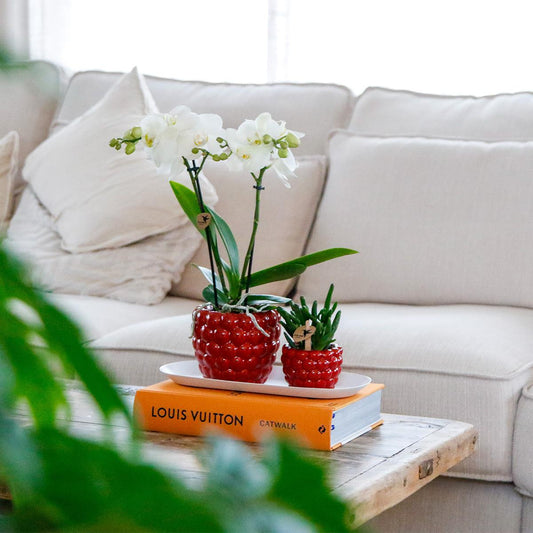
White Phalaenopsis Orchid (Phalaenopsis) – Set with Rhipsalis on a bamboo tray
Regular price 74,95 €Regular price -
-
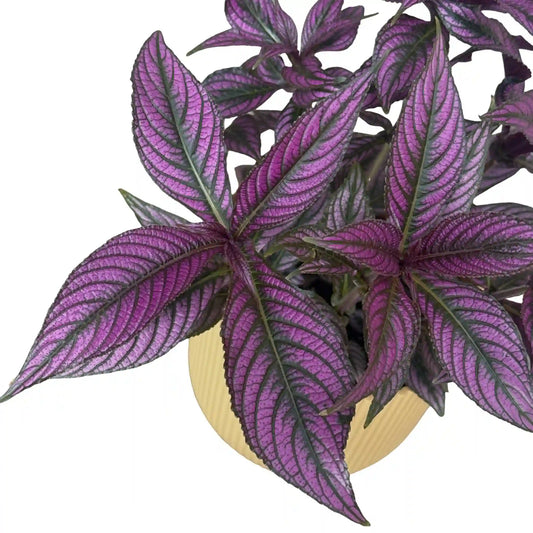
Strobilanthes Dyerianus ‘Persian Shield’
Regular price From 14,95 €Regular price39,95 €Sale price From 14,95 €Sold out



✂️ Bromeliad care: watering the vase, water and fertilizer
For vase-forming bromeliads, the RHS (Royal Horticultural Society) recommends keeping the central well filled, ideally with rainwater or demineralized water, and emptying and refilling it every one to two months to prevent stagnant water. Keep the potting mix moist but never soggy.
UF IFAS (University of Florida) recommends rinsing the vase regularly to flush away salts left by evaporation. The pineapple plant is different: water the potting mix and do not let water collect in the center. As for fertilizer, the RHS notes that these plants from nutrient-poor environments need almost none.
🔹 Central vase: A little soft water, emptied and replaced every 1 to 2 months (except for pineapple)
🔹 Potting mix: Moist, never soggy; always empty the saucer
💧 Water: Rainwater or demineralized water: hard water marks the foliage (RHS)
🌱 Fertilizer: One-third to half the recommended dose every 1 to 2 months, applied to the potting mix and never in the vase (UF IFAS)
💧 Humidity: Tray of wet pebbles or group plants together
🍂 Bromeliad care through the seasons
Bromeliads grow mainly from spring to fall. The RHS (Royal Horticultural Society) says to ensure a minimum of 10 °C in winter, while the Missouri Botanical Garden recommends nighttime temperatures above 60 °F, or about 16 °C, for Guzmania. In winter, water less often and reduce the amount of water in the vase.
UF IFAS even recommends emptying the center if temperatures may fall below 40 °F, or about 4 °C: cold damage then appears as a brown line across the leaves.
📅 Seasonal care calendar
| Season | Key task |
|---|---|
| 🌸 Spring | Repot separated offsets and resume feeding with very dilute fertilizer. |
| ☀️ Summer | Keep the vase filled with soft water and replace it regularly; avoid strong sun. |
| 🍂 Fall | Water less often, give the last dose of fertilizer and bring the plant indoors before chilly nights. |
| ❄️ Winter | Keep above 10 °C, water sparingly and empty the vase if the room gets cold. |
🌱 Bromeliad after flowering: faded bloom, offsets and reblooming
When the bracts turn brown, do not throw the plant away: most rosette-forming bromeliads flower only once, then gradually decline one to two years after flowering, according to UF IFAS (University of Florida), producing offsets at the base. Cut the faded flower spike back to the leaves and continue watering the mother plant, which nourishes its offsets.
The RHS recommends separating them with a knife in April or May, when they reach about one-third the size of the mother plant; UF IFAS waits until they are half its size. Then expect to wait several years before an offset flowers: NC State says 3 to 5 years for Vriesea.
For pineapple, you can also root the leafy crown of the fruit; NC State estimates it takes at least 24 months to flower.
🐛 Common problems: causes and solutions
Most bromeliad problems are caused by water or light. Here are the most commonly searched symptoms and what they mean, according to the RHS, UF IFAS and NC State Extension (North Carolina State University).
| Symptom | Likely cause | Solution |
|---|---|---|
| Flower browns and rosette turns yellow | ⚠️ Normal end of the cycle after its one-time flowering | Cut off the flower spike and keep the mother plant until the offsets are large enough |
| Soft center, rotting base | 💧 Too much water, soggy potting mix or stagnant water | Empty the vase, let the mix dry out and repot in a very free-draining mix |
| Brown leaf tips | 💧 Overwatering or standing water (RHS) | Let it drain, empty the saucer and replace the water in the vase |
| Yellowish, shortened foliage | 💧 Too much direct light | Move the plant farther from the window or filter the light |
| Dark, long, drooping leaves | ☀️ Not enough light | Move it closer to a bright window, but avoid scorching sun |
| Cottony clusters or small shells | 🐛 Mealybugs or scale insects | Isolate the plant, wipe with a cotton pad soaked in alcohol and check the offsets |


🌸 Our indoor bromeliad varieties
Here are the genera and species most commonly sold under the name bromeliad, along with details from botanical sources. Epiphytes are grown in much the same way; the terrestrial pineapple is watered at the potting mix. For more color ideas, see our colorful plants.
| Variety | What makes it special |
|---|---|
| Guzmania lingulata | The classic bromeliad: red, pink or orange bracts for 2 to 4 months, 30 to 60 cm tall (MBG). |
| Lutheria splendens (formerly Vriesea splendens) | The flaming sword: an upright spike of red bracts and yellow flowers (NC State); Kew reclassified it in the genus Lutheria. |
| Aechmea fasciata | The silver vase: silvery foliage and a large pink flower spike, native to southeastern Brazil (NC State). |
| Ananas comosus | The pineapple plant: a terrestrial bromeliad with spiny leaves that produces a small decorative fruit on top. |
| Ananas comosus var. variegatus | A variegated form of pineapple, listed by the RHS among easy-to-grow indoor bromeliads. |
| Neoregelia carolinae f. tricolor | Listed by the RHS among easy-to-grow bromeliads; the genus Neoregelia is classified as non-toxic by the ASPCA. |
🎨 Which plants go well with bromeliads?
Bromeliads share their needs with flowering plants that thrive in bright light and humid air. Their best-known cousin is the Tillandsia (air plant), from the same Bromeliaceae family: it lives without soil and is soaked in rainwater instead of keeping water in a cup.
Phalaenopsis orchids, which are also epiphytes, grow in a similar bark-based potting mix. The Anthurium adds to the display of colorful bracts, while the Spathiphyllum brings its white spathes.
For a more vibrant look, explore our guide to plants with colorful foliage or browse our plants for the bathroom, which enjoy the same humidity.
⚠️ Are bromeliads toxic to cats and dogs?
The answer depends on the genus. NC State Extension (North Carolina State University) classifies Guzmania lingulata as non-toxic to cats, dogs, and horses, as it does Aechmea fasciata, according to NC State.
The ASPCA (American Society for the Prevention of Cruelty to Animals) does not have a general “bromeliad” listing, but classifies two other Bromeliaceae, Neoregelia and Cryptanthus, as non-toxic to dogs and cats.
The pineapple plant is an exception: its NC State pineapple profile indicates low toxicity, as the fruit, leaves, and sap can irritate the skin or throat (bromelain, calcium oxalates). Its leaves are also prickly, so keep it out of pets’ reach.
To create a pet-safe home, find species checked one by one in our list of plants that are non-toxic to cats.
✅ Our expert tips for success
To help your bromeliad thrive, remember three things: bright light without scorching sun, a little fresh, soft water in the central cup (except for the pineapple), and potting mix that never stays waterlogged. Accept its natural cycle: the rosette blooms once, then passes the baton to its offsets.
To trigger flowering, the RHS suggests enclosing a mature rosette with several ripe apples or bananas in a large plastic bag for up to fifteen days. Growers do the same with ethephon, which releases ethylene: according to the UF IFAS publication on flower induction, it induces flowering in Aechmea, Guzmania, and Vriesea in about two months.
Bromeliads are the plants people most often describe to me as “dead” when they’re simply doing what they’re meant to do. When I see a rosette turning yellow after flowering, I look at its base first: there’s almost always an offset waiting there. I love that kind of patience, which turns a flowering plant you bought into a little family line to follow. And I always remind people to empty the water from the central cup when the house gets cooler.

Laura Bruneau
Jardinière & autrice