Tillandsia (air plant): care, watering, flowers, and varieties

To care for a Tillandsia, soak it regularly in rainwater, let it dry completely upside down, place it in bright, filtered light, and keep it above 12°C. Nicknamed an air plant or soil-free plant, this bromeliad (Tillandsia ionantha, T. xerographica, T. usneoides…) grows attached to trees and takes in water through its leaves, not its roots.
This explains the two most common mistakes: a plant that goes thirsty because it is only misted, or one that rots because it does not dry out. This guide draws on Kew, the RHS (Royal Horticultural Society), Penn State Extension (Pennsylvania State University), NC State Extension, and UF IFAS (University of Florida).
🌿 Why choose an air plant?
Tillandsia needs neither a pot nor potting mix: it can sit on a piece of wood, a stone, or a shell, or be hung up, opening up display possibilities that are impossible with a potted plant. Species range from the small rosette of T. ionantha, whose leaves grow no longer than 6 cm according to the RHS, to the large, silvery sphere of T. xerographica.
Its often vividly colored bloom marks the start of a new cycle: the plant then produces offsets that take over.
| Benefit | What it means for you |
|---|---|
| Soil-free growing | No repotting or potting mix: a mount, rainwater, and light are all it needs |
| Wide range of sizes | From a rosette just a few centimeters across to a cascade of Spanish moss |
| Striking blooms | Pink or red bracts and violet to blue flowers, depending on the species (RHS) |
| Self-propagating | Offsets that appear after flowering detach easily |
🔎 Tillandsia at a glance
According to Kew (Plants of the World Online, genus Tillandsia), the genus Tillandsia L. comprises 700 accepted species native to tropical and subtropical America.
The RHS guide to air plants explains that they cling to branches, cliffs, and even power lines using short, stiff roots, and that their leaves are covered in trichomes, specialized cells that absorb water. In some species, these trichomes are so dense that they give the plant its silvery appearance.
According to Penn State Extension, Tillandsias are divided into xeric types, which are gray and fuzzy and come from dry climates, and mesic types, which are greener and smoother and prefer filtered light.
| Feature | Verified details |
|---|---|
| 🏷️ Botanical name | Tillandsia L. (genus); common species include T. ionantha Planch., T. xerographica Rohweder, and T. usneoides (L.) L. |
| 🧬 Family | Bromeliaceae (the pineapple family) |
| 🌳 Type | Evergreen perennial epiphyte or lithophyte, grown without soil |
| 🌍 Origin | Tropical and subtropical America (POWO) |
| 🍃 Foliage | Rosettes of silvery-gray leaves (xeric species) or green leaves (mesic species), covered in trichomes |
| 🌸 Flowering | Once per rosette, from spring to fall (RHS), followed by offsets |
| 📏 Size | About 12 cm for T. ionantha, 0.5 to 1 m for T. xerographica (RHS) |
| ⚠️ Toxicity | Not documented by the ASPCA for the genus; no mention in the RHS and NC State profiles consulted |
📋 Quick care guide
Essential growing guidelines, at a glance.
| Factor | Guideline |
|---|---|
| Light | Bright but filtered; south-facing window with a sheer curtain, or an east- or west-facing window |
| Watering | Soak in rainwater, then dry completely; misting alone is not enough |
| Growing medium | None: mount, attach, or glue it to a support |
| Humidity | Welcome, but ensure good air circulation |
| Temperature | 12°C minimum, 30°C maximum if the air is humid (RHS) |
| Repotting | Unnecessary; change the mount only if needed |
| Fertilizer | Orchid or bromeliad fertilizer at one-quarter strength, once a month |
| Toxicity | No dedicated ASPCA profile; keep out of pets' reach |
| Difficulty | Moderate to difficult according to the RHS; easy once you master soaking |
📍 Where to place a Tillandsia and when to set it up
Place your Tillandsia in the brightest room, out of harsh direct sun: the RHS guide recommends bright, indirect light, ideally at a south-facing window behind a sheer curtain.
Penn State Extension recommends an east- or west-facing window instead and warns against placing the plant near heating or air-conditioning vents. NC State Extension notes that most species need high light levels to flower.
📍 Ideal spot: near a bright window, hanging or on an airy mount; a bathroom is suitable if it is bright, since humidity cannot make up for a lack of light.
🕰️ Best time: year-round: with no soil or pot, Tillandsia can be set up in any season; simply avoid transporting it in cold weather.
🌳 Outdoors in summer: RHS profiles (hardiness rating H1c) allow for summering the plant outdoors in partial shade; bring it inside before nighttime temperatures approach 12°C.
🪴 How to set up a soil-free Tillandsia, step by step
Tillandsia is not planted in soil: the RHS states that it needs no compost and can be glued or attached to a mount. Driftwood, stones, and shells, as cited by the RHS, are suitable, as long as water is not left against the base of the rosette.
Tillandsia cyanea, often sold in a pot, is also described by the RHS as a plant to be fixed to a mount.
| Step | What to do |
|---|---|
| 1. Choose a mount | Wood, stone, shell, or hanger: choose a material that dries quickly and does not retain water. |
| 2. Prepare the plant | Give it an initial soak in rainwater, then let it dry completely. |
| 3. Attach it | Secure it with a soft tie or glue only the base, without covering the center of the rosette. |
| 4. Position it | If possible, angle the rosette downward so water never collects in the center. |
| 5. Place it | Set it in bright, filtered light in a well-ventilated spot, away from radiators. |
columns: 4
columns_mobile: 2
-

 Livraison offerte Sold out
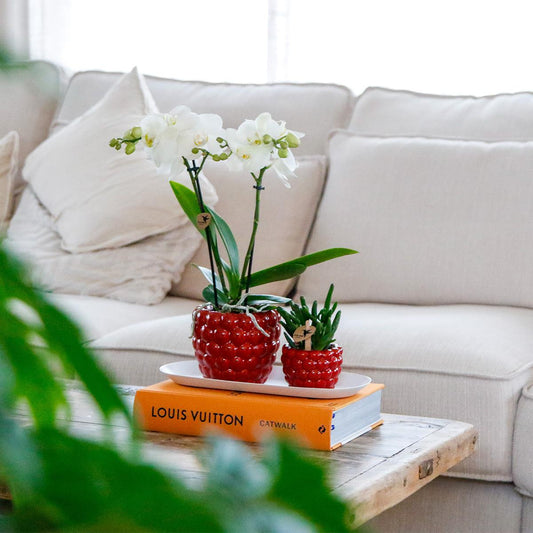
White Phalaenopsis Orchid (Phalaenopsis) – Set with Rhipsalis on a bamboo tray
Regular price 74,95 €Regular price -
-



✂️ Everyday Tillandsia care
Caring for an air plant follows a simple cycle: soak thoroughly, then dry thoroughly. The RHS emphasizes drying between waterings, which it considers very important for the plant's health, as well as good ventilation.
Its guide says that misting between soaks can help limit dehydration, but notes that it does not provide enough water on its own and must never replace soaking: soaking remains the basic method.
🔹 Soaking: From spring to fall, the RHS recommends immersing the plant an average of 2 to 3 times a week; Penn State also reports good results with a weekly soak lasting 20 minutes to 1 hour.
💧 Water: Rainwater is best: the RHS advises against tap water, especially hard water, because its dissolved salts precipitate on the trichomes and clog them.
🔹 Drying: Shake the plant and leave it to drain upside down, as NC State recommends for T. xerographica, to prevent crown rot.
🌱 Fertilizer: Once a month, use orchid or bromeliad fertilizer diluted to one-quarter strength (Penn State).
👀 Monitoring: Check the base of the rosettes: aphids and mealybugs are the pests cited by the RHS.
🍂 Watering Tillandsia through the seasons
Should you soak or mist a Tillandsia? We recommend soaking as the main method, since the RHS puts it at the heart of its watering advice and considers misting alone insufficient.
Penn State Extension describes other practices, which we mention without recommending them: misting until water runs off, sometimes every other day when indoor air is dry, or rinsing under the tap twice a week.
Our article misting: useful or not? explains that misting does not raise air humidity for long: for an air plant, a quick spray is only a small amount of water, never a substitute for soaking.
In winter, water less often: the RHS advises against watering when temperatures fall to 12°C, as the plant stays wet for too long, and NC State Extension reduces soaking T. xerographica to once a month.
📅 Seasonal care calendar
| Season | Key task |
|---|---|
| 🌸 Spring | Resume soaking in rainwater, apply diluted fertilizer, detach offsets once they are large enough |
| ☀️ Summer | Soak regularly, move outdoors in partial shade if desired, flowering depending on the species |
| 🍂 Fall | Space out soaks, bring indoors before chilly nights, gradually stop fertilizing |
| ❄️ Winter | Soak rarely, dry quickly, keep in a bright room above 12°C |
🌱 Flowering and offsets: how to propagate a Tillandsia
Will a Tillandsia bloom again? Not from the same rosette: Penn State Extension and the RHS explain that it flowers only once in its lifetime, then produces offsets (pups) at its base before declining. RHS profiles for T. ionantha and T. xerographica indicate that they take 5 to 10 years to reach maturity.
Wait until an offset is one-third the size of the mother plant before detaching it, then care for it like a mature plant. You can also leave the offsets in place to form a clump. Growing from seed is possible but slow: the RHS grows seedlings at around 25°C and keeps them in these conditions for 2 years.
🐛 Common problems: causes and solutions
A Tillandsia that turns brown, dries out, or loses its leaves is almost always reacting to a problem with water, drying, or heat. Here are symptoms described by the RHS, their likely causes, and how to fix them. If the rosette is soft and black in the center, also read our guide rot: causes and how to save your plant.
| Symptom | Likely cause | Solution |
|---|---|---|
| Brown or black center or leaves | 🍄 Rot: water sitting in the center and stagnant air | Shake after every soak, dry upside down, and improve ventilation |
| Leaves drying out | ☀️ Dehydration: soaks too infrequent, heat, dry air | Soak overnight, then soak more often (RHS) |
| Plant declining despite regular soaks | 💧 Hard tap water, whose salts clog the trichomes (RHS) | Switch to rainwater or low-mineral water |
| Lower leaves falling off | 🍄 Stress after a change in environment or watering, sometimes the start of rot | Keep its location stable and check the base of the rosette |
| Brown or discolored leaves | ☀️ Overheating in direct sun behind glass, dry air | Provide more shade and increase ambient humidity |
| Cottony clumps, insects, or chewed leaves | 🐛 Mealybugs, aphids, slugs outdoors | Remove insects, isolate the plant, and watch for slugs in summer |


🌸 Our Tillandsia varieties
Here are the Tillandsias most sought after in France, with characteristics verified against Kew and RHS sources. We do not sell live Tillandsias; the only product in our range from this genus is dried Tillandsia usneoides, sold as decorative moss: it is no longer living and is used only in arrangements.
| Variety | What makes it special |
|---|---|
| Tillandsia ionantha | Small rosette with leaves up to 6 cm long, ranging from silvery gray to green; violet-blue flowers with yellow stamens in spring and summer (RHS), native to Mexico and Central America (POWO) |
| Tillandsia xerographica | Nicknamed the king of air plants by the RHS: silvery-gray rosette with curled leaves, 0.5 to 1 m tall and wide, flower spike up to 40 cm long |
| Tillandsia usneoides (Spanish moss) | Rootless epiphyte when mature (NC State), forming strands around 2.4 m (8 feet) or longer according to UF IFAS; neither a moss nor a parasite |
| Tillandsia aeranthos | Narrow gray-green leaves and small, dark blue flowers emerging from pink bracts in summer (RHS) |
| Tillandsia cyanea (Wallisia cyanea) | Nicknamed pink quill by the RHS, often sold in pots; dark green leaves up to 35 cm long, purple flowers on pink bracts in spring or autumn (RHS). POWO now lists this name as a synonym of Wallisia cyanea |
🎨 Which plants go well with a Tillandsia?
Tillandsias pair well with other epiphytes that enjoy filtered light and good air circulation. Its closest relative among the plants in our guides is the bromeliad (Guzmania, Aechmea, pineapple plant), from the same Bromeliaceae family. It also absorbs water through its leaves, but stores it in the vase-shaped center of its rosette.
Rhipsalis, a trailing epiphytic cactus, makes a perfect hanging companion. Orchids share its preference for soft water and drying out between waterings: see our complete orchid care guide, as well as the zigzag cactus, another forest plant.
For a glass arrangement, choose an open container: our guide to plants for closed or open terrariums will help you choose the right jar, and our article terrariums: humidity and condensation explains why a closed jar stays too humid for a plant that needs to dry out.
Finally, browse our easy-care plants, hanging plants, bathroom plants, and all our houseplants.
⚠️ Are Tillandsias toxic to cats and dogs?
We couldn't find an ASPCA (American Society for the Prevention of Cruelty to Animals) profile specifically for Tillandsia, and the RHS, NC State, and Penn State profiles we consulted do not report any toxicity.
The ASPCA classifies another bromeliad, Neoregelia (blushing bromeliad), as non-toxic to dogs and cats, but this assessment does not cover the Tillandsia genus. To be safe, keep the plant out of reach: a cat that chews on it will damage it anyway.
Consult a veterinarian if your pet shows any unusual symptoms after eating a plant. For plants whose safety has been documented species by species, see our list of non-toxic plants for cats.
✅ Our expert tips for success
Three simple steps are key to a thriving Tillandsia: soak it in rainwater rather than misting it, let it dry completely upside down, and give it bright, filtered light at temperatures above 12°C. If in doubt, check the center of the rosette (too much water), then the leaf tips (not enough water). After flowering, don't throw anything away: the offsets will carry it on.
For a long time, like many people, I thought an air plant lived on air and the occasional spritz. It was only when I switched to soaking it in rainwater, followed by proper drying, that I saw my rosettes perk up again. And when the first one blooms, I recommend smiling rather than worrying: it means offsets are on the way.

Laura Bruneau
Jardinière & autrice