Rhipsalis (mistletoe cactus): care, watering, propagation and varieties

To care for a Rhipsalis, place it in bright but indirect light, plant it in an airy mix for epiphytic cacti, and water it moderately as soon as the top of the potting mix is dry, keeping it just moist in winter.
Nicknamed mistletoe cactus, coral cactus, or spaghetti cactus, Rhipsalis (Rhipsalis baccifera is the most common species) is a forest cactus: it grows attached to branches, not in desert sand. That is why it is just as sensitive to scorching sun and prolonged drought as it is to excess water.
This guide draws on Kew, the RHS (Royal Horticultural Society), NC State Extension (North Carolina State University), and the ASPCA. You’ll find information on light, propagation, diagnosing damaged stems, and choosing species.
🌿 Why choose a Rhipsalis?
Rhipsalis has a striking trailing habit: cascades of slender stems without aggressive spines, perfect for dressing up a hanging planter or the top of a shelf. Depending on the species, the stems are cylindrical, chain-like, or flattened, making it easy to build a whole collection. It flowers indoors in winter or spring, then produces small decorative berries.
It is also safe for pets—a real advantage for a plant cats love to paw at.
| Benefit | What it means for your home |
|---|---|
| Trailing habit and no spines | Green cascades for a hanging planter or high shelf, with no risk of getting pricked |
| Non-toxic to pets | Classified as non-toxic to dogs and cats by the ASPCA |
| Flowers indoors | Small white flowers in winter or spring, followed by white or pinkish berries |
| Very easy to propagate | A stem segment roots without any special equipment in spring or summer |
🔎 Rhipsalis at a glance
According to Kew (Plants of the World Online, genus Rhipsalis), the genus Rhipsalis Gaertn. comprises about 45 accepted species native to tropical and subtropical America, tropical and southern Africa, the western Indian Ocean islands, and Sri Lanka.
The POWO profile for Rhipsalis baccifera describes it as an epiphytic or lithophytic succulent (growing on trees or rocks) and lists Rhipsalis cassytha among its synonyms.
A study published in Scientific Reports (Correa-Cano et al., 2018) notes that R. baccifera is the only cactus species naturally found in Africa and Sri Lanka.
NC State Extension adds that it is also native to Florida, where it is classified as endangered, and that it can grow to about 9 m (30 feet) long in the understory trees. Finally, the RHS describes green to bluish-green stems reaching a maximum length of 2.5 to 4 m.
| Feature | Verified details |
|---|---|
| 🏷️ Botanical name | Rhipsalis Gaertn. (genus); key species Rhipsalis baccifera (J.S.Muell.) Stearn, synonym R. cassytha |
| 🧬 Family | Cactaceae |
| 🌳 Type | Epiphytic or lithophytic cactus, perennial evergreen |
| 🌍 Origin | Tropical America, tropical and southern Africa, western Indian Ocean islands, Sri Lanka (POWO) |
| 🍃 Foliage | No leaves: fine green stems that are cylindrical, chain-like, or flattened, depending on the species |
| 🌸 Flowering | Small white funnel-shaped flowers in winter and spring, followed by white to pinkish berries |
| 📏 Size | Trailing stems measuring 1.2 to 1.8 m according to NC State, up to 2.5 to 4 m according to the RHS |
| ⚠️ Toxicity | Non-toxic to dogs, cats, and horses (ASPCA, NC State) |
📋 Quick care guide
The essential growing guidelines, all in one place.
| Care requirement | Guideline |
|---|---|
| Light | Bright and indirect; gentle morning sun, no hot afternoon sun |
| Watering | Moderately while growing, as soon as the top of the potting mix is dry; just moist in winter |
| Potting mix | Mix for epiphytic cacti, airy and free-draining, acidic pH (below 6) |
| Humidity | High: use a tray of damp pebbles or group plants together |
| Temperature | RHS H1b: minimum 10 to 15°C; ideally around 16 to 27°C |
| Repotting | In spring, only when the roots fill the pot |
| Fertilizer | Diluted, low-nitrogen liquid fertilizer once a month while growing |
| Toxicity | Non-toxic to dogs, cats, and horses (ASPCA) |
| Difficulty | Easy, as long as you treat it like a forest plant |
📍 Where to place a Rhipsalis and when to bring it home?
Place Rhipsalis near a bright window, protected from hot sun: for R. paradoxa, the RHS recommends bright indirect light, a little morning sun, and afternoon shade. NC State Extension classifies it as a partial-shade plant, receiving between 2 and 6 hours of direct sun a day.
In the wild, it grows beneath the canopy: filtered light suits it better than an unshaded south-facing window.
📍 Ideal location: hanging in front of an east-facing window, or set back a little from a west- or south-facing window; a bright bathroom also provides the humidity it likes.
🕰️ Best time: in spring or summer, when the plant is growing; this is also the season for stem cuttings, according to the RHS.
🌳 Outdoors in summer: the RHS H1b rating permits summering it outdoors in a warm, sheltered spot in partial shade; bring it inside before nighttime temperatures drop below 10 to 15°C.
🪴 How to repot a Rhipsalis step by step
The RHS recommends compost for epiphytic cacti: a richer, airier mix than desert cactus potting soil, similar to orchid mix. NC State Extension specifies that it prefers acidic soil (pH below 6), which is sandy and very well drained.
A small pot with drainage holes is enough: too much soil will hold water for too long.
| Step | What to do |
|---|---|
| 1. Prepare | Water lightly the day before so the root ball slips out without breaking the stems, which are fragile at the base. |
| 2. Choose a pot | Choose one only slightly wider, with a drainage hole; a hanging planter lets the stems trail freely. |
| 3. Prepare the potting mix | Use a mix for epiphytic cacti, or light potting soil mixed with fine bark and perlite. |
| 4. Repot | Set the root ball at the same level as before and fill around it without compacting, to keep the mix airy. |
| 5. Water | Wait a few days, then water moderately and allow it to drain thoroughly. |
columns: 4
columns_mobile: 2
-

 Livraison offerte Sold out
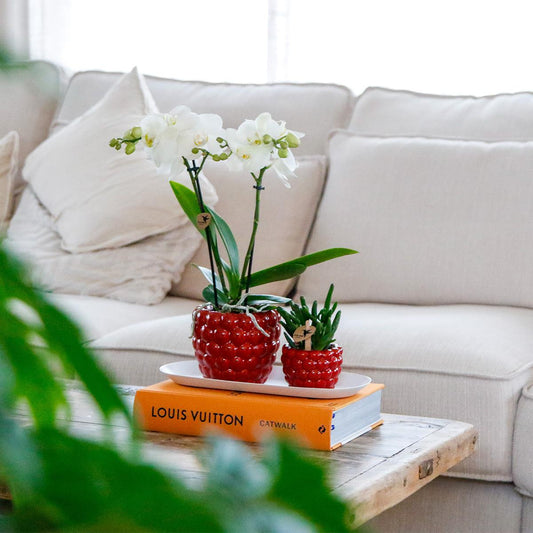
White Phalaenopsis Orchid (Phalaenopsis) – Set with Rhipsalis on a bamboo tray
Regular price 74,95 €Regular price -
-

 Sold out
-




✂️ Everyday Rhipsalis care
Caring for Rhipsalis comes down to one idea: it’s a cactus, but a humid forest cactus. The RHS advises watering moderately during the growing season and keeping the potting mix just moist in winter; NC State Extension recommends watering when the surface of the potting mix is dry, without overdoing it, since standing water causes root rot.
💧 Watering: Check the potting mix by touch: water as soon as the top is dry, using soft or rainwater if possible, then empty the saucer.
💧 Humidity: The high humidity it likes is best provided by a tray of damp pebbles or by grouping plants together, rather than by misting.
🌱 Fertilizer: Apply diluted, low-nitrogen liquid fertilizer once a month during the growing season, as recommended by the RHS.
✂️ Pruning: Shorten stems that are too long or dry in spring; keep healthy segments to propagate.
👀 Check for pests: Inspect the branching stems: mealybugs (RHS), spider mites, and aphids (NC State) can settle there.
🍂 Watering Rhipsalis through the seasons
When should you water Rhipsalis? From spring to late summer, water as soon as the top of the potting mix is dry, without following a fixed schedule: how often you water depends on the light, the pot, and the room temperature. It needs more water than a desert cactus: the RHS recommends moderate watering while it’s growing, not infrequent watering. Water less often in fall.
In winter, the RHS advises keeping the potting mix just moist, and keeping it above the H1b threshold of 10 to 15°C: this is also when flowers often appear, described by NC State as about 1 cm across.
📅 Seasonal care calendar
| Season | Key task |
|---|---|
| 🌸 Spring | Repot if needed, take stem cuttings, resume moderate watering and fertilizing |
| ☀️ Summer | Water as soon as the top is dry, apply diluted fertilizer once a month, move outdoors if sheltered |
| 🍂 Fall | Water less often, stop fertilizing, bring indoors before chilly nights |
| ❄️ Winter | Keep the potting mix just moist, in a bright room at a minimum of 10 to 15°C; expect flowers and berries |
🌱 How to propagate Rhipsalis from cuttings
Stem cuttings are the easiest way to propagate Rhipsalis: the RHS says it can be grown from seed at 19 to 24°C or from stem cuttings in spring and summer. Cut a healthy segment a few centimeters long with a clean tool, then leave the cut end to dry and callus in the air, in the shade, for a few days.
Then insert it just barely into slightly moist potting mix for epiphytic cacti, in bright light away from direct sun. Water propagation also works, but transferring the cutting to soil is more challenging; compare the two approaches in our guide to propagating in water or potting mix.
For a fuller hanging planter, place several cuttings in the same pot.
🐛 Common problems: causes and solutions
A Rhipsalis that turns yellow, goes soft, or dries out is almost always signaling an issue with watering, light, or temperature. Here are the most common symptoms, their causes as documented by the RHS and NC State Extension, and how to correct them. If the stems are soft at the base, follow our guide to root rot: causes and how to save your plant.
| Symptom | Likely cause | Solution |
|---|---|---|
| Soft, yellow, or brown stems at the base | 🍄 Overwatering, root rot | Let the potting mix dry, remove the plant from its pot, cut off black roots, and repot in fresh mix; see our root rot guide |
| Wrinkled, dull stems that are drying out | ⚠️ Prolonged thirst or air that is too dry | Water thoroughly, let it drain, then add a tray of damp pebbles |
| Yellowed or discolored stems on the window side | 💧 Too much hot, direct sun | Move the plant farther back or use a sheer curtain in the afternoon |
| Pale, long, spindly shoots | ☀️ Not enough light | Move it closer to a bright window, away from scorching sun |
| White, cottony clusters on the stems | 🐛 Mealybugs | Remove them with a cotton swab dipped in alcohol, isolate the plant, and check it weekly |
| Fine webbing, speckled stems | ⚠️ Spider mites, encouraged by dry air | Rinse the stems, increase ambient humidity, and keep an eye on the plant |


🌸 Rhipsalis varieties
Here are the Rhipsalis varieties most sought after in France, with verifiable botanical details, including our arrangements. The Kolibri Greens set of 2 Rhipsalis in silver ceramic pots, 9 cm in diameter, is also in our catalog, but is not currently available online.
| Variety | What makes it special |
|---|---|
| Rhipsalis baccifera (mistletoe cactus) | Fine cylindrical stems and white to pinkish berries; often sold as R. cassutha, a spelling close to R. cassytha, a synonym recognized by POWO and the RHS |
| Rhipsalis paradoxa | Nicknamed chain cactus; small white flowers along the stems from late winter to early spring (RHS) |
| Rhipsalis pilocarpa | Bushy growth, stems up to 45 cm, 4 cm white flowers followed by dark red berries (RHS) |
| Rhipsalis cereuscula | Known as rice cactus or coral cactus in English, native to South America |
| White Phalaenopsis and Rhipsalis set | A white orchid and a Rhipsalis arranged on a bamboo tray, two epiphytes with similar needs |
🎨 What plants go well with a Rhipsalis?
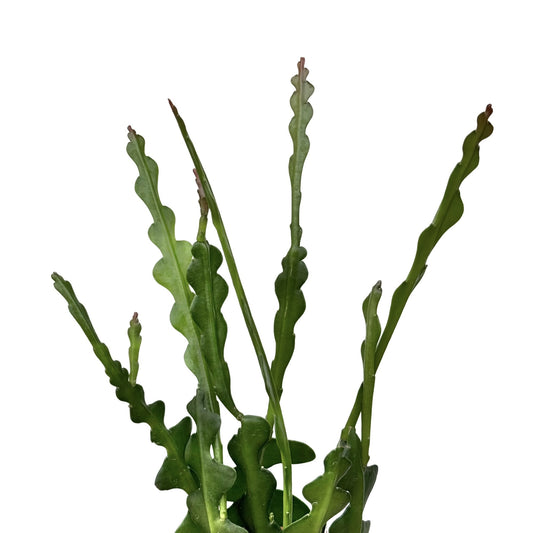
Rhipsalis shares its needs with other epiphytic plants that enjoy filtered light and an airy potting mix. Its closest cousin in our plant guides is the zigzag cactus, another epiphytic cactus. It pairs naturally with orchids, as in our set: check out our complete orchid care guide.
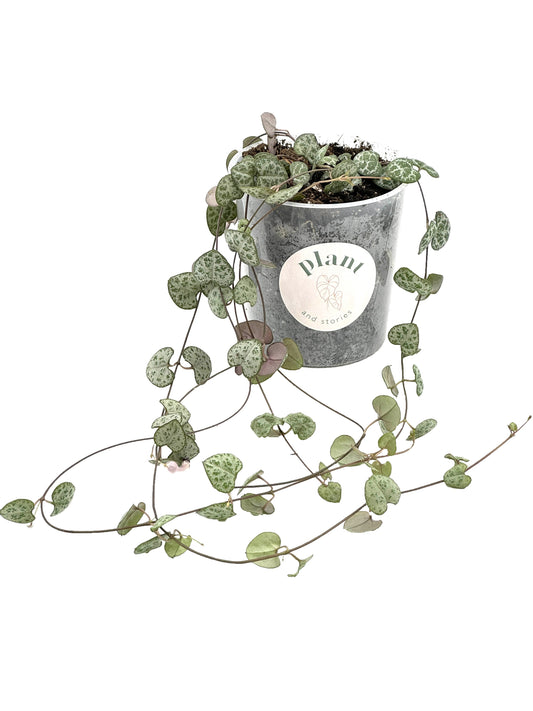
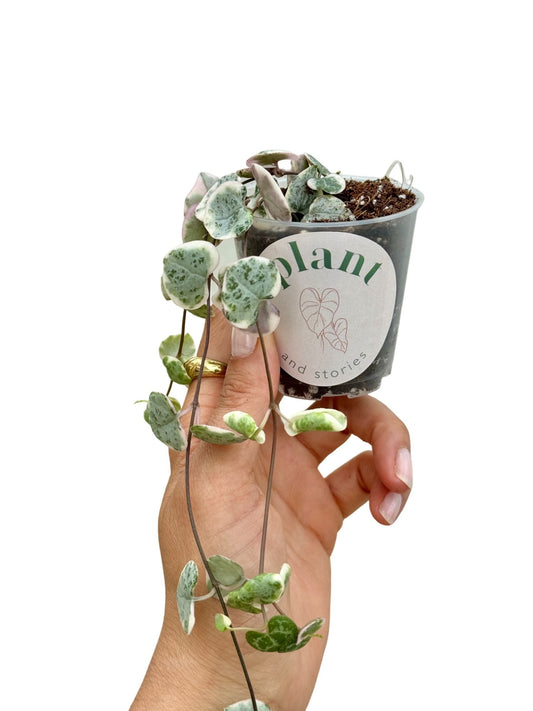
For a mixed hanging display, pair it with the string of hearts (Ceropegia woodii).
And if you’re unsure whether to choose a forest or desert cactus, read our cactus and succulent guide, then browse our hanging plants, cacti and succulents, and bathroom plants.
⚠️ Is Rhipsalis toxic to cats and dogs?
No, the available information is reassuring. The ASPCA (American Society for the Prevention of Cruelty to Animals) lists mistletoe cactus, under the name Rhipsalis cassutha, as non-toxic to dogs, cats, and horses. NC State Extension also lists it as non-toxic to these three animals in its Rhipsalis baccifera profile.
These assessments apply to mistletoe cactus; we couldn’t find a dedicated profile for other species in the genus. A cat chewing on its stems will mainly damage the plant: hang it out of reach, and consult a veterinarian if your pet shows any unusual symptoms after eating a plant.
✅ Our expert tips for success
Three things make for a thriving Rhipsalis: bright light without harsh sun, a well-draining potting mix for epiphytic cacti, and moderate watering once the top layer is dry. If anything seems off, check the base of the stems first (watering), then their color (light). Keep it above 10–15°C (50–59°F) in winter, and propagate stem segments to make the hanging plant fuller.
Rhipsalis is the plant I give to people who think all cacti look alike: it always surprises them. I care for it more like my orchids than my cacti, and that shift in perspective makes all the difference. When its little flowers and then berries appear in the middle of winter, you understand why it’s called mistletoe cactus.

Laura Bruneau
Jardinière & autrice