Ceropegia woodii (String of Hearts): care, propagation and varieties

To care for a Ceropegia woodii, place it in bright light with some gentle sunlight, plant it in a cactus mix, and only water when the soil is completely dry, reducing watering significantly in winter. Nicknamed string of hearts or chain of hearts, this plant behaves like a succulent: its fleshy leaves and large tuber at the base store water.
This is why it forgives neglect but not overwatering. This guide draws on Kew, the RHS (Royal Horticultural Society), NC State Extension (North Carolina State University), and the University of Wisconsin. You will find the right exposure, tuber propagation, the diagnosis of bare stems, and the choice between our varieties.
🌿 Why choose a string of hearts?
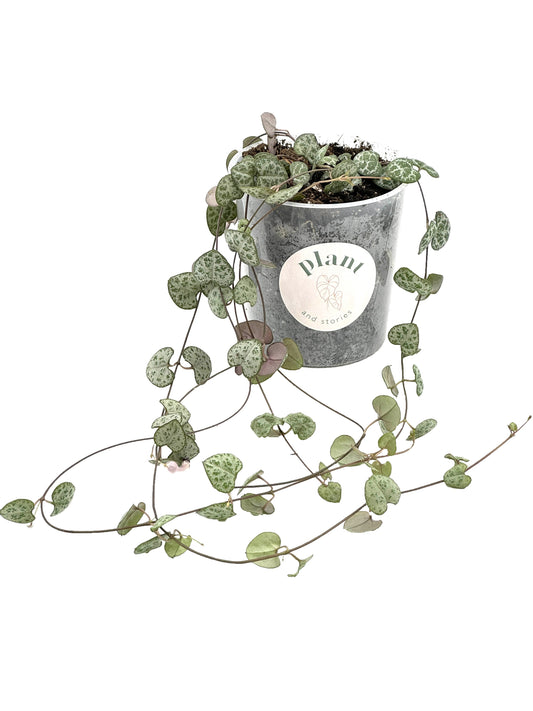
The string of hearts is one of the most graphic trailing plants: its threadlike, almost invisible stems seem to string small hearts marbled with silver like beads on a thread. It takes up very little floor space and dresses up a high shelf, a windowsill, or a hanging basket.
Its nature as a succulent makes it low-maintenance in terms of watering, and its rapid growth quickly rewards beginners. Finally, it almost propagates itself thanks to its aerial tubers, ideal for filling out the pot or offering cuttings.
| Asset | What it changes in your home |
|---|---|
| Very fine trailing habit | Garlands of heart-shaped leaves hanging down a shelf or hanging basket |
| Tolerates missed watering | Its fleshy leaves and basal tuber store water for several weeks |
| Ultra-easy propagation | Aerial tubers root as soon as they touch a substrate |
| Original flowering | Small lantern-shaped flowers, from summer to autumn, for an indoor plant |
🔎 The ID card of the Ceropegia woodii
According to Kew (Plants of the World Online, Ceropegia woodii), Ceropegia woodii is an accepted name, in the family of Apocynaceae: it is a tuberous climbing geophyte, originating from an area ranging from Zimbabwe to South Africa (SANBI, the South African National Biodiversity Institute, also lists it in Mozambique and Eswatini).
The RHS lists it as Ceropegia linearis subsp. woodii, a name you will also encounter in garden centers. The University of Wisconsin describes heart-shaped leaves 1 to 2 cm long, dark green marbled with silver on top and green to purple underneath.
Its waxy lantern-shaped flowers bear small downward-facing hairs that temporarily hold small flies attracted by their scent, according to the same source: this is how they are pollinated.
| Criterion | Verified detail |
|---|---|
| 🏷️ Botanical name | Ceropegia woodii (accepted name by POWO); treated as Ceropegia linearis subsp. woodii by the RHS |
| 🧬 Family | Apocynaceae, subfamily Asclepiadoideae |
| 🌳 Type | Trailing or climbing succulent perennial, with basal tuber and aerial tubers |
| 🌍 Origin | From Zimbabwe to South Africa (POWO), also Mozambique and Eswatini (SANBI) |
| 🍃 Foliage | Heart-shaped leaves 1 to 2 cm long, dark green marbled with silver, green to purple underside |
| 🌸 Flowering | Tubular lantern-shaped flowers about 2.5 cm, white to purple-pink, summer and autumn |
| 📏 Size | About 10 cm tall; trailing stems 0.5 to 1 m in pot (RHS), up to 90 cm according to NC State |
| ⚠️ Toxicity | No toxicity reported by the sources consulted; no ASPCA sheet |
📋 Quick technical sheet
The essential care points, gathered at a glance.
| Parameter | Guideline |
|---|---|
| Light | Bright, with a little gentle direct sun (morning or evening); shade = bare stems |
| Watering | Only on completely dry substrate; very reduced in winter |
| Substrate | Cactus potting mix, sandy and draining, acidic to neutral pH |
| Humidity | Sufficient ambient indoor air, no misting necessary |
| Temperature | RHS H1c, not hardy; 15 °C minimum in winter for good comfort |
| Repotting | In spring, pot barely larger and with drainage holes; terracotta recommended |
| Fertilizer | Low-nitrogen fertilizer diluted by half, 2 to 3 times in season at most |
| Toxicity | Not reported by RHS, NC State, Wisconsin; out of reach as a precaution |
| Difficulty | Easy, if you resist the urge to water |
📍 Where to place a string of hearts and when to plant it?
Place the string of hearts near a very bright window: NC State Extension requires bright indirect light and states that a lack of light spaces out the leaves along the stems. In South Africa, SANBI (South African National Biodiversity Institute) even recommends a few hours of direct sun per day for indoor cultivation.
So gentle morning or evening sun suits it, but scorching summer sun behind glass can burn the foliage.
📍 Ideal location: in front of an east or west-facing window (orientations cited by the RHS), or near a south-facing bay window with a sheer curtain in summer; a hanging basket in front of the glass is perfect.
🕰️ Best time: spring or early summer, when the plant resumes its growth: this is also the season for stem cuttings according to the RHS.
🧗 Trailing or climbing: let the stems hang from a high shelf, or wrap them around a small hoop for a fuller effect.
🪴 How to repot a Ceropegia woodii step by step
The RHS recommends a cactus potting mix: this is the most important point, because the roots and the basal tuber rot quickly in soil that remains moist. Repot in spring, only when the roots fill the pot: too large a volume of soil remains moist for too long.
A terracotta pot, which is more porous, helps the substrate dry out between waterings.
| Step | The right action |
|---|---|
| 1. Prepare | Let the root ball dry for a few days before unpotting: it comes out more easily and the roots break less. |
| 2. Choose the pot | Barely larger diameter, drainage hole essential, terracotta preferred. |
| 3. Prepare the substrate | Cactus potting mix, or lightened potting mix with lots of coarse sand and perlite. |
| 4. Install | Place the basal tuber at the same level as before, without burying it deeper, and untangle the stems. |
| 5. Wait | Wait a few days before the first light watering, to allow the damaged roots to heal. |
columns: 4
columns_mobile: 2
-
-
-
-

 Sold out
-

 Sold out




✂️ Daily care of the string of hearts
The care of a Ceropegia woodii boils down to lots of light and little water. NC State Extension recommends letting the substrate dry completely between waterings, and the University of Wisconsin reminds that the plant tolerates dry soil much better than waterlogged soil.
💧 Watering: Push a finger in: water thoroughly only if the substrate is dry throughout, then empty the saucer.
🌱 Fertilizer: The RHS recommends a low-nitrogen liquid fertilizer 2 or 3 times during growth; Wisconsin, at most once a month at half strength.
✂️ Pruning: Shorten stems that are too long or bare in spring and keep the pieces for cuttings.
🔹 Untangling: Gently separate the tangled stems during watering, to prevent them from breaking during the next move.
👀 Monitoring: Inspect the leaf axils: mealybugs, aphids, and shield bugs are the pests cited by the RHS.
🍂 Watering a string of hearts according to the seasons
When to water a string of hearts? From spring to the end of summer, water as soon as the substrate is dry throughout, without following a fixed calendar: the frequency depends on the light, the pot, and the heat of your room. In autumn, space them out gradually.
In winter, the plant slows down: the RHS advises keeping it dry outside the growing season, and NC State Extension reducing watering during this rest. Regarding temperature, the University of Wisconsin recommends staying above 15 °C in winter, and SANBI places its summer optimum between 25 and 30 °C.
📅 Care calendar by season
| Season | Key action |
|---|---|
| 🌸 Spring | Repotting if necessary, stem and tuber cuttings, gradual resumption of watering |
| ☀️ Summer | Watering on dry substrate, low-nitrogen fertilizer 2 to 3 times, flowering possible |
| 🍂 Autumn | Spacing out waterings, stopping fertilizer, tuber cuttings still possible in the heat |
| ❄️ Winter | Almost dry substrate, bright room at 15 °C minimum, away from cold drafts |
🌱 How to make a string of hearts cutting
The string of hearts cutting is one of the simplest there is, thanks to aerial tubers: these small potato-shaped balls form at the nodes, along the stems. NC State Extension indicates that an aerial tuber roots and produces a new plant as soon as the stem touches the soil.
Tuber method: place the stem on a small pot of cactus potting mix, press the tuber against the substrate, hold it with a pin and keep the substrate barely moist; cut the stem when new shoots appear.
Stem method: the RHS recommends 10 to 15 cm cuttings at the beginning of summer, in moist cactus potting mix, at 22 to 25 °C. The cutting in water also works; compare the two approaches in our guide cutting in water or potting mix.
🐛 Common problems: causes and solutions
A string of hearts that loses its leaves or becomes bare almost always sends a watering or light signal. Here are the most frequent symptoms, their causes documented by NC State Extension, the RHS, and the University of Wisconsin, and the corrective action.
| Symptom | Probable cause | Solution |
|---|---|---|
| Bare stems, very spaced out leaves | ☀️ Lack of light | Move the plant closer to a bright window with a little gentle sun, then prune the bare stems to propagate them |
| Yellow and soft leaves that fall | 🍄 Overwatering, beginning of root rot | Let dry completely, unpot and check the basal tuber; see our root rot guide |
| Wilting and wrinkled leaves | ⚠️ Prolonged thirst | Water thoroughly, let drain, then resume a rhythm on dry substrate |
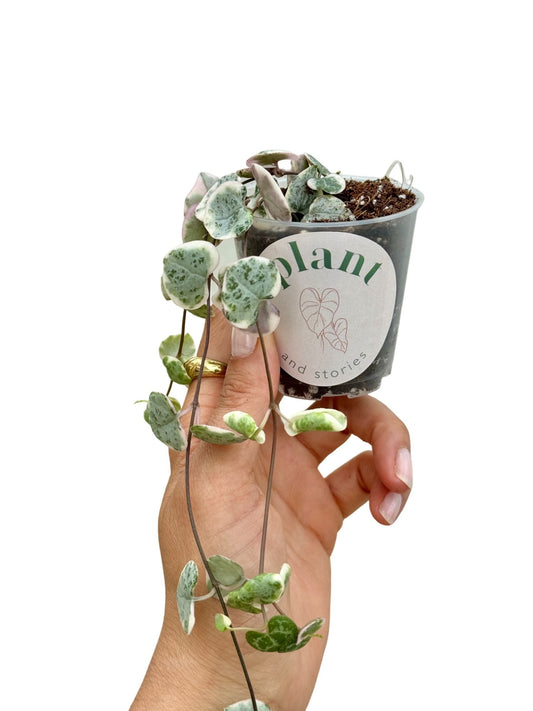
| Dull pink and cream variegation, solid green leaves | ☀️ Insufficient light for a variegated form | Offer more bright light; cut the stems that have become entirely green |
| White cottony clusters at the nodes | 🐛 Mealybugs | Remove them with cotton soaked in alcohol, isolate the plant and check every week |
| Burned leaves, dry spots | ☀️ Too strong summer sun behind the glass | Place a sheer curtain or move the hanging basket back a few dozen centimeters |


🌸 Our Ceropegia varieties
Here are the most cultivated forms of string of hearts, including the two we offer, with verifiable botanical details.
| Variety | Its asset |
|---|---|
| Ceropegia woodii (typical form) | Dark green leaves marbled with silver, the most vigorous and easiest to succeed |
| Ceropegia woodii 'Variegata' | Leaves variegated with cream and pink (f. variegata according to Wisconsin); the RHS links this name to the cultivar 'Lady Heart' |
| Ceropegia woodii 'Silver Glory' | Commercial selection with widely silvered foliage, for a luminous hanging basket |
| Ceropegia woodii 'Pink' | Trade name for forms with pink-edged or tinted leaves, close to 'Variegata' |
| Ceropegia sandersonii | Neighboring climbing species, accepted name on POWO, sought after for its large flowers; reserved for collectors |
🎨 With what plants to associate a string of hearts?
The heart-shaped vine shares its needs with plants that love light and infrequent watering. For a hanging display of trailing plants, it pairs well with the Hoya linearis, another cascading trailer. If you love heart-shaped leaves, discover the Hoya kerrii fact sheet, the heart plant.
And because it is grown like a succulent, our cactus and succulent guide will help you create a dry, bright corner. For the container, read terracotta or plastic pots and discover our hanging plants.
⚠️ Is the heart-shaped vine toxic to cats and dogs?
The data is reassuring but incomplete.
The heart-shaped vine (rosary vine in English) does not appear in our search of the ASPCA (American Society for the Prevention of Cruelty to Animals) database, neither as toxic nor non-toxic, and none of the fact sheets from the RHS, NC State Extension, or the University of Wisconsin report any toxicity.
Some websites claim it is non-toxic, while others say it contains oxalates, with no verifiable source in either case. As a precaution, place it out of reach: its trailing stems attract playful cats, and the ASPCA reminds us that ingesting any plant can cause digestive problems. If ingestion is followed by symptoms, contact your veterinarian or a veterinary poison control center.
✅ Our expert tips for success
A successful heart-shaped vine depends on three things: plenty of light, a cactus mix, and watering only when the soil is dry. At the first sign of weakness, first check the spacing between the leaves (light), then the firmness of the leaves and tuber (watering). Keep it above 15°C in winter and propagate its aerial tubers to fill out the pot.
The heart-shaped vine is the plant I recommend to those who overwater: it forces you to wait and observe. I like placing its tubers on the soil of the same pot to thicken the clump; it's the one thing that makes all the difference in a sparse hanging display. And the first time you discover its little lantern-shaped flowers, you look at it differently.

Laura Bruneau
Jardinière & autrice