

Calathea rufibarba (Goeppertia rufibarba): caring for the velvet calathea

To care for a Calathea rufibarba, give it bright, indirect light, a stable temperature of around 18–24 °C (64–75 °F) that never drops below 16 °C (61 °F), consistently moist but never waterlogged potting mix, preferably watered with rainwater, and humidity of 60% or higher.
These guidelines draw on the NC State Extension species profile (North Carolina State University) and the RHS guide to growing Calathea.
Its accepted botanical name is now Goeppertia rufibarba, and it is nicknamed the “velvet calathea” for its soft-to-the-touch leaves. This profile focuses on what sets it apart: identification, sensitivity to water and dry air, cultivars, and pets. For the care basics shared by the whole genus, our complete Calathea care guide remains the go-to reference.
🌿 How can you identify a Calathea rufibarba?
Its name says it all: “rufibarba” means “red-bearded.” The NC State Extension profile describes reddish hairs on the petioles, midrib, and undersides of the leaves; elongated leaves up to 10 inches (about 25 cm) long, carried on petioles about 20 cm long; wavy margins; and purple undersides.
The RHS describes its leaves as having a velvety texture, hence its nickname. Unlike Calathea makoyana, most often nicknamed the “peacock plant” for its painted patterns, rufibarba has no markings: all its charm lies in the texture and movement of its leaves.
Some retailer listings nevertheless call it a “peacock plant”: the Latin name is a more reliable guide.
| Feature | What it means for your home |
|---|---|
| Velvety foliage | Soft to the touch, thanks to the rusty hairs on the petioles, veins, and undersides—an invitation to reach out and touch it |
| Purple undersides | The wavy margins reveal the purplish underside: two colors on a single leaf |
| Upright, clumping growth | 60 to 90 cm tall and 30 to 60 cm wide according to NC State: a striking floor plant |
| Pet-friendly | Non-toxic to cats and dogs, making it a worry-free choice for homes with pets |
🔎 Calathea rufibarba at a glance
Here is the verified profile of the species. The accepted name, authors, dates, and origin come from Plants of the World Online (POWO), maintained by the Royal Botanic Gardens, Kew, which also notes its humid tropical habitat; the description, size, and flowering details come from NC State Extension.
The basionym Calathea rufibarba was published by Fenzl in 1879, and the species was transferred to the genus Goeppertia in 2012.
| Criterion | Verified details |
|---|---|
| 🏷️ Botanical name | Goeppertia rufibarba (Fenzl) Borchs. & S.Suárez (2012); common synonym: Calathea rufibarba Fenzl (1879) |
| 🧬 Family | Marantaceae, like Maranta, Stromanthe, and Ctenanthe |
| 🌳 Type | Tropical, rhizomatous, evergreen perennial with an upright, clumping habit |
| 🌍 Origin | Northeastern Brazil (state of Bahia), humid tropical biome |
| 🍃 Foliage | Elongated leaves up to about 25 cm long, with wavy edges, a velvety texture, purple undersides, and rusty hairs |
| 🌸 Flowers | Small orange or yellow flowers in spring and summer, rare indoors |
| 📏 Size | 60 to 90 cm tall, 30 to 60 cm wide (NC State, converted from feet) |
| ⚠️ Toxicity | Non-toxic to cats, dogs, and horses (ASPCA, Calathea spp.) |
📋 Quick care guide
The essential growing guidelines, all in one place.
| Parameter | Guideline |
|---|---|
| Light | Bright, indirect light: north- or east-facing window in summer, closer to a south-facing window in winter (RHS) |
| Watering | Keep the potting mix evenly moist from April to September; in winter, let the surface dry out without ever allowing the root ball to dry out |
| Water | Rainwater or distilled water (NC State); failing that, tap water left to stand for 24 hours (RHS), which loses its chlorine but not its fluoride |
| Growing medium | Peat-free potting mix that drains well but retains moisture, lightened with perlite |
| Humidity | 60% or higher according to NC State |
| Temperature | Around 18 to 24 °C (NC State); never below 16 °C and avoid sudden fluctuations (RHS) |
| Repotting | Every few years, in spring or summer, when the clump fills the pot |
| Fertilizer | Balanced liquid fertilizer once a month from April to September |
| Toxicity | Non-toxic to cats and dogs (ASPCA, NC State) |
| Difficulty | Moderate: particular about water, dry air, and stability |
📍 Where should you place your Calathea rufibarba, and when?
The ideal spot combines bright light, no direct sun, and steady warmth. NC State notes that direct sunlight can scorch the leaves, while the RHS recommends avoiding temperature fluctuations. Buy or repot it in spring, when growth resumes, and avoid moving it in the middle of winter.
☀️ Light: near a north- or east-facing window in summer; in winter, move it closer to a south-facing window, keeping it behind a sheer curtain
🌡️ Conditions: a room at around 18 to 24 °C, away from radiators, entry doors, and air-conditioning vents
📅 Timing: buy, position, and repot it in spring or summer; keep it in one spot afterward
🪴 Repotting Calathea rufibarba: the right way
Rufibarba forms a clump from rhizomes that like moisture but not standing water.
The RHS recommends peat-free potting mix that drains well but retains moisture, a pot just one or two sizes larger than the root ball, and repotting every few years in spring or summer, once the clump has filled the pot. NC State suggests lightening the mix with perlite or vermiculite.
Our 17 cm potted plant can therefore stay in its container for several seasons before needing a larger one.
| Step | What to do |
|---|---|
| 1. Choose a pot | Use a pot with drainage holes, one or two sizes larger than the root ball (RHS), no more |
| 2. Prepare the mix | Peat-free houseplant potting mix, lightened with a handful of perlite |
| 3. Remove it gently | Loosen the roots around the outer edge; remove any that are soft or brown |
| 4. Replant at the same depth | Keep the crown at the same height, without burying the bases of the petioles |
| 5. Water with soft water | Water with rainwater, let it drain, then empty the saucer |
columns: 4
columns_mobile: 2
-

 Livraison offerte
Calathea Rufibarba - 17cm Pot - Height 55-60cm
Regular price From 49,95 €Regular price49,95 €From 39,96 €Livraison offerte -

 Sold out
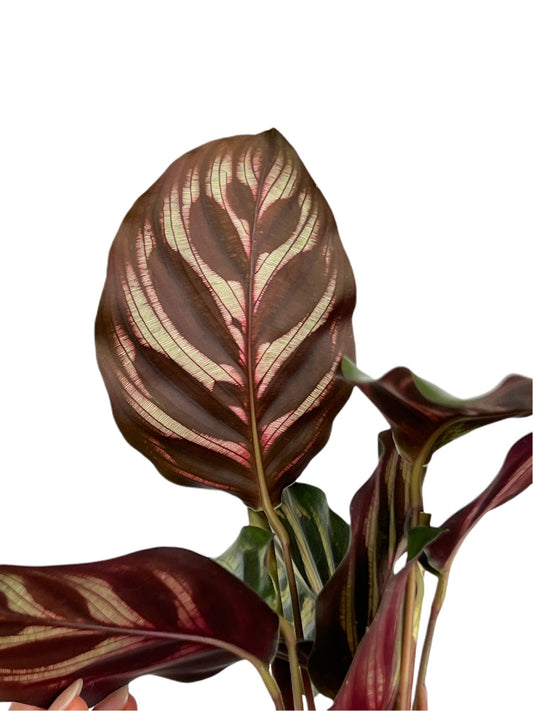
Calathea Makoyana
Regular price From 7,95 €Regular price7,95 €From 6,36 €Sold out -
-

 Livraison offerte
Calathea Crocata - 14cm Pot - Height: 40 - 45cm
Regular price From 49,95 €Regular price49,95 €From 39,96 €Livraison offerte




✂️ Everyday Calathea rufibarba care
Rufibarba is more sensitive than most Calathea to water quality and dry air. NC State recommends distilled water or rainwater, as fluoride in tap water causes leaf edges to turn brown.
Avoid misting: it is not very effective and leaves marks on this velvety foliage. Our article Misting: useful or not? explains why.
💧 Watering: Keep the potting mix evenly moist from April to September; in winter, wait until the surface dries out
💧 Water quality: Use rainwater or distilled water; tap water left to stand for 24 hours, which the RHS considers acceptable, loses its chlorine but retains the fluoride implicated by NC State
💧 Humidity: Place a tray of moist pebbles or clay pebbles under the pot, group plants together, or put it in a bright bathroom
🌱 Fertilizer: Apply balanced liquid fertilizer once a month from April to September; none in winter
🧹 Cleaning: Dust with a soft brush or a dry hand; do not use leaf shine or a wet sponge on the velvety leaves
🍂 Leaves curling, closing, or turning brown: what’s going on?
This is the most common question about rufibarba. If the leaves rise and fold in the evening, then open in the morning, all is well: the RHS notes that many Calathea, like the rest of the Marantaceae family, display nyctinasty—a movement in which the leaves fold upward at night, like praying hands.
If they stay curled during the day, check the root ball first: in our experience, the most common causes are potting mix that has become too dry or air dried out by heating. According to the RHS, brown tips and edges are caused by air that is too dry; NC State also points to fluoride in tap water.
In winter, the RHS also notes edema: water-soaked-looking spots that appear when the potting mix stays too wet.
📅 Seasonal care calendar
| Season | Key task |
|---|---|
| 🌸 Spring | Growth resumes; repot or divide if the clump fills the pot; start fertilizing again in April |
| ☀️ Summer | Keep the potting mix evenly moist, fertilize monthly, boost humidity, and watch for spider mites |
| 🍂 Fall | Water less often, apply the last fertilizer in September, and provide as much light as possible without direct sun |
| ❄️ Winter | Let the potting mix surface dry between waterings, keep above 16 °C, and place away from radiators |
🌱 Propagating Calathea rufibarba by division
Rufibarba cannot be propagated from stem cuttings; it is propagated by dividing its rhizomatous roots, as NC State notes. The RHS recommends dividing in spring by cutting the root ball into several sections, each with several leaves. Pot each division in a small pot of peat-free mix, water with soft water, and place somewhere warm with indirect light and humid air.
One or two leaves may wilt while the plant establishes: this is normal as long as new shoots appear. Avoid dividing a small clump—a division that is too small will struggle to establish.
🐛 Common problems: causes and solutions
Most rufibarba problems stem from water, dry air, or cold. NC State lists spider mites, mealybugs, aphids, and scale insects among its pests, and root rot as a risk when overwatered; the RHS also mentions fungus gnats. For humidity, see our guide to increasing air humidity.
| Symptom | Likely cause | Solution |
|---|---|---|
| Brown tips and edges | 💧 Air too dry (RHS) or fluoride in tap water (NC State) | Use rainwater, set the pot on a tray of moist pebbles, and move it away from radiators |
| Leaves curled during the day | 💧 Potting mix too dry or air dried out | Check the root ball with your finger, water with soft water, and increase humidity |
| Yellow leaves, soft base | 🍄 Overwatering and root rot (NC State) | Let the surface dry, empty the saucer, and check the roots if they are brown |
| Water-soaked spots in winter | 💧 Edema caused by overly wet potting mix (RHS) | Water less often in winter and keep the plant above 16 °C |
| Dry, discolored spots | ☀️ Direct sun scorching the foliage (NC State) | Move the plant farther from the window or filter the light with a sheer curtain |
| Fine webbing, dull leaves | 🕷️ Spider mites, encouraged by dry air | Rinse the undersides of the leaves with lukewarm water and increase ambient humidity |


🌸 Calathea rufibarba varieties and related plants
NC State lists several Goeppertia rufibarba cultivars: 'Blue Grass', 'Wavestar', 'Tropistar' and, in the Color Full series, Elger Grass, Soft Kitty, and Xena. Here are the most distinctive ones, our rufibarba available in store, and two relatives for comparison. The details for each cultivar below are based on NC State’s descriptions.
| Variety | What makes it special |
|---|---|
| Calathea rufibarba, 17 cm pot | Plant about 55 to 60 cm tall, with wavy leaves and purple undersides, ready to place on the floor or a low piece of furniture |
| Calathea rufibarba 'Blue Grass' | According to NC State: compact, up to 1.5 feet (about 45 cm) tall, with fuzzy blue-green leaves and wavy edges |
| Calathea rufibarba 'Wavestar' | According to NC State: up to 2 feet (about 60 cm) tall, with narrow, light-green leaves |
| Calathea rufibarba Elger Grass | Part of the Color Full series according to NC State: dark green, lance-shaped leaves, burgundy stems, and velvety hairs; the series also includes Soft Kitty and Xena |
| Calathea makoyana | Often nicknamed the “peacock plant,” its graphic counterpoint is velvet: see our makoyana profile |
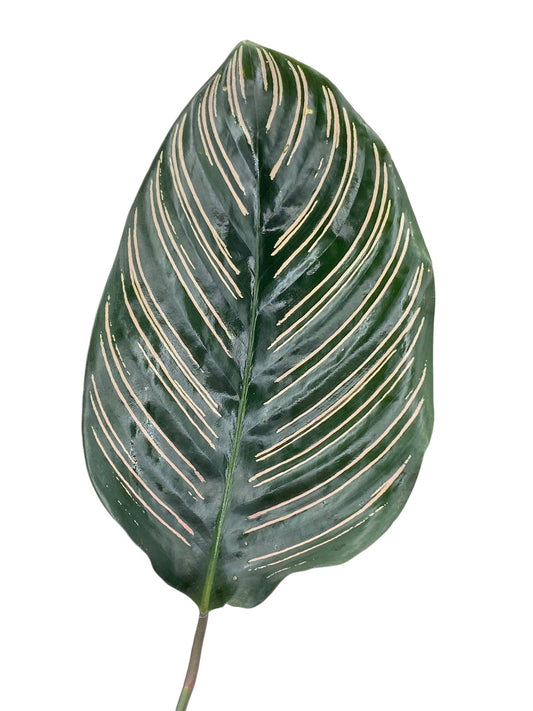
| Calathea ornata | Smooth, glossy leaves striped with pale pink (NC State), for a contrasting duo: see our ornata profile |
🎨 Which plants pair well with Calathea rufibarba?
Rufibarba shares its needs with other members of the prayer plant family: indirect light, stable warmth and humid air. Grouping these plants together helps maintain local humidity, as the RHS points out.
Its plain velvet stands out beside a Calathea ornata with fine pink stripes, a Calathea crocata with orange flowers, or a Maranta, or prayer plant. For an all-velvet duo, place it near a Calathea warscewiczii, which is taller and has a velvety purple underside.
For a completely pet-safe corner, browse our pet-friendly plants collection.
⚠️ Is Calathea rufibarba toxic to cats and dogs?
No. The ASPCA (American Society for the Prevention of Cruelty to Animals) classifies Calathea (Calathea spp.) as non-toxic to dogs, cats and horses. NC State also indicates that Goeppertia rufibarba is non-toxic to both cats and dogs.
If a page claims it contains toxic calcium oxalates, note that neither the ASPCA nor NC State supports this. A cat chewing the leaves will mainly damage the plant; if symptoms occur, consult your veterinarian.
Our article Is Calathea safe for pets? and our list of non-toxic plants for cats go into more detail.
✅ Our expert tips for success
Keep three simple steps in mind to help your Calathea rufibarba thrive. First, give it a bright spot out of direct sunlight, at around 18–24°C and never below 16°C, and leave it there. Next, use soft water, preferably rainwater, to keep the potting mix moist without waterlogging it. Finally, maintain humid air with a pebble tray or by grouping plants together to prevent brown tips.
For everything you need to know about the genus, see our Calathea guide.
Rufibarba is the Calathea you find yourself stroking as you walk past without thinking: its russet velvet is always a surprise. The most common issue I see is brown tips after a few weeks of cold tap water and a radiator that’s too close. In that case, I recommend not cutting off all the damaged leaves at once, but adjusting the water and humidity first, then judging by the new leaves. Watching its leaves gently fold up in the evening is still a little spectacle.

Laura Bruneau
Jardinière et autrice


