

Calathea warscewiczii (Goeppertia warszewiczii): Care and Flowers

To grow a thriving Calathea warscewiczii, give it bright but filtered light, steady warmth of around 18 to 24 °C, humidity above 60%, and a substrate that stays lightly moist, watered with soft water: these are the guidelines from NC State Extension (North Carolina State University's outreach service).
Its accepted botanical name is Goeppertia warszewiczii, but it is almost always sold under the name Calathea warscewiczii. General care advice for the genus (watering, humidity, repotting) is covered in our Calathea care guide.
This profile focuses on what sets warscewiczii apart: its velvety foliage, size, cream-colored flowers, specific sensitivities, and how it differs from the other Calathea sold alongside it.
🌿 How to identify a Calathea warscewiczii
You can recognize it first by touch. NC State Extension describes large, soft, velvety, deep green leaves with a light green pattern that fans out from the central vein toward the edges like a feather. Turn a leaf over: the underside is deep purple and covered in dense fuzz, which is why it is called the jungle velvet calathea.
The basal leaves are about 18 to 46 cm long and 10 to 20 cm wide (7 to 18 inches by 4 to 8 inches); they are oval to lance-shaped, pointed, and have wavy edges. The whole plant reaches around 50 cm to 1.2 m tall and just as wide. Its second distinguishing feature is its flowers.
NC State notes that it has the uncommon ability to flower indoors, producing tubular cream-white flowers that turn yellow and then pinkish. Like all Marantaceae, it also folds its leaves in the evening, a movement triggered by darkness that botanists call nyctinasty.
| Feature | What it means for your home |
|---|---|
| Velvety foliage | A peach-skin feel and an almost black green that catches the living room light |
| Purple undersides | Each leaf that lifts in the evening reveals a dramatic purple underside |
| Possible cream-colored blooms | Rare among indoor Calathea: cream flowers that turn yellow and then pinkish |
| Non-toxic | A large statement plant you can safely place near a cat or dog |
🔎 Calathea warscewiczii at a glance
Here is the verified profile of Calathea warscewiczii. Its accepted name, synonyms, and native range come from Plants of the World Online (POWO), the database of the Royal Botanic Gardens, Kew. POWO recognizes Goeppertia warszewiczii (Lem.) Borchs. & S.Suárez, a combination published in 2012 in the journal Systematic Botany, based on the name Maranta warszewiczii, described by Lemaire in 1854.
Calathea warszewiczii and Calathea picta are among its synonyms. The spelling “warscewiczii” used in the trade corresponds, in POWO, to another name (Maranta warscewiczii John Edwards), which is also listed as a synonym: both spellings therefore refer to the same plant. The dimensions and descriptions of the leaves and flowers come from the NC State Extension profile.
| Characteristic | Verified details |
|---|---|
| 🏷️ Botanical name | Goeppertia warszewiczii (Lem.) Borchs. & S.Suárez; synonyms Calathea warszewiczii, Calathea picta |
| 🧬 Family | Marantaceae, like Maranta and other Calathea |
| 🌳 Type | Tropical herbaceous perennial with a clumping growth habit and rhizomes |
| 🌍 Origin | Central America: Costa Rica, El Salvador, Honduras, Nicaragua, and Panama (POWO) |
| 🍃 Foliage | Dark green, velvety leaves with a light green feather pattern; fuzzy purple undersides |
| 🌸 Flowers | Tubular cream-white flowers, then yellow, then pinkish; possible indoors |
| 📏 Size | About 50 cm to 1.2 m tall and wide; leaves 18 to 46 cm long |
| ⚠️ Toxicity | Non-toxic to cats and dogs (ASPCA, NC State) |
📋 Quick care guide
Essential growing guidelines, all in one place.
| Factor | Guideline |
|---|---|
| Light | Bright, filtered light or partial shade; never direct sun, which scorches the leaves |
| Watering | Keep the substrate moist but never waterlogged; use rainwater or demineralized water |
| Substrate | Rich in organic matter, well-draining, and lightened with perlite or vermiculite |
| Humidity | Above 60%, according to NC State |
| Temperature | About 18 to 24 °C (65 to 75 °F), without sudden fluctuations |
| Repotting | In spring, every 1 to 2 years |
| Fertilizer | Balanced liquid fertilizer once a month in spring and summer |
| Toxicity | Non-toxic to cats and dogs |
| Difficulty | Moderate, according to NC State: demanding mainly in terms of humidity and water quality |
📍 Where should you place a Calathea warscewiczii?
This is the first question people ask in search results. In the wild, this Marantaceae grows in the humid tropical biome under a canopy, so at home it needs light, but filtered. NC State classifies it as a partial-shade plant and notes that direct sun scorches Goeppertia leaves. Conversely, too little light causes the foliage pattern to fade.
Choose a warm, stable room, away from radiators, air conditioners, and doors that open to the cold: cold is one of the causes of soft stems and drooping leaves cited by NC State. A bright bathroom or kitchen works well because the air is more humid there.
☀️ Exposure: near an east- or west-facing window, out of direct sunlight, or behind a sheer curtain in front of a south-facing window
🌡️ Environment: a room kept at around 18 to 24 °C, with no drafts or nearby radiator
📅 Timing: move and repot it in spring, when growth resumes; do not put it outdoors in France
🪴 Repotting and substrate for Calathea warscewiczii
Warscewiczii forms a clump from rhizomes and grows large, so choose a stable pot with drainage holes, only slightly wider than the root ball. NC State recommends a substrate rich in organic matter and well-draining, lightened with perlite and vermiculite, with an acidic to neutral pH. It should stay consistently moist without ever becoming waterlogged.
Our article potting soil or substrate: what's the difference? can help you put together the right mix. According to the genus profile from NC State Extension on Goeppertia, repotting every 1 to 2 years, preferably in spring, is sufficient.
| Step | What to do |
|---|---|
| 1. Choose the right time | In spring, when new leaves appear; never in the middle of winter |
| 2. Prepare the pot | A pot with drainage holes, only slightly wider than the root ball; add weight if the clump is tall |
| 3. Prepare the substrate | Potting soil rich in organic matter, lightened with perlite or vermiculite |
| 4. Repot | Set the root ball at the same level, fill around it without pressing too firmly or burying the crown |
| 5. Water | Water with soft water until it drains through, then empty the saucer |
columns: 4
columns_mobile: 2
-

 Sold out
Calathea Makoyana
Regular price From 7,95 €Regular price7,95 €From 6,36 €Sold out -
-

 Livraison offerte
Calathea Crocata - 14cm Pot - Height: 40 - 45cm
Regular price From 49,95 €Regular price49,95 €From 39,96 €Livraison offerte -

 Livraison offerte
Calathea Rufibarba - 17cm Pot - Height 55-60cm
Regular price From 49,95 €Regular price49,95 €From 39,96 €Livraison offerte




✂️ Specific care for Calathea warscewiczii
Day to day, care for it like other Calathea, with extra attention to three things: air humidity, water quality, and consistency. Its large velvety leaves lose water quickly in the dry air of a heated apartment, and their edges brown quickly because of fluoride in tap water or dry air, two causes cited by NC State.
💧 Watering: Keep the substrate lightly moist: water as soon as the surface dries, and never leave water in the saucer
💧 Water quality: Use room-temperature rainwater or demineralized water, as NC State recommends, to prevent brown edges caused by fluoride
💧 Humidity: Aim for above 60%: group your plants or place the pot on a tray of damp clay pebbles rather than misting
🌱 Fertilizer: Use a balanced liquid fertilizer once a month in spring and summer; none in winter
🔹 Velvety foliage: Dust with a soft, dry or barely damp cloth, without leaf shine products: the fuzz holds onto water and products
🍂 Calathea warscewiczii through the seasons
Warscewiczii responds to warmth. Spring and summer are when it produces new leaves and, with a little luck, cream-colored flowers: this is the time for monthly feeding, repotting if the roots have run out of space, and closer attention to watering. In fall, water a little less often and stop fertilizing.
Winter is the riskiest season: heating dries out the air, while a cold windowsill can bring the temperature below the 18 to 24 °C range. Move it away from the window at night and increase the humidity around it, as explained in our guide to increasing air humidity.
📅 Seasonal care calendar
| Season | Key task |
|---|---|
| 🌸 Spring | Repot if needed, divide, resume monthly feeding |
| ☀️ Summer | Keep the substrate moist, humidity above 60%, flowering possible |
| 🍂 Fall | Water slightly less often, stop fertilizing, move closer to the light |
| ❄️ Winter | No fertilizer, lukewarm water, keep away from radiators and cold windows |
🌱 Propagating Calathea warscewiczii by division
NC State lists only one propagation method for this species: division. Calathea cannot be propagated from stem cuttings like a Pothos; a single leaf placed in water will not grow into a new plant. Take advantage of spring repotting, when the clump is well established. Remove the plant from its pot, gently loosen the root ball, and look for sections that each have roots and several leaves.
Separate them by hand or with a clean blade, then pot each section in a small container of fresh substrate. Water with soft water and keep the young plants warm, in filtered light and humid conditions, while they establish. Some leaf loss after division is normal.
🐛 Common problems: causes and solutions
With foliage this large and velvety, every care mistake leaves a visible mark, and NC State's species profile even notes that the pattern fades when light is insufficient. It lists spider mites, mealybugs, aphids, and scale insects as pests, as well as root rot from overwatering and leaf spots when air circulation is poor.
| Symptom | Likely cause | Solution |
|---|---|---|
| Drooping leaves, soft stems | 💧 Too much water or a chill | Let the substrate dry out a little, empty the saucer, and move the plant somewhere warm |
| Leaves curling and turning yellow | 💧 Not enough water | Water as soon as the surface dries; don't wait for the root ball to shrink away from the pot |
| Brown leaf edges | 💧 Air too dry or fluoride in tap water | Raise humidity above 60% and switch to rainwater or demineralized water |
| Scorched patches, faded pattern | ☀️ Direct sun, or conversely, too little light for the pattern | Filter the sunlight or move the plant closer to a bright window |
| Fine webbing, dull leaves | 🕷️ Spider mites, encouraged by dry air | Rinse the undersides of the leaves, isolate the plant, and increase humidity |
| Leaf spots, gray mold | 🍄 Stale air, fungi (gray mold) | Remove affected parts and ventilate the room without creating a cold draft |


🌸 Calathea varieties to compare
Warscewiczii is often sold alongside other Calathea, sometimes under the name peacock plant. This nickname most often refers to makoyana, and NC State even applies it to zebrina: common names can be misleading, so rely on the Latin name. NC State also describes the warscewiczii's pattern as resembling a peacock feather. Here's how to tell them apart; each has its own detailed profile. Explore the whole family in our Calathea collection.
| Variety | Its standout feature |
|---|---|
| Calathea warscewiczii | Jungle velvet: large, dark green velvety leaves, purple undersides, cream flowers |
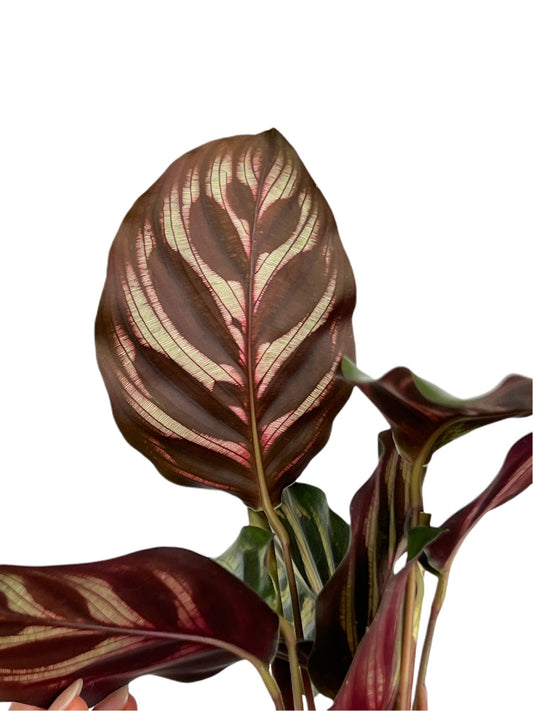
| Calathea makoyana | The one most often nicknamed peacock plant, with patterned foliage; find its care advice in its profile |
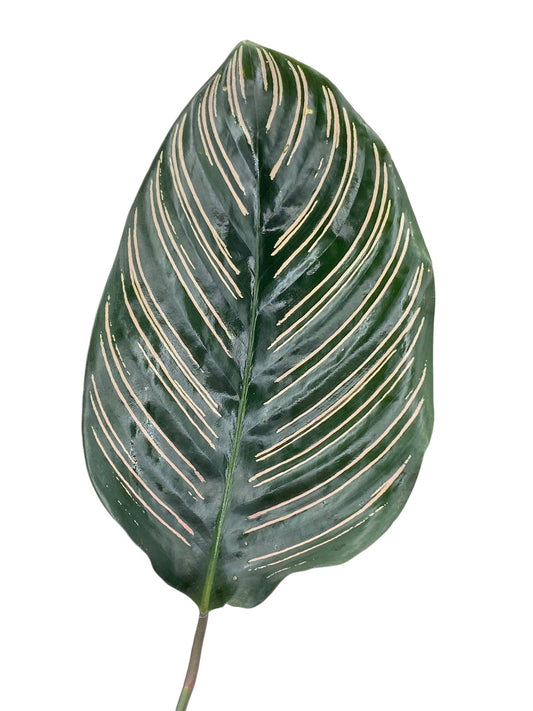
| Calathea ornata | The pinstriped Calathea (called pinstripe plant by NC State), with a more graphic look |
| Calathea crocata | Nicknamed the eternal flame plant, it is chosen first and foremost for its orange blooms |
| Calathea rufibarba | NC State's furry feather calathea: elongated leaves up to about 25 cm long, covered in reddish-brown hairs |
| Calathea zebrina | The other large velvety Calathea: leaves up to about 50 cm long, striped with pale green (NC State) |
🎨 Which plants pair well with Calathea warscewiczii?
Pair it with plants that enjoy the same warm, humid atmosphere to create a pocket of humidity that benefits them all. Its cousin, Maranta, the prayer plant, shares its needs and nighttime movements. At its base, a Fittonia with colorful veins echoes its foliage.
For a velvety-leaved collection corner, Philodendron melanochrysum also needs warmth and humidity. Find more ideas in our rare plants and indoor plants collections.
⚠️ Is Calathea warscewiczii toxic to cats and dogs?
No. The ASPCA (American Society for the Prevention of Cruelty to Animals) classifies Calatheas (Calathea spp.) as non-toxic to dogs, cats, and horses, and NC State's Goeppertia warszewiczii fact sheet lists it as non-toxic to cats and dogs. Some competing websites claim it contains calcium oxalates, but neither of these authoritative sources mentions them.
The real risk is to the plant: its large, velvety leaves show marks at the slightest bite or scratch.
For more information, read our article Is Calathea safe for pets?, our list of non-toxic plants for cats, and our pet-friendly plants collection.
✅ Our expert tips for success
Keep three rules in mind for your Calathea warscewiczii. First, humidity: above 60%, achieved by grouping plants together or using a tray of damp pebbles, because its large velvety leaves dry out quickly. Second, water: use soft water at room temperature and keep the substrate moist but not waterlogged. Finally, stability: keep it in a room at around 18–24 °C, in filtered light and away from drafts.
With these guidelines, it can offer you something few Calatheas provide indoors: cream-colored flowers amid velvety foliage. For care tips that apply to the entire genus, keep our complete Calathea guide close at hand.
Warscewiczii is the Calathea I most want to touch whenever I pass by: its dark velvet is unique. I've noticed that it is less forgiving of dry air than its smooth-leaved cousins; its edges turn brown quickly near a radiator. So I recommend it to those who already have a cluster of plants and a supply of rainwater. And when its cream-colored flowers appear, all the effort is forgotten.

Laura Bruneau
Jardinière et autrice


