Croton (Codiaeum variegatum): care, light and leaf drop

To properly care for a croton, place it in bright light without harsh direct sunlight, keep it warm without ever letting the temperature drop below 15°C, water it as soon as the top of the potting mix has dried, and surround it with humid air, away from radiators and drafts.
The croton sold in garden centers is Codiaeum variegatum, a shrub in the spurge family, and not a species in the botanical genus Croton, despite its common name. Its thick, glossy foliage, variegated with yellow, orange, red, and green, makes it one of the most colorful houseplants. It has a reputation as a finicky plant, especially because it loses its leaves at the slightest sudden change.
This guide explains how to avoid this, step by step, with guidelines verified by botanical and academic sources.
🌿 Why choose a croton?
The croton offers colors that few other houseplants can match, and it keeps them all year round because its foliage is evergreen. The University of Wisconsin describes thick, leathery leaves 2 to 12 inches long (about 5 to 30 cm), linear to oval, entire or deeply lobed, sometimes wavy or spirally twisted.
It is also a plant that grows tall: grown in a pot, it becomes a real floor plant, ideal for structuring a bright corner of the living room.
| Strength | What it brings to your home |
|---|---|
| Year-round color | Evergreen foliage in yellow, orange, red, pink, or purple depending on the variety, without waiting for flowers |
| Very varied leaf shapes | Oval, narrow, lobed, or twisted leaves: each cultivar has its own silhouette |
| Structuring floor plant | In a pot, it forms a dense shrub 30 to 90 cm or more tall, according to the RHS |
| Reliable indicator | It reacts quickly to cold or lack of light: you know immediately what to correct |
🔎 The croton's ID card
According to POWO (Plants of the World Online), the botanical database of Kew Gardens, the accepted name is Codiaeum variegatum (L.) Rumph. ex A.Juss., published in 1824.
The species is native to Malesia (the Southeast Asian biogeographic region, not to be confused with Malaysia) to the southwest Pacific and Queensland, where it grows as a shrub or small tree in the tropical rainforest biome. Its base name is Croton variegatus L. (1753): Linnaeus had originally classified it in the genus Croton, hence the common name that remains in use.
Today, the two genera are distinct within the spurge family: POWO lists 17 species of Codiaeum compared to 1,129 species of Croton, such as Croton tiglium, a tropical Asian shrub unrelated to the houseplant.
The NC State University extension reminds us that wild plants have green leaves and that it is the cultivars that are variegated.
| Criterion | Verified detail |
|---|---|
| 🏷️ Botanical name | Codiaeum variegatum (L.) Rumph. ex A.Juss.; basionym Croton variegatus L. |
| 🧬 Family | Spurge family (Euphorbiaceae), plant with white latex |
| 🌳 Type | Tropical evergreen shrub, grown as a houseplant |
| 🌍 Origin | From Malesia to the southwest Pacific, tropical rainforests (POWO) |
| 🍃 Foliage | Alternate, leathery, and glossy leaves, variegated depending on the cultivar |
| 🌸 Flowering | Small, inconspicuous flower clusters: white male flowers, yellowish female flowers without petals (NC State) |
| 📏 Size | 30 to 90 cm or more in a pot according to the RHS; about 90 cm indoors according to NC State |
| ⚠️ Toxicity | All parts are toxic; latex irritates the skin and eyes (RHS) |
📋 Quick care sheet
The essential care guidelines, all at a glance.
| Parameter | Guideline |
|---|---|
| Light | Bright and indirect; no summer full sun behind glass |
| Watering | When the top of the potting mix has dried; rainwater or softened water, at room temperature |
| Substrate | Acidic potting mix (peat-free ericaceous soil), light and well-draining, 3 parts to 1 part fine gravel (RHS) |
| Humidity | High: tray of moist clay pebbles under the pot, away from radiators |
| Temperature | 18 to 35°C (RHS); minimum 15°C, away from drafts |
| Repotting | When the roots fill the pot, into a container 2.5 to 5 cm wider |
| Fertilizer | Once or twice during the growing season, more often to promote faster growth |
| Toxicity | Irritating latex, all parts toxic: wear gloves and keep out of reach of children and pets |
| Difficulty | Moderate: easy if warmth and stability are maintained |
📍 Where to place a croton and what light to give it?
The croton is a light-loving plant: this is what maintains its colors. The RHS (Royal Horticultural Society) requires bright but indirect light in summer, specifying that a lack of light causes the leaves to lose their colors or even fall, while summer full sun through glass can burn them.
The University of Wisconsin adds that stronger light produces brighter colors and more compact growth, while insufficient light causes the leaves to turn green again and too strong direct sun makes them gray and dull.
🏠 Indoors: near an east or west window, or set back from a south window protected by a sheer curtain; in winter, move it closer to the window to compensate for the reduced light
🌤️ Outdoors in summer: the RHS classifies it as H1b: it can go outside in the middle of summer, sheltered from the wind and midday sun, then be brought back in well before the nights cool down
🌡️ Stability: choose a permanent spot, away from doors, open windows in winter, and radiators: every sudden change can cause leaf drop
🪴 How to repot a croton?
The croton likes a light, well-draining, and rather acidic substrate. The RHS recommends an acidic peat-free potting mix, without garden soil, for example 3 parts ericaceous plant potting mix to 1 part fine gravel.
According to the RHS, a croton can remain in its original pot for 1 to 2 years, then be repotted in spring every few years, as soon as the roots fill the container. The University of Wisconsin recommends only moving up to a pot 1 to 2 inches wider (about 2.5 to 5 cm): a pot that is too large retains moisture and exposes the plant to rot.
| Step | The right approach |
|---|---|
| 1. Choose the time | In spring, when growth resumes and the room remains warm |
| 2. Prepare the pot | A container with drainage holes, 2.5 to 5 cm wider than the old one, with a saucer that is emptied |
| 3. Mix the substrate | Peat-free acidic potting mix and fine gravel, about 3 to 1, as suggested by the RHS |
| 4. Place the root ball | Keep the same crown level, fill without packing too tightly, wear gloves against the latex |
| 5. Water and let settle | Water until it runs through, let drain, then place back in the same spot as before |
columns: 4
columns_mobile: 2
-
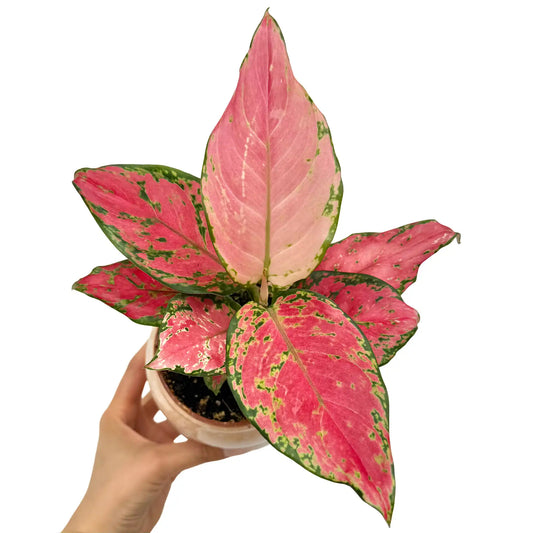
Aglaonema Pink Star
Regular price From 9,95 €Regular price9,95 €From 7,96 € -
Aglaonema Pictum Tricolor
Regular price From 9,95 €Regular price9,95 €From 7,96 €



✂️ Croton care: watering, humidity, fertilizer, and pruning
Croton care relies on consistency: neither dryness, nor excess water, nor sudden variation. According to the University of Wisconsin, it loses its leaves if it remains too wet or too dry for too long.
For air humidity, the RHS recommends placing the pot on a tray of moist clay pebbles or gravel, without the bottom sitting in water; you will find other solutions in our guide to increase air humidity.
💧 Watering: Water when the top of the potting mix has dried, about half an inch to an inch deep (about 1.3 to 2.5 cm) according to the University of Wisconsin; reduce in winter. The RHS prefers room-temperature rainwater, as hard water alkalizes the substrate
💧 Humidity: Moist pebble tray, grouping with other plants, and above all, no radiators nearby
🔹 Leaves: Wipe them with a damp cloth, as recommended by the RHS: dust-free, they capture light better
🌱 Fertilizer: Once or twice during the growing season, or more often for faster growth (Wisconsin); nothing in winter
✂️ Pruning: In spring, cut with clean pruning shears above a node to keep a compact and branched shape (RHS); wear gloves, as the latex drips
🍂 Croton through the seasons: warmth, rest, and leaf drop
The croton cannot tolerate the cold. The RHS sets its ideal range between 18 and 35°C and specifies a minimum of 15°C: below this, and in case of cold drafts, the leaves fall.
The University of Wisconsin gives a similar range of 60 to 85°F (about 16 to 29°C) and observes leaf drop if the temperature remains below 50°F (about 10°C). NC State places it in USDA zones 11 to 12, meaning frost-free climates: in France, it remains an indoor plant, with a summer outing at best.
In winter, growth slows: water less, stop fertilizing, and give it the brightest spot in the house, without contact with a cold window.
📅 Care calendar by season
| Season | Key action |
|---|---|
| 🌸 Spring | Repotting if needed, light pruning, resume fertilizing, gradually move toward the light |
| ☀️ Summer | More frequent watering, humidity around the pot, propagation in early summer, possible outing sheltered from the midday sun |
| 🍂 Autumn | Bring in before cool nights, check for mites before heating, reduced watering |
| ❄️ Winter | Very bright and stable spot, at least 15°C, away from radiators, no fertilizer |
🌱 How to propagate a croton?
The croton is propagated by stem cuttings or air layering. The RHS recommends semi-flexible stem cuttings in early summer with bottom heat, or air layering in spring, and suggests sealing the cut with powdered charcoal to limit the flow of latex.
Take a healthy stem end just below a node, remove the bottom leaves, let the latex stop flowing, then plant it in a light and barely moist mixture, in a warm place and in light without direct sun. The University of Wisconsin specifies that sowing is possible but does not reproduce the cultivar: only vegetative propagation preserves the colors of a variety.
Work with gloves: the white sap irritates the skin. To choose between water and potting mix, consult our guide propagate in water or potting mix.
🐛 Common problems: causes and solutions
When a croton is doing poorly, it shows it first by losing its leaves. The RHS attributes this drop to a substrate that is too dry, air that is too dry, cold drafts, and temperatures below 15°C; the University of Wisconsin adds that environmental changes that are too rapid cause shock, for example when arriving home.
Regarding pests, the RHS lists mealybugs and greenhouse thrips, the University of Wisconsin lists mealybugs, mites, and aphids, and NC State lists mites and thrips.
| Symptom | Probable cause | Solution |
|---|---|---|
| Leaves falling in autumn or winter | ❄️ Cold (below 15°C), draft, cold window | Change rooms, move away from doors and windows, keep a stable temperature |
| Leaf drop after purchase or moving | 💧 Acclimatization shock (different light, temperature, humidity) | Do not move it anymore, water normally, wait for new growth |
| Leaves drying out, brown edges | ⚠️ Substrate too dry or air too dry | Water as soon as the top has dried, moist pebble tray, move away from the radiator |
| Soft, yellow leaves, blackened crown | 🍄 Overwatering, waterlogged substrate, root rot (RHS) | Empty the saucer, let the top dry, repot in a well-draining substrate if needed |
| New green leaves, dull colors | ☀️ Lack of light | Gradually move closer to the window, without summer full sun behind the glass |
| Fine webs, speckled leaves, or cottony clusters | 🐛 Mites or mealybugs, favored by dry air | Isolate, shower the foliage, remove the mealybugs, and treat the underside of the leaves |


🌸 Our favorite croton varieties
Here are the most common croton cultivars, described according to the Universities of Wisconsin and North Carolina and the RHS. Trade names vary depending on the labels: rely first on the appearance of the foliage.
| Variety | Its strength |
|---|---|
| Croton 'Petra' | The most common form according to NC State and the University of Wisconsin: dark green leaves marked with yellow, pink, and red-orange; in 'Petra', the colour follows the veins (RHS) |
| Croton 'Mrs Iceton' | Leaves that emerge a bright, warm yellow and then turn pink and red as they mature (University of Wisconsin); sometimes sold under the shortened name 'Iceton' |
| Croton 'Mammy' | Elongated, twisted, multicoloured leaves, predominantly green and purple (University of Wisconsin); the spelling 'Mamey' is also found in garden centres |
| Croton 'Gold Dust' | Rounded oval leaves in bright green, speckled with golden yellow (University of Wisconsin, NC State), a completely different style from flame-coloured foliage |
| Croton 'Sunny Star' | Leaves marked with contrasting streaks or spots, according to the RHS |
| Croton 'Eleanor Roosevelt' | Medium green leaves flecked with golden yellow that turn dark red (NC State) |
🎨 What plants to pair with croton?
Croton pairs well with colourful foliage that shares its love of bright light and warmth. At its feet, coleus extends its red and purple tones, while Hypoestes, the polka dot plant adds touches of pink. For a less bright corner, Aglaonema offers softer variegation.
On the family side, Euphorbia trigona is a cousin in the Euphorbiaceae family, also milky, but grown as a succulent. For other ideas, browse our guide to indoor plants with colourful foliage and the colourful plants collection.
⚠️ Is croton toxic to cats, dogs and children?
Yes, croton is a toxic plant and should be kept out of reach. The RHS states that all its parts are toxic and that its white latex irritates the skin and eyes; it recommends wearing gloves when handling it.
The NC State extension classifies its toxicity as low severity: toxic only if ingested in large quantities, causing nausea, vomiting and diarrhoea, and brief skin irritation or allergic dermatitis after repeated contact.
The toxic principle cited is a group of diterpene esters, found in the bark, leaves, stems, sap, roots, flowers, fruit and seeds, and not calcium oxalates as is sometimes stated.
The University of Wisconsin confirms that the milky sap can cause contact dermatitis in sensitive people, and NC State adds that it stains fabrics. We did not find a croton fact sheet in the ASPCA (American Society for the Prevention of Cruelty to Animals) plant database: these references therefore come from the RHS and universities.
If you live with a cat, our list of non-toxic plants for cats helps you choose plants that are safe for him. In case of ingestion by an animal or child, contact your veterinarian or a poison control centre.
✅ Our expert tips for success
To successfully grow croton, remember three words: light, warmth, stability. Give it a bright place away from scorching sun, never let it fall below 15°C, water as soon as the top of the potting mix has dried, and surround it with humid air. Above all, choose a place for it and do not move it again: most leaf drop is caused by temporary cold or a sudden move.
With these steps, it will keep its bright colours year after year and become one of the most spectacular plants in the house.
Croton is a plant that taught me patience: it does not like to be moved, and it lets you know by dropping a few leaves. I realised that it needed to be given a bright and warm place from the start, and then left alone. Once settled, it is a real living painting, and I love watching its young leaves change colour over the weeks.

Laura Bruneau
Jardinière et autrice