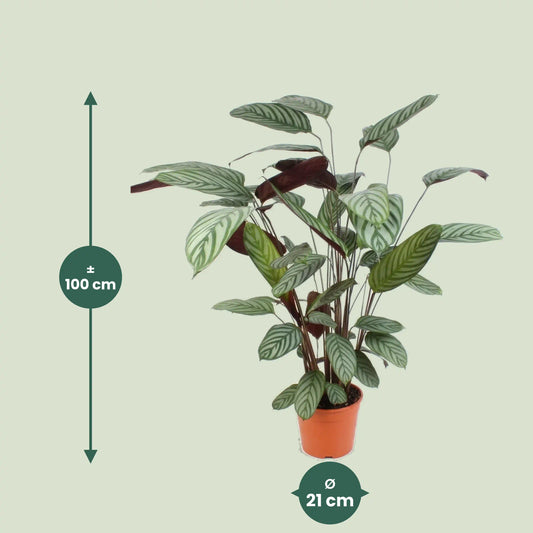
Ctenanthe (Ctenanthe burle-marxii): care, leaves and varieties

To care for a Ctenanthe, place it in bright but filtered light, keep its potting mix slightly moist without waterlogging it, water it with filtered or rainwater and keep it warm, away from drafts: these are the common guidelines for the RHS (Royal Horticultural Society) and NC State Extension.
The Ctenanthe genus belongs to the same family as Calathea and Maranta, the Marantaceae, and shares most of its needs with them; our Calathea care guide details these common basics.
This guide focuses on what is unique to Ctenanthe: recognizing the species and cultivars sold, understanding why its leaves fold up in the evening or curl during the day, and choosing the right water and light to keep its stripes well-defined.
🌿 How to recognize a Ctenanthe?
The most common Ctenanthe for homes is Ctenanthe burle-marxii. The RHS describes it as a perennial plant with finely hairy, purplish stems, oblong pale green leaves crossed by dark green bands that form a herringbone pattern, with a purple underside.
Hence its nickname the herringbone plant; it is also sold as a prayer plant, a name it shares with Maranta. Other Ctenanthe on the market often have longer leaves, variegated with cream (C. oppenheimiana 'Tricolor' according to the RHS) or yellow-green (C. lubbersiana according to NC State).
They all share a typical behavior of their family: their leaves stand upright and fold up in the evening, then open in the morning.
| Feature | What this means for you |
|---|---|
| Graphic foliage | Herringbone stripes and a purple underside that brighten up a shelf or console |
| Compact growth | According to the RHS, C. burle-marxii grows to 0.5 to 1 m tall and 0.1 to 0.5 m wide in 5 to 10 years |
| Filtered light | It is content with filtered light, unlike many colorful plants that require sun |
| Non-toxic to pets | The UC Master Gardeners classify it as non-toxic to pets |
🔎 Ctenanthe ID card
Here is its verified ID card. The accepted name and area of origin come from Plants of the World Online (POWO), a database of the Royal Botanic Gardens, Kew, which lists Ctenanthe burle-marxii H.Kenn., published in 1982 in the Canadian Journal of Botany, and locates it in the state of Espírito Santo, in southeastern Brazil.
The RHS lists Calathea stromata among its synonyms, a sign of the close historical relationship between the two genera. The description, size, and hardiness come from the RHS guide.
| Criterion | Verified detail |
|---|---|
| 🏷️ Botanical name | Ctenanthe burle-marxii H.Kenn. (1982), accepted name by POWO; Ctenanthe genus |
| 🧬 Family | Marantaceae (Marantaceae), like Calathea, Maranta, and Stromanthe |
| 🌳 Type | Perennial herbaceous plant with a rhizome, grown as a houseplant |
| 🌍 Origin | Brazil, state of Espírito Santo (POWO) |
| 🍃 Foliage | Oblong, pale green with dark green herringbone bands, purple underside (RHS) |
| 🌸 Flowering | Small clusters of white flowers, intermittently (RHS), inconspicuous |
| 📏 Size | 0.5 to 1 m tall, 0.1 to 0.5 m wide at maturity according to the RHS |
| ⚠️ Toxicity | Non-toxic to pets according to the UC Master Gardeners |
📋 Quick care guide
The essential care guidelines, all at a glance.
| Parameter | Guideline |
|---|---|
| Light | Bright and indirect or partial shade; never direct sun |
| Watering | Keep the potting mix consistently moist; water when the surface begins to dry |
| Water | Filtered, distilled, or rainwater; tap water can brown the tips |
| Potting mix | Rich, moist, and well-draining mix, lightened with bark and perlite |
| Humidity | Medium to high; no continuous dry air (NC State) |
| Temperature | Not below around 15°C, away from cold drafts (NC State) |
| Repotting | Late spring or early summer, when the roots fill the pot |
| Fertilizer | Liquid fertilizer once a month from spring to summer |
| Toxicity | Non-toxic to pets according to the UC Master Gardeners |
| Difficulty | Medium: sensitive to hard water, cold, and dry air |
📍 Where to place a Ctenanthe?
The RHS recommends bright but indirect light, and NC State Extension says it is intolerant of direct sun. Lack of light also has a price: according to the UC Master Gardeners, a Ctenanthe kept too far from the light loses its variegation and produces uniformly green foliage.
A study by the University of Florida (UF/IFAS) on the 'Loursii' cultivar supports this: at 50 foot-candles (about 540 lux), the plants were judged unattractive, while at 150 foot-candles (about 1,600 lux), they were highly attractive, with fewer necrotic spots. The author notes that 150 foot-candles is the minimum recommended level for neighboring Marantaceae, such as Calathea and Stromanthe.
In your home, this corresponds to a bright room, near a window but out of the sun.
☀️ Exposure: near an east or west window, or set back from a south window behind a sheer curtain
🌡️ Environment: a heated, stable room, away from radiators, front doors, and cold glass
💧 Humidity: a bright bathroom or a group of plants, for more humid air
🪴 Repotting and dividing a Ctenanthe
Ctenanthe forms a clump from a rhizome. The RHS recommends repotting it every year, in late spring or early summer, in a peat-free mix based on loam. For Ctenanthe lubbersiana, NC State Extension recommends a fresh, well-draining, humus-rich mix, lightened with orchid bark and perlite.
Choose a perforated pot, just wider than the root ball. If you have just acquired it, let it acclimate for a few weeks first, as explained in our guide repotting after purchase, and for making the mix, see potting soil or potting mix: which one to choose.
| Step | The right approach |
|---|---|
| 1. Choose the time | Late spring or early summer, when the roots fill the pot (RHS) |
| 2. Prepare the mix | Rich, fresh potting mix, lightened with fine bark and perlite for drainage |
| 3. Remove from the pot | Gently remove the root ball and untangle the circling roots |
| 4. Divide if necessary | Separate the clump into pieces, each with leaves, roots, and a piece of rhizome |
| 5. Water and shelter | Water until it drains, empty the saucer, and keep the plant in light shade for a few days |
columns: 4
columns_mobile: 2
-

 Livraison offerte
Ctenanthe Burle Marxii - Dormant plant - Fishbone - 12cm pot
Regular price From 44,95 €Regular price -
Ctenanthe Burle-Marxii - Dormant plant - Fishbone - 14cm pot - Height: 35-40 cm
Regular price 44,95 €Regular price -

 Livraison offerte
Ctenanthe Amagris - 14 cm Pot - Height: 25–40 cm
Regular price From 44,95 €Regular price -

 Sale
-

 Livraison offerte
Calathea Orbifolia - 21cm Pot - Height 60 - 70cm
Regular price From 64,95 €Regular price -

 Livraison offerte
Calathea Makoyana - Peacock Plant - 12cm Pot - Height 25cm
Regular price From 44,95 €Regular price -


Maranta Fascinator Lemon Lime - Pet-friendly - Prayer plant - 12cm pot - Height 25-35cm
Regular price From 39,95 €Regular price -
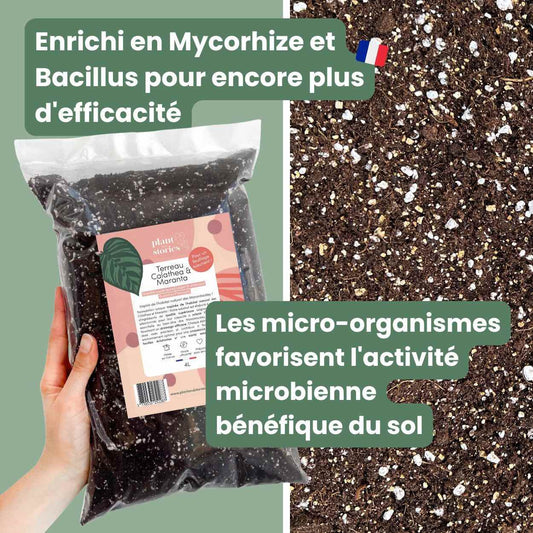
Premium Calathea & Maranta Potting Soil - Enriched with Mycorrhizae and Bacillus - Made in France
Regular price 11,99 €Regular price11,99 €Sale price 11,99 €


✂️ Ctenanthe care: water, warmth, and humidity
Ctenanthe requires consistency more than complicated care. The RHS recommends watering generously and feeding every month with a liquid fertilizer from spring to summer, then keeping the potting mix moist in winter, at a constant temperature and away from drafts.
Its main sensitivity is to water: the NC State guide for Ctenanthe oppenheimiana indicates that tap water leaves salt and mineral deposits that brown the tips, and that the plant does not tolerate hard or cold water well.
💧 Watering: Water when the first 2.5 cm (one inch) of potting mix is dry, a guideline given by NC State for C. lubbersiana; never let the root ball dry out completely
💧 Water quality: Filtered, distilled, or rainwater, at room temperature: the UC Master Gardeners remind us that the sodium in tap water can brown the leaves
💧 Humidity: A tray of moist gravel, a group of plants, or a humidifier, rather than misting
🌱 Fertilizer: Liquid fertilizer once a month during the growing season; NC State and the UC Master Gardeners recommend half strength
🧹 Cleaning: Remove damaged leaves at the base; the RHS specifies that no pruning is necessary
🍂 Ctenanthe through the seasons
Its rhythm follows the light and warmth. In spring and summer, it unfurls its new leaves: this is the season for monthly fertilizer, repotting, and dividing. In autumn, the days shorten: move it closer to a window without direct sun and stop fertilizing. Winter is the delicate season, as heating dries the air and the windows cool down.
NC State says it is intolerant of temperatures below 60°F, or about 15°C, and cold drafts; the RHS classifies it as H1B, meaning it can only go outside in summer if nights remain above 10 to 15°C. Read our solutions for dry heating air.
📅 Seasonal care calendar
| Season | Key action |
|---|---|
| 🌸 Spring | Repotting or dividing, resume monthly fertilizer, new leaves |
| ☀️ Summer | Keep potting mix consistently moist, filtered light, monitor humidity, monthly fertilizer |
| 🍂 Autumn | Move closer to the window, stop fertilizing, water slightly less frequently |
| ❄️ Winter | Not below around 15°C, just moist potting mix, humidified air, no drafts |
🌱 Propagating Ctenanthe by division
The RHS indicates two ways, sowing and dividing in spring; in practice, only dividing is within everyone's reach, and NC State designates it as the best method for C. lubbersiana. The UC Master Gardeners also recommend dividing in spring.
On a well-developed clump, remove the plant from the pot and separate it by hand or with a clean knife into two or three pieces, each with several leaves and roots. Repot each piece in a small pot with fresh potting mix, water, then keep them warm, in filtered light, and in humid air.
A few leaves may wilt at first: the plant is recovering when a new leaf unfurls in the center.
🐛 Common problems: causes and solutions
With Ctenanthe, most problems are visible on the leaves. First reflex: distinguish between evening and daytime. In the evening, the leaves stand upright and fold up: the UC Master Gardeners call this movement nyctinasty, and it is normal. During the day, however, leaves curled up on themselves with brown edges indicate a lack of water, according to NC State.
Regarding pests, the RHS notes mealybugs (see our guide against mealybugs), and NC State adds spider mites and thrips.
| Symptom | Probable cause | Solution |
|---|---|---|
| Leaves folding up in the evening | ⚠️ Natural movement of the family (nyctinasty) | Nothing to do: they open up in the morning |
| Leaves curled up during the day, brown edges | 💧 Lack of water (NC State) | Water as soon as the surface dries, without letting the root ball dry out |
| Brown tips | 💧 Salts and minerals from tap water (NC State), air too dry | Switch to filtered or rainwater and increase ambient humidity |
| Yellow leaves, waterlogged potting mix | 🍄 Overwatering (NC State); Botrytis in too moist soil (UC Master Gardeners) | Let it dry out, empty the saucer, remove soft parts, and repot if necessary |
| Uniformly green foliage | ☀️ Insufficient light (UC Master Gardeners) | Move the plant closer to a window, without direct sun |
| Fine webs, speckled leaves | ⚠️ Spider mites, favored by dry air | Shower the underside of the leaves and follow our anti-spider mite guide |


🌸 Our Ctenanthe varieties
The genus comprises 16 species accepted by POWO, from Costa Rica to tropical South America; those you encounter in garden centres, such as C. burle-marxii, C. setosa or C. lubbersiana, are Brazilian, alongside several widely available cultivars. Here is how to identify them, according to POWO, the RHS, NC State and, for 'Amagris', the American plant patent PP14641 and the Flora & Fauna database of Singapore's National Parks (NParks). Discover the ones we offer in our Ctenanthe collection.
| Variety | Its best feature |
|---|---|
| Ctenanthe burle-marxii | The best-selling species: pale green herringbone leaves with purple undersides, 0.5 to 1 m (RHS); also available as herringbone prayer plant |
| Ctenanthe 'Amagris' | A cultivar, not a species: a mutation discovered in Belgium in 2000 (patent PP14641), more compact, with narrow grey-green leaves and purple undersides; up to 30 cm according to NParks |
| Ctenanthe setosa | A species from eastern and southern Brazil according to POWO, a tropical rainforest perennial |
| Ctenanthe lubbersiana 'Golden Mosaic' | Dark green leaves striped with cream or yellowish-green (NC State); a species from southern and southeastern Brazil according to POWO |
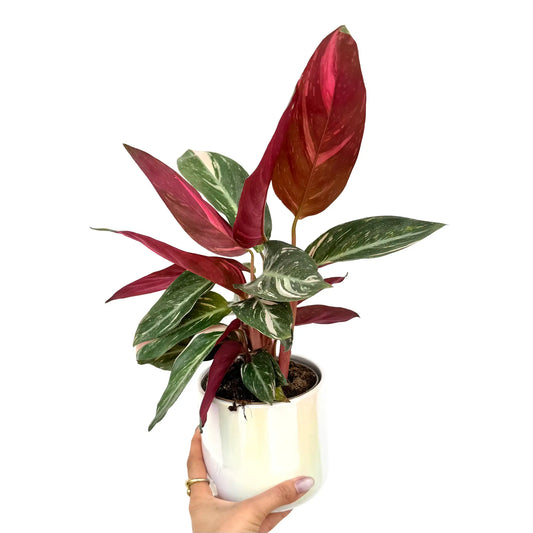
| Ctenanthe oppenheimiana 'Tricolor' | Lanceolate leaves variegated with creamy white, with wine-red undersides, approximately 1 m according to the RHS 'Tricolor' page |
| Stromanthe 'Triostar' | See also: a related genus, Stromanthe thalia, with leaves variegated with white, cream and pink according to NC State, which also folds its leaves at night |
🎨 What plants to pair with Ctenanthe?
It shares its requirements with other Marantaceae: filtered light, fresh potting mix, and humid air. Group it with a lower, trailing Maranta, the prayer plant, a Calathea ornata with fine pink stripes, or a Calathea zebrina with broad light green bands.
This grouping creates a more humid microclimate that benefits all of them; our article to increase humidity offers other solutions.
For a low-light area, also browse our selection of plants for dark rooms and our shade plants and houseplants collections.
⚠️ Is Ctenanthe toxic to cats and dogs?
No, according to the source we were able to check. The Master Gardeners of the University of California (UCANR) state that Ctenanthe species are non-toxic to pets. The RHS and NC State pages we consulted do not mention any toxicity.
We were unable to find an ASPCA page specifically for the Ctenanthe genus: the ASPCA's guidance on Calathea, mentioned in our article are Calathea safe for animals?, concerns another genus in the same family and is not conclusive for this one.
An animal that chews a lot of leaves may experience temporary digestive upset, as with any plant. To create a safe home environment, also consult our list of non-toxic plants for cats.
✅ Our expert tips for success
Remember three rules for your Ctenanthe. First, light: bright but filtered, as it cannot tolerate direct sunlight and too much shade will fade its stripes. Next, water: always keep the potting mix fresh, preferably watering with rainwater or filtered water, and keep it in a room that does not drop below around 15°C.
Finally, read its leaves: folded up in the evening, everything is fine; curled up during the day, it is thirsty. For the basics common to the entire family, our Calathea guide remains the reference.
My first Ctenanthe burle-marxii gave me quite a fright: one evening, all its leaves were standing straight up, as if closed. The next morning, they had opened up again. Since then, I keep it near an east-facing window, water it with rainwater, and only worry if the leaves remain curled up in the middle of the day: that almost always means I have let the root ball dry out.

Laura Bruneau
Jardinière & autrice