

Dracaena marginata (Madagascar dragon tree): care, varieties

To care for a Dracaena marginata, give it bright light without scorching sun, water thoroughly when the top 5 centimetres of potting mix are dry, using rainwater or filtered water, and keep it between 18 and 30 °C. This Madagascar dragon tree is the finest of the Dracaena house plants: thin stems, often several per pot, and narrow leaves edged in red.
This guide focuses on what makes it unique: its current botanical name, its marked sensitivity to fluoride, the normal shedding of lower leaves, the size of a cane, and its coloured varieties. For other species, such as Dracaena fragrans, see our complete guide to the Dracaena genus.
🌿 Why choose a Dracaena marginata
The Dracaena marginata provides a light and graphic silhouette: bare stems, sometimes sinuous, each bearing a tuft of narrow leaves.
According to NC State Extension (the North Carolina State University extension), it is a slow-growing, drought-tolerant shrub that reaches about 1.8 m indoors and responds well to pruning. Clemson HGIC highlights that it is widely used in homes and offices because it tolerates low light.
Its coloured cultivars, from cream to yellow and pink, allow you to choose the colour intensity according to the brightness of the room.
| Asset | What this means for you |
|---|---|
| Aerial growth on several canes | Vertical volume that does not block light, ideal near a sofa or desk |
| Slow growth | It keeps its height for several years and is rarely repotted |
| Forgives a missed watering | Drought-tolerant according to NC State, it is much more sensitive to overwatering |
| Pruning cane by cane | Each cut stem regrows just below the cut, allowing you to stagger the heights |
🔎 The Dracaena marginata ID card
Dracaena marginata is the commercial name, but not the accepted name. According to Plants of the World Online (POWO), the database of the Royal Botanic Gardens, Kew, the Madagascar dragon tree is called Dracaena reflexa var. angustifolia Baker, a name published in 1875, and Dracaena marginata Lam. is listed among its synonyms, alongside Pleomele marginata or Draco marginata.
Botanists therefore link it to the Dracaena reflexa species, of which it forms a narrow-leaved variety, as indicated by the epithet angustifolia. Kew locates its natural range in the western Indian Ocean: Madagascar, Mauritius, Rodrigues, Réunion, the Seychelles, Aldabra, the Comoros, and the Chagos archipelago.
In terms of description, the RHS (Royal Horticultural Society) Dracaena marginata guide presents it as an upright evergreen shrub with long sword-shaped leaves, dark green and finely edged in reddish-brown, and the Clemson University garden information centre (Clemson HGIC) mentions narrow purple margins.
| Criterion | Verified detail |
|---|---|
| 🏷️ Botanical name | Dracaena reflexa var. angustifolia Baker (syn. Dracaena marginata Lam.) |
| 🧬 Family | Asparagaceae (Asparagaceae) |
| 🌳 Type | Evergreen shrub with thin stems, often branched or grouped in canes |
| 🌍 Origin | Western Indian Ocean: Madagascar, Mascarene Islands, Seychelles, Comoros, Chagos (POWO) |
| 🍃 Foliage | Narrow sword-shaped leaves, dark green edged in red-brown, grouped in a tuft at the top of the stems |
| 🌸 Flowering | Rare indoors; the plant is grown for its foliage |
| 📏 Size | About 1.8 m indoors (NC State); 2.5 to 4 m in 10 to 20 years (RHS) |
| ⚠️ Toxicity | Toxic to dogs, cats, and horses (saponins, ASPCA) |
📋 Quick technical guide
The essential care points, gathered at a glance.
| Parameter | Guideline |
|---|---|
| Light | Bright and indirect; tolerates lower light |
| Watering | Thoroughly when the top 5 cm are dry |
| Substrate | Well-draining potting mix, pH 6.0 to 6.5, little perlite |
| Humidity | Ambient air; moist gravel tray in heated winter |
| Temperature | 18 to 30 °C; never below 10 to 15 °C |
| Repotting | Every 2 to 3 years, one pot size up |
| Fertiliser | Liquid from April to October, without superphosphate |
| Toxicity | Dogs, cats, and horses: keep out of reach |
| Difficulty | Easy, provided you take care with the water |
📍 Where to place a Dracaena marginata: light and heat
Place your Dracaena marginata in bright but indirect light, for example near an east- or west-facing window, as recommended by the RHS growing guide.
Its RHS guide calls for full light with protection from direct and hot sun, and NC State Extension adds that it tolerates filtered light and even dense shade. In a dark room, it survives, but its stems stretch and the coloured cultivars lose their brilliance.
Keep a stable temperature of 18 to 30 °C according to the RHS; Clemson HGIC places the ideal between about 16 and 21 °C during the day, with slightly cooler nights.
☀️ Ideal: East or west window, or south bay window behind a sheer curtain
🌥️ Acceptable: Bright room without direct sun: slower growth, longer stems
🚫 Avoid: Summer sun through glass, radiators, cold draughts
🪴 Repotting a Dracaena marginata without excess perlite
Repot the Dracaena marginata in spring, every two to three years, in a pot one size larger: this is the pace indicated by the RHS. For the mix, the RHS suggests three parts peat-free potting mix for acid-loving plants, one part perlite, and one part medium pine bark.
As the marginata is very sensitive to fluoride, Clemson HGIC advises against potting mixes rich in perlite and recommends a pH of 6.0 to 6.5. We therefore keep perlite in a small proportion and rely on bark for aeration.
After a purchase, also see when to repot a plant after purchase.
| Step | The right action |
|---|---|
| 1. Choose the time | In spring, when roots emerge from the drainage hole |
| 2. Prepare the pot | A pot with drainage holes one size larger, no more |
| 3. Prepare the mix | Peat-free potting mix for acid-loving plants, pine bark, very little perlite |
| 4. Keep the canes grouped | Replace the entire root ball without separating the stems, at the same level as before |
| 5. Water with rainwater | Water thoroughly, drain completely, return to indirect light |
columns: 4
columns_mobile: 2
-

 Livraison offerte
Dracaena Marginata
Regular price From 49,95 €Regular price -

 Livraison offerte
Dracaena Marginata Bicolor
Regular price From 49,95 €Regular price -
Dracaena Marginata - Dragon Tree - Set of 2 Plants - 17cm Pot - Height 70-80cm
Regular price 79,95 €Regular price -

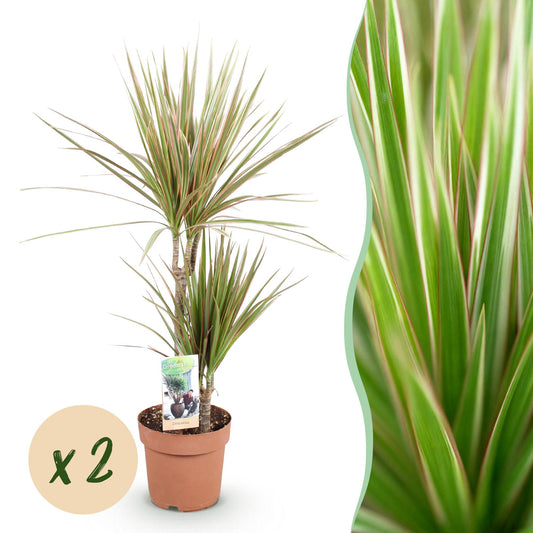
Dracaena Marginata Bicolor - Dragon Tree - Set of 2 Plants - 17cm Pot - Height 70-75cm
Regular price 69,95 €Regular price


✂️ Caring for the Dracaena marginata: water, fluoride and fertiliser
Caring for the Dracaena marginata relies on spaced watering and quality water. The RHS advises watering only when the top 5 centimetres of potting mix are dry, and Clemson HGIC says to water thoroughly then; NC State specifies letting it dry between waterings, but not too severely.
Fluoride is its real weakness: NC State recommends distilled or non-fluoridated water, the RHS rainwater or filtered water, and Clemson HGIC avoiding fertilisers containing superphosphate, which are often rich in fluoride. Feed with a liquid fertiliser for indoor plants from April to October.
💧 Watering: Thoroughly when the top 5 cm are dry, empty the saucer
💧 Water quality: Rainwater, filtered or distilled, never softened
🌱 Fertiliser: Liquid from April to October, superphosphate-free formula
💧 Humidity: Moist gravel tray or grouped plants, no misting
🔹 Lower leaves: Remove dry leaves at the base of the tuft, it is normal
🍂 Pruning a Dracaena marginata cane through the seasons
To reduce a Dracaena marginata that is too tall, cut one cane at a time in spring, to the desired height. The RHS observes that dragon trees produce new shoots just below the cut, and the RHS specifies that weak stems can be cut back to 15 cm in spring.
By cutting the canes at different heights, you get a tiered and fuller plant. Classified as H1b by the RHS, it can spend the summer outdoors sheltered, then must come inside before nights drop below 10 to 15 °C. In winter, space out waterings and remove fertiliser.
📅 Care calendar by season
| Season | Key action |
|---|---|
| 🌸 Spring | Repot if necessary, cut back a cane, resume fertilising in April, cuttings |
| ☀️ Summer | Water as soon as 5 cm of potting mix are dry, possible outdoor placement sheltered, monitor for spider mites |
| 🍂 Autumn | Stop fertilising at the end of October, bring inside before nights below 10 to 15 °C |
| ❄️ Winter | Spaced waterings, stable heat, away from radiators and cold glass |
🌱 Propagating a Dracaena marginata: head and stem cuttings
Stem cutting is the method NC State Extension recommends for the marginata. Clemson HGIC also mentions head cuttings, stem cuttings, air layering and basal pups, in spring or late summer. The RHS indicates semi-hardwood or hardwood cuttings with bottom heat in summer, and sowing at 18 to 21 °C.
Take the top of a cane with its tuft, remove the lower leaves and plant it in a light, just moist mix, in a warm place with indirect light. The stem cuttings are planted in the direction of growth. To choose the medium, read propagating in water or potting mix.
🐛 Common problems: causes and solutions
With the Dracaena marginata, the first concern is the shedding of lower leaves. It is often normal: NC State Extension indicates that lower leaves fall with age, gradually exposing the stem. It becomes a warning sign when many leaves turn yellow at once, along the entire height.
Browning tips first signal fluoride in tap water, according to the RHS, and Clemson HGIC reminds of the dragon trees' great sensitivity to this element. Regarding pests, the RHS mentions the tetranychid mite (spider mite), thrips and mealybugs, and judges the plant generally free of diseases.
Also see why the lower leaves turn yellow.
| Symptom | Probable cause | Solution |
|---|---|---|
| A few lower leaves turn yellow and fall | ⚠️ Natural ageing of the tuft | Nothing to correct: remove dry leaves by hand |
| Tips and edges yellow then brown | 💧 Fluoride in water, abundant perlite, superphosphate fertiliser | Rainwater or filtered water, rinse the potting mix, change fertiliser |
| Many yellow leaves, moist potting mix, soft base | 💧 Overwatering, suffocated roots | Let dry, empty the saucer, repot if roots are brown |
| Soft leaves drooping, dry potting mix deep down | ☀️ Prolonged drought | Water thoroughly until it drains, then return to the normal pace |
| Long, leaning stems, reduced tuft | ☀️ Lack of light | Move closer to the window, turn the pot, cut back in spring |
| Dull leaves, light spots, fine webs | 🕷️ Tetranychid mites or thrips | Shower the foliage, isolate the plant, treat if necessary |


🌸 Our Dracaena marginata varieties
Here are the Dracaena marginata we offer online, described according to the RHS and NC State Extension. Large specimens of 'Green', 'Magenta', 'Sunray' and 'Bicolor' can also join our Dracaena collection depending on arrivals. NC State finally describes 'Tricolor' (green edged in white and pink) and 'Colorama' (pink striped with white and green, 1.5 to 1.8 m), which we do not offer.
| Variety | Its asset |
|---|---|
| Dracaena marginata in a 17 cm pot | The type: narrow dark green leaves finely edged in red-brown, described by the RHS |
| Dracaena marginata, set of 2 | Two plants to create a pair or group the stems into a fuller plant |
| Dracaena marginata 'Bicolor' in a 17 cm pot | Very narrow dark green leaves edged in cream with a fine red border, according to the RHS |
| Dracaena marginata 'Bicolor', set of 2 | The same cream and red foliage in two plants, for a brighter effect |
| 'Magenta' | Green leaves with magenta-red margins, with a small palm-like habit according to NC State |
| 'Sunray' | Deep green leaves with a yellow centre, columnar habit, 1.5 to 2.5 m according to the RHS |
🎨 What plants to pair with a Dracaena marginata
Dracaena marginata pairs well with plants that, like it, enjoy indirect light and measured watering. The Yucca has a similar small tree-like habit with sword-shaped leaves, but is even hardier, while the Sansevieria, now classified in the Dracaena genus, fills the base of a tall plant.
The Zamioculcas adds shiny, broad leaves that contrast with its narrow ribbons. For a taller arrangement, browse our large and medium plants.
⚠️ Is Dracaena marginata toxic to cats and dogs?
Yes: the ASPCA (American Society for the Prevention of Cruelty to Animals) 'Madagascar Dragon Tree' fact sheet classifies Dracaena marginata as toxic to dogs, cats and horses due to its saponins.
Ingestion can cause vomiting, sometimes with blood, lethargy, loss of appetite, excessive salivation and, in cats, dilated pupils. The RHS also lists it as harmful if ingested by dogs, cats, rabbits and rodents. NC State Extension rates the toxicity as mild, but also mentions it for humans (mouth and stomach irritation, vomiting). Keep it out of reach and call a vet if ingested.
✅ Our expert tips for success
A successful Dracaena marginata depends on four things: bright light without scorching sun, watering thoroughly only when the top 5 cm are dry, water low in fluoride and a stable temperature between 18 and 30 °C. Accept the loss of lower leaves, as this is part of its growth, and only take action if the yellowing affects the whole plant.
When a stem becomes too tall, cut it back in spring and propagate the top cutting. To compare it with other dragon trees, find our Dracaena fact sheet.
The marginata is the dragon tree I recommend for bright interiors where you want height without bulk. At my place, it handles a forgotten watering without flinching, while waterlogged soil quickly makes it suffer. I like to cut back a single stem in spring to create a tiered plant, and I always repot the cut head. And since I water it with rainwater, its tips stay neat for much longer.

Laura Bruneau
Jardinière & autrice


