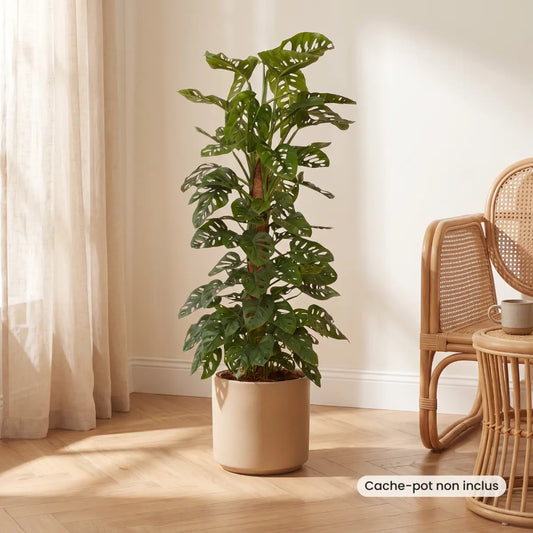
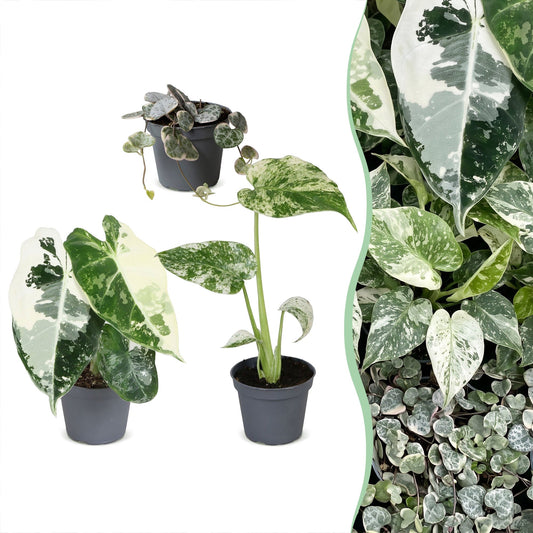
Monstera deliciosa variegata: caring for the variegated Monstera

To care for a Monstera variegata, give it more light than a green Monstera but never direct sun, water it when the top of the potting mix has dried out, and remove stems that have reverted to solid green.
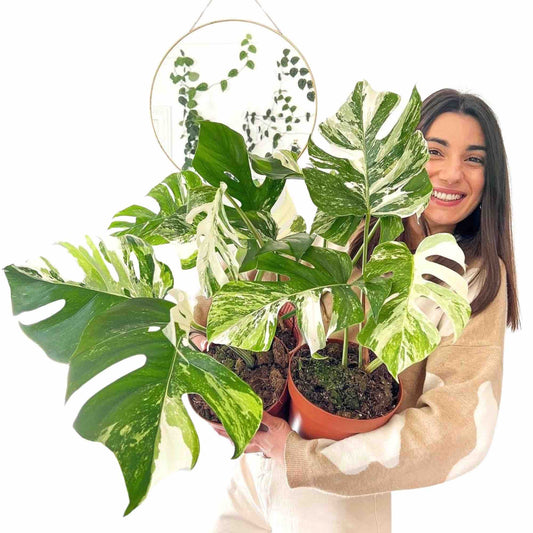
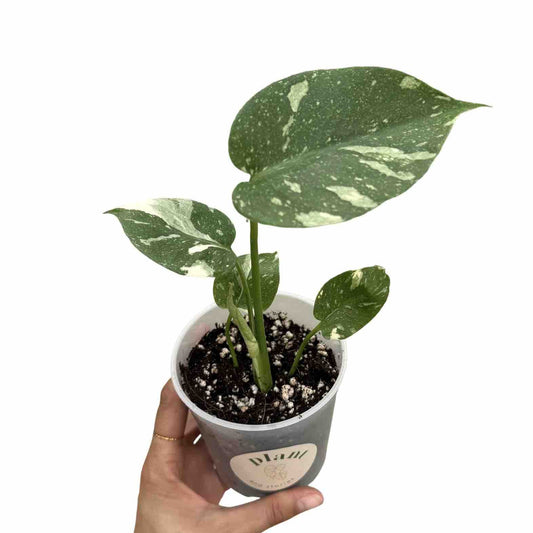
Monstera variegata, also known as white Monstera, white-variegated Monstera, bicolored Monstera, or two-tone Monstera, is a Monstera deliciosa (family Araceae) with cream-white marbling on its leaves: these pale areas, which lack chlorophyll, make the plant slower-growing and more delicate than the green form. This page covers its day-to-day care.
To choose one, compare varieties, and read the variegation on the stem before buying, see our guide to buying a Monstera variegata; for care of the green form, see our Monstera deliciosa care guide.
🌿 White and green Monstera: what does variegata mean, and what difference does variegation make?
“Variegata” comes from the Latin variegatus, meaning mottled: in botany, the word refers to a variegated plant whose leaves combine two colors.
Monstera variegata is therefore not a separate species: it is a variegated form of Monstera deliciosa Liebm., the species that Plants of the World Online, Kew’s database describes as a vine of humid tropical habitats, native from southern Mexico (Veracruz, Oaxaca, Chiapas) to Guatemala.
The University of Connecticut document on reversions in variegated plants (UConn) notes that areas of a leaf that are not green contain no chlorophyll: highly variegated plants are generally less vigorous and produce smaller leaves.
A white-and-green Monstera therefore produces less energy than a green Monstera, resulting in slower growth and a need for more precise care.
| Advantage | What it means for you |
|---|---|
| Unique foliage | Each leaf has a different pattern, marbled and splashed with cream-white (RHS) |
| A plant that stays manageable for a long time | Its slow growth gives you time to find a place for it: the RHS estimates 10 to 20 years to reach its mature size |
| The same care routine as a green Monstera | Only light, watering, and pruning green stems require extra attention |
| A plant that can be propagated from cuttings | A cutting taken from a variegated node reproduces the variegation, unlike growing from seed (University of Minnesota) |
🔎 Monstera variegata at a glance
Here is the verified profile of Monstera variegata. The RHS (Royal Horticultural Society) profile for Monstera deliciosa 'Variegata' describes it as a vigorous climber with large, split or perforated, deep-green leaves marbled and splashed with cream-white, reaching 2.5 to 4 m tall and 1 to 1.5 m wide at maturity.
The University of Florida (UF/IFAS, fact sheet HS1071) lists several variegated forms of Monstera deliciosa, including 'Variegata' and 'Marmorata'. The commercial name “Monstera variegata” therefore covers plants with varying degrees of variegation.
| Category | Verified details |
|---|---|
| 🏷️ Botanical name | Monstera deliciosa 'Variegata' (RHS); species Monstera deliciosa Liebm. (Kew POWO) |
| 🧬 Family | Araceae |
| 🌳 Type | Evergreen vine that climbs using aerial roots |
| 🌍 Origin | Species native from southern Mexico to Guatemala, in humid tropical habitats (Kew POWO); variegation is a mutation that appears after germination (University of Minnesota) |
| 🍃 Foliage | Large, split leaves marbled and splashed with cream-white (RHS) |
| 🌸 Flowering | Arum-type inflorescence (spathe and spadix); according to the University of Minnesota, Monstera does not flower or fruit as a houseplant |
| 📏 Size | 2.5 to 4 m tall at maturity, reached in 10 to 20 years (RHS) |
| ⚠️ Toxicity | Insoluble calcium oxalates: toxic to dogs and cats (ASPCA) |
📋 Quick care guide
Essential growing guidelines, all in one place.
| Factor | Guideline |
|---|---|
| Light | Bright, indirect light, more abundant than for a green Monstera (NC State); no direct sun (RHS) |
| Watering | When the top 1 to 2 in. of potting mix has dried out (Penn State); water less in winter (RHS) |
| Potting mix | Open, well-draining, slightly acidic (RHS); mix rich in organic matter with bark or perlite (Penn State) |
| Humidity | Preferably above 50% (Penn State); use a humidifier or group plants together |
| Temperature | 65 to 77°F year-round (RHS); around 60 to 85°F according to NC State |
| Repotting | In spring, into a pot only slightly larger, with drainage holes |
| Fertilizer | Balanced liquid fertilizer once a month during the growing season (RHS) |
| Support | Moss pole, which the roots can attach to if the moss stays moist (RHS) |
| Toxicity | Toxic to dogs and cats (ASPCA); gloves recommended when handling (RHS, Penn State) |
| Difficulty | Moderate: slower-growing and less tolerant of lighting mistakes than a green Monstera |
📍 Where to place a Monstera variegata: finding the right light
Place your Monstera variegata very close to an east- or west-facing window, or set it back from a south-facing window behind a sheer curtain.
In its Monstera growing guide, the RHS recommends indirect light, for example near an east- or west-facing window, and warns that direct sun can scorch the leaves; its 'Variegata' profile recommends partial shade, with a south-, east-, or west-facing aspect. NC State Extension (North Carolina State University) notes that variegated cultivars need more light than dark-green cultivars.
For more detail on distances and window orientations, read our guide: Monstera: what light and exposure does it need?.
🌅 East- or west-facing window: The best spot: plenty of light, little direct sun. At a west-facing window, filter the afternoon sun in summer with a sheer curtain.
🌞 South-facing window: Move the plant back or filter the light with a sheer curtain: the white areas, which lack chlorophyll, scorch quickly in direct sun.
🔄 Rotate the pot: Monstera leans toward the light: turning the pot a quarter turn from time to time keeps the plant balanced and its variegation evenly distributed.
🪴 Repotting Monstera variegata: potting mix and pot in 5 steps
Monstera variegata needs the same airy potting mix as a green Monstera, but is even less tolerant of excess water because it drinks more slowly. Penn State Extension recommends a well-draining, soil-free potting mix rich in organic matter, with a neutral pH (6.0 to 8.0), to which bark, perlite, or charcoal can be added.
The RHS recommends an open, slightly acidic mix: one part peat-free ericaceous potting mix to two parts orchid mix. Both sources agree on the key point: use a mix that allows air to circulate around the roots.
For complete step-by-step instructions, see our guide to repotting and watering Monstera.
| Step | What to do |
|---|---|
| 1. Pick the right time | In spring, when the plant starts growing again, or when roots emerge from the pot |
| 2. Choose a pot | One only slightly larger, always with drainage holes: a large volume of potting mix stays wet for too long |
| 3. Prepare the mix | Airy aroid mix, or potting mix amended with bark and perlite (Penn State) |
| 4. Install the support | Position the moss pole while repotting, before adding the potting mix, to avoid damaging the roots |
| 5. Water and drain | Water thoroughly, then empty the saucer: the RHS advises against leaving the pot standing in water |
columns: 4
columns_mobile: 2
-

 Sold out
Variegated Monstera
Regular price 69,95 €Regular price89,95 €Sale price 69,95 €69,95 €55,96 €Sold out -
 Sold out
Monstera Variegata Cutting
Regular price From 12,00 €Regular price12,00 €From 9,60 €Sold out -
Monstera Thai Constellation
Regular price From 19,95 €Regular price24,95 €Sale price From 19,95 €19,95 €From 15,96 €Sale -

 Sold out
Monstera Deliciosa Aurea
Regular price 89,95 €Regular price150,00 €Sale price 89,95 €89,95 €71,96 €Sold out -

 Sold out
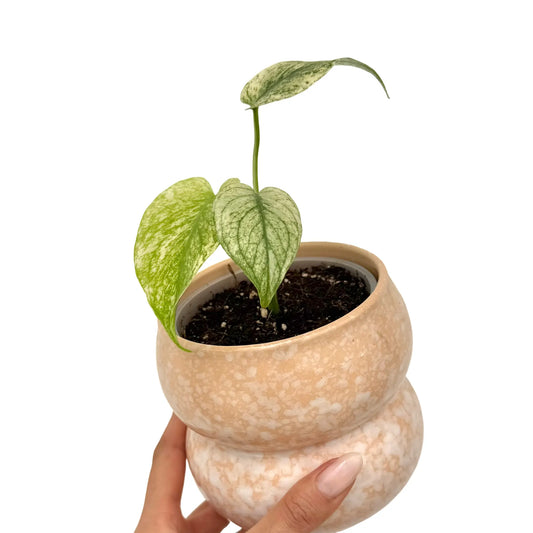
Monstera Deliciosa Mint
Regular price From 39,95 €Regular price79,95 €Sale price From 39,95 €39,95 €From 31,96 €Sold out -
Transparent climbing plant support - Pack of 3 + free velcro (Monstera, Pothos)
Regular price From 9,99 €Regular price13,89 €Sale price From 9,99 €9,99 €From 8,00 €Sale




✂️ Monstera variegata care: watering, humidity, fertilizer, and support
Caring for a Monstera variegata follows the same routine as for a green Monstera, but requires finer adjustments: fewer green leaves mean less water is used and the plant is less forgiving of overwatering. Here are the five things to keep an eye on.
💧 Watering: Water thoroughly when the top 1 to 2 in. of potting mix has dried out, according to Penn State; NC State recommends letting the top quarter to third of the pot dry out. The RHS recommends using rainwater or filtered water at room temperature and keeping the potting mix just moist in winter.
💧 Humidity: Penn State recommends humidity preferably above 50% and a humidifier if the air is very dry. According to Penn State Extension, misting, even daily, does not raise humidity; group your plants together instead. See our guide to raising humidity for plants.
🌱 Fertilizer: Apply a balanced liquid fertilizer once a month while the plant is growing, from April to September, as the RHS recommends for the 'Variegata' form. There is no need to overdo it: slow growth is natural.
🪢 Support: The RHS recommends training Monstera up a moss pole, which it can root into if the moss stays moist. See our guide to the moss pole for Monstera or try a clear support stake that does not cast shade.
🔹 Clean leaves: Wipe the leaves with a soft, damp cloth when dust dulls them, without rubbing the more delicate white areas. Check the undersides: the RHS lists mealybugs and red spider mites as potential pests.
🍂 Monstera variegata through the seasons
In spring and summer, Monstera variegata grows: this is the time to repot, resume fertilizing, and prune stems that have reverted to green. The RHS rates 'Variegata' H1B: it can be moved outdoors for the summer where minimum temperatures stay between 50 and 59°F, in a sheltered, partially shaded spot, then brought back inside before the nights turn cold.
In autumn and winter, move it closer to the window, water less often, and stop fertilizing. The air in heated homes is often very dry: Penn State notes that indoor humidity can easily fall below 30% in winter. Keep it away from radiators and cold drafts, which the RHS advises against.
📅 Seasonal care calendar
| Season | Key task |
|---|---|
| 🌸 Spring | Repot if needed, resume monthly fertilizing, prune green stems |
| ☀️ Summer | Bright, filtered light; water as soon as the surface dries; may be moved outdoors to a bright, shaded spot |
| 🍂 Autumn | Bring indoors before cold nights, water less often, gradually stop fertilizing |
| ❄️ Winter | Keep close to the window, keep potting mix just moist, do not fertilize, keep away from radiators |
🌱 Propagating Monstera variegata: take a cutting with a variegated node
A Monstera variegata cutting must include at least one node, or it will not grow again. The University of Minnesota Extension explains that a leaf or petiole on its own, without a node or axillary bud, will not produce new growth and will eventually rot.
Cut 1 to 2 in. below the node, in the internode; roots form in about 2 to 4 weeks, but the first leaf may take 2 to 3 months. The same source notes that seeds do not pass on variegation: only a cutting preserves it.
So choose a node whose stem is itself variegated: a completely green node will most likely produce a green plant. North Dakota State University (NDSU) notes that some variegated Monsteras are more difficult to root.
You can start the cutting in water, as the RHS suggests, or in sphagnum moss: see our complete guide to propagating in sphagnum moss. Our Monstera variegata cutting is available as a stem section, a top cutting, or a potted plant.
🐛 Monstera variegata problems: brown or yellow leaves, or leaves turning green again
Most problems with a Monstera variegata show up on the white areas and new leaves. The white parts are the most fragile: without chlorophyll (UConn), they are the first to show damage from direct sunlight, which the RHS and UF/IFAS associate with leaf scorch, and dry air, which causes leaf edges to turn brown according to the RHS.
A dry brown spot on a white area will not turn green again: you can leave it or cut off the leaf if it is badly damaged. Reversion, or the return to all-green growth, is a natural phenomenon described by UConn: the more efficient green growth eventually takes over if it is not removed.
| Symptom | Likely cause | Solution |
|---|---|---|
| White areas turning brown and drying out | ☀️ Direct sunlight or light that is too intense on tissue without chlorophyll (RHS, UF/IFAS) | Move the plant farther away or filter the light with a sheer curtain; cut off badly damaged leaves |
| Brown, dry leaf edges | ⚠️ Air that is too dry, especially near a radiator (RHS) | Use a humidifier, group plants together, and move them away from heat sources |
| New leaves entirely green | ⚠️ Reversion: green growth is taking over (UConn) | Cut off the young green stem above the last node that still has variegation |
| Almost entirely white leaf becoming weak | ⚠️ Too little chlorophyll to sustain itself (UConn) | Keep it as long as it remains viable; the plant gets its energy from its green leaves |
| Yellow leaves, waterlogged potting mix | 🍄 Overwatering and risk of root rot (Penn State, RHS) | Let the mix dry out, check the drainage, and repot in an airy mix |
| Leggy stems, small leaves without holes | ☀️ Not enough light (RHS) or a plant that is still young (NC State) | Move it closer to a window and give it a moss pole |


🌸 Our variegated Monstera varieties and how their care differs
Several variegated Monstera varieties share the same basic care needs, with a few differences. NC State describes 'Thai Constellation' as marbled and speckled with creamy white; Penn State notes that 'Thai Constellation' is more compact, with shorter internodes. To compare these varieties before choosing, our buying guide details the stability of each type of variegation.
| Variety | What makes it special |
|---|---|
| Monstera variegata | White or cream variegation, marbled or in patches depending on the plant (product page): bright, filtered light; prune green stems |
| Monstera variegata cutting | Stem section, top cutting, or potted plant (product page): root in a warm spot with filtered light; the first leaf appears in 2 to 3 months (University of Minnesota) |
| Monstera 'Thai Constellation' | Marbled and speckled with cream (NC State), more compact (Penn State); see our Monstera Thai Constellation guide |
| Monstera deliciosa Aurea | Golden-yellow variegation (product page): same care, and the same caution around direct sunlight |
| Monstera deliciosa Mint | Mint-green and creamy-white variegation (product page): like all variegated plants, it needs more light than a green Monstera (NC State) |
| Super White and Half Moon (trade names) | Refer to leaves that are very white or white on one half: spectacular, but less chlorophyll means a slower-growing, more fragile plant (UConn) |
🎨 Pairing Monstera variegata, Thai Constellation, and other variegated varieties
Monstera variegata grows very well alongside other aroids that enjoy the same filtered light and air that is not too dry. Grouping plants together also helps maintain some humidity around them, as Penn State points out.
It shares its care needs with the more compact Monstera Thai Constellation, and with the smaller, heavily fenestrated Monstera adansonii variegata.
Keep an eye out for pests that can spread from one plant to another: our guide to thrips on Monstera can help you identify them. To understand why we do not recommend misting leaves, read Misting: useful or not?.
The full range is available in the Monstera collection.
⚠️ Is Monstera variegata toxic to cats and dogs?
Yes. The ASPCA (American Society for the Prevention of Cruelty to Animals) lists Monstera deliciosa, the species to which Monstera variegata belongs, under “Cutleaf Philodendron”: it is toxic to dogs and cats (“Toxic to Dogs, Toxic to Cats”) because it contains insoluble calcium oxalates.
Reported symptoms include mouth irritation, intense burning and irritation of the mouth, tongue, and lips, excessive drooling, vomiting, and difficulty swallowing. The RHS states that the 'Variegata' form is harmful if ingested and irritating to the skin and eyes, and advises wearing gloves.
Keep it out of reach of pets and children, call your veterinarian if it is ingested, and see our list of plants that are non-toxic to cats.
✅ Our expert tips for success
To grow a Monstera variegata successfully, remember four key practices: provide brighter light than you would for a green Monstera, but filter it; water by checking the feel of the soil in a well-aerated mix; maintain adequate humidity without misting; and prune stems that have reverted to green. Also accept that a white area may eventually turn brown: this is the downside of tissue without chlorophyll, not necessarily a care mistake.
If you are still deciding between several variegated Monstera varieties, our buying guide can help you choose.
With a Monstera variegata, I always look at the new leaves before changing anything: they tell me whether the spot is right. My first instinct is to move it closer to an east-facing window behind a sheer curtain, and to cut off without hesitation any stem that starts growing entirely green again. I also remind people not to panic over a brown spot on a white area: I only cut off the leaf when it is really badly damaged.

Laura Bruneau
Jardinière et autrice