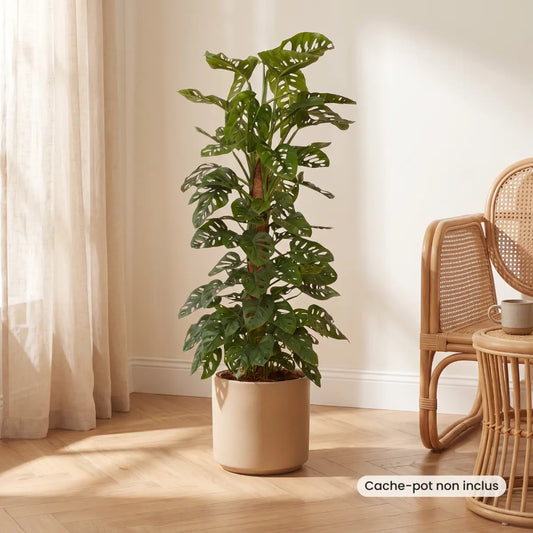
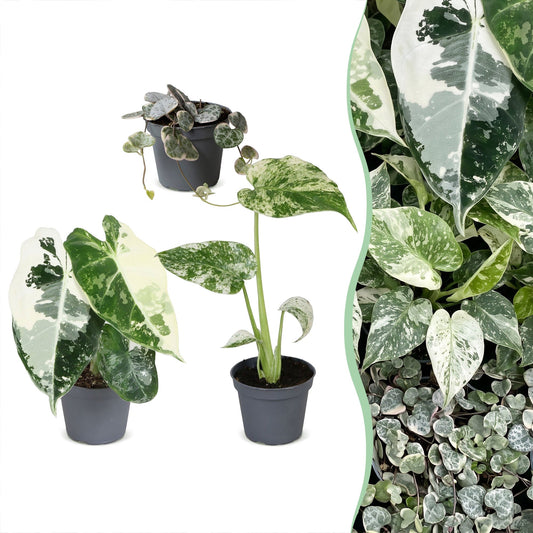
Monstera Variegata: The Complete Guide to Buying One Wisely

A Monstera Variegata is a Monstera whose foliage has variegation (light-colored areas) caused by a mutation. Beautiful, but more demanding than a green Monstera: whether you're shopping our Monstera collection or elsewhere, the key to a successful purchase is choosing the right variety and knowing how to assess its variegation before you buy.
This guide will help you choose between Thai Constellation, Albo and Aurea, recognize a healthy plant, understand reversion, and master its care (substrate, light, humidity) to keep its variegation stable.
What is a Monstera Variegata?
A Monstera Variegata is a Monstera deliciosa in which certain cells do not produce chlorophyll, creating white or cream-colored patches on the leaves. Like the classic Monstera, it is a climbing, hemiepiphytic plant in the Araceae family.
Indoors, a Monstera Variegata can climb to 2 to 3 meters with a support and develop leaves 30 to 40 cm across once mature. It grows more slowly than a green Monstera because variegation reduces the surface area that captures light.
This variegation is a mutation that makes the plant slower-growing and more fragile, because the white areas do not photosynthesize. A completely white leaf cannot survive without chlorophyll. This explains its price and the special care it requires.
Albo, Thai Constellation or Aurea: which variety should you choose?
For beginners, Thai Constellation is the safest choice: its variegation is genetically stable and does not disappear, unlike Albo and Aurea, which are chimeric and can revert. Here are the three leading varieties.
Prices for a Monstera Variegata range from a few dozen euros to over 100 euros, depending on the variety, size and number of variegated leaves. Thai Constellation, which is lab-produced, is often more consistent and a little more affordable than Albo, whose price rises with its rarity, making it a sought-after collector's plant.
| Variety | Variegation and stability | Best for |
|---|---|---|
| Thai Constellation | Cream, genetically STABLE (does not revert) | Ideal for beginners |
| Albo Borsigiana | White, chimeric and UNSTABLE (may revert) | Experienced plant enthusiasts |
| Aurea (Marmorata) | Golden yellow, chimeric and unstable like Albo | Patient collectors |
If you're new to variegated plants, I wholeheartedly recommend Thai Constellation over Albo: its variegation is stable, it doesn't revert, and it can handle small mistakes. Albo is beautiful but temperamental, so I reserve it for people who have already successfully grown an aroid. I've been growing and testing these varieties for years, and Thai is still my number-one recommendation for a first purchase.
Variegation, chimeras and reversion: what you need to know
In Albo and Aurea, variegation is “chimeric”: the plant contains two types of cells (with and without chlorophyll), an unstable balance that can shift toward all-green growth. This is called reversion. Thai Constellation, on the other hand, has variegation encoded in its DNA, so it is stable.
Understanding this mechanism changes everything about plant care: you can't “fix” a leaf that has reverted. Instead, take preventive action by providing enough light and pruning in the right place. A well-lit plant retains its variegation much better over the long term.
One point that is often poorly explained: “Borsigiana” is not a different species from Monstera deliciosa. According to Plants of the World Online (Kew), it is not a distinct species but a synonym of Monstera deliciosa (Kew does not recognize it at the variety rank); the difference lies in the growth habit and stem spacing, not the species.
How to recognize a healthy plant when buying
Before buying, check that the stem itself is variegated (not just one leaf), that the balance of green and white is reasonable, and that the roots are healthy. This is what ensures the plant will thrive over time.
Beware of overly flattering photos: one highly variegated leaf can hide an unbalanced plant whose other leaves are all green or, conversely, too white and therefore fragile. Assess the stem, leaves and roots as a whole, never just one spectacular detail. A reputable seller will be happy to show you the plant from every angle before you buy.
| What to check | Why it matters |
|---|---|
| Variegation on the stem | It ensures the next leaf will remain variegated |
| Balance of green and white | Too much white = a fragile plant with little photosynthesis |
| Roots | Firm and light-colored, never soft or blackened |
| No pests | Inspect the undersides of the leaves and the stems |
How to read variegation on the stem: the key step
The real secret to a successful purchase is to look at the bud: the variegation line must run through the axillary bud (where the next leaf will emerge) for the next growth to remain variegated. A green stem at the bud will produce a green leaf.
It takes a little practice to read this, but it can make the difference between a successful purchase and a disappointment. On a well-established plant, you'll see the variegation “run down” the stem to the newest nodes: this is a sign that the mutation is stable and will carry through to the next leaves.
The right substrate for a Monstera Variegata
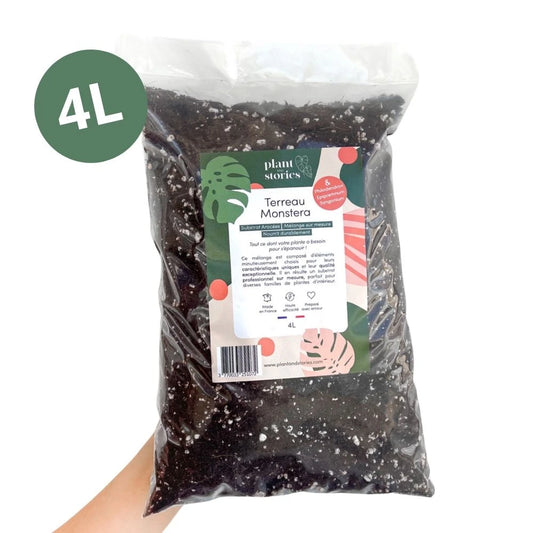
A Monstera Variegata needs an airy, well-draining substrate for aroids, never compact potting soil that suffocates the roots. Aim for a mix that retains a little moisture while allowing air to circulate.
As a rule, repot every 2 years in spring, using a pot only slightly larger and one that has drainage holes. An oversized pot holds too much water around the roots and encourages rot, a real risk for a plant already weakened by its variegation. For step-by-step instructions, see our Monstera repotting guide.
| Component | Purpose |
|---|---|
| Pine bark | Aeration and drainage |
| Perlite | Prevents the substrate from compacting |
| Sphagnum moss or coco fiber | Retains moisture without waterlogging |
| Aroid substrate | Ready-to-use, balanced mix |
columns: 4
columns_mobile: 2
-
Monstera Soil - Enriched with Mycorrhiza and Bacillus - Araceae Substrate
Regular price From 9,50 €Regular price23,75 €Sale price From 9,50 €Sale -
Transparent climbing plant support - Pack of 3 + free velcro (Monstera, Pothos)
Regular price From 9,99 €Regular price13,89 €Sale price From 9,99 €Sale -
Plant Addict Living Sphagnum Pack - Sphagnum for Plants - Sphagnum Moss - 3 Sachets
Regular price 26,50 €Regular price28,50 €Sale price 26,50 €Sale -
Set of Transparent Araceae Pots - Transparent Growing Pots for Plants
Regular price From 8,97 €Regular price9,75 €Sale price From 8,97 €Sale






Light, watering and humidity
Variegation needs more light than a green Monstera, because there is less chlorophyll to capture energy: aim for bright, indirect light, with no direct sun, which can burn the white areas. Here are some guidelines.
In practice, in summer you may need to water every 7 to 10 days, and cut back considerably in winter when the plant slows down. It's better to let the substrate dry slightly on the surface than to keep it constantly wet: a Monstera Variegata hates having its roots sitting in water.
| Factor | Guideline |
|---|---|
| Light | Bright and indirect, about 6 hours a day |
| Watering | When the top 2 to 3 cm of substrate are dry |
| Humidity | Above 60% |
| Temperature | Between 18 and 27 °C, never below 13 °C |
📋 Quick care facts (for experienced gardeners)
The plant's essential care guidelines at a glance.
| Factor | Guideline |
|---|---|
| Type | Climbing hemiepiphyte (Araceae) |
| Variegation | Mutation; stable (Thai) or unstable chimeric (Albo, Aurea) |
| Light | Bright, indirect, ~6 hours/day; no direct sun |
| Temperature | 18 to 27 °C; never below 13 °C |
| Humidity | Above 60% |
| Substrate | Airy and well-draining (bark, perlite, sphagnum) |
| Watering | When the top 2–3 cm are dry |
| Repotting | About every 2 years, in spring |
| Toxicity | Toxic if ingested (pets, children) |
Caring for your Monstera Variegata throughout the seasons
Care follows the rhythm of the light: feed and water more during the warmer months, then scale back in winter. Here's the schedule.
A diluted fertilizer every 2 to 4 weeks from spring through summer is plenty; stop fertilizing altogether in winter. Too much fertilizer burns the roots and won't speed up growth, which is naturally slow in variegated varieties.
📅 Seasonal care calendar
| Season | Key task |
|---|---|
| 🌸 Spring | Growth resumes; repot if needed; restart diluted fertilizer. |
| ☀️ Summer | Water more often; mist; keep out of direct sunlight. |
| 🍂 Fall | Water less often; gradually stop fertilizing. |
| ❄️ Winter | Reduce watering; provide maximum light (short days); no fertilizer. |
Troubleshooting: reversion, spots and struggling roots
Most Monstera Variegata problems are easy to diagnose: loss of variegation, dry edges or limp leaves each have a simple cause. Here's what to do.
In most cases, the solution is the same: adjust the light, review your watering schedule and check the drainage. A Monstera Variegata whose needs are understood is actually surprisingly resilient, and rewards patience with increasingly spectacular leaves.
| Symptom | Likely cause and solution |
|---|---|
| Variegation disappears (reverts to green) | Not enough light or pruning beyond a green node; prune back to a variegated node |
| Brown, dry leaf edges | Air too dry; increase humidity |
| Yellow, limp leaves | Overwatering; let the substrate dry out and check drainage |
| A white area turns brown | Tissue without chlorophyll is fragile: keep it out of direct sunlight |


Laura Bruneau
Jardinière & autrice