Peperomia: Care, Watering, Propagation, and Varieties (Guide)

To care for a Peperomia, place it in bright light but out of direct summer sun, plant it in a very airy potting mix, and water only when the soil has partially dried out, reducing watering in winter. The genus Peperomia, in the Piperaceae family (the pepper family), comprises compact plants with thick leaves that store water—which is why overwatering kills them far more often than neglect.
This guide draws on Kew, the RHS (Royal Horticultural Society), NC State Extension (North Carolina State University), Clemson University Extension, and the ASPCA. You’ll find practical guidance on light and temperature, leaf propagation, diagnosing falling leaves, and the varieties we grow.
🌿 Why choose a Peperomia?
Peperomia is an ideal plant for small spaces: most varieties stay compact (about 20 to 30 cm for P. argyraea or P. polybotrya, according to Clemson) and fit on a desk, shelf, or windowsill. Its leaves offer a rare variety within a single genus: round and glossy, puckered, striped like a watermelon, or marbled like a tortoiseshell.
It tolerates the dry air in our homes better than many tropical plants and forgives the occasional missed watering. What’s more, the best-selling species are classified as non-toxic to cats and dogs—a real plus in a home with pets.
| Benefit | What it means for you |
|---|---|
| Compact size | A decorative plant that fits on a desk or shelf without taking over |
| Water-storing leaves | Missing a watering causes no harm, unlike with a fern |
| Non-toxic to pets | P. obtusifolia, argyreia, and caperata are listed as non-toxic by the ASPCA |
| Leaf propagation | A single leaf with its petiole is enough to grow a new plant |
🔎 Peperomia at a glance
According to Kew (Plants of the World Online, genus Peperomia), the genus Peperomia Ruiz & Pav. is an accepted name in the Piperaceae family, with 1,447 accepted species found throughout the world’s tropical and subtropical regions.
The RHS notes that most peperomias grown indoors come from tropical rainforests, where many grow as epiphytes on trees. Note the name of the watermelon variety: Kew recognizes Peperomia argyraea; argyreia, the spelling most commonly used in garden centers, is a synonym.
Finally, Pilea peperomioides (Chinese money plant) is not a Peperomia: it’s a different genus in the Urticaceae family, which we cover in our Pilea peperomioides care guide.
| Characteristic | Verified details |
|---|---|
| 🏷️ Botanical name | Peperomia Ruiz & Pav., a genus accepted by POWO (1,447 species) |
| 🧬 Family | Piperaceae, the pepper family |
| 🌳 Type | Herbaceous perennials or epiphytes, often with semi-succulent fleshy leaves |
| 🌍 Origin | Tropical and subtropical regions; indoor species mostly come from tropical America |
| 🍃 Foliage | Thick, smooth, puckered, striped, or marbled depending on the species; evergreen |
| 🌸 Flowers | Thin cream or green spikes, not very ornamental according to the RHS |
| 📏 Size | About 20 to 60 cm depending on the species (Clemson, NC State); trailing stems reach 30 cm on P. prostrata |
| ⚠️ Toxicity | Non-toxic to cats and dogs according to the ASPCA (P. obtusifolia, argyreia, caperata) |
📋 Quick care guide
Essential growing guidelines, all at a glance.
| Factor | Guideline |
|---|---|
| Light | Bright, indirect; east- or west-facing window, winter sun is fine |
| Watering | When the potting mix has partially dried out, check with your finger; empty the saucer |
| Potting mix | Very airy: potting soil, perlite, and bark; cactus mix for succulent varieties |
| Humidity | Tolerates average indoor air; appreciates higher humidity (a tray of damp pebbles) |
| Temperature | 18 to 30 °C (RHS); at least 10 °C for species from dry habitats |
| Repotting | Every 2 to 3 years in spring, when the roots fill the pot |
| Fertilizer | Half-strength liquid fertilizer every 2 weeks from April to October (RHS) |
| Toxicity | Non-toxic to cats and dogs (ASPCA) |
| Difficulty | Easy, as long as you don’t overwater |
📍 Where to place a Peperomia and when to bring it home
Where should you place a Peperomia?
Near a bright window, out of harsh direct sunlight: the RHS recommends an east- or west-facing windowsill, or a spot set back from a south-facing window, as direct summer sun can scorch the foliage, while winter sun is well tolerated. NC State Extension notes that P. obtusifolia can tolerate several months of low light without stress, but variegated or colorful varieties lose their vibrancy.
📍 Ideal location: Near an east- or west-facing window, on a shelf or bright desk; a bright bathroom or terrarium suits species that like humid air, according to the RHS.
🕰️ Best time: Spring, when growth begins—the ideal time to repot or bring home a new plant.
🌡️ Heated room: A room kept between 18 and 30 °C, away from radiators and cold drafts; succulent forms prefer a slightly cooler winter, but temperatures should not fall below 10 °C.
🪴 How to repot a Peperomia step by step
The mix recommended by the RHS combines two parts peat-free ericaceous potting mix, one part perlite, and one part medium-grade pine bark; for succulent peperomias, cactus mix is sufficient. The roots are fine and sparse: an oversized pot stays wet and encourages rot.
Repot in spring, roughly every 2 to 3 years, only when the roots fill the pot.
| Step | What to do |
|---|---|
| 1. Check | Repot only if roots are coming out of the drainage hole or have completely filled the root ball. |
| 2. Choose a pot | One only slightly larger in diameter, with a drainage hole; terracotta helps the potting mix dry out. |
| 3. Prepare the mix | Airy potting mix with perlite and bark, including for P. prostrata; reserve cactus mix for succulent forms from dry habitats. |
| 4. Plant | Set the root ball at the same level as before, without packing the mix down firmly or burying the crown. |
| 5. Water lightly | Moisten the mix without soaking it, then let it drain before putting the plant back in its cachepot. |
columns: 4
columns_mobile: 2


✂️ Everyday Peperomia care
Peperomia care mostly comes down to watering: the RHS advises letting the potting mix partially dry out between waterings and always checking it with your finger rather than watering out of habit. Is it a succulent? Not quite: it’s a semi-succulent tropical plant, whose thick leaves store water, which is why it needs careful watering.
💧 Watering: Water thoroughly when the top few centimeters of potting mix are dry, then empty the saucer: standing water leads to root rot.
💧 Humidity: It appreciates more humid air: place the pot on a wide tray of damp pebbles or group your plants together rather than misting.
🌱 Fertilizer: Half-strength liquid fertilizer every 2 weeks from April to October, according to the RHS; none in winter.
🧹 Cleaning: Wipe smooth leaves with a damp cloth to remove dust and keep them glossy.
👀 Check regularly: Inspect the undersides of the leaves and the stems: mealybugs, spider mites, and whiteflies are the pests listed by NC State Extension.
🍂 Watering a Peperomia through the seasons
How should you water a Peperomia throughout the year? From spring through fall, water when the surface of the potting mix has dried out, without following a fixed schedule: frequency depends on light, warmth, and pot size. In winter, growth slows and the RHS recommends watering less.
Succulent species from dry habitats appreciate a slightly cooler room then, but never below 10 °C. Clemson Extension notes that Peperomia can spend the summer outdoors when nighttime temperatures stay above about 15 °C (60 °F).
📅 Seasonal care calendar
| Season | Key task |
|---|---|
| 🌸 Spring | Repot if needed, take leaf and stem cuttings, resume fertilizing in April |
| ☀️ Summer | Water after the mix partially dries, fertilize every 2 weeks, protect from direct sun |
| 🍂 Fall | Gradually water less often; apply the last dose of fertilizer in October |
| ❄️ Winter | Reduce watering, keep in a bright, heated room; at least 10 °C for succulent forms |
🌱 How to propagate Peperomia
Peperomia is very easy to propagate from a leaf or stem, ideally in spring and summer. Leaf cutting: Clemson University Extension recommends taking a leaf with at least 2.5 cm (1 inch) of petiole and inserting it into a propagation mix; new plants grow from the base of the petiole.
The RHS notes that some peperomias with fleshy leaves can be propagated this way; P. obtusifolia is one example. Stem cutting: Clemson recommends taking sections about 8 to 13 cm (3 to 5 inches) long, removing their lower leaves, and placing them in a light potting mix under a humidity dome in indirect light.
For P. prostrata, NC State Extension recommends leaf propagation; in practice, a stem cutting placed on the potting mix will also root. Deciding between water and potting mix? Compare the two methods in our guide to propagating in water or potting mix.
🐛 Common problems: causes and solutions
Why is a Peperomia losing its leaves? In most cases, it’s overwatering: Clemson notes that an overwatered Peperomia drops its leaves, while NC State Extension says excess water turns the foliage yellow and causes root rot. Here are the most common symptoms and what to do about them.
| Symptom | Likely cause | Solution |
|---|---|---|
| Falling leaves, soft stems at the base | 🍄 Overwatering, root rot | Let the mix dry out, remove the plant from its pot, cut away brown roots, and repot in dry mix; see our root rot guide |
| Yellow, soft leaves | ⚠️ Potting mix too wet or pot without drainage | Water less often, empty the saucer, and choose a pot with drainage holes |
| Brown leaf tips | 💧 Fluoride in tap water (RHS) or very dry air | Water with rainwater or filtered water and set the pot on a tray of damp pebbles |
| Discolored leaves, dry patches | ☀️ Direct summer sun through the window | Move the plant farther from the window or filter the light with a sheer curtain |
| Elongated stems, sparse and dull leaves | ☀️ Not enough light | Move the plant closer to an east- or west-facing window, then propagate the overly long stems |
| White, cottony clusters in the leaf axils | 🐛 Mealybugs | Remove them with a cotton swab dipped in alcohol, isolate the plant, and check it weekly |


🌸 Our Peperomia varieties
The genus includes more than 1,400 species, but only about ten are commonly found in garden centers. Here are the ones we grow, along with their verified features.
| Variety | What makes it special |
|---|---|
| Peperomia prostrata (string of turtles) | An epiphytic species from Ecuador (POWO) with round leaves less than 2.5 cm across, marbled like a tortoiseshell; trailing stems about 30 cm long; NC State Extension recommends keeping its potting mix slightly moist, never waterlogged |
| Peperomia 'Crème Brûlée' | Described as a selection of P. obtusifolia, with fleshy golden-to-cream leaves; compact size that suits a desk |
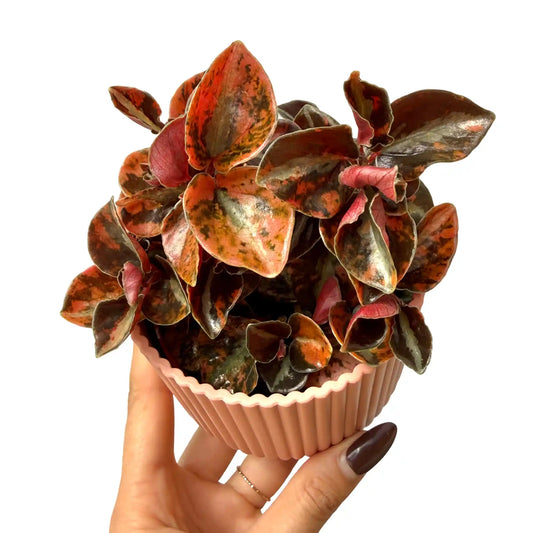
| Peperomia obtusifolia | The hardiest species, native to Florida and tropical America: thick, glossy leaves; grows up to 60 cm according to NC State; also available in a variegated form |
| Peperomia argyraea (watermelon) | Silver-striped leaves resembling watermelon skin, native to Brazil; grows to about 20 cm tall according to Clemson |
| Peperomia caperata 'Rosso' et P. polybotrya 'Raindrop' | 'Rosso' has quilted leaves with red undersides (a species from southeastern Brazil); 'Raindrop' has glossy, raindrop-shaped leaves and grows to about 30 cm according to Clemson |
| Peperomia sarcophylla et 'Obtipan' | P. sarcophylla (accepted name according to Kew: P. pseudovariegata var. sarcophylla) has small, very fleshy leaves; 'Obtipan' is a compact commercial cultivar with thick foliage |
🎨 What plants pair well with a Peperomia?
Peperomia pairs well with plants that thrive in bright, indirect light and need moderate watering. For a shelf of trailing plants, String of Turtles pairs well with String of Hearts (Ceropegia woodii) and Hoya linearis, which also prefer a well-draining potting mix.
Small species such as P. prostrata or P. caperata also work well in an open jar terrarium: read our guide to terrariums: humidity and condensation before you get started.
To create a jungle that’s safe for your pets, check out our selection of non-toxic plants for dogs and browse all our Peperomia.
⚠️ Is Peperomia toxic to cats and dogs?
No, not for the best-selling species—and this has been verified species by species. The ASPCA (American Society for the Prevention of Cruelty to Animals) lists Peperomia obtusifolia (baby rubber plant), Peperomia argyreia (watermelon) and Peperomia caperata as non-toxic to cats and dogs.
For P. prostrata, which is not listed in the ASPCA database, NC State Extension says it is non-toxic to cats and dogs. We couldn't find toxicity information for P. polybotrya or P. sarcophylla: Clemson only says that most peperomias are considered safe for pets.
As with any plant, ingesting a large amount may cause digestive upset: contact your veterinarian if symptoms occur.
✅ Our expert tips for success
A thriving Peperomia comes down to three things: bright light without scorching sun, a very airy potting mix in a pot with drainage holes, and watering only after the soil has partially dried out. At the first sign of distress, check the potting mix and the base of the stems first, as excess water is responsible for most leaf drop.
Keep it between 18 and 30 °C, water with rainwater if possible, and propagate a leaf to grow more of your favorite varieties.
Peperomia is the plant I add to every office arrangement: it stays small and tolerates the dry air of an open-plan office well. My most useful tip is to lift the pot before watering: if it feels light, it’s time; otherwise, wait. And I love giving away an obtusifolia leaf stuck in a small pot—the wonder of watching an entire plant grow from its petiole never wears off.

Laura Bruneau
Jardinière & autrice