How to use an LED grow light for your indoor plants?

Using a LED grow light properly isn't just about plugging it in above a pot. Distance, duration, spectrum, and settings determine the result. When properly adjusted, it stimulates growth and flowering even in a dimly lit room.
This practical guide details every step: where to place the light, how far from the foliage, how many hours a day, and what mistakes to avoid so you never stress your plants.
columns: 4
columns_mobile: 2
-
Horticultural lamp for indoor plants - Horticultural growth lamp - Full spectrum plant lamp with 2 bulbs
Regular price 49,99 €Regular price54,99 €Sale price 49,99 €Sold out -

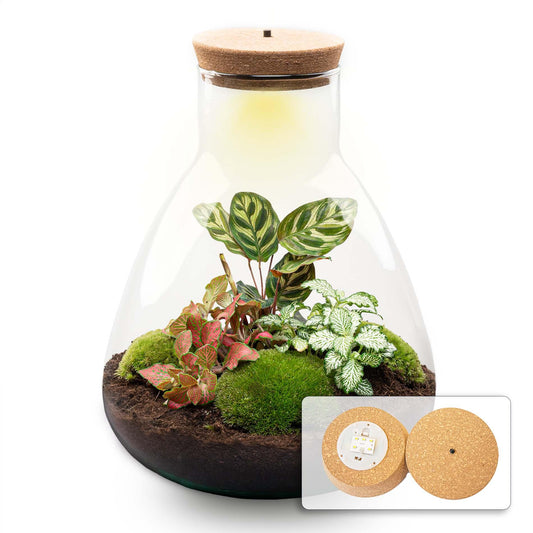
Luminous Calathea and Fittonia terrarium kit, Erlenmeyer flask with LED stopper, 30 cm high
Regular price From 104,95 €Regular price -

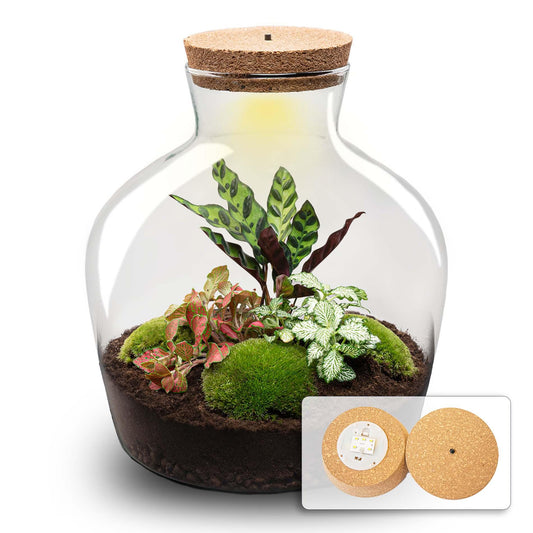
Large illuminated Calathea and Fittonia terrarium kit, 29 cm diameter jar with LED stopper, with or without tools
Regular price From 104,95 €Regular price -


Illuminated bonsai Ficus Ginseng and Fittonia terrarium kit, glass bottle with LED cork, 25 cm high
Regular price 79,95 €Regular price -
8 L recycled glass terrarium bottle with LED stopper, Ø 23 cm, height 25 cm
Regular price 54,95 €Regular price


💡 What is a grow light really used for on a daily basis?
It replaces or supplements sunlight to enable photosynthesis where natural light is lacking. According to the RHS (Royal Horticultural Society), artificial lighting is particularly useful in winter and in dark rooms.
In practical terms, a LED grow light supports three uses: reviving plants that are leggy, ensuring the success of seedlings and cuttings, and maintaining flowering during the cold season. Each of these uses relies on proper adjustment rather than an overly powerful light.
This is where success is determined: a correctly installed light transforms a dark corner into a growing space, while a poorly placed light wastes energy without benefiting the plants.
| Use | What the light enables |
|---|---|
| Houseplants | steady growth away from windows, without stretched stems |
| Seedlings and cuttings | even rooting, 14 to 16 hours a day |
| Winter flowering | reviving orchids, 10 to 12 hours a day |
📏 How far should you place the light from your plants?
For a compact LED, allow 20 to 40 cm above the foliage. Too close, and the light can burn the leaves; too far, and it loses most of its effectiveness.
The right distance depends on the plant's stage and the light's power. Observe the foliage: pale or burned leaves indicate a light that is too close, while stretched stems betray light that is too far away.
This setting is not fixed. As the plant grows, the distance changes, making a light whose height can be easily adjusted essential.
| Plant stage | Recommended distance |
|---|---|
| Seedlings and young shoots | 20 to 30 cm, close and stable light |
| Growing plants | 30 to 40 cm to cover broader foliage |
| Flowering plants | to be adjusted according to sensitivity, orchid or Monstera |
⏱️ How many hours a day and what cycle?
Allow on average 12 to 16 hours of light per day, never 24 hours a day. Plants need a period of darkness to rest and regulate their metabolism, as the RHS reminds us.
The ideal duration depends on the growth phase. A seedling requires long days of light, while a flowering plant prefers shorter days. A timer automates this cycle and guarantees a regularity that the human hand often forgets.
Respecting the alternation between day and night is not a minor detail: it is this regularity that structures growth and prevents the plant from becoming exhausted over the long term.
| Phase | Light duration per day |
|---|---|
| Seedlings and young shoots | 14 to 16 hours |
| Vegetative growth | 12 to 14 hours |
| Flowering or winter maintenance | 10 to 12 hours |
columns: 4
columns_mobile: 2
-
Monstera Soil - Enriched with Mycorrhiza and Bacillus - Araceae Substrate
Regular price From 9,50 €Regular price23,75 €Sale price From 9,50 €Sale -
Plant Addict Living Sphagnum Pack - Sphagnum for Plants - Sphagnum Moss - 3 Sachets
Regular price 26,50 €Regular price28,50 €Sale price 26,50 €Sale -
Duo - Universal Substrate 10L + Universal Liquid Fertilizer 250ml + free graduated pipette
Regular price 32,00 €Regular price37,00 €Sale price 32,00 €Sale -
Set of Transparent Araceae Pots - Transparent Growing Pots for Plants
Regular price From 8,97 €Regular price9,75 €Sale price From 8,97 €Sale





🎛️ How to set the intensity and timer?
Adapt the intensity to the number of plants and their sensitivity, then rely on a timer for the rhythm. Light that is too strong stresses an orchid just as light that is too weak causes a seedling to become leggy.
Useful intensity is, moreover, judged less by watts than by the light actually received by the foliage, a measure called PPFD, which is detailed by INRAE. Two lights of the same power can illuminate very differently depending on their quality and distance.
A few simple accessories significantly improve the daily result, especially in a dark corner where every photon counts. They cost little and prevent many disappointments.
| Setting or accessory | Its role |
|---|---|
| Timer or programmable outlet | respect a regular day/night cycle without thinking about it |
| Variable intensity | moderate the light for sensitive plants |
| Reflector | concentrate the light on the foliage in a dark corner |
🚫 What mistakes to avoid with a grow light?
The first mistake is to leave the light on continuously, which exhausts the plant instead of helping it. Three pitfalls occur most often and can be corrected in a few seconds.
A quick visual check each week is enough to spot these mistakes before they permanently damage the plant. The table below summarizes them with the solution.
| Common mistake | Consequence | Solution |
|---|---|---|
| Light 24 hours a day | exhausted plant, slowed growth | respect 8 to 12 hours of darkness |
| Light too close | burned or pale leaves | raise the light to at least 30 cm |
| No timer | irregular cycles, stress | install a programmable outlet |

☀️ Grow light or window light: which to choose?
The two complement each other rather than opposing each other. Window light remains valuable, but it varies depending on orientation, weather, and season, making it unpredictable for a demanding plant.
A grow light, on the other hand, provides stable and controllable light, independent of the sky. It also illuminates areas that no window reaches, such as a hallway or an interior wall. In winter, when the length of the day drops, it naturally takes over.
The best strategy is to use the window as a base and the light as reinforcement: a few hours of extra light in the morning and evening during the shoulder seasons, and a main lighting of 12 to 14 hours a day in the heart of winter. You thus offer your plants regular light all year round.
However, be careful with direct light from a south-facing window in summer: combined with a light, it can burn some sensitive foliage. In this case, move the plant away from the window or reduce the duration of artificial lighting to preserve the balance, even if you have to shift the light to the least sunny hours of the day.
🌱 How to adapt the light to your plants?
Not all plants have the same light requirements, and the same light is adjusted differently depending on the species grown. An orchid, an aromatic plant, and a succulent do not require the same intensity or duration.
Understory plants, such as Calathea, prefer moderate and diffused light; aromatic plants and young seedlings demand more intense light and long days; cacti and succulents, high-light plants, on the contrary, require long days and a fairly close light. Observing the reaction of the foliage remains the best guide for adjustment.
In practice, group plants with similar needs under the same light. You simplify the settings and avoid burning the most sensitive while feeding the hungriest.
A word on seedlings, which are very demanding of light: placed too far from the light, they become leggy and weak. Move the light closer to 20 to 30 cm and give them 14 to 16 hours a day to obtain stocky plants, ready to be repotted. This is often where a grow light makes its most visible difference.
| Plant type | Recommended setting |
|---|---|
| Understory plants (Calathea) | moderate light, 10 to 12 hours a day |
| Aromatic plants and seedlings | intense light, 14 to 16 hours a day |
| Cacti and succulents | 12 to 14 hours a day, intense light, fairly close light |
🔌 How to install the light safely?
A careful installation protects your plants as well as your home. Three simple precautions are enough to avoid common incidents with artificial lighting.
First, ensure the stability of the light to prevent it from falling on a pot or a piece of furniture. Then, keep water splashes away from the bulbs and electrical components, especially during watering or misting. Finally, provide good air circulation around the plants, especially in a confined space.
A LED heats up very little, but a monthly check of the cable and the outlet remains a good habit. These actions take a few minutes and extend the life of your equipment, often rated up to 25,000 hours.
In a closed room, also remember to ventilate regularly. A stagnant atmosphere promotes excessive humidity and foliage diseases, even under perfect lighting. A few minutes of ventilation a day is enough to maintain healthy air around the plants.
✅ Our tips for getting started
Place the light 20 to 40 cm from the foliage, set 12 to 16 hours a day depending on the phase, and always give your plants a night. Observe each week and adjust the height: it is the best setting there is.
With these few guidelines, a LED grow light becomes a reliable ally for growing all year round, even in the least luminous rooms. Regularity always trumps raw power.
Finally, keep a small notebook of the settings that work for your plants: the distance, the duration, and the position that suits them. You will save valuable time at each change of season and easily reproduce your best results from one year to the next.
At first, I left my light on almost constantly thinking I was doing the right thing. My plants stagnated. Since I have been following a 14-hour cycle with a simple timer, the difference is clear: denser foliage, steady growth. The right rhythm matters as much as the right light.

Laura Bruneau
Jardinière & autrice