

Moisture Meter for Houseplants: Mastering Watering

A plant moisture meter is the little probe that takes the guesswork out of watering: instead of guessing whether the potting mix is dry, you measure it. It enforces a simple rule: water according to the actual condition of the potting mix, never on a fixed schedule. Find our accessories in our gardening tools. By measuring the actual moisture in the potting mix and air, a moisture meter eliminates guesswork: water when the plant needs it, neither too much nor too little. This helps prevent the leading cause of houseplant death—overwatering—and maintain a comfortable humidity level of 40 to 60%.
This guide explains why a moisture meter is your ally in successful watering, how to choose between a soil probe and a room sensor, how to use it with a suitable potting mix, and which care habits to adopt.
Why is a moisture meter your plants’ best ally?
A moisture meter measures the actual moisture in the potting mix, making it the best defense against the leading cause of houseplant death: overwatering. It turns guesswork into an informed decision.
Watering on a fixed schedule—for example, every Sunday—ignores light, temperature, and ambient humidity, all of which can greatly affect a plant’s needs. The finger test is useful, but only tells you about the top few centimeters. A probe measures at root level, where it matters. The New York Botanical Garden also explicitly recommends using a moisture meter to make sure humidity stays within the target range.
Technically, most soil probes don’t measure water directly; they measure the electrical conductivity of the potting mix. Because water conducts electricity better than air, moist potting mix produces a higher reading. It’s simple, reliable, and battery-free for analog models. This technology also explains why a probe needs to be inserted in the right place: an air pocket or a root can temporarily skew the reading, so it’s a good idea to take measurements in several spots in larger pots.
Soil probe or room sensor: which tool should you choose?
There are two types of devices that are often confused: a soil probe, which measures moisture in the potting mix, and a room sensor, which measures air humidity. They answer two different questions. For more information, see a reliable hygrometer.
A soil probe answers the question, “Should I water?” A room sensor answers, “Is the air humid enough for my tropical plants?”—a crucial question for Calatheas and Anthuriums, which need more than 60% relative humidity. Many plants benefit from both measurements. Some devices even combine both functions, allowing you to monitor watering and the room’s conditions with a single tool—very handy in a spot where several demanding plants are grouped together.
| Tool | What it measures | Purpose |
|---|---|---|
| Soil probe | Moisture in the potting mix | Decide when to water |
| Room sensor | Air humidity | Adjust humidity levels |
| Analog model | Electrical resistance | Simple, battery-free |
| Digital model | Precise numerical reading | Detailed readings |
A moisture meter has saved more plants for my clients than any fertilizer. Most people overwater out of affection. The probe settles the matter: we water only when it says to. I always recommend keeping it as a learning tool, so you can eventually understand each plant’s rhythm and water at the right time, even without it.
How do you use your moisture meter correctly?
The process is simple but precise: insert the probe vertically, about two-thirds of the way down the pot, as close to the roots as possible, without forcing it past a stone. Wait about 60 seconds for the needle to settle, then take a reading.
Most dials run from 1 (dry) to 10 (wet). Then adjust according to the plant: an aroid like a Monstera likes to stay between 5 and 6, while a cactus or succulent should dry out almost completely, to around 1 or 2, before the next watering. In general, test every 7 to 10 days. Horticultural extension services, such as the University of Arkansas Cooperative Extension Service, also present moisture meters as a practical way to learn about watering and better understand how well your potting mix drains.
columns: 4
columns_mobile: 2
-
Digital Thermometer Hygrometer
Regular price From 5,99 €Regular price5,99 €Sale price From 5,99 € -
Plant sprayer, mist spray bottle, fine mist, 250ml
Regular price From 5,00 €Regular price5,00 €Sale price From 5,00 € -
Graduated watering bulb pipette, precision watering bulb
Regular price From 5,00 €Regular price5,00 €Sale price From 5,00 € -
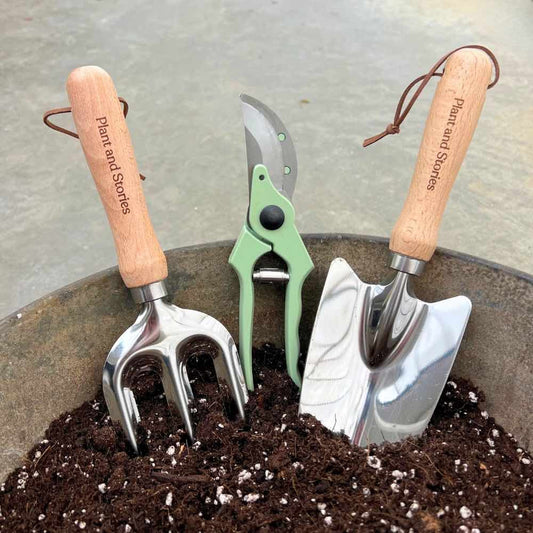
Gardening Tool Kit - Set of 3 Essential Tools - Garden Tool Set
Regular price 15,95 €Regular price29,95 €Sale price 15,95 €Sale




Using a moisture meter with our specialty potting mixes
A moisture meter works best with a good potting mix: in a well-draining, airy mix, the reading accurately reflects the water available to the roots. In compact, waterlogged potting soil, the reading stays artificially high.
That’s why this tool works particularly well with a suitable potting mix: the probe helps you understand how quickly your mix dries out and adjust watering accordingly. It can also reveal drainage problems: if the reading stays at its maximum for several days after watering, the mix may be too dense or the pot may not have drainage holes.
| Reading after watering | Interpretation |
|---|---|
| Rises, then dries in 2–3 days | Healthy, well-draining potting mix |
| Stays at maximum for several days | Potting mix is too dense or pot has no drainage holes |
| Doesn’t change after watering | Dirty probe or hydrophobic potting mix |
📋 Quick reference guide (for experienced gardeners)
Key moisture meter guidelines at a glance.
| Parameter | Guideline |
|---|---|
| How it works | Measures the electrical conductivity (moisture) of the potting mix |
| Depth | ~2/3 of the way down the pot, near the roots |
| Reading time | About 60 seconds |
| Scale | 1 (dry) to 10 (wet) |
| Aroids | Aim for 5 to 6 |
| Cacti / succulents | Let the reading drop to 1–2 |
| Testing frequency | Every 7 to 10 days |
| After use | Remove and wipe the probe |
Using your moisture meter throughout the seasons
Use a moisture meter year-round, checking more often in summer and keeping an eye on dry air in winter.
📅 Seasonal care calendar
| Season | Key action |
|---|---|
| 🌸 Spring | Resume watering: check the potting mix’s moisture before each watering |
| ☀️ Summer | Hot weather: the potting mix dries quickly, so check every 2 to 3 days |
| 🍂 Fall | Water less often; a moisture meter helps prevent overwatering in fall |
| ❄️ Winter | Heating dries the air: monitor ambient humidity and aim for 40 to 60% |


Analog or digital: which should you choose?
For most households, an analog probe moisture meter is more than enough: it needs no batteries and gives an instant reading. Digital models offer a more precise numerical reading, sometimes with light or pH measurements too.
The choice mostly depends on how you plan to use it. If you simply want to know when to water, an analog model is perfect and virtually indestructible. For a collector who wants to track each plant precisely or compare moisture, light, and pH, a 3-in-1 digital model is much more convenient. In either case, the care rule is the same: never leave the probe in the pot.
| Common mistake | Consequence |
|---|---|
| Leaving the probe in the pot | Corrosion and inaccurate readings |
| Relying on a single spot | Unrepresentative reading |
| Ignoring the plant | Misinterpreting the reading |
| Using the same threshold for all plants | Over- or underwatering, depending on the species |
| Feature | Analog | Digital |
|---|---|---|
| Battery | None | Often required |
| Reading | Dial needle | Numerical value |
| Features | Moisture only | Sometimes light and pH |
| Best for | Simple everyday use | Precise tracking and collections |
Troubleshooting: inconsistent readings
When the probe gives strange readings, it’s almost always due to improper use or maintenance. Here’s how to interpret the signs.
| Symptom | Likely cause and solution |
|---|---|
| Always reads “dry,” even after watering | Dirty probe or hydrophobic potting mix |
| Needle jumps | Contact with a stone: test in a different spot |
| Always reads “wet” | Compact potting mix or pot without drainage |
| Reading drifts over time | Corrosion: clean the probe and don’t leave it in the pot |
Used correctly and paired with a good potting mix, a moisture meter helps prevent the two most common watering mistakes: giving a plant too much or too little water. It’s particularly useful for beginners, for whom overwatering out of affection is by far the leading cause of plant loss.
Master watering with Plant and Stories
A moisture meter eliminates the main source of watering mistakes by giving you an objective reading for each plant. Used with a well-draining potting mix and a little observation, it becomes a genuine plant-care ritual.
To put together your toolkit, explore our gardening tools and specialty potting mixes, carefully selected in France. Paired with a little observation, they make watering a simple, manageable task instead of a source of anxiety. Used every day, a moisture meter turns watering into a precise practice rather than a gamble. Get into the habit of checking before each watering, note the readings that work for each plant, and you’ll soon see your plants thrive. It’s a small tool, but it’s often what makes the difference between a plant that merely survives and one that flourishes.

Laura Bruneau
Jardinière & autrice


