

Leyland Cypress: The Complete Guide to a Fast-Growing, Dense Privacy Hedge

🌲 Leyland cypress, champion of fast-growing hedges
When you need to quickly screen off a neighboring property or block prevailing winds, the Leyland cypress has virtually no rival. This hybrid conifer is the fastest of them all: it grows at a spectacular rate and forms a privacy screen in just two to three growing seasons, while other conifers take twice as long.
But this vigor has a downside: without regular maintenance, Leyland cypress quickly becomes an unmanageable giant. This guide explains how to plant it, water it, prune it twice a year and monitor its health, while respecting the legal distances from your neighbors’ properties, so you can enjoy a dense hedge without any unpleasant surprises.
| Characteristic | Leyland cypress at a glance |
|---|---|
| Botanical name | x Cupressocyparis leylandii |
| Growth | Very fast, 60 to 90 cm per year |
| Unpruned height | Can exceed 15 to 20 m |
| Hardiness | -15 to -20 °C |
| Planting distance | 80 cm to 1 m |
🔎 Profile of x Cupressocyparis leylandii
Leyland cypress is a horticultural hybrid created by crossing two conifers, which accounts for its extraordinary growth rate. Its evergreen, dense, deep-green foliage forms compact screens that are highly valued for privacy and wind protection.
As for climate, it tolerates temperatures as low as -15 to -20 °C. It is slightly less hardy than arborvitae, but hardy enough for the vast majority of temperate regions. It grows in full sun and in any well-drained soil, with few requirements when it comes to soil type.
| Criterion | Details |
|---|---|
| Family | Cupressaceae |
| Origin | Horticultural hybrid |
| Foliage | Evergreen, dense, deep green |
| Form | Columnar, vigorous |
| Soil | Any well-drained soil |
| Exposure | Full sun |
🚀 Record-breaking growth
Growing 60 to 90 cm per year, and sometimes nearly a meter in good conditions, Leyland cypress is simply the fastest-growing hedge conifer. This vigor explains its popularity among those who want immediate results.
The catch to know before planting: left unpruned, Leyland cypress can exceed 15 to 20 m in height, or even grow taller. It is a full-fledged tree disguised as a hedge plant. Without regular pruning from the first few years, it quickly becomes too tall to manage without machinery.
The best strategy is to decide on the target height from the outset, for example 2 m, and never let it exceed that height for long, so you can keep the hedge manageable at human height.
📏 Planting distances and legal requirements
Space your Leyland cypresses 80 cm to 1 m apart. There’s no need to plant them closer: their very fast growth will fill in the hedge in no time, while planting too densely only increases root competition without speeding up the results.
Dig a hole about 50 cm wide and deep, loosen the soil at the bottom and make sure water does not pool, as excess moisture weakens the tree and encourages disease. After planting, water generously and apply several centimeters of mulch around the base to retain moisture during the first year.
Finally, keep the regulations in mind: unless neighbors agree otherwise, a hedge over 2 m tall must be planted at least 2 m from the property line, compared with just 0.5 m for a hedge kept below 2 m. Since Leyland cypress grows quickly, it’s best to plan for this from the start.
| Situation | Required distance |
|---|---|
| Between plants | 80 cm to 1 m |
| Hedge over 2 m tall | At least 2 m from the property line |
| Hedge kept at 2 m or less | At least 0.5 m from the property line |
columns: 4
columns_mobile: 2
-

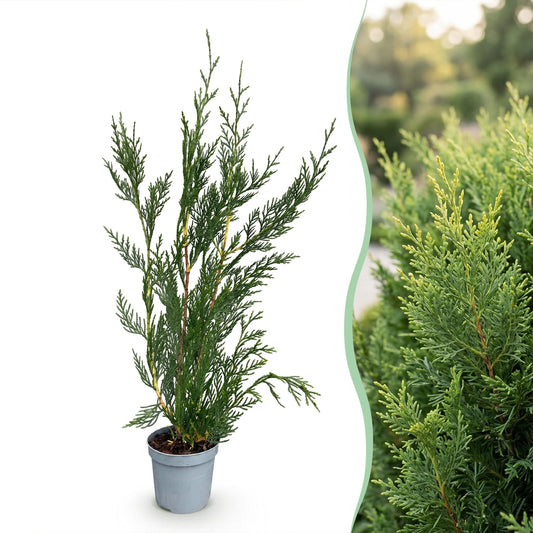
Leyland Cypress 2001 (Cupressocyparis leylandii), evergreen hedging plant, 9 cm pot, Height 30-40 cm
Regular price From 59,95 €Regular price -

 Livraison offerte Sold out
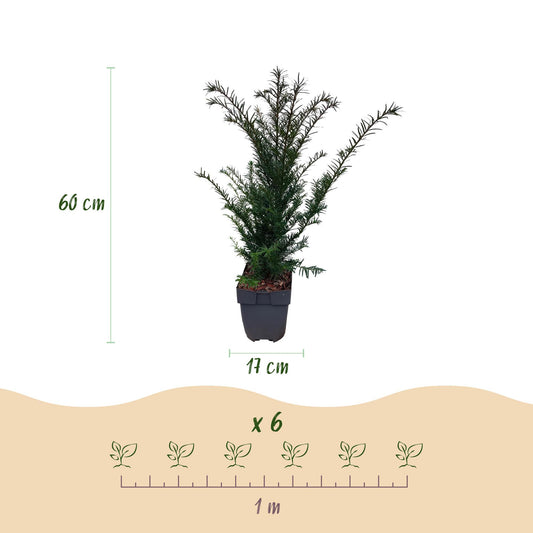
Common yew (Taxus baccata), evergreen hedging plant, 17 cm pot, Height 60 cm - Pack of 6
Regular price 104,95 €Regular price -

 Livraison offerte Sale
Common yew (Taxus baccata), evergreen hedging plant, 9 cm pot, Height 20–30 cm
Regular price From 59,95 €Regular price179,95 €Sale price From 59,95 €Livraison offerte Sale -

 Livraison offerte Sold out
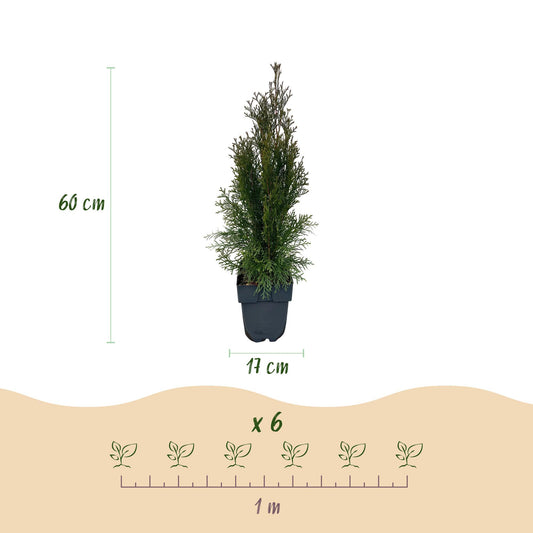
Thuja Smaragd (Thuja occidentalis), evergreen hedge plant, 17 cm pot, Height 60 cm - Pack of 6
Regular price 94,95 €Regular price -

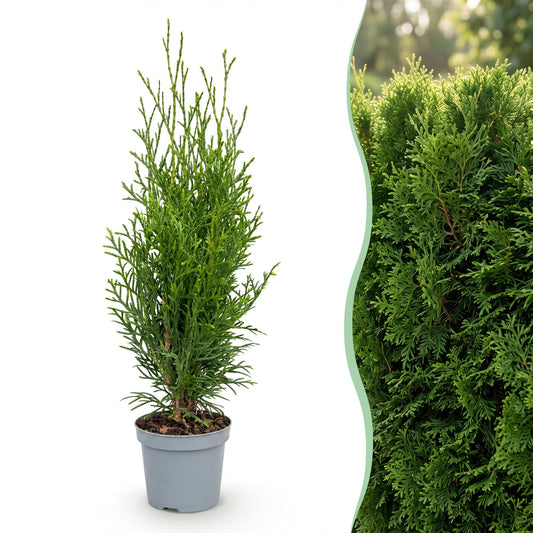
Thuja Smaragd (Thuja occidentalis), evergreen hedge plant, 9 cm pot, Height 20-30 cm
Regular price From 54,95 €Regular price


💧 Watering and soil
Leyland cypress needs less water than arborvitae, but young plants need regular watering. During the first year, give each plant about 10 liters as soon as the soil dries on the surface, to establish a strong root system capable of supporting this rapid growth.
It adapts to any soil as long as it is well drained: standing water is its weak point, as it encourages root suffocation and disease. NC State Extension notes Phytophthora in particular in poorly drained soils. Mulch around the base reduces evaporation and protects shallow roots during dry summers.
Once established, the hedge is fairly self-sufficient, but prolonged water stress during heat waves can cause browning and leave the trees more vulnerable to disease. Consistent watering is therefore better than sporadic heavy watering.
✂️ Pruning: two essential sessions
This is non-negotiable with Leyland cypress: it needs pruning twice a year to keep it under control. Without this discipline, its vigor takes over and the hedge gets out of hand within a few seasons. Ideally, prune once in late spring and again in late summer.
Like arborvitae, Leyland cypress does not grow back from old wood, as the RHS points out: cutting too severely into the brown, leafless part leaves a permanent gap. Always prune into the green growth and shape the hedge regularly from a young age to maintain foliage along its full height.
📅 Seasonal care calendar
| Season | Key tasks |
|---|---|
| Spring | Planting, renewed growth, first formative pruning and fertilizer application. |
| Summer | Second pruning in late summer to control vigorous growth, regular watering of young plants and mulching. |
| Fall | Planting is still possible, gradually reduce watering and check branches for signs of disease. |
| Winter | Dormant period, no pruning, watch for cypress canker and protect young plants from drying winds. |
🍂 Yellowing and cypress canker
A yellowing Leyland cypress is most often suffering from lack of water, especially young plants during dry summers. First, check the soil moisture at depth before considering a more serious cause.
The main disease to know about is cypress canker, caused by the fungus Seiridium (Clemson Cooperative Extension). It enters through wounds, causes resin to ooze from branches and kills entire branches, leaving irreversible brown patches. To reduce the risk, always prune in dry weather and disinfect your tools between plants.
| Symptom | Likely cause | Solution |
|---|---|---|
| Widespread yellowing, dull foliage | Not enough water | Water deeply and mulch around the base |
| Dying branches, resin | Cypress canker (Seiridium) | Cut out affected wood, disinfect tools and prune in dry weather |
| Brown gap after pruning | Pruned too severely into old wood | Avoid this: Leyland cypress does not grow back from old wood |
⚖️ Pros and cons of Leyland cypress
Leyland cypress’s greatest advantage is its speed: it provides a privacy screen in two to three years, faster than any other hedge conifer. Its dense foliage offers excellent privacy and good wind protection.
Its main drawback is the flip side of this strength: it grows so fast that it soon becomes too tall unless pruned twice a year, and it does not tolerate cuts into old wood. It therefore needs consistent care to prevent it from becoming a chore.
| Criterion | Advantage | Drawback |
|---|---|---|
| Growth rate | Privacy screen in 2 to 3 years | Quickly grows too tall |
| Maintenance | Dense, screening foliage | Needs pruning twice a year |
| Pruning | Easy to shape when young | Does not grow back from old wood |
| Soil | Undemanding; grows in any well-drained soil | Susceptible to canker when stressed |
Given its vigorous growth and susceptibility to wind, young Leyland cypress benefits from staking during its first year in exposed locations. A simple angled stake secured on the side facing the prevailing winds prevents the still poorly rooted root ball from being lifted out of the ground during fall gales—a common problem that can jeopardize the establishment of a plant otherwise considered easy to grow.
The real challenge with Leyland cypress is not getting it to grow, but keeping it under control: without pruning, it can exceed 15 to 20 meters. The best approach is to set a target height from the outset (often 2 to 3 m) and never let it get away from you, because you cannot cut a cypress back into old wood without leaving a permanent gap. Two annual pruning sessions, in spring and late summer, are enough to maintain a neat, dense screen over the long term.
🌿 In summary: keeping your Leyland cypress under control
Leyland cypress is unbeatable when it comes to quickly establishing a tall, dense hedge, provided you’re prepared to meet its needs: full sun, well-drained soil, planting 80 cm to 1 m apart, watering during the first year, and, above all, pruning twice a year to keep it at the right height.
Respect legal distances, watch for canker and never cut into old wood: your privacy screen will stay healthy, dense and even for many years. Explore our plants and collections for fast-growing hedges below.


Laura Bruneau
Jardinière & autrice


