

Which Hedge Grows Fastest? A Comparison

Want a hedge that quickly screens out the neighbors, without waiting five years? Not all hedge plants grow at the same rate: some put on 20 cm a year, while others grow nearly a meter. This comparison ranks species by their actual growth rate (in cm per year), then explains which one to choose for your needs—because the fastest isn’t always the best.
Which hedge grows the fastest? The rankings
The fastest-growing hedge is Leyland cypress, at 70 to 80 cm per year, well ahead of other evergreens. Aside from bamboo (which is in a league of its own), most good hedge plants grow between 20 and 60 cm per year. Here’s how the species in our catalog rank.
| Hedge plant | Growth (cm/year) | Foliage |
|---|---|---|
| Leyland cypress | 70 to 80 cm | Evergreen (conifer) |
| Cherry laurel | 30 to 60 cm | Evergreen |
| Photinia ‘Red Robin’ | 30 to 60 cm | Evergreen |
| Oleaster (Elaeagnus) | Moderate growth | Evergreen |
| Yew | 20 to 40 cm | Evergreen (conifer) |
| Hornbeam | About 35 cm | Marcescent |
| Arborvitae | 20 to 30 cm | Evergreen (conifer) |
| Privet | 15 to 30 cm | Semi-evergreen |
As a general guide, a normally growing shrub puts on 30 to 40 cm a year. Growth is considered fast from 40–50 cm/year, and very fast above 60 cm. Running bamboo is in a different category (1 to 1.5 m per year), but requires a rhizome barrier; clump-forming Fargesia grows more moderately but is still vigorous.
Beware of a common pitfall: the quoted rate is a “cruising speed,” reached once the plant is well established. In the first year, most of its energy goes into the roots, so above-ground growth is modest. That’s normal—and it’s what sets the plant up to grow faster in the years that follow.
Fast growth: what’s the trade-off?
A very fast-growing hedge comes with more maintenance: the faster it grows, the more trimming and space it needs. Leyland cypress is a classic example: spectacular at first, but it can become invasive if left unchecked.
| Fast-growing plant | What to watch out for |
|---|---|
| Leyland cypress | Can reach 15 m tall; must be trimmed twice a year and won’t regrow from old wood |
| Cherry laurel | Vigorous and wide-spreading: allow plenty of room and trim annually |
| Photinia ‘Red Robin’ | Fast-growing, but needs shaping to stay dense |
| Bamboo | Very fast-growing: choose clump-forming varieties (Fargesia) or install a rhizome barrier |
| Privet | Slower-growing but very forgiving: a good balance of speed and maintenance |
The takeaway: aim for the growth rate you actually need. For a long-lasting, easy-care screen, a well-planted species that grows 40–50 cm a year will often catch up with an ultra-fast grower that’s poorly maintained. See our guide to creating a privacy hedge.
Also consider the plant’s mature size: a vigorous species planted too close to a fence or patio will soon become a nuisance, forcing you to prune it hard and weakening it. Choosing a moderately growing species and planting it in the right spot avoids this vicious cycle and ultimately gives you a more attractive hedge for years to come.
Plant well for fast growth: spacing and density
How quickly a hedge establishes depends as much on planting as on the species: the right density and spacing, plus fall planting, can save you a season (see the RHS guide to planting hedges). As a general rule, plant 1 to 3 plants per linear meter, depending on how vigorous the species is.
| Factor | Guideline |
|---|---|
| Planting density | 1 to 3 plants per linear meter (the denser the planting, the faster the screen forms) |
| Distance from the boundary | 0.50 m if the hedge is under 2 m tall; 2 m if taller (French Civil Code, Art. 671) |
| Best time to plant | In fall, when the ground isn’t frozen, so roots can establish before summer |
| Size of young plants | Young plants (9 cm pots) often establish and catch up with larger ones |
A young, well-rooted plant gets going faster than a large, stressed one, so there’s no need to pay a premium for instant height. A plant in a 9 cm pot will often catch up within two growing seasons with a larger plant that took a year to get over transplant shock.
columns: 4
columns_mobile: 2
-

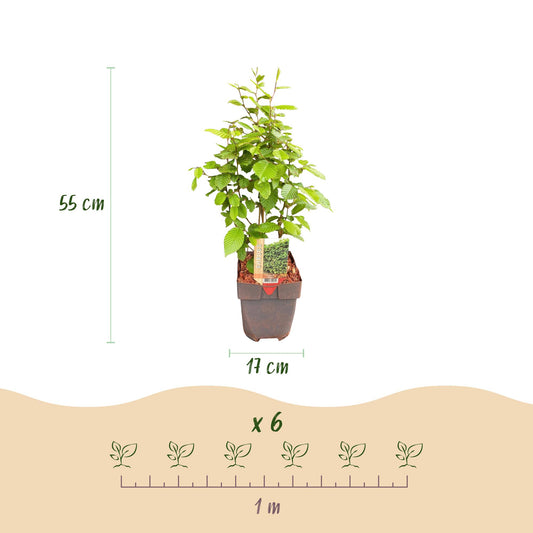 Livraison offerte Sold out
Hornbeam (Carpinus betulus), hardy hedging plant, 17 cm pot, Height 55 cm - Pack of 6
Regular price 89,95 €Regular price -


Compacta Oleaster (Elaeagnus x ebbingei), evergreen hedging plant, 9 cm pot, Height 25–35 cm
Regular price From 54,95 €Regular price -

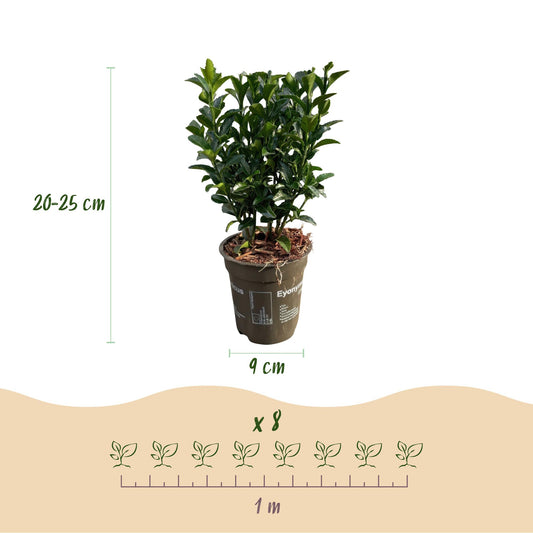 Livraison offerte Sale
Green Spire Euonymus, evergreen hedging plant, 9 cm pot, Height 20–25 cm
Regular price From 49,95 €Regular price54,95 €Sale price From 49,95 €Livraison offerte Sale -

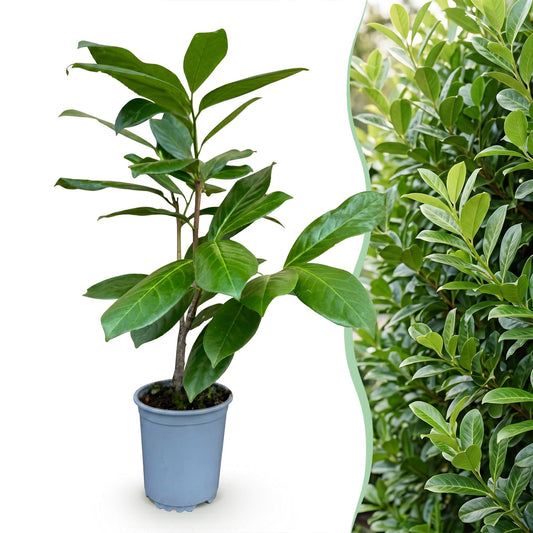
Cherry laurel Rotundifolia (Prunus laurocerasus), evergreen hedging plant, 9 cm pot, Height 25-35 cm
Regular price From 54,95 €Regular price -

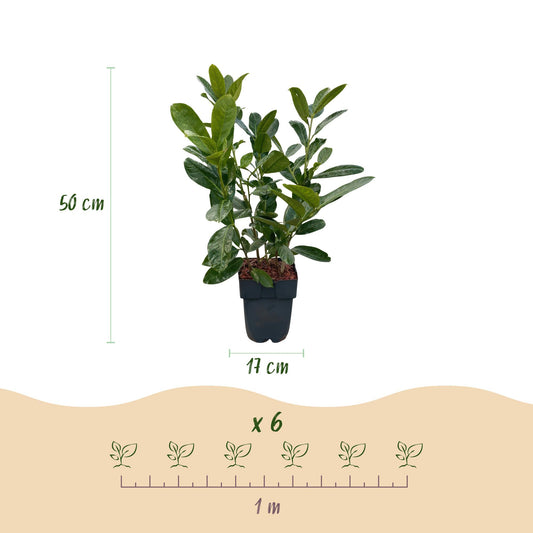 Livraison offerte Sold out
Cherry laurel Rotundifolia (Prunus laurocerasus), evergreen hedge plant, 17 cm pot, Height 50 cm - Pack of 6
Regular price 99,95 €Regular price -

 Livraison offerte Sold out
Photinia Carré Rouge (Photinia x fraseri), evergreen hedge plant - Set of 6
Regular price 109,95 €Regular price -

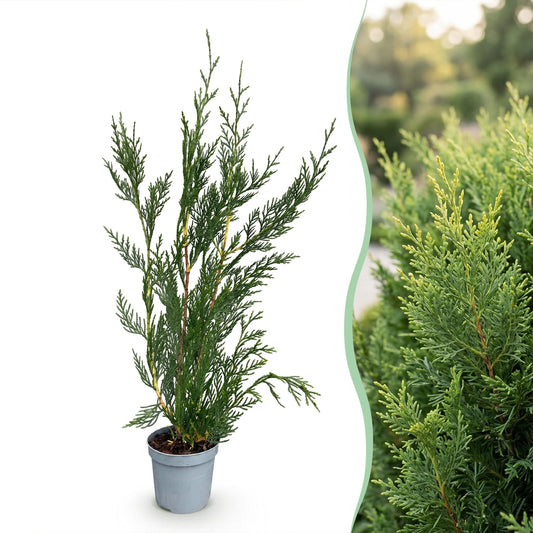
Leyland Cypress 2001 (Cupressocyparis leylandii), evergreen hedging plant, 9 cm pot, Height 30-40 cm
Regular price From 59,95 €Regular price -

 Livraison offerte
Privet (Ligustrum), hardy hedging plant, 9 cm pot, Height 35–45 cm
Regular price From 54,95 €Regular price -

 Livraison offerte Sale
Common yew (Taxus baccata), evergreen hedging plant, 9 cm pot, Height 20–30 cm
Regular price From 59,95 €Regular price179,95 €Sale price From 59,95 €Livraison offerte Sale -

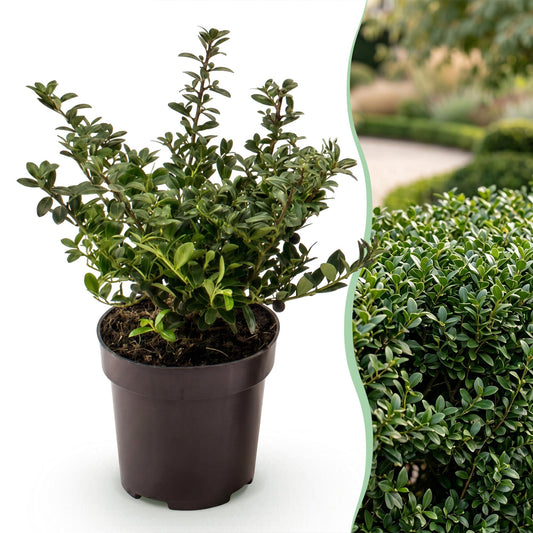
Stokes' Crenate Holly (Ilex crenata), evergreen hedging plant, 9 cm pot, Height 20-30 cm
Regular price From 59,95 €Regular price


Which fast-growing hedge should you choose?
The right hedge depends on what you need: instant screening, colorful foliage, shade tolerance, or minimal maintenance (the RHS explains how to choose the right hedge). There’s a species in our rankings for every need.
| Your needs | Recommended species | Why |
|---|---|---|
| Screen out the neighbors fast | Leyland cypress | The fastest growth (up to 80 cm/year) |
| A dense, traditional screen | Cherry laurel | Fast-growing, with broad, screening foliage |
| Color and style | Photinia ‘Red Robin’ | Bright red new growth and fast growth |
| Poor soil / coastal garden | Oleaster (Elaeagnus) | Hardy, very tolerant, moderate growth |
| Minimal maintenance | Privet | Slower-growing but tough and easy to trim |
Also consider the site and soil: oleaster is a good choice for coastal gardens or poor soil (NC State Extension); yew and cherry laurel (Oregon State University) tolerate shade well, whereas Leyland cypress prefers full sun. Matching the species to your site conditions will help ensure it achieves its stated growth rate in your garden.
To compare evergreens, take a look at our dedicated guides: Leyland cypress, cherry laurel, and Smaragd arborvitae.


How to plant a fast-growing hedge successfully
A fast-growing hedge gets off to a good start with a few simple, measurable steps: the right planting density, a wide hole, watering after planting, and mulch. Here are the guidelines, which apply to all the species above.
📋 Quick reference
The essential guidelines for a fast-growing hedge, at a glance.
| Factor | Guideline |
|---|---|
| Best time to plant | Fall (when the ground isn’t frozen); otherwise, spring |
| Density | 1 to 3 plants per linear meter, depending on how vigorous the species is |
| Legal distance | 0.50 m (<2 m) or 2 m (>2 m) from the boundary: Art. 671 |
| Hole size | 2 to 3 times the volume of the root ball |
| Watering in the first year | Deep and regular, especially the following summer |
| Mulch | 5 to 7 cm around the base to retain moisture |
| Formative pruning | Start in the first year to encourage a dense base |
| Pruning frequency | Once or twice a year, depending on how vigorous the species is |
| Row spacing | Two staggered rows for an instant screen |
Consistent watering in the first year is the real growth booster: lack of water, more than the species itself, is what holds a young hedge back.
Fast-growing hedge maintenance calendar
A fast-growing hedge needs attention all year: plant in fall, protect it in winter, encourage new growth in spring, then water and prune in summer. Here’s your seasonal guide.
📅 Seasonal maintenance calendar
| Season | Key task |
|---|---|
| 🌸 Spring | Prune after the first flush of growth; water during dry spells. |
| ☀️ Summer | Water regularly (especially young plants); prune vigorous species a second time. |
| 🍂 Fall | Plant (the ideal time), mulch, and water after planting. |
| ❄️ Winter | Avoid pruning in freezing weather; check stakes and mulch. |
In the field, people always ask me for “the fastest one,” and I often tell them: not necessarily. Leyland cypress can screen out the neighbors in two years, but it needs pruning twice a year for life. For most gardens, a densely planted cherry laurel or photinia, planted in fall, creates a beautiful screen without becoming a chore. Real speed is growth you can keep under control over the long term.
Mistakes that slow a hedge down
Most hedges that “stop growing” aren’t held back by the species, but by easy-to-avoid planting mistakes: compacted soil, too little water, or neglected pruning.
| Common mistake | What to do instead |
|---|---|
| Planting too far apart | Allow 1 to 3 plants per meter for a fast screen |
| Neglecting watering in the first year | Water deeply, especially during the following summer |
| Skipping formative pruning | Prune in the first year to encourage a dense base |
| Planting in spring in dry soil | Plant in fall, when the ground isn’t frozen |
| Forgetting to mulch | Apply 5 to 7 cm of mulch to retain moisture and suppress weeds |
Leyland cypress, arborvitae, or cherry laurel: which should you choose?
If raw speed is your priority, Leyland cypress comes out on top (70–80 cm/year). For a balance of speed and maintenance, cherry laurel is the best choice; arborvitae (20–30 cm/year) grows more slowly but is very dense and uniform. Leyland cypress needs pruning twice a year and plenty of room, while cherry laurel is more forgiving.
In short: choose Leyland cypress to screen out the neighbors as quickly as possible, cherry laurel for a dense, easy-care screen, and arborvitae for a neat, structured hedge without excessive growth. And if biodiversity matters to you, consider mixing two or three species: a mixed hedge grows almost as quickly as a single-species hedge, is more resistant to disease, and provides shelter for garden wildlife.
Whatever you choose, remember that actual growth depends on how you plant: a moderately growing species, well established in fall, watered and mulched, will always outperform a fast-growing champion planted in a hurry at the wrong time.

Laura Bruneau
Jardinière & autrice


