

Dahlias: planting tubers, care and overwintering

To grow dahlias successfully, plant the tubers in a sunny spot in fertile, well-drained soil once the frosts have passed. Put in a stake at planting time, pinch out the stem at around 40 cm, then lift the tubers in autumn and store them somewhere cool and frost-free.
The genus Dahlia, in the Asteraceae family, is native from Mexico to Colombia according to Kew, and its many cultivars flower from summer until the first frosts.
This guide covers every step, with information verified against Kew, the RHS and four American universities. For the timing of all garden bulbs, also see our guide to planting bulbs, including dahlias.
🌿 Why plant dahlias in the garden
Few flowers offer such variety: the RHS describes blooms in a wide range of styles and bright or pastel colours, measuring 5 to 30 cm across, that flower from summer until the first frosts.
According to North Carolina State University Extension (NC State Extension), flower heads measure 2 to 12 inches (about 5 to 30 cm) across and plants range from 1 to 6 feet (about 0.3 to 1.8 m) tall, making them suitable for both borders and the back of flower beds.
They take over from spring bulbs just as many perennials begin to slow down, and provide an abundance of cut flowers. The only drawback is that they are frost-tender, so they need a simple overwintering routine, which we explain below.
To incorporate them into a long-lasting planting scheme, see our guide to creating an easy-care flower bed.
| Benefit | What it means for your garden |
|---|---|
| Flowers from summer to the first frosts | Continuous blooms from midsummer through autumn, when the garden begins to fade |
| Many shapes and sizes | From dwarf border dahlias to giant varieties, from pompons to single flowers |
| Cut flowers | The more you pick and deadhead, the more flowers the plant produces |
| Reusable tubers | With proper storage, the same tubers will flower again and can be divided year after year |
🔎 Dahlia at a glance
According to Plants of the World Online (POWO), the Royal Botanic Gardens, Kew's database, the genus Dahlia Cav., published in 1791, comprises 42 accepted species native from Mexico to Colombia, and belongs to the Asteraceae family.
According to the POWO profile for Dahlia pinnata, Dahlia pinnata Cav., of which Dahlia variabilis Desf. is a synonym, is a tuberous geophyte described as a cultigen from Mexico, growing mainly in the tropical seasonal biome.
The genus also includes very different forms, such as Dahlia imperialis, which Kew describes as a shrub or tree with a climbing habit.
Garden dahlias are cultivars: the international dahlia register maintained by the RHS, the international registration authority for dahlia cultivars, groups them into 14 classes according to flower shape.
| Feature | Verified details |
|---|---|
| 🏷️ Botanical name | Dahlia Cav. (1791); garden cultivars; cultivated type species: Dahlia pinnata Cav. (syn. D. variabilis) |
| 🧬 Family | Asteraceae (formerly Compositae), like daisies and asters |
| 🌳 Type | Tuberous herbaceous perennial (geophyte), grown as a summer bulb |
| 🌍 Origin | Mexico to Colombia (POWO) |
| ❄️ Hardiness | Frost-tender: cultivars rated H3 by the RHS, meaning -5 to 1 °C; USDA zones 7a to 10b according to NC State |
| 🍃 Foliage | Deciduous, with green or dark purple compound leaves, depending on the cultivar |
| 🌸 Flowering | Midsummer to autumn; flower heads about 5 to 30 cm across according to NC State |
| 📏 Mature size | About 0.3 to 1.8 m tall and 0.3 to 0.9 m wide (NC State) |
📋 Quick growing guide
Essential growing information at a glance.
| Factor | Guideline |
|---|---|
| Position | Full sun, in a warm spot sheltered from the wind |
| Soil | Fertile, rich in organic matter, well-drained, never waterlogged |
| Hardiness | H3 according to the RHS (-5 to 1 °C): foliage is killed by frost, so tubers need protection |
| Watering | None until the first two leaves appear, then water regularly in dry weather |
| Planting | Tubers from mid to late April; plants started under cover go outside after the last frosts |
| Pruning | Pinch out at about 40 cm; deadhead weekly |
| Flowering | Midsummer until the first frosts |
| Care | Moderate: staking, pinching, lifting and frost-free storage every autumn |
| Toxicity | Toxic to dogs, cats and horses (ASPCA); gloves are recommended when handling tubers |
📍 Where and when to plant dahlias
Choose a warm, sheltered, sunny spot with fertile, well-drained soil: these are the conditions recommended by the RHS (Royal Horticultural Society). NC State Extension also mentions partial shade with 2 to 6 hours of sun, but flowering is most abundant in full sun.
As for timing, the RHS recommends planting tubers directly in the ground from mid to late April, and moving plants started under cover outdoors only from late May or early June, after the last frosts, when temperatures remain above 5 °C.
For Oregon State University Extension, the right signal is soil that stays around 60 °F (about 15 °C) for several days in a row.
☀️ Ideal: A sunny border or flower bed sheltered from the wind, with loosened and enriched soil
🪴 In a pot: A large pot with drainage holes for dwarf or medium-sized dahlias; use a potash-rich fertiliser in summer
🚫 Avoid: Heavy, waterlogged soil in winter, dense shade, and planting in soil that is still cold
🪴 How to plant a dahlia tuber
Plant a dahlia tuber on its side, with the eye (the bud at the crown) facing upwards, as described by Oregon State, which recommends digging a hole about 4 to 6 inches (10 to 15 cm) deep.
The RHS says to place the top of the tuber just below the soil surface, while NC State Extension recommends covering it with about 3 inches (7.5 cm) of soil: stay within this range, planting a little deeper in light soil. Space plants at least 60 cm apart according to the RHS, and further apart for giant varieties.
One often-overlooked point: Oregon State recommends not watering after planting until the first two leaves have appeared, to prevent the tuber from rotting in cold, damp soil.
| Step | What to do |
|---|---|
| 1. Choose the right time | Mid to late April for tubers, once the soil has warmed (about 15 °C according to Oregon State) |
| 2. Prepare the soil | Loosen the soil and enrich it with compost; check that it drains well |
| 3. Put in the stake | For tall varieties, put in a 1.2 to 1.5 m stake before planting the tuber |
| 4. Position the tuber | On its side, eye facing upwards, with the crown just below the surface or covered by about 7.5 cm of soil |
| 5. Wait before watering | Do not water until the first two leaves appear, then water regularly |
columns: 4
columns_mobile: 2
-

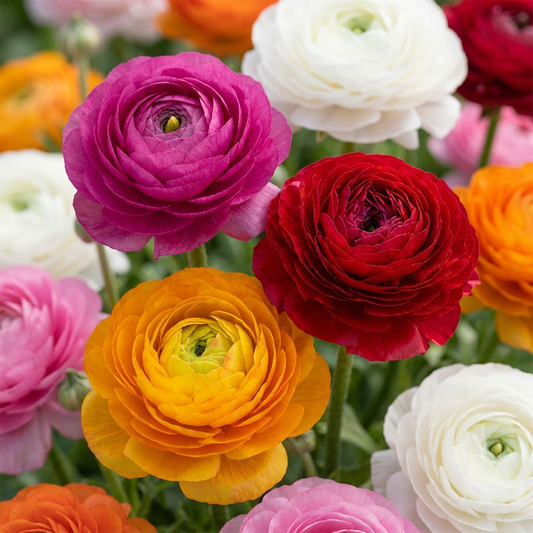
Florist’s ranunculus mix (Ranunculus asiaticus) – spring-to-summer flowering – bulb size 5/6
Regular price From 39,95 €Regular price39,95 €From 31,96 €Livraison offerte -


Agapanthus 'Albus' (Agapanthus africanus) - flowering perennial - 11 cm pot - Height 25 cm
Regular price From 39,95 €Regular price39,95 €From 31,96 €Livraison offerte -

Daylily 'Autumn Red' (Hemerocallis) - flowering perennial - 11 cm pot - Height 25 cm
Regular price From 39,95 €Regular price39,95 €From 31,96 €Livraison offerte -


Coneflower 'Magnus' (Echinacea purpurea) - melliferous perennial - 11 cm pot - Height 25 cm
Regular price From 39,95 €Regular price39,95 €From 31,96 €Livraison offerte -


‘Goldsturm’ Black-Eyed Susan (Rudbeckia fulgida) – nectar-rich perennial – 11 cm pot – height 25 cm
Regular price From 39,95 €Regular price39,95 €From 31,96 €Livraison offerte -

 Livraison offerte
Aster (Aster) - perennial melliferous - 11 cm pot - Height 25 cm
Regular price From 39,95 €Regular price39,95 €From 31,96 €Livraison offerte


✂️ Dahlia care: staking, pinching, watering and feeding
Dahlia care focuses on the growing season. The RHS recommends pinching out the tip of the main stem when it reaches about 40 cm, just above a pair of leaves, to encourage a bushier plant. Then keep 7 to 10 strong stems per plant, or just 3 to 5 for giant-flowered varieties.
According to Oregon State, stakes should be at least 4 to 5 feet (about 1.2 to 1.5 m) tall; the RHS recommends a sturdy stake for each stem of the tallest varieties. Oregon State recommends starting to feed 30 days after planting, every 3 to 4 weeks, with a low-nitrogen formula.
For dahlias in pots, the RHS recommends a liquid, potash-rich fertiliser, such as tomato feed, every two weeks from early July to early September.
🔹 Pinching: Pinch out the tip of the main stem at about 40 cm, just above a pair of leaves (RHS)
🪢 Staking: Use soft ties as the plant grows; giant varieties need one stake per stem
💧 Watering: Water regularly in dry weather once the plant is established, without letting the soil become waterlogged
🌱 Feeding: Use a low-nitrogen formula from 30 days after planting (Oregon State); use potash-rich feed for plants in pots (RHS)
🔹 Deadheading: Ideally, remove faded flowers every week to prolong flowering (RHS)
🍂 Overwintering dahlias: lifting or mulching the tubers
Dahlias do not survive frost, so overwintering is an issue every autumn. According to its page on overwintering tender plants, the RHS recommends lifting tubers once the first frost has blackened the foliage, and its growing guide sets the deadline at the end of November.
Oregon State suggests cutting back the stems and leaving the tubers in the ground for 3 to 7 days before lifting them, while Pennsylvania State University Extension (Penn State) notes that tubers need at least 120 days in the ground to mature.
Turn the clumps upside down for a few weeks to dry, then store them in dry compost, sand or straw, somewhere cool, dark and frost-free. For storage temperatures, NC State recommends 35 to 45 °F (about 2 to 7 °C), while Penn State recommends 40 to 50 °F (about 4 to 10 °C).
In mild regions, the RHS says tubers can be left in the ground under dry mulch: 15 cm in its growing guide, at least 5 cm on its overwintering page; they will flower a little later as a result.
For other garden bulbs, see our guide to what to do with bulbs after flowering.
📅 Seasonal care calendar
| Season | Key task |
|---|---|
| 🌸 Spring | Divide clumps and take cuttings in late winter; plant tubers from mid to late April; protect against slugs |
| ☀️ Summer | Pinch out at 40 cm, stake, water in dry weather, feed, and enjoy flowers from midsummer |
| 🍂 Autumn | Enjoy flowers until the frosts; lift once frost has blackened the foliage; dry upside down |
| ❄️ Winter | Store somewhere cool, dark and frost-free; check tubers; apply a thick mulch in mild climates |
🌱 Dividing and taking cuttings from dahlias
The RHS recommends dividing clumps and taking cuttings from late winter to early spring, and sowing seeds from early to mid-spring under cover with heat.
To divide a clump, cut it with a clean, sharp knife, making sure each division retains part of the crown: Penn State explains that a tuber needs to retain a neck and part of the crown to carry a viable eye, and that a neck thinner than a pencil may dry out before spring.
Take cuttings from the young shoots of a clump brought back into growth under cover, then plant them 50 to 60 cm apart according to the RHS. Seed-grown plants will differ from the parent variety, so sow seeds for experimentation only.
🐛 Common problems: causes and solutions
Slugs and snails are the number-one enemy of young shoots according to the RHS, which also lists aphids, capsid bugs, earwigs, caterpillars and mites, as well as powdery mildew and several viruses. Oregon State recommends putting slug protection in place two weeks after planting or as soon as the first shoots appear.
Most disappointments, however, are caused by growing conditions: cold, wet soil, too little sun or poorly stored tubers.
| Symptom | Likely cause | Solution |
|---|---|---|
| Tuber rots without sprouting | ❄️ Soil too cold and wet; watering before shoots emerge | Plant in warmed soil; do not water until the first two leaves appear (Oregon State) |
| Young shoots eaten | 🐌 Slugs and snails (RHS) | Protect plants as soon as shoots emerge; collect pests in the evening; put barriers around plants |
| White coating on leaves | 🍄 Powdery mildew (RHS) | Improve air circulation around clumps, thin out stems and water at the base |
| Chewed petals, damaged flowers | 🐛 Earwigs or caterpillars (RHS) | Inspect regularly; use traps or remove by hand |
| Few flowers, long, floppy stems | ☀️ Too little sun; no pinching or deadheading | Move to a sunnier spot, pinch out at 40 cm and cut flowers weekly |
| Tubers shrivelled or mouldy in winter | ⚠️ Storage too dry or too damp | Check after a few weeks and replace the damp material (Penn State) |
-

All our flower bulbs to plant: tulips, daffodils, alliums, crocuses and many...


🌸 Dahlia varieties by flower shape
Rather than commercial names, here are the main flower forms recognized by the RHS International Dahlia Register, which lists 14 numbered groups, along with their codes as shown on RHS plant profiles. Each form comes in many colors and heights.
| Variety | What makes it special |
|---|---|
| Decorative (D, group 5) | Large double flowers, such as 'Café au Lait', with cream petals tinged with peach; 1–1.5 m tall, rated H3 by the RHS |
| Cactus and semi-cactus (C and S-c, groups 8 and 9) | Two distinct groups in the register, highly prized at the back of borders and for bouquets |
| Ball and pompon (Ba and Pom, groups 6 and 7) | Two groups with regular, double flowers, the most sought-after for cut flowers |
| Collerette (Col, group 3) | A distinct group in the international register, appreciated for its lighter look |
| Peony-flowered (P, group 14) | 'Bishop of Llandaff': very dark purple foliage, bright red semi-double flowers, 6 cm across; 0.5–1 m tall, awarded the RHS AGM |
| Dwarf bedding (DwB) | Register designation for bedding dahlias generally no taller than 600 mm, perfect for borders and pots |
🎨 What to plant with dahlias
Dahlias pair well with plants that, like them, enjoy sunshine and flower late in the season.
In a border, combine them with Buenos Aires verbena, perennial sage and ornamental grasses, which soften the look of their large blooms. Peony-flowered varieties extend the season of the peony, while airy gypsophila complements their stems in bouquets.
In spring, ranunculus fills the same role as a cut-flower bulb before the dahlias take over.
To complete your borders, browse our flower bulbs to plant alongside dahlias, our outdoor flowering plants and our perennials for borders.
⚠️ Are dahlias toxic to cats and dogs?
Yes, but only mildly. According to the ASPCA (American Society for the Prevention of Cruelty to Animals), dahlias (Dahlia species) are toxic to dogs, cats and horses, causing mild gastrointestinal symptoms and mild dermatitis; the toxic principle is unknown.
NC State Extension classifies the risk as low: the foliage is toxic if eaten in large quantities, and skin irritation may occur after repeated handling of tubers or contact with leaves followed by sun exposure (phototoxicity).
Wear gloves when dividing and cleaning tubers, keep them out of pets' reach while in storage, and contact your veterinarian or a poison control center if ingested.
✅ Our expert tips for success
Growing dahlias successfully comes down to four steps: plant them in a sunny spot in warm, well-drained soil; stake them at planting time; pinch them back at around 40 cm; and deadhead every week. In fall, dig up the tubers after the first frost, dry them upside down and store them frost-free, or apply a thick mulch if your winters are mild.
Choose varieties according to how you plan to use them: dwarf and peony-flowered types for borders, decorative and cactus types at the back of borders, and pompons for bouquets.
For all the bulbs in your garden, see our guide When and how to plant bulbs, and for winter protection, our guide to protecting plants from frost.
Dahlias are the plants that make me look forward to the end of summer most of all. I learned not to water them too early: that mistake cost me more tubers than any other. I also recommend labeling each clump before digging it up, because all the tubers look alike in spring. And I cut flowers without hesitation, because the more you cut, the more they bloom again.

Laura Bruneau
Jardinière et autrice


