Star jasmine (Trachelospermum): planting, pruning and care

To help star jasmine thrive, plant it in spring against a south- or west-facing wall or trellis, sheltered from cold winds, in well-drained soil; guide its young stems, water it during the first year, then simply give it a light prune in early spring.
Its botanical name, Trachelospermum jasminoides, is a reminder that it is not a true jasmine: if you're unsure which jasmine to choose, our guide Jasmine: types, planting and pruning compares all the groups.
Here, we focus exclusively on Trachelospermum, the evergreen climber most widely planted for screening, which our complete guide to climbing plants lists as a must-have. Its true hardiness, pruning, propagation from cuttings, growing in pots and red winter leaves: every detail has been checked against information from Kew, the RHS and American universities.
🌿 Why plant star jasmine
Star jasmine ticks almost every box for a garden climber: glossy evergreen foliage, a powerful summer fragrance and manageable growth.
According to the RHS (Royal Horticultural Society), its dark green oval leaves reach 10 cm, and its white flowers, about 2.5 cm across, are highly fragrant; the plant has received the Award of Garden Merit, a mark of reliable garden performance.
The Missouri Botanical Garden also notes that it can be trained as a hedge or ground cover, and grown in a pot. Its flowers attract bees, according to NC State Extension.
| Benefit | What it means for you |
|---|---|
| Evergreen screen | Year-round green screening on a trellis, fence or pergola |
| Summer fragrance | Highly fragrant, star-shaped white flowers, best planted near a patio or window |
| Climbs by twining | Twining stems wrap around their support, without clinging roots that mark walls |
| Pet-safe | Classified as non-toxic to dogs, cats and horses by the ASPCA |
🔎 Star jasmine at a glance
According to Plants of the World Online (POWO) from the Royal Botanic Gardens, Kew, the accepted name is Trachelospermum jasminoides (Lindl.) Lem., published in 1851 by Lemaire, in the Apocynaceae family; its native range extends from central-western and southern Japan to Vietnam, via China, Korea and Taiwan, in a subtropical biome.
Kew lists the genus Trachelospermum on POWO as comprising 10 species native to tropical and subtropical Asia. As the Missouri Botanical Garden points out, it belongs to a different family from true jasmines in the genus Jasminum, which are in the Oleaceae family—hence its nickname, false jasmine. Its stems release a milky sap when broken.
| Feature | Verified details |
|---|---|
| 🏷️ Botanical name | Trachelospermum jasminoides (Lindl.) Lem. |
| 🧬 Family | Apocynaceae, like oleander; not Oleaceae |
| 🌳 Type | Evergreen, woody, twining vine |
| 🌍 Native range | Japan, China, Korea, Taiwan, Vietnam (POWO) |
| ❄️ Hardiness | H4 according to the RHS, meaning -10 to -5°C; USDA zones 8 to 10 |
| 🍃 Foliage | Evergreen, glossy dark green, leaves up to 10 cm long, often bronze-red in winter |
| 🌸 Flowering | Star-shaped white flowers about 2.5 cm across, highly fragrant, in late spring and summer |
| 📏 Mature size | 4 m or more according to the RHS guide; up to about 6 m according to the Missouri Botanical Garden |
📋 Quick facts
Essential growing information at a glance.
| Factor | Guideline |
|---|---|
| Position | Sun or light shade; south-, west- or east-facing wall, sheltered from cold winds |
| Soil | Well drained and fertile; neutral to alkaline, tolerates slightly acidic soil |
| Hardiness | H4 (RHS): -10 to -5°C; protect young plants and pots |
| Watering | Regularly in the first year and in pots; thereafter, only during dry spells |
| Planting | In spring, before new growth starts |
| Pruning | Lightly in early spring (RHS pruning group 11) |
| Flowering | Late spring and summer, white and highly fragrant |
| Care/difficulty | Easy; guide young stems, mulch and watch for scale insects |
| Toxicity | Non-toxic to dogs, cats and horses (ASPCA); sticky sap, gloves recommended |
📍 Where and when to plant star jasmine
Position your star jasmine in sun or light shade, ideally against a south- or west-facing wall or fence: this is the location recommended by the RHS growing guide, which also advises sheltering it from cold, drying winds.
The plant tolerates more shade, but the Missouri Botanical Garden warns that it will then grow less densely and flower less well. Plant in spring, before new growth starts, so it can establish its roots before its first winter. As for soil, the RHS prefers it well drained and fertile, and neutral to alkaline: there is no need to provide ericaceous compost.
☀️ Ideal: South- or west-facing wall, fence or trellis, sheltered from northerly winds, with well-drained soil
🌥️ Acceptable: East-facing position or light shade: good foliage, but less abundant flowering
🚫 Avoid: Waterlogged clay soil in winter, an icy wind tunnel or deep shade
🪴 Planting star jasmine against a support or in a pot
Planting is straightforward if you put the support in place first: the RHS recommends a trellis or wires stretched across the wall, and reminds gardeners that young plants need to be guided and tied in until they twine around the support on their own.
For screening along a fence, allow for each plant to spread about 0.9 to 1.8 m (3 to 6 feet, according to the Missouri Botanical Garden) and space your plants accordingly. For container growing, the RHS recommends a good-quality peat-free compost and a container that will not dry out too quickly.
| Step | What to do |
|---|---|
| 1. Install the support | Put up a trellis, wires or fence before planting, a few centimetres away from the wall |
| 2. Prepare the soil | Dig a wide hole and loosen the soil; improve heavy soil to prevent waterlogging |
| 3. Position the root ball | At the same depth as in its nursery pot, tilted slightly towards the support |
| 4. Guide the stems | Tie young stems loosely to the support until they start to twine around it |
| 5. Water and mulch | Water thoroughly, then apply organic mulch, leaving 10 cm clear around the base |
columns: 4
columns_mobile: 2
-

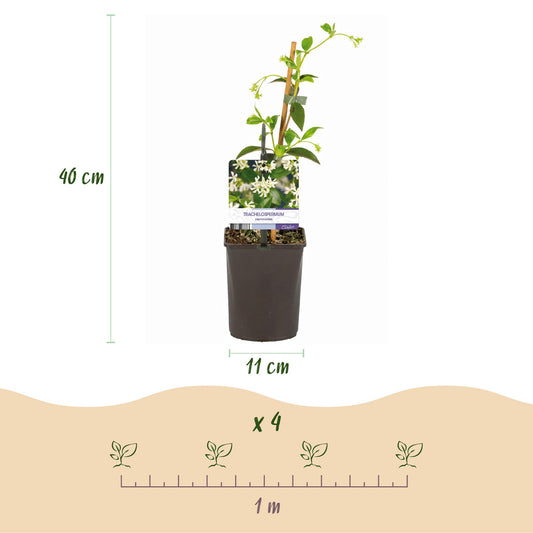
Star Jasmine (Trachelospermum jasminoides) - fragrant evergreen climber - 9 cm pot - Height 35 cm - Pack of 2
Regular price 39,95 €Regular price39,95 €31,96 €Livraison offerte -

 Livraison offerte
Star jasmine (Trachelospermum jasminoides) – fragrant evergreen climber
Regular price From 54,95 €Regular price54,95 €From 43,96 €Livraison offerte -

 Livraison offerte
Passionflower (Passiflora) – flowering climber – 9 cm pot – 35 cm tall
Regular price From 39,95 €Regular price39,95 €From 31,96 €Livraison offerte -


‘New Dawn’ Climbing Rose (Rosa) – Flowering Climber – 11 cm Pot – 40 cm Tall – Pack of 2
Regular price 39,95 €Regular price39,95 €31,96 €Livraison offerte


✂️ Star jasmine care: watering, feeding and pruning
Star jasmine is easy to care for, and that's one of its greatest strengths: the RHS describes it as a slow-growing plant that needs little or no pruning.
Water regularly for at least the first year, then only during dry spells in summer; once established, it tolerates drought, according to North Carolina State University Extension (NC State Extension). Fertiliser is unnecessary in fertile soil; in a pot, however, regular feeding during the growing season is beneficial.
If the plant grows beyond its allotted space, shorten the stems by two-thirds in spring, cutting back to a side shoot.
💧 Watering: Regularly in the first year and in pots; in the ground, only during summer droughts
🌱 Fertiliser: Not needed in fertile soil; apply a general fertiliser in spring if the soil is poor, and feed regularly in pots
🍂 Mulching: Apply a thick layer of compost or well-rotted manure in spring or autumn
✂️ Pruning: Light tidy-up in early spring; cut back overlong stems by two-thirds
🔹 Sap: Wear gloves and clean your tools: the milky sap is sticky
🍂 Star jasmine in winter: hardiness, frost and red leaves
Yes, star jasmine can stay outdoors over winter where temperatures do not fall below about -10°C, but it is not frost-proof everywhere: the RHS profile rates it H4, meaning hardiness from -10 to -5°C, while the Missouri Botanical Garden lists it for USDA zones 8 to 10, with the coldest zone reaching about -12°C.
In cold regions or frost pockets, the RHS recommends protection: apply a thick insulating mulch around the base in autumn, and wrap pots in horticultural fleece or bubble wrap. For techniques, see our guide to protecting plants from frost.
If its leaves turn red, there is no need to worry: the RHS says they often turn bronze-red in winter, and that during cold snaps they may become spotted or fall off; the plant will recover unless the winter is exceptionally severe.
📅 Seasonal care calendar
| Season | Key task |
|---|---|
| 🌸 Spring | Planting, light pruning, mulching, resume watering and feeding container plants |
| ☀️ Summer | Fragrant flowers, water during dry spells, take semi-ripe cuttings |
| 🍂 Autumn | Take cuttings if desired, apply insulating mulch around the base, plant in mild climates |
| ❄️ Winter | Bronze-red foliage is normal, protect pots, do not prune in frosty weather |
🌱 Propagating star jasmine from cuttings and by layering
Star jasmine can be propagated from semi-ripe cuttings in summer or early autumn, or by layering in spring, according to the RHS. Take sections of this year's growth that have started to harden at the base, remove the lower leaves and insert them into a light growing medium kept just moist.
The RHS notes that cuttings root best in a heated propagator, with bottom heat of 15 to 20°C. Layering is simpler: bend a flexible stem down to the ground, bury a section of it and sever it from the parent plant once rooted. The RHS does not mention sowing seeds; cuttings and layering remain the recommended methods.
🐛 Common problems: causes and solutions
Star jasmine is robust: NC State Extension reports no serious insect or disease problems. Most issues are caused by soil, cold or container growing. Here are the most common problems and how to deal with them.
| Symptom | Likely cause | Solution |
|---|---|---|
| Red or bronze leaves in winter | ❄️ Normal cold-weather response described by the RHS | Wait until spring: the foliage will turn green again; protect it if the frost intensifies |
| Spotted leaves that fall after a frost | ❄️ Cold snap close to or below the H4 limit | Cut off dead parts in spring and mulch around the base the following winter |
| Yellowing foliage, plant declining | 🍄 Root rot (Phytophthora) in heavy, wet soil (RHS) | Replant in well-drained soil or in a pot; never allow water to pool |
| Few or no flowers | 💧 Too much shade, a young plant or a shy-flowering variety | Give it more sun, be patient during the first few years, and prune only when essential |
| White clusters or small shells on the stems | 🐛 Mealybugs or scale insects (RHS) | Remove by hand or with a cotton pad dipped in alcohol; cut out badly affected stems |
| Plant drying out in summer in a pot | 🌬️ Root ball drying out, container too small or exposed to wind | Water as soon as the surface dries and repot into a larger container |
-

Clematis, wisteria, passionflowers, climbing roses and star jasmine to adorn walls, pergolas...
-

Outdoor plants that keep their foliage all year round: evergreen privacy hedges,...


🌸 Our star jasmine varieties
The classic star jasmine remains a reliable choice, but the genus Trachelospermum includes other forms; here are those described by the RHS, along with the trade names you may come across at nurseries.
| Variety | What makes it special |
|---|---|
| Star jasmine (Trachelospermum jasminoides) | The standard species: highly fragrant white flowers, evergreen foliage, awarded by the RHS |
| T. jasminoides 'Waterwheel' | Narrow leaves with silver veins, purplish red in winter; may flower sparingly (RHS) |
| T. jasminoides 'Variegatum' | Variegated foliage, also awarded the RHS Award of Garden Merit |
| Trachelospermum asiaticum | Asiatic jasmine with small, 2–5 cm leaves and cream flowers with buff centres; hardy to H4 (RHS) |
| T. asiaticum 'Pink Showers' | Fragrant, pale pink star-shaped flowers: an option for a pink star jasmine |
| 'Star of' range (Venice, Ibiza, Toscana) | Trade names for star jasmines with white, pink or yellow flowers, available from nurseries |
🎨 Which plants pair well with star jasmine?
On a pergola or large fence, pair star jasmine with a climber that flowers at a different time: a clematis or a climbing rose will extend the flowering season, while a climbing honeysuckle adds a second fragrance.
To compare growth, hardiness and whether plants are evergreen, see our comparison of climbing plants and our selection of evergreen climbers. At its base, choose plants that thrive in the same well-drained, calcareous soil, such as lavender.
As a privacy screen, it makes a useful addition to a hedge: see our guide to creating a privacy hedge.
On a balcony, grow it in a large container alongside other plants for balconies and patios; also explore our climbing plants, including our Trachelospermum, our evergreen plants, our plants for balconies and patios and all our outdoor plants.
⚠️ Is star jasmine dangerous or toxic?
For your pets, no: the ASPCA (American Society for the Prevention of Cruelty to Animals) classifies Trachelospermum jasminoides as non-toxic to dogs, cats and horses, and NC State Extension also reports it as non-toxic to them. However, it should be handled with some care.
Its stems release a sticky, milky sap when cut: NC State recommends cleaning tools after pruning. Meanwhile, the University of Florida's risk assessment (UF/IFAS) cites sources stating that the plant should not be eaten and that handling it may cause skin irritation or an allergic reaction.
So wear gloves when pruning, and don't confuse it with its cousin, oleander, another Apocynaceae that is toxic.
✅ Our expert tips for success
For a thriving star jasmine, plant it in spring in sun or light shade, in well-drained soil, against a sturdy support and sheltered from cold winds. Train it at first, water it during its first year, mulch it before winter and limit pruning to early spring.
Bear in mind its true hardiness rating, H4 according to the RHS, and protect it in colder regions; don't be alarmed by its red leaves in winter. To compare it with other jasmines, return to our jasmine guide.
Star jasmine is the climber I most often recommend for covering a wire fence or a boundary fence, because it stays beautiful all year round and its June fragrance is unforgettable. I always point out that it takes a little patience at first: during the first two seasons, it focuses more on establishing itself than climbing. I prune it very little, just to keep the stems on the support. And when someone sends me a photo of red leaves in January, I reassure them: that's its winter look.

Laura Bruneau
Jardinière et autrice