Virginia creeper (Parthenocissus): planting and pruning

Virginia creeper (Parthenocissus) is the queen of autumn-clad walls: it covers a bare wall in green foliage that blazes red and purple with the first cold weather. Vigorous and hardy, it has the special ability to cling on its own with small adhesive pads, without any support or training.
🌿 Why plant Virginia creeper?
Virginia creeper ticks all the boxes for covering a large area with little effort. It climbs on its own up a wall, facade or gable, grows quickly (up to 1 to 3 m per year), tolerates all aspects and is happy in ordinary soil. But its signature feature is its spectacular autumn colour.
The RHS (Royal Horticultural Society) ranks it among the most reliable climbers for a wall, recommending it for large areas that it can cover completely.
| Benefit | What it means for your garden |
|---|---|
| Autumn colour | the foliage turns a blazing red and purple before falling |
| Clings on its own | tendrils with adhesive pads let it climb on its own up a sound wall; a little guidance helps it get started |
| Fast-growing climber | quickly covers a large area, reaching 10 to 20 m high |
| Hardy and undemanding | withstands cold (down to -30 °C for Virginia creeper) and tolerates both shade and full sun |
🔎 Virginia creeper at a glance
The genus Parthenocissus includes Virginia creeper (Parthenocissus quinquefolia, with five leaflets), Boston ivy (Parthenocissus tricuspidata, with three-lobed leaves) and the less familiar Henry's creeper (Parthenocissus henryana), with silver-veined foliage. All are deciduous climbers, related to the grapevine.
| Feature | Verified details |
|---|---|
| 🏷️ Botanical name | Parthenocissus quinquefolia, tricuspidata and henryana |
| 🧬 Family | Vitaceae (like the grapevine) |
| 🌳 Type | woody deciduous climber |
| 🧗 Clinging habit | tendrils with adhesive pads: clings on its own to a sound wall |
| 🌍 Origin | North America (quinquefolia), East Asia (tricuspidata, henryana) |
| 🍃 Foliage | green in summer, blazing red to purple in autumn |
📋 Quick facts
The key facts about Virginia creeper, at a glance.
| Feature | Details |
|---|---|
| Aspect | any aspect; autumn colours are brighter in sun |
| Soil | ordinary, any type, well-drained; tolerates lime and established drought |
| Hardiness | varies by species: down to -30 °C (Virginia), -20 to -25 °C (Boston), -12 to -15 °C (Henry) |
| Height | 10 to 20 m, depending on the support |
| Clinging habit | tendrils with adhesive pads (small discs): climbs a wall on its own |
| Foliage | deciduous, green, turning red and purple in autumn |
| Growth | fast and vigorous, 1 to 3 m per year once established |
| Flowering | inconspicuous in summer, followed by small decorative blue-black berries |
| Pruning | to keep it in check: clear windows, gutters and roof |
| Toxicity | berries toxic if eaten; sap can irritate (gloves recommended) |
🍃 Is Virginia creeper evergreen?
No: Virginia creeper (Parthenocissus) is a deciduous climber. It sheds its leaves every winter, just after its spectacular autumn display, leaving a tracery of bare stems until spring. There is no true evergreen Virginia creeper: for a wall that stays green all year, choose ivy or another evergreen climber instead.
Only Henry's creeper keeps its foliage a little longer in mild climates, but it is not evergreen.
📍 Where and when to plant Virginia creeper: aspect, soil and walls
Virginia creeper grows just about anywhere: in sun, partial shade or shade. The only difference is its autumn colour, which is more intense and appears earlier in a sunny spot. Soil type is unimportant as long as it is well drained: it tolerates lime and urban pollution, and copes with summer drought once well established (water regularly during the first year).
Hardiness depends on the species: Virginia creeper withstands the harshest winters (down to -30 °C), Boston ivy tolerates around -20 to -25 °C, while the more tender Henry's creeper is best suited to regions with mild winters.
☀️ Aspect: any aspect; full sun for the best autumn colours
🌱 Soil: ordinary, any type, well drained; tolerates lime and drought
🧱 Support: a sound wall is all it needs: it clings on its own; avoid fragile render
🪴 How to plant Virginia creeper, step by step
Plant in spring or autumn at the foot of the wall you want to cover, in full sun for beautiful colours or in shade for a tricky wall. One plant is enough to cover a large facade in just a few years.
| Step | What to do |
|---|---|
| Choose a location | a large, sound wall, facade or gable, away from gutters and openings |
| Prepare the soil | dig a hole two to three times wider than the root ball; Virginia creeper thrives in almost any well-drained soil |
| Position the plant | 30 to 40 cm from the wall, with the root ball level with the soil and stems pointing towards the wall |
| Guide the first growth | loosely tie the first stems to the wall: the adhesive pads will soon take over |
| Water and mulch | water generously during the first year and mulch around the base to help it establish |
columns: 4
columns_mobile: 2
-


Engelmann ivy (Parthenocissus quinquefolia) — climbing vine with brilliant foliage
Regular price From 54,95 €Regular price54,95 €From 43,96 €Livraison offerte -
Boskoop Boston ivy (Parthenocissus tricuspidata) – a climber with fiery foliage
Regular price From 39,95 €Regular price39,95 €From 31,96 €Livraison offerte -


Henry’s Virginia creeper (Parthenocissus henryana) – a climbing plant with fiery foliage
Regular price From 39,95 €Regular price39,95 €From 31,96 €Livraison offerte -

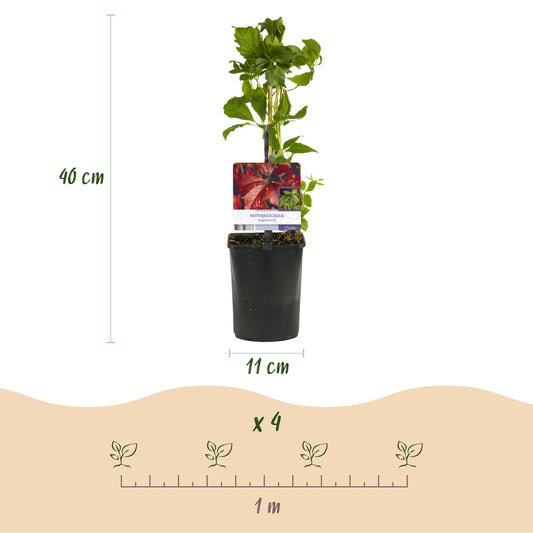
Engelmann's Virginia creeper (Parthenocissus quinquefolia 'Engelmannii') - Climbing plant with fiery foliage - 9 cm pot - Height: 35 cm - Pack of 2
Regular price 39,95 €Regular price39,95 €31,96 €Livraison offerte


✂️ Virginia creeper care: pruning and monitoring
Once established, Virginia creeper needs very little care beyond keeping it in check. The main task is pruning it to prevent it from spreading where it shouldn't.
💧 Watering: keep it watered during the first year; after that, it can fend for itself, even in drought
✂️ Pruning: to keep it in check, clear windows, gutters and the roof in summer; harder pruning is also possible in late winter
👀 Monitoring: act early: it climbs quickly and readily works its way under roof tiles and behind gutters
🔹 Adhesive pads: never yank stems abruptly from a fragile wall: cut them first, let them dry, then remove the pads
🍂 Virginia creeper through the seasons
Fresh, tender foliage emerges in spring, then the plant climbs rapidly throughout the summer. The grand spectacle comes in autumn: in just a few days, the wall turns from green to scarlet and purple before the leaves fall, leaving a tracery of stems for winter.
📅 Seasonal care calendar
| Season | Key task |
|---|---|
| 🌸 Spring | Buds break and fresh, tender foliage appears; guide the first stems; planting |
| ☀️ Summer | Rapid growth; prune to keep it in check and clear openings; water in the first year |
| 🍂 Autumn | Blazing red and purple foliage; small blue-black berries; ideal time to plant; leaves fall |
| ❄️ Winter | Dormant, bare wall (deciduous); harder pruning of the framework of stems is possible in late winter |
🌱 How to propagate Virginia creeper
Virginia creeper is one of the easiest climbers to propagate. In summer or autumn, take 15 to 20 cm stem cuttings and plant them in a light potting mix, keeping it moist. Layering, by pegging a flexible stem down into the soil, is almost certain to succeed.
🐛 Common problems: vigorous growth, clinging habit and walls
Virginia creeper is virtually disease-free; its only problems stem from its vigorous growth and powerful grip.
| Symptom | Likely cause | Solution |
|---|---|---|
| It takes over and climbs too high | ⚠️ natural vigour and rapid growth | prune every summer and keep it away from openings and the roof from the outset |
| Stems work their way under roof tiles or gutters | ⚠️ tendency to seek sheltered corners | keep a 50 cm clear strip below the roof and behind gutters |
| Marks or damaged render on the wall | 🌬️ powerful adhesive pads | plant it only against sound walls; don't yank the stems off |
| White coating on the leaves | 🍄 powdery mildew in an enclosed spot | improve airflow and avoid walls with no air circulation; rare and mild |
-

Clematis, wisteria, passionflowers, climbing roses and star jasmine to adorn walls, pergolas...
-

For quick results in the garden: fast-growing shrubs, hedges and climbers that...


🌸 Our Virginia creeper varieties
Choose by leaf shape and autumn colour: here are the reliable favourites.
| Variety | What makes it special |
|---|---|
| Parthenocissus tricuspidata 'Veitchii' | Boston ivy, three-lobed leaves, brilliant scarlet red, clings exceptionally well |
| Parthenocissus quinquefolia | true Virginia creeper, five leaflets, tolerates shade, turns red to purple in autumn |
| Parthenocissus henryana | Henry's creeper, silver-veined foliage (with stronger contrast in partial shade), more decorative and less invasive, but less hardy: best reserved for regions with mild winters (around -12 to -15 °C) |
| Parthenocissus tricuspidata 'Lowii' | small, finely cut leaves and more moderate growth: the best choice for a small wall or limited space |
| Parthenocissus quinquefolia 'Engelmannii' | smaller leaflets, improved grip and intense scarlet autumn colour |
🎨 Where to grow it and what to pair it with
Reserve Virginia creeper for large areas it can cover on its own: a gable, facade, large boundary wall or sturdy pergola. On a pergola, it provides dense shade in summer and a shower of red leaves in autumn.
It is often confused with ivy: the difference is simple—Virginia creeper is deciduous (it loses its leaves in winter, after they turn red) and clings with tendrils bearing adhesive pads, while ivy stays green all year and attaches itself with more invasive aerial rootlets.
For a flowering climber as a companion, pair it at a distance with a climbing honeysuckle, and explore all the options in our climbing plants collection.
⚠️ Virginia creeper and toxicity: what you need to know
Virginia creeper's small blue-black berries are toxic if eaten: they contain calcium oxalate in the form of needle-shaped crystals (raphides), which irritate the mouth, throat and digestive system. They have no culinary use and should be kept out of reach of young children and pets (dogs and cats).
The sap can also irritate the skin of people who are sensitive when pruning, so it is best to wear gloves. The Missouri Botanical Garden confirms that it is toxic if ingested.
✅ Our expert tips for success
Virginia creeper is unbeatable for quickly and effortlessly covering a large wall, with the added bonus of a fireworks display of colour every autumn. Give it a sound surface and plenty of room, prune it to keep it clear of openings, and it will cover your facade for decades.
To compare it with other climbers, consult our climbing plants guide.
Virginia creeper is my favourite climber for turning a large, dreary wall into an autumn painting, without installing a single support. One warning I always repeat: plan for its vigour. Plant it well away from gutters and the roof, prune it every summer without hesitation, and reserve it for a sound wall. In the right spot, it is one of the most beautiful and easiest climbers around.

Laura Bruneau
Jardinière et autrice