Crape Myrtle (Lagerstroemia): Planting, Pruning and Flowering

To grow a crape myrtle successfully, plant it in full sun in a warm, sheltered spot with well-drained soil, and prune it lightly in late winter: it flowers on the current year's growth, from July to September.
Crape myrtle, Lagerstroemia indica, is not a lilac at all: it is a member of the Lythraceae family from Asia, with no close relation to the common lilac (Syringa), which belongs to the Oleaceae family.
It deserves a place in our guide to Mediterranean plants and among our summer-flowering flowering shrubs.
This guide covers planting, pruning, actual hardiness across species and hybrids, reasons for a lack of blooms, and diseases, with information verified against Kew, the RHS, the US National Arboretum and American universities.
🌿 Why plant a crape myrtle?
Crape myrtle is one of the few shrubs that flowers in the height of summer, when the heat brings the rest of the garden to a standstill: North Carolina State University Extension (NC State Extension) places its flowering period from July to September, with abundant, showy blooms.
The RHS describes conical panicles up to 20 cm long, with crinkled petals, from summer into autumn; NC State Extension also notes its colorful fall foliage. In winter, its bark, which exfoliates in brown and gray patches, takes center stage. NC State Extension adds that once established, it is resistant to deer, drought and pollution.
| Benefit | What it means for your garden |
|---|---|
| Flowers in the height of summer | Colorful panicles from July to September, when spring-flowering shrubs have finished blooming |
| Four seasons of interest | Bronze young leaves, summer flowers, colorful fall foliage and decorative winter bark |
| Drought-tolerant once established | Once established, it tolerates dry summers and urban pollution |
| From dwarf shrub to small tree | Cultivars range from under 1 m to trees reaching 9 m: there is one for every space |
🔎 Crape myrtle at a glance
According to Plants of the World Online (POWO) from the Royal Botanic Gardens, Kew, Lagerstroemia indica L. is the accepted species name, published by Linnaeus in 1759; it is a shrub or tree of the subtropical biome in the Lythraceae family.
Despite its name, its native range includes the Himalayas, Assam, Bangladesh, Nepal, southern China, Hainan, Taiwan, Myanmar, Cambodia and Vietnam; POWO lists “India” among the areas where it has been introduced.
According to the RHS (Royal Horticultural Society), it reaches 4 to 8 m tall and wide over 20 to 50 years; NC State Extension gives a range of 6 to 30 feet (about 1.8 to 9 m), depending on the variety.
| Criterion | Verified details |
|---|---|
| 🏷️ Botanical name | Lagerstroemia indica L. (1759) |
| 🧬 Family | Lythraceae, like purple loosestrife |
| 🌳 Type | Deciduous shrub or small tree, often multi-stemmed |
| 🌍 Origin | Himalayas, southern China, Taiwan and Indochina, according to Kew |
| ❄️ Hardiness | RHS H3: -5 to 1 °C; × fauriei hybrids retain their branches through USDA zone 7b |
| 🍃 Foliage | Deciduous, dark green, bronze as it emerges, red and orange in autumn |
| 🌸 Flowering | July to September, panicles up to 20 cm, in white, pink, red, lavender or purple |
| 📏 Mature size | 4 to 8 m in the UK (RHS); under 1 m to 9 m, depending on cultivar |
📋 Quick growing guide
Essential growing information at a glance.
| Parameter | Guideline |
|---|---|
| Position | Full sun, 6 to 8 hours a day, in a warm, sheltered spot |
| Soil | Well-drained; chalk, loam or sand; acidic to alkaline pH |
| Hardiness | L. indica: RHS H3 (-5 to 1 °C); × fauriei hybrids are hardier |
| Watering | Weekly in the absence of rain for the first two months, then during dry summers |
| Planting | Ideally in spring; through early autumn in mild climates |
| Pruning | Lightly in late winter: remove dead wood, crossing branches and dry seed capsules |
| Flowering | July to September, on the current year's growth |
| Care | Easy in the sunny south; more challenging in cool climates |
| Toxicity | Non-toxic to dogs, cats and horses (ASPCA) |
📍 Where and when to plant a crape myrtle
Plant crape myrtle in the warmest, sunniest spot in the garden: NC State Extension's “Crapemyrtles for North Carolina” guide explains that it flowers poorly in partial shade and not at all in dense shade, while the University of Maryland recommends 6 to 8 hours of direct summer sun.
The RHS recommends a sheltered south- or west-facing position, against a warm wall in areas exposed to frost. Choose a well-ventilated spot to reduce the risk of powdery mildew. As for timing, NC State Extension advises that it can be planted in spring, summer or early autumn, but in cold climates it should be planted early enough for the roots to establish before frost: in France outside the south, aim for spring.
For hardiness, distinguish the species from its hybrids: L. indica is rated H3, which, according to the RHS hardiness scale, corresponds to -5 to 1 °C. It is hardy in coastal and mild areas, except during severe winters. Hybrids of L. indica × L. fauriei selected by the US National Arboretum, such as 'Sioux' and 'Tonto', retain their branches through USDA zone 7b (about -15 to -12 °C) and their roots through zone 6.
☀️ Ideal: Full south- or west-facing sun, against a warm wall, in well-drained soil and a Mediterranean or mild Atlantic climate
🪴 In a pot: Compact cultivar in a large container on a very sunny patio, sheltered during severe cold
🚫 Avoid: Partial shade, a cold, damp hollow, or a cramped spot with no air circulation
🪴 Planting crape myrtle in the ground or in a pot
Crape myrtle is not fussy about soil type: the RHS profile for Lagerstroemia indica lists chalk, loam or sand, and acidic, neutral or alkaline soil, as long as it is well drained.
For planting, the University of Georgia (UGA Extension) recommends digging a hole at least twice as wide as the root ball, planting at the same depth as in the container, then adding 3 to 5 inches (about 7.5 to 12.5 cm) of bark or shredded-leaf mulch.
The RHS also lists it among plants suitable for containers: choose a compact cultivar and a sturdy, stable container with drainage holes.
| Step | What to do |
|---|---|
| 1. Choose the right time | In spring, after the last frosts, to allow good root establishment before winter |
| 2. Prepare the hole | At least twice as wide as the root ball; loosen the soil |
| 3. Set the root ball in place | At the same depth as in the container, without burying the root collar |
| 4. Backfill and mulch | With the original soil, then add 7.5 to 12.5 cm of mulch |
| 5. Water | Water thoroughly, then weekly in the absence of rain for two months |
columns: 4
columns_mobile: 2
-

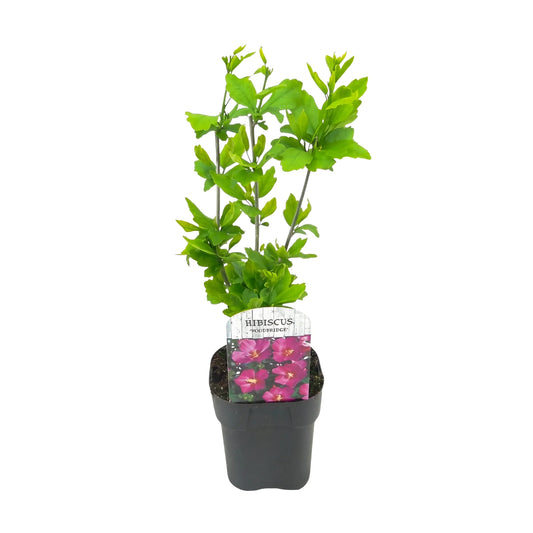
Hibiscus 'Woodbridge' (Hibiscus syriacus) - flowering shrub - 17 cm pot - Height 45 cm
Regular price From 44,95 €Regular price44,95 €From 35,96 €Livraison offerte -

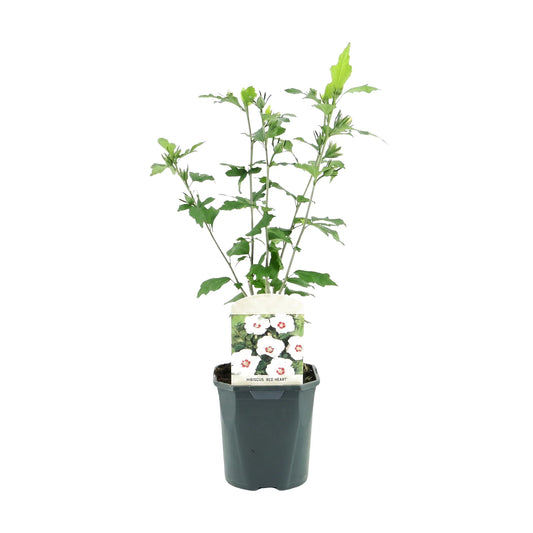
Hibiscus 'Red Heart' (Hibiscus syriacus) - flowering shrub - 17 cm pot - Height 45 cm
Regular price From 44,95 €Regular price44,95 €From 35,96 €Livraison offerte -


Hibiscus 'Blue Bird' (Hibiscus syriacus) - flowering shrub - 17 cm pot - Height 45 cm
Regular price From 44,95 €Regular price44,95 €From 35,96 €Livraison offerte -


Butterfly Bush 'Flower Power' (Buddleja × weyeriana) - honey-producing shrub - 17 cm pot - Height 30 cm
Regular price From 39,95 €Regular price59,95 €Sale price From 39,95 €39,95 €From 31,96 €Livraison offerte Sale -


Dwarf Meyer Lilac 'Palibin' (Syringa meyeri) - fragrant shrub - 19 cm pot - Height 90 cm
Regular price 69,95 €Regular price69,95 €55,96 €Livraison offerte -
Olive (Olea europaea), Mediterranean ornamental shrub, 19 cm pot, Height 90 cm
Regular price 69,95 €Regular price69,95 €55,96 €Livraison offerte -


Ceanothus Victoria (Ceanothus), flowering Mediterranean shrub, purple flowers, 19 cm pot, Height 90 cm
Regular price 69,95 €Regular price69,95 €55,96 €Livraison offerte -

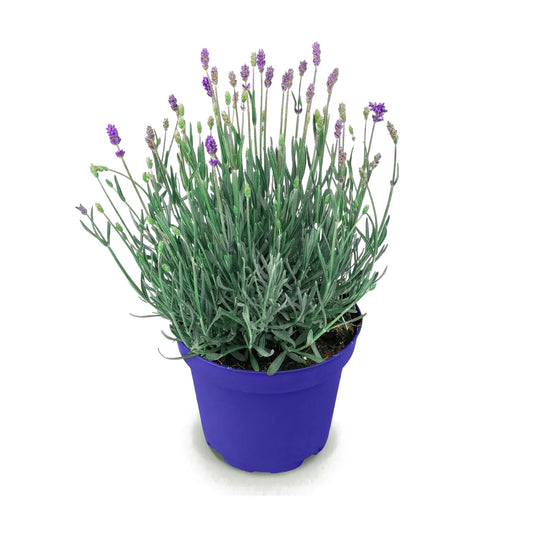
Lavender 'Hidcote' (Lavandula angustifolia) - fragrant honey-producing perennial - 12 cm pot - Height 25 cm
Regular price From 34,95 €Regular price34,95 €From 27,96 €Livraison offerte


✂️ Crape myrtle care: watering, fertilizer and pruning
Crape myrtle care comes down to three things: watering while it establishes, fertilizing sparingly and pruning lightly. The University of Georgia recommends watering weekly for the first two months if there is no rain; once established, it tolerates drought, but supplemental watering during dry summers helps it flower better. Take care with fertilizer: NC State Extension notes that heavy fertilization reduces flowering in favor of foliage.
As for pruning, Clemson University Extension points out that it flowers on new wood and only needs light pruning, in late winter or early spring while the plant is dormant.
💧 Watering while establishing: Weekly in the absence of rain for the first two months
💧 Watering established plants: Water during dry summers to support flowering; in pots, water when the top of the potting mix dries out
🌱 Fertilizer: Apply sparingly in spring; too much produces leaves instead of flowers
✂️ Pruning: In late winter: remove dead wood, crossing branches, suckers and old seed capsules
👀 What to look out for: Powdery mildew in humid summers, and aphids and sooty mold on young shoots
🍂 Pruning crape myrtle: when and how
Prune crape myrtle in late winter or very early spring, before new growth begins: Clemson and the University of Georgia recommend pruning while the plant is dormant; the University of Georgia advises against pruning in early autumn, as this would encourage new growth.
Since, according to NC State Extension, flowers form at the tips of the current year's shoots, pruning in late winter does not remove any blooms. Remove dead wood, crossing branches, shoots growing toward the center and suckers at the base, then cut off old clusters of seed capsules just above a lateral bud.
Avoid the severe topping known in the US as “crape murder”: Clemson considers it unnecessary in most cases, and the University of Georgia explains that pruning is not essential for flowering and that drastic pruning encourages suckers and disease. The RHS does note, however, that it tolerates hard pruning: reserve this for rejuvenating a plant damaged by frost.
📅 Seasonal care calendar
| Season | Key task |
|---|---|
| 🌸 Spring | Late-winter pruning, plant after the frosts, mulch and resume watering |
| ☀️ Summer | Flowers from July to September, water during drought, remove spent flowers |
| 🍂 Autumn | Red and orange foliage, stop all pruning, plant only in mild climates |
| ❄️ Winter | Decorative bark; protect young plants and containers during severe cold |
🌱 Propagating crape myrtle from cuttings
Taking cuttings is the easiest way to reproduce a cultivar true to type. The University of Georgia recommends semi-ripe cuttings from June to August; rooting hormone is generally unnecessary, and roots appear within three to four weeks.
The RHS also lists softwood cuttings in late spring and sowing seeds in spring at 10 °C, but plants grown from seed do not reliably retain a cultivar's characteristics. Keep cuttings in bright light, out of harsh direct sun, in a light mix kept just moist.
🐛 Common problems: causes and solutions
Crape myrtle is robust, but the University of Maryland Extension describes several problems, mostly cosmetic: powdery mildew, a white-gray coating on leaves, young stems and buds; Cercospora leaf spot, small 3 to 6 mm yellow spots with a grayish coating on the undersides of the leaves; aphids, whose honeydew feeds sooty mold; and crape myrtle bark scale, which forms white, waxy clusters.
NC State Extension also lists flea beetles and leaf spots. In protected growing conditions, the RHS notes spider mites and whiteflies. Finally, a lack of flowers is almost always due to insufficient sun, overly heavy pruning or too much fertilizer.
| Symptom | Likely cause | Solution |
|---|---|---|
| Green shrub with no flowers | 💧 Partial shade, heavy pruning, too much fertilizer or a summer that is too cool | Full sun for 6 to 8 hours, light pruning, moderate fertilization |
| White coating on leaves and buds | 🍄 Powdery mildew, encouraged by stagnant air | Choose a well-ventilated spot, remove affected parts, use a resistant cultivar |
| Black, sticky leaves | 🍄 Sooty mold growing on aphid honeydew | Remove aphids (with a jet of water or beneficial insects), then rinse the foliage |
| White, waxy clusters on the bark | 🐛 Crape myrtle bark scale | Brush the bark and prune heavily infested branches |
| Small yellow spots, gray coating on leaf undersides, leaf drop | ⚠️ Cercospora leaf spot | Collect fallen leaves, improve airflow and choose a resistant cultivar |
| Dry branches in spring | ❄️ Frost damage to the branches | Wait for new growth to resume, then cut back to live wood |
-

Our flowering outdoor shrubs: buddleias, dogwoods, deutzias, hibiscus, mock oranges and more...


🌸 Crape Myrtle Varieties
We don’t currently offer crape myrtles in our store. Here are the varieties documented by authoritative sources, to help you choose based on color, size and disease resistance; nursery trade names such as 'Dynamite' or 'Red Imperator' aren’t described here because no authoritative profile is available.
| Variety | What makes it stand out |
|---|---|
| Lagerstroemia indica (type) | Shrub or small tree growing 4 to 8 m (13 to 26 ft), according to the RHS; white, pink or purple flowers; rated H3 |
| the RHS profile for 'Rosea' | More compact (2.5 to 4 m / 8 to 13 ft), with pink flowers in late summer; flowering depends on warmth, according to the RHS |
| 'Natchez' | L. indica × L. fauriei hybrid with white flowers, reaching about 9 m (30 ft), cinnamon-brown bark, and powdery mildew resistance |
| 'Sioux' | × fauriei hybrid from the U.S. National Arboretum, 4 to 6 m (13 to 20 ft), narrow growth habit, medium-pink flowers, resistant to powdery mildew |
| 'Tonto' | × fauriei hybrid, 1.2 to 3.4 m (4 to 11 ft), rounded growth habit, fuchsia flowers, resistant to powdery mildew |
| Lagerstroemia speciosa | Tropical species (“giant crape myrtle”), USDA zones 10b to 11b: cannot tolerate frost, so don’t confuse it with the others |
🎨 Plants to pair with crape myrtle
Pair crape myrtle with plants that, like it, thrive in warmth and well-drained soil. In a Mediterranean garden border, its August blooms follow on from spring-blooming ceanothus, while lavender and rosemary fill in around its base.
For an informal summer hedge, alternate it with rose of Sharon (Hibiscus syriacus), which flowers at the same time.
Find more ideas among our Mediterranean plants to pair with Lagerstroemia, in our Flowering Shrubs and Outdoor Flowering Plants collections, or browse our outdoor plants.
⚠️ Is crape myrtle toxic?
For pets, no: the ASPCA (American Society for the Prevention of Cruelty to Animals) lists crape myrtle, Lagerstroemia indica, as non-toxic to dogs, cats and horses.
We haven’t found an authoritative source on potential toxicity to humans. This lack of information doesn’t mean the plant is edible, so keep it out of reach of young children as a precaution. The ASPCA information applies specifically to Lagerstroemia indica; it doesn’t apply to other plants nicknamed “lilac.” If a pet ingests an unusual amount, contact your veterinarian.
✅ Our expert tips for success
Growing crape myrtle successfully comes down to four rules: give it the hottest spot in the garden in full sun, plant it in well-drained soil, use little fertilizer, and prune lightly in late winter, since it flowers on the current year’s growth. Outside the south of France, plant it against a south-facing wall or choose a hardier × fauriei hybrid that resists powdery mildew, and plant it in spring.
Never top it: you’ll ruin its shape and bark, and it won’t flower any more abundantly. To protect a young plant over winter, see our guide to protecting plants from frost.
For me, crape myrtle is the shrub of summers in the South: when everything dries up in August, it’s covered in flowers. I always recommend giving it the warmest spot in the garden rather than relying on fertilizer to make it bloom. And I can’t stress the bark enough: don’t butcher it when pruning; its trunks are just as beautiful in winter as its flowers are in summer. In the north, I’d choose a hybrid known to resist powdery mildew without hesitation.

Laura Bruneau
Jardinière et autrice