Misting Houseplants: Helpful or Not?

Is misting useful? The honest answer: not for increasing humidity over the long term—the effect lasts just a few minutes. It is still useful for a few other specific purposes. The rule comes down to one sentence: for humidity, group your plants together and use a humidifier; for cleaning or rinsing, misting can do the trick. Find everything you need to care for your plants in our fertilizers and plant care range.
This guide explains why misting doesn't solve humidity problems, when it can still be useful, which methods really work, and how to avoid its drawbacks.
💦 Does misting really increase humidity?
No, not for long: the humidity gained from misting drops back down within 5 to 10 minutes, once the droplets have evaporated. It's one of the most persistent myths in plant care.
According to Iowa State University Extension, misting is not an effective way to increase relative humidity: foliage dries quickly, and you'd have to mist several times a day to make a real difference, which isn't realistic. The gap is huge: in winter, the air in a heated home often falls to 10–30% humidity, while many plants need 40 to 50%.
In other words, a quick spray raises the humidity around the plant for a few minutes, then it all drops again. A hygrometer would confirm it in no time.
❓ Why isn't misting enough?
The problem is simple: wetting leaves isn't the same as humidifying the air. Misting addresses the visible symptom, not the cause, which is overly dry ambient air.
The droplets evaporate within minutes and the water vapor disperses throughout the room, away from the plant. To maintain a genuinely high level of humidity, you'd have to mist almost continuously. That's why horticultural sources agree: misting is ineffective as a long-term humidity strategy. Some estimates suggest misting every ten minutes to actually maintain humidity around the foliage—a pace that's obviously impractical day to day and clearly illustrates why this pleasant little ritual can't replace a genuine source of humidity.
| Common belief | Reality |
|---|---|
| “It humidifies the air” | The effect lasts just a few minutes |
| “It replaces a humidifier” | No: the air dries out again right away |
| “Once a day is enough” | You'd have to do it constantly |
| “It fixes brown leaf edges” | Often caused by water or salts, not the air |
I love misting—it's soothing—but I'm honest with my customers: it doesn't solve humidity problems. When a Calathea has brown edges, misting won't make any difference. What works is a pebble tray or a humidifier. After years of experience, I see misting as something enjoyable and a way to clean leaves, not as a humidity solution.
📍 When is misting useful?
Misting does have genuine uses, as long as you don't confuse it with a humidity strategy. It's useful for three specific tasks: cleaning foliage, rinsing off certain pests, and watering air plants.
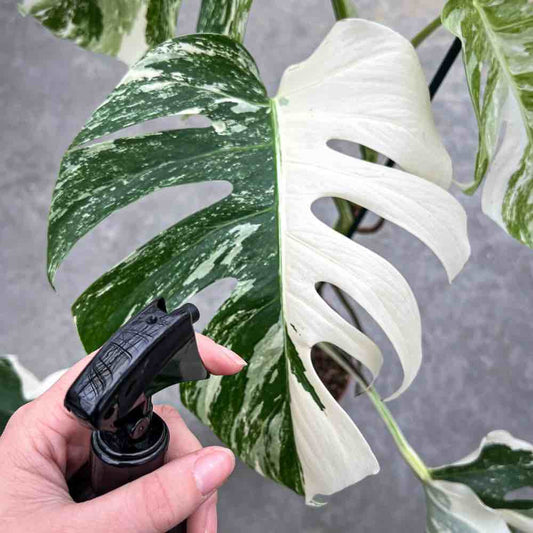
Cleaning dust off leaves improves photosynthesis and the plant's appearance. Rinsing with water every 15 days can also be part of a strategy to combat spider mites. Finally, for air plants (Tillandsia), which don't have roots in a growing medium, misting is a genuine watering method. In all three cases, the goal isn't to increase air humidity, but to have a direct effect on the leaf or plant: that's precisely why misting is useful for these tasks, even though it fails as a long-term humidity strategy. Used properly, it becomes an occasional tool rather than a daily ritual.
columns: 4
columns_mobile: 2
-
Plant sprayer, mist spray bottle, fine mist, 250ml
Regular price From 5,00 €Regular price5,00 €Sale price From 5,00 €5,00 €From 4,00 € -
Complete Plant Care Routine Pack - 250ml Spray Bottle + Concentrated Black Soap + Pair of Cleaning Gloves
Regular price 15,95 €Regular price19,95 €Sale price 15,95 €15,95 €12,76 €Sale -
Plant cleaning gloves - Anti-limescale
Regular price 10,00 €Regular price10,00 €Sale price 10,00 €10,00 €8,00 € -
Graduated watering bulb pipette, precision watering bulb
Regular price From 5,00 €Regular price5,00 €Sale price From 5,00 €5,00 €From 4,00 € -
Fertilizer for All Indoor Plants - 250ml Liquid Fertilizer - Root and Foliar Fertilizer + Free Graduated Pipette!
Regular price 18,00 €Regular price20,00 €Sale price 18,00 €18,00 €14,40 €Sale



🌫️ Methods that really increase humidity
To genuinely raise humidity, three methods work: grouping plants together, using a tray of damp clay pebbles, or setting up a humidifier. These are the methods that change the air your plant breathes.
Grouping plants together creates a microclimate, as each one releases water vapor through transpiration. A tray of clay pebbles (or stones) filled with water beneath the pot increases local humidity by 10 to 15% as the water evaporates. And a humidifier remains the most reliable solution, able to maintain a stable level throughout an entire room. Placing plants near a bathroom or kitchen can also help temporarily.
| Method | Effectiveness |
|---|---|
| Humidifier | The most reliable, stable, and long-lasting |
| Grouping plants together | Creates a microclimate through transpiration |
| Tray of damp pebbles | Provides continuous local humidity |
| Misting | Almost no lasting effect |
📋 Quick reference (for experienced gardeners)
The key facts about misting, at a glance.
| Parameter | Guide |
|---|---|
| Effect on humidity | Just a few minutes |
| Indoor humidity in winter | Often 10 to 30% |
| Humidity needs of many plants | 40 to 50% relative humidity |
| Valid use 1 | Cleaning foliage |
| Valid use 2 | Rinsing off certain pests |
| Valid use 3 | Watering air plants |
| Genuine humidity solution | Humidifier, grouping plants, pebbles |
| Risk of overdoing it | Overly wet foliage, diseases |
⚠️ The drawbacks of excessive misting
Misting too much, or at the wrong time, can harm your plant. Many plants don't like their leaves to stay wet for more than 2 hours, which doesn't make physiological sense: they need water at their roots, not on their leaf blades.
Foliage that stays wet, especially in the evening, encourages fungal diseases and leaf spots. Water left standing on leaves can also weigh them down and, in some species, mark the leaf blade if the water is hard. That's why it's best to mist sparingly, in the morning, and let the leaves dry.
| Risk | Cause and prevention |
|---|---|
| Fungal diseases | Leaves wet in the evening: mist in the morning |
| Leaf spots | Hard water: use soft water |
| Weighed-down leaves | Too much water: mist lightly |


⚖️ Comparison: misting versus real solutions
To understand why misting disappoints, simply compare it with methods that work over time. The difference comes down to one word: lasting effect.
| Solution | Duration of effect | Coverage |
|---|---|---|
| Misting | A few minutes | Very localized, around the plant |
| Pebble tray | Continuous as long as there's water | Local, around the pot |
| Grouping plants | Continuous | The group of plants |
| Humidifier | Stable and long-lasting | The whole room |
It's easy to see why misting doesn't measure up: its effect is both the shortest and the most localized. For a plant genuinely suffering from dry air, the other methods are what make a difference.
📊 How many plants really need humidity?
Not all plants need high humidity: many do perfectly well with the ambient air in a home. Knowing which ones are fussy and which are tolerant can save you a lot of unnecessary effort.
Tropical plants with thin leaves, such as Calathea, Maranta, and Fittonia, appreciate high humidity. By contrast, succulents, cacti, and many common houseplants tolerate drier air perfectly well. So before worrying about humidity, check your plant's actual needs: brown edges are often caused by irregular watering, hard water, or excess fertilizer salts instead.
| Plant type | Humidity needs |
|---|---|
| Calathea, Maranta, Fittonia | High (> 60%) |
| Tropical aroids | Moderate to high |
| Common houseplants | Moderate; tolerant |
| Succulents, cacti | Low |
🩺 Diagnosis: whether to mist, depending on your plant
The answer depends on the plant and what it needs. Here's how to decide.
| Situation | Best action |
|---|---|
| Calathea with brown edges | Humidifier or pebbles, not misting |
| Dusty leaves | Mist, then wipe clean, in the morning |
| Air plant (Tillandsia) | Misting is a suitable way to water it |
| Very dry air in winter | Humidifier, group plants together |
According to University of Georgia Extension, it's better to group plants together, use a humidifier, or move them closer to damp rooms than to rely on misting. To help you, our range of fertilizers and plant care products and our houseplants are here to support you every day.
💚 Create a healthy environment with Plant and Stories
Misting is enjoyable and useful for cleaning, but it's not a humidity solution. To genuinely increase humidity, rely on grouping plants, clay pebbles, or a humidifier: that's what will help your tropical plants thrive.
To create a suitable indoor environment, explore our houseplants and care products, carefully selected in France. Understanding what misting can and can't do helps you focus your efforts where they really matter for your plants.