How and why to clean the foliage of your houseplants?

Just as you clean your house every day, your houseplants also need regular care.
In addition to watering and fertilizing them, it is necessary to clean the leaves of houseplants .
Indeed, this step is necessary to take care of your little patch of greenery.
Are you looking for practical and effective tips to keep your plants healthy?
Whether you are a novice or experienced, having a green thumb is a skill you can acquire with the right methods .
In this article, we teach you how to get rid of the dust, residue and dirt accumulated on the foliage of your green plants.
Why do you need to maintain the foliage of your houseplants?
There are three main reasons why you should clean the leaves of your houseplants.
A matter of aesthetics
Simply because you want a clean and healthy home.
Cleaning the leaves helps to remove dust and dirt .
When these elements accumulate on your plants, your interior can look neglected, even if the rest of the apartment is clean.
You also bring more shine to the leaves by cleaning them.
Thus, they remain beautiful and radiant.

To improve photosynthesis
Dirt residue prevents the leaves from benefiting from the sun.
However, it is through photosynthesis that they obtain the energy and nutrients necessary for their survival.
In other words, when your plant cannot effectively capture sunlight, it can wither and die.
Cleaning the leaves of houseplants is therefore necessary to help them benefit from the virtues of light .
This is especially necessary in winter, when there is less light and the sun is not shining.
Clean the leaves of your houseplants for their health and yours.
Your plants need to breathe .
They do this mainly through pores, more commonly known as stomata .
When these are blocked, they can no longer exchange gases with the atmosphere.
However, one of the reasons you bought houseplants was to purify the air inside your home.
Cleaning the leaves also helps to reduce the occurrence of plant diseases .
Indeed, dirty foliage can become a fertile breeding ground for parasites.
This will compromise the overall health of your houseplants.
In other words, they can no longer develop normally.
The plant's growth is therefore slowed.
By regularly cleaning the foliage of your plants, you promote a healthy environment while preventing health problems.
How to clean and make the leaves of green plants shine?
To have plants bursting with health, here are a few tips.
The pair of microfiber cleaning gloves : a reliable choice
For plants with large leaves such as monstera , alocasia , philodendron , anthurium , calathea , etc., you can use one of our pairs of microfiber plant cleaning gloves .
Gently take each leaf to wipe it, taking care not to apply pressure to the top and not to damage or tear it.
Don't forget to clean the underside of the leaf; parasites love to hide there.

Specifically designed to be comfortable, soft and effective against dust, dirt and especially limescale.
This gives you the ideal accessory to lovingly care for your green plants.
How to clean sticky plant leaves?
If you find that some leaves are dirtier and stickier than others, you can use a mixture of water and a small amount of liquid black soap .
In fact, white vinegar is also effective.
However, be sure to rinse the leaves thoroughly with clean water after cleaning them to remove any product residue .
It is also possible to wash plant leaves directly in the shower .
If you have a ficus, a chlorophytum and other plants of this kind, this tip is much more practical.
However, be careful to wrap the pot well in a plastic bag so that the soil or substrate does not receive more water than it needs.
Allow to drain for a few minutes before putting the plant back in place.
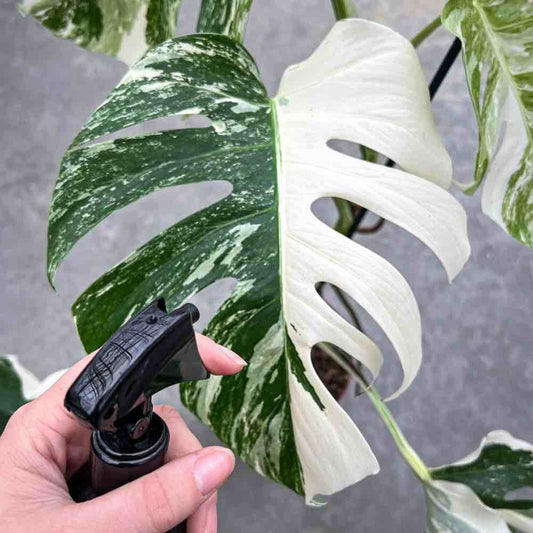
The spray bottle for small plants
It is possible to use a fine mist sprayer to spray water on the leaves and then wipe them with a soft cloth.
This will also increase the humidity and your houseplants will be delighted.

Use a soft-bristled brush or paintbrush for succulents.
Plants with fuzzy leaves like begonias, or succulent plants like cacti, echeveria, agave and cacti, do not particularly appreciate cloths and sponges.

To clean the leaves of these houseplants, you can use a brush or a soft-bristled brush .
Tilt the pot slightly while cleaning to prevent dust from falling everywhere.
When should you clean the leaves of houseplants?
The ideal frequency with which you should clean the leaves of your houseplants depends on several factors.
You must take into account your environment (dust, sunlight, ventilation, etc.), the specific needs of your plants as well as the nature of the plant itself.
But to give you an idea, it is necessary to clean the foliage as soon as you notice dust or when the leaves look dull.
A few additional tips
- For larger plants or those with thick leaves, consider using a dry cloth to remove dust before proceeding to wet cleaning.
- Avoid wetting the soil of water-sensitive plants by using plastic film during cleaning.
- Make sure to clean the plant's pot and saucer regularly. This helps remove dirt residue, prevents the accumulation of pests, and reduces the risk of fungal diseases.
- Use rainwater whenever possible for cleaning and avoid water that is too hard.
- Don't forget to remove dead or damaged leaves , as they can provide a breeding ground for pests and diseases.
In summary, cleaning the foliage of your houseplants provides numerous benefits for their health and well-being.
You promote better air circulation as well as optimal light absorption, necessary for photosynthesis.
You also reduce the risk of plant diseases and pests.
We therefore encourage you to clean the leaves of your houseplants regularly and to integrate this step into your care routine.
In this way, you take care of your little urban jungle, just as it takes care of the air quality in your home.
Ask your questions and share your own tips in the comments!

Laura Bruneau
Jardinière & autrice