Fertilizer for green plants: which natural or liquid fertilizer should you choose?

To feed an indoor foliage plant, choose a balanced fertilizer or one that is slightly higher in nitrogen, dilute it exactly as directed on the label, and apply it only while the plant is growing, to already moist potting mix. A natural fertilizer can do the job: compost, vermicompost, or liquid organic fertilizer really do nourish plants, more slowly than mineral fertilizers.
By contrast, most of the “homemade fertilizers” you hear about (coffee grounds, banana peels, eggshells, cooking water) provide little in a pot and come with risks. This guide explains how to read fertilizer labels and choose a fertilizer for indoor plants, which one to give each plant, how to measure the dose, and what the sources really say about natural fertilizers.
For a detailed month-by-month schedule, see our guide “When to Fertilize Your Indoor Plants”.
🌟 Why does an indoor foliage plant need fertilizer?
Because a pot is a closed environment. The RHS notes that plants growing in the ground often do not need fertilizer, whereas container plants do need feeding: their roots only have access to the nutrients in the potting mix. Fertilizer provides the three major nutrients—nitrogen, phosphorus, and potassium—and often trace elements as well.
According to the University of Connecticut Extension (UConn), many soilless potting mixes lack these trace elements, while organic fertilizers contain some or all of them. However, fertilizer is no substitute for light or proper watering: a plant that does not get enough light will not benefit from added nutrients.
| Benefit | What it changes |
|---|---|
| Replenished nutrients | Potting mix becomes depleted; fertilizer replenishes it |
| Denser foliage | Nitrogen supports the growth of leaves and stems (RHS) |
| Trace elements | Iron, magnesium, or zinc that some potting mixes do not provide |
| Controlled dosage | Liquid fertilizer can be measured to the nearest milliliter with a pipette |
📊 Natural, organic, liquid, or homemade fertilizer: an honest comparison
Here’s what store-bought fertilizers and the natural or homemade fertilizers most commonly recommended are really worth in an indoor pot. Each row is based on the sources cited in this guide; where no reliable source has measured an effect, we say so.
| Material | What it really provides | In an indoor pot | Main risk | Our verdict |
|---|---|---|---|---|
| Store-bought liquid fertilizer | N-P-K and trace elements listed on the label | Works quickly and is easy to measure precisely | Overfertilizing and salt buildup | The simplest go-to option |
| Liquid organic fertilizer (seaweed, nettle, fish) | Nutrients of plant or animal origin (RHS) | Faster-acting than dry organic fertilizers and suitable for pots (RHS) | Variable nutrient content if the label does not list the N-P-K | A good choice if the N-P-K is listed |
| Well-rotted compost | Nutrients released slowly by soil organisms (RHS) | In a thin top layer or when repotting | Moist organic matter can attract fungus gnats (Oregon State) | Use occasionally, when repotting |
| Vermicompost | Nutrient-rich material (UConn) | As a component of the potting mix | Same risk of fungus gnats if the pot stays wet | A good option when repotting |
| Nettle manure tea | Preparation assessed as a plant protection product (fungicide, insecticide), with no fertilizer claim (ANSES) | Garden recipe: 1 kg of nettles to 10 L of water in the proposal assessed by ANSES | ANSES found no studies on its effectiveness | Better suited to the garden |
| Coffee grounds | Nitrogen-containing proteins, but a highly variable pH of 4.6 to 8.4 (Arizona) | In compost, at no more than 20% of the volume | A thick layer blocks water and air | Use in compost, not in the pot |
| Banana peel | Potassium, but its decomposition uses up nitrogen (UC ANR) | Slow effect, not measured in pots | Decomposing material feeds fungus gnat larvae | Use in compost |
| Eggshells | Calcium, which is rarely lacking (UC ANR) | Calcium remains unavailable except when finely ground in acidic conditions (UC ANR) | No risk beyond being ineffective | Useless in pots |
| Cooking water | No reliable source has measured its benefits | Effect unknown | Salt if the water was salted | Avoid if salted |
| B1 “vitamins” | Plants make their own vitamin B1 (Arizona) | No demonstrated benefit | Unnecessary expense | Useless |
📋 Quick reference
Keep these guidelines in mind before every fertilizer application.
| Reference | The rule |
|---|---|
| N (nitrogen) | Growth of leaves and stems |
| P (phosphorus) | Growth of roots and shoots |
| K (potassium) | Flowering, fruiting, cold resistance |
| Foliage plant | Balanced fertilizer or one slightly higher in nitrogen |
| Dose | Follow the label; never use more. 5 ml per liter for our all-purpose fertilizer |
| Timing | Only while the plant is growing |
| Winter | Almost no plants need fertilizer |
| Potting mix | Always moisten it before applying fertilizer; never apply to dry mix |
| Flushing | Use water equal to twice the pot’s volume every 4 to 6 months |
| Signs of overfertilizing | Brown tips, white crust, lower leaves dropping |
How to use liquid fertilizer for foliage plants, step by step
Liquid fertilizer is the easiest type to measure precisely indoors. UConn advises applying it only to potting mix that is already moist and following the label: most soluble fertilizers call for monthly applications, while smaller, more frequent doses provide a gentler, more gradual feed.
The RHS adds that liquid organic fertilizers act faster than dry organic fertilizers and are well suited to potted plants.
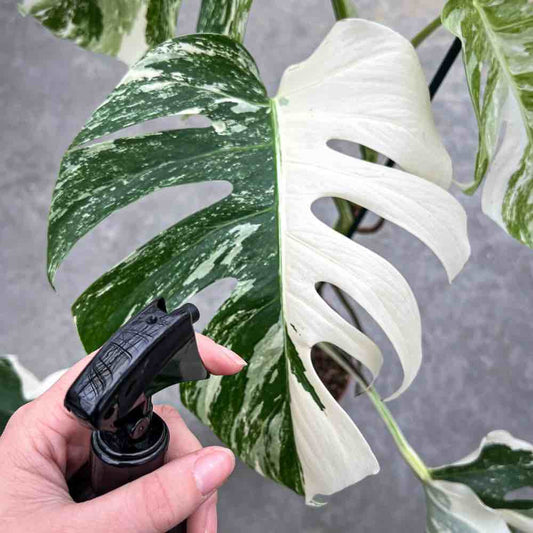
Spraying leaves does not replace applying fertilizer at the base of the plant: according to Linda Chalker-Scott of Washington State University, leaves cannot absorb enough material to meet the needs of the whole plant, and only trace elements can be effectively applied this way; nitrogen, phosphorus, and potassium are absorbed through the roots.
| Step | What to do |
|---|---|
| 1. Check that the plant is growing | Look for new leaves and brighter days; otherwise, wait |
| 2. Water first | The potting mix should be moist, never dry, when you apply fertilizer |
| 3. Measure with a pipette | Use exactly the dose on the label, diluted in room-temperature water |
| 4. Water until it drains | Let the water run through the pot, then empty the saucer |
| 5. Note the date | Follow the interval on the label; do not shorten it |
| 6. Flush occasionally | Use clear water equal to twice the pot’s volume every 4 to 6 months |
columns: 4
columns_mobile: 2
-
Fertilizer for All Indoor Plants - 250ml Liquid Fertilizer - Root and Foliar Fertilizer + Free Graduated Pipette!
Regular price 18,00 €Regular price20,00 €Sale price 18,00 €Sale -


Hoya Fertilizer - 250ml Liquid Fertilizer - Root and Foliar Fertilizer + Free Graduated Pipette!
Regular price 18,00 €Regular price20,00 €Sale price 18,00 €Sale -
Orchid Fertilizer - Phalaenopsis Fertilizer - 250ml Liquid Fertilizer - Root and Foliar Fertilizer + Free Graduated Pipette!
Regular price 18,00 €Regular price20,00 €Sale price 18,00 €Sale -
Duo - Universal Substrate 10L + Universal Liquid Fertilizer 250ml + free graduated pipette
Regular price 32,00 €Regular price37,00 €Sale price 32,00 €Sale -

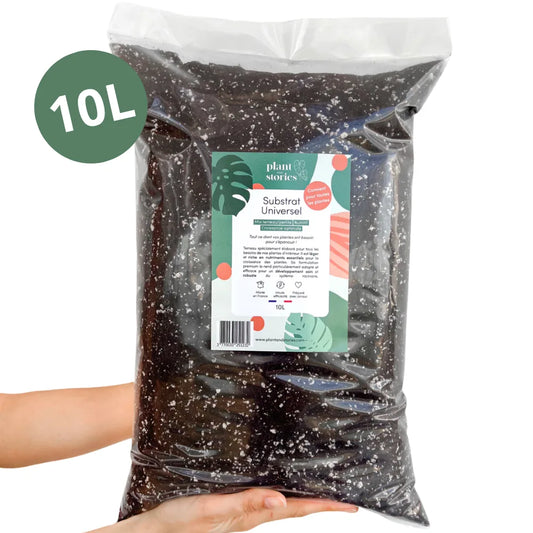
Universal Substrate enriched with Mycorrhizae and Bacillus - Premium Quality - Universal potting mix
Regular price From 9,50 €Regular price23,75 €Sale price From 9,50 €Sale -





🧭 Which fertilizer should you use for indoor foliage plants, Monstera, Hoya, or orchids?
There is no single perfect fertilizer for every plant, but a few simple rules can help. UConn says that foliage plants respond better to a fertilizer higher in nitrogen, and that for a mixed collection, a fertilizer with three similar numbers suits most indoor plants.
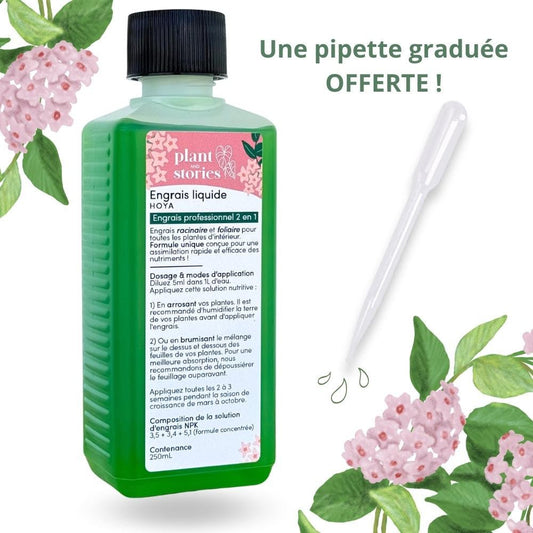
For flowering plants, sources highlight two nutrients: UConn mentions phosphorus, while the RHS mentions potassium. Specialty fertilizers, such as our liquid fertilizer for Hoya, have a higher potassium content.
| Your plant | The right fertilizer |
|---|---|
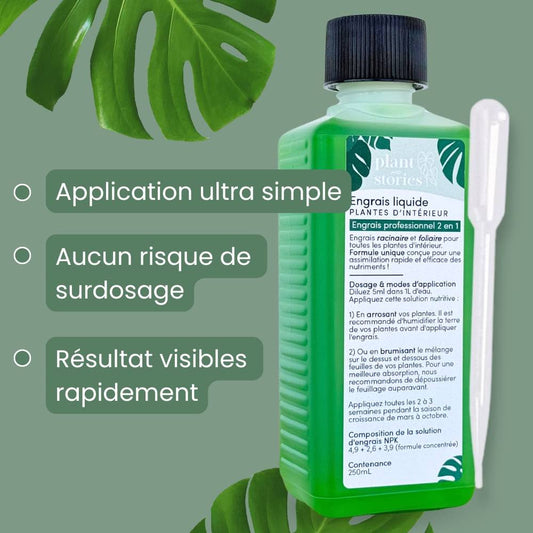
| Foliage plant (pothos, Philodendron) | Balanced fertilizer or one slightly higher in nitrogen, such as our liquid fertilizer for all indoor plants (N-P-K 4.9-2.6-3.9) |
| Monstera (natural or liquid fertilizer) | The same foliage fertilizer during the growing season; add a little vermicompost to the potting mix when repotting. See our Monstera care guide |
| Hoya and flowering plants | Fertilizer higher in potassium during the growing season; see how to get a Hoya to flower |
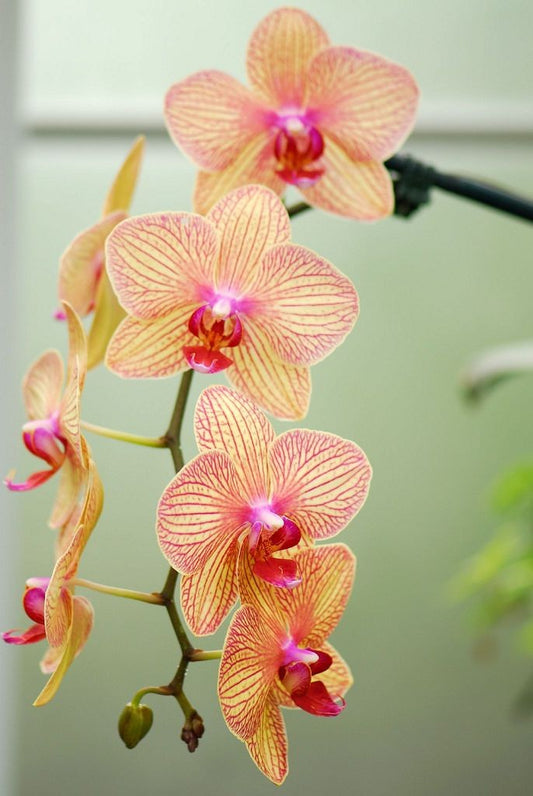
| Phalaenopsis orchid | Highly diluted specialty fertilizer, such as our liquid orchid fertilizer; see how to get an orchid to bloom again |
| Recently repotted plant | Fresh potting mix is already enriched and feeds the plant (3 to 4 months for our all-purpose substrate, according to its product information), so wait. See repotting a plant after purchase |
| Cacti and succulents | No fertilizer in winter, according to the RHS; see our tips for cacti and succulents |
| Semi-hydroponic plant | Use a fertilizer formulated for this growing method; see our semi-hydroponics guide |
📐 What do the N-P-K numbers on fertilizer mean?
The three numbers printed on the packaging give the percentages of nitrogen (N), phosphate (P), and potassium (K), in that order. According to UConn, they represent the dry-weight percentages of total nitrogen, available phosphate, and water-soluble potassium: a 20-20-20 fertilizer therefore contains 20% of each.
According to the RHS (Royal Horticultural Society), nitrogen supports the growth of leaves and stems, phosphorus supports roots and shoots, and potassium supports flowering, fruiting, and cold resistance. UConn cites 20-20-20 and 10-8-7 as examples of balanced fertilizers.
Our all-purpose fertilizer has an N-P-K of 4.9-2.6-3.9: a formula slightly higher in nitrogen, suitable for foliage plants. The numbers alone do not tell the whole story: a concentrated fertilizer needs to be diluted more, and the label specifies the dose.
📐 Natural or mineral fertilizer: what really changes?
To fertilize a plant naturally, use an organic fertilizer, also called natural or organic-certified depending on the label: according to the RHS, it comes from living things and may be plant-based (seaweed, nettle, comfrey) or animal-based (fish, blood, bone, poultry manure). Mineral fertilizer is made synthetically or derived from mined minerals.
The RHS makes a simple comparison: organic fertilizers are effective but generally less concentrated and slower, because soil organisms first have to break them down; mineral fertilizers are more concentrated and faster acting. In an indoor pot, solid organic fertilizer therefore takes time to work. Liquid organic fertilizers are an exception: they work faster and are suitable for pots.
Vermicompost, which UConn’s vermicomposting fact sheet describes as nutrient-rich, can be added to a potting mix.
Nettle manure tea is a different matter: in its opinion on a draft decree, ANSES (the French Agency for Food, Environmental and Occupational Health & Safety) assesses it as a plant protection product (a fungicide or “growth enhancer” sprayed on soil, and an insecticide against aphids and mites), and says not to “refer to properties of a fertilizer.”
It notes that “no studies allow its effectiveness to be assessed” and advises against applying it to flowering plants, as its high nitrogen content encourages foliage at the expense of flowering. For root health itself, see our article on mycorrhizae: the RHS also notes that excess nutrients inhibit mycorrhizal fungi.
📐 Coffee grounds, banana peels, eggshells: do these homemade fertilizers work?
These are the most widely shared “natural fertilizers,” but the sources are more cautious than social media. Regarding coffee grounds, the University of Arizona Extension notes that they contain nitrogen-rich proteins, but their pH varies from 4.6 to 8.4, so they are not always acidic.
She advises not to exceed 20% of the volume of a compost pile, as mixtures above 30% have often proved harmful, and to spread only a thin layer, since a thick layer of fine particles blocks water and air.
As for banana peels and eggshells, expert gardeners at the University of California (UC ANR) explain that bananas provide potassium, but their decomposition uses up nitrogen that the plant needs; eggshells, meanwhile, retain their calcium unless they are ground into a fine powder in an acidic environment (pieces were still there three years later), and plants rarely lack calcium.
Their advice for bananas: compost them, then apply the compost as a top dressing; the University of Arizona recommends the same approach for coffee grounds.
Indoors, there is an added risk: according to Oregon State University Extension, fungus gnat larvae live in roughly the top half-inch of moist potting soil and feed on decaying organic matter. As for cooking water, no reliable source has measured its benefits; if it is salted, never pour it into a pot.
🗓️ When should you fertilize a houseplant?
Only when it is growing. UConn places the active growing period between March and October and advises against fertilizing in winter, when light levels and temperatures drop.
The RHS takes the same view: almost no plants need fertilizer during the winter months, even if they flower at that time of year, and its December advice for houseplants recommends reducing watering and fertilizing as the days grow shorter.
The exact schedule depends on the fertilizer and the plant: our guide, “When to Fertilize Houseplants” provides a detailed schedule, while our winter houseplant guide covers cold-season care.
📅 Seasonal care calendar
| Season | Key task |
|---|---|
| 🌸 Spring | Resume feeding when growth picks up, following the label dosage |
| ☀️ Summer | Peak growing season: feed regularly, making sure the potting mix is moist before fertilizing |
| 🍂 Fall | Space out feedings, then stop as the days grow shorter |
| ❄️ Winter | No fertilizer for most plants; flush the pot if a white crust appears |
🐛 Too much fertilizer: how to recognize and correct overfertilization
Excess fertilizer leaves telltale signs. According to the University of California’s “Soluble Salts” fact sheet, dissolved fertilizer becomes soluble salt that builds up in the pot as water evaporates; it slows growth, browns leaf tips, causes lower leaves to fall off, and forms a pale crust on the potting mix.
UConn adds that excess salts burn young roots and prevent the plant from taking up water, causing it to wilt even when the potting mix is moist.
The fix is simple: flush the pot with an amount of water equal to twice its volume, at least every 4 to 6 months, and never let the pot sit in its saucer; in cases of severe buildup, UConn recommends repotting in fresh potting mix.
| Mistake | Why it’s a problem | Solution |
|---|---|---|
| Fertilizing in winter | The dormant plant does not use the nutrients, so salts build up | Stop feeding in fall and resume when growth returns |
| Pouring fertilizer onto dry potting mix | Concentrated salts burn the roots (UConn) | Water first, then apply diluted fertilizer |
| Doubling the dosage to speed things up | Excess salts, brown tips, damaged roots | Follow the label dosage to the milliliter |
| Spreading a thick layer of coffee grounds | The layer blocks water and air (Arizona) | Add them to the compost, up to 20% of its volume |
| Burying food scraps in the pot | Decaying matter attracts fungus gnats (Oregon State) | Compost it, then use the finished compost |
| Mistaking a lack of light for a nutrient deficiency | Fertilizer cannot replace light | Improve the light before feeding |
| Relying on foliar feeding alone | Leaves do not absorb enough N-P-K (WSU) | Feed through the roots; foliar feeding is only useful for micronutrients (WSU) |


🌿 Our houseplant fertilizers and guides
To learn more, here are our liquid fertilizers and the guides that complement this one, each linking to its own page.
| Our selection | Why choose it |
|---|---|
| liquid fertilizer for all houseplants | All-purpose N-P-K 4.9-2.6-3.9 fertilizer with iron, magnesium, and zinc; use 5 ml per liter |
| liquid fertilizer for Hoya | N-P-K 3.5-3.4-5.1, richer in potassium, for Hoya during the growing season |
| liquid fertilizer for orchids | Formula for orchids, more diluted than the all-purpose fertilizer: 1 to 2.5 ml per liter when watering, according to the product page |
| 10 L all-purpose potting mix and liquid fertilizer bundle | Fresh potting mix and the fertilizer to take over after a few months |
| graduated pipette | For measuring by the milliliter and avoiding overfertilizing |
| our guide, When to Fertilize Houseplants | A detailed year-round fertilizing schedule |
| why fungus gnats appear in pots | If fungus gnats appear after adding organic matter |
| the difference between potting mix and substrate | Understand what your potting mix already contains |
🔑 Vitamins, tonics, and “boosters”: should you use them?
No, not to feed a plant.
Vitamin B1, often sold as a plant tonic, has no proven effect: according to the same University of Arizona Extension service, a healthy plant makes its own vitamin B1, and studies on woody plants, annual flowers, and crops have found no growth benefits.
Claims of “miracle growth” often come from in-vitro cultivation in sterile media, not from potted plants.
What is marketed as a “houseplant vitamin” is actually a complete fertilizer, light, and proper watering; for the water itself, see using rainwater to water your plants.
🔑 Our liquid fertilizers: what we know about their composition
For transparency, here is what our product pages say. Our all-purpose fertilizer lists an N-P-K of 4.9-2.6-3.9, with iron, magnesium, and zinc, described on its product page as micronutrients, and is dosed at 5 ml per liter of water; our Hoya fertilizer lists 3.5-3.4-5.1. The product pages do not specify whether the nutrients are organic or mineral-based, so we do not market them as natural fertilizers.
If you are looking for an organic option, compost, vermicompost, or a liquid organic fertilizer with a listed N-P-K are the safest choices. According to its product page, our all-purpose substrate contains micronutrients, mycorrhizae, and Bacillus bacteria; our full range is available in our fertilizers and plant care collection.
✅ Our method for feeding your houseplants
Remember three rules. Choose a fertilizer whose label lists a balanced N-P-K or one with slightly more nitrogen for foliage plants. Apply it only during the growing season, to moist potting mix, and at the recommended dose. Flush the pot from time to time to remove salts.
Natural fertilizers such as compost and vermicompost have their place when repotting; food scraps and coffee grounds, on the other hand, belong in the compost. And if your plant has stopped growing, check the light first: it determines whether the fertilizer will be useful.
People often ask me what natural fertilizer to use on a houseplant that has stopped growing. My first question is always about light, and my second is when the pot was last flushed. My food scraps and coffee grounds go into the compost, never directly into an indoor pot: I’ve seen fungus gnats take hold far too often. For my foliage plants, I prefer a well-measured liquid fertilizer during the growing season, then nothing from fall through spring.

Laura Bruneau
Jardinière & autrice