Why do I have gnats in my plants?

You take good care of your plants, yet little flies appear above the pots. Why? The answer almost always comes down to one word: moisture. According to the RHS (Royal Horticultural Society), fungus gnats thrive in potting mix that stays consistently moist and is rich in organic matter.
Understanding the cause is already half the battle. Here’s why fungus gnats settle in your home, and how to get rid of them for good with Felti nematodes and sticky yellow traps.
🔍 Why fungus gnats appear around your plants
The little black flies in your pots are fungus gnats (sciarid flies), small flies measuring 3 to 4 mm. They lay their eggs in moist potting mix, and their larvae—translucent maggots up to 6 mm long—feed on decaying organic matter in the soil. According to the RHS (Royal Horticultural Society), potting mix that stays soggy all the time encourages their numbers to multiply, while letting it dry out helps keep them in check.
In other words, fungus gnats are almost always a symptom of overwatered or overly rich potting mix, not an unavoidable problem or a sign of a sick plant. The good news: these are two factors you can control completely, and correcting them is often enough to turn things around.
🪪 What are these little flies?
Before taking action, it helps to know a little about the insect itself so you can target it effectively.
| Characteristic | Fungus gnats (sciarid flies) at a glance |
|---|---|
| 📏 Adult size | 3 to 4 mm, small dark gray-brown flies |
| 🐛 Larva | Translucent whitish maggot up to 6 mm long, with a black head |
| 🫚 Where it develops | In moist potting mix rich in organic matter |
| 🍽️ What the larva eats | Dead roots, decaying matter, young seedling roots |
| 💧 What encourages it | Potting mix that stays soggy (overwatering) |
| 🌱 Plants at risk | Seedlings and cuttings in particular; established plants are rarely damaged |
| 🎯 Long-term solution | Steinernema feltiae nematodes (biological control) |
| 🟡 Extra support | Sticky yellow traps to catch the adults |
💧 Cause no. 1: overwatering
Potting mix that never dries out is a perfect breeding ground: constant moisture for egg-laying, plus organic matter for the larvae. This is by far the most common cause, and often the hardest to accept, because we water our plants out of love.
Yet most houseplants prefer potting mix that dries out a little between waterings. If you water as soon as the surface looks dry, the soil beneath it actually stays constantly moist—exactly where the larvae thrive. Identifying and correcting this habit can solve a large share of infestations on its own.
| Watering habit | Effect on fungus gnats |
|---|---|
| 💧 Watering too often | Constantly moist potting mix = continuous egg-laying and larvae |
| 🪴 Saucer full of water | Constant moisture at the base of the pot |
| 🕳️ Pot without drainage | Water collects and the potting mix stays soggy |
| 🌱 Letting the surface dry out | Breaks the females' egg-laying cycle |
🌱 Other factors that attract them
Watering isn’t the only cause. Potting mix that’s very rich in compost, plant debris rotting on the surface, or a newly purchased plant can also bring in fungus gnats. Often, several of these factors combine, which explains why one plant gets infested while the one next to it does not.
| Factor | Why it attracts them | What to do |
|---|---|---|
| Very rich potting mix | Organic matter = food for the larvae | Use a more free-draining mix with less fresh compost |
| Recently repotted plant | New potting mix may already contain eggs | Inspect it and let the surface dry out |
| Plant debris on the surface | Decaying dead leaves | Clear the top of the pot |
| Newly purchased infested plant | Larvae brought in from the store | Quarantine for 2 weeks |
The best approach: check these factors one by one on the affected plant. Often, you’ll find two or three causes at once—overwatering, a full saucer, and very rich potting mix, for example—and correcting them together is enough to nip the problem in the bud.
🎯 How to get rid of them for good
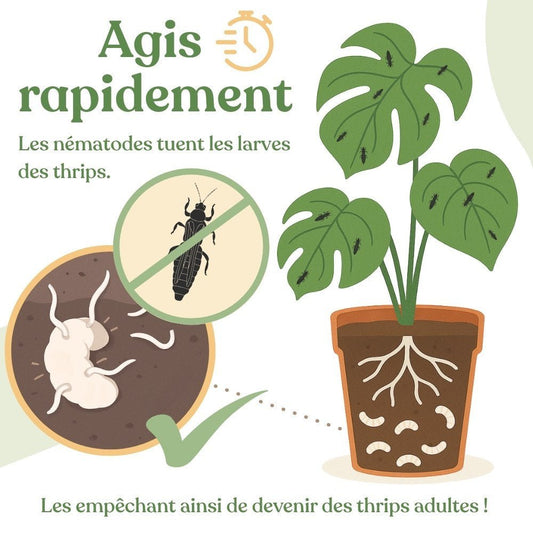
Correcting your watering habits stops the infestation from getting worse, but larvae are already in the potting mix, so you need to eliminate them to put the problem behind you. Felti nematodes (Steinernema feltiae) are microscopic worms that parasitize these larvae directly in the soil, without posing any danger to your plants, pets, or you.
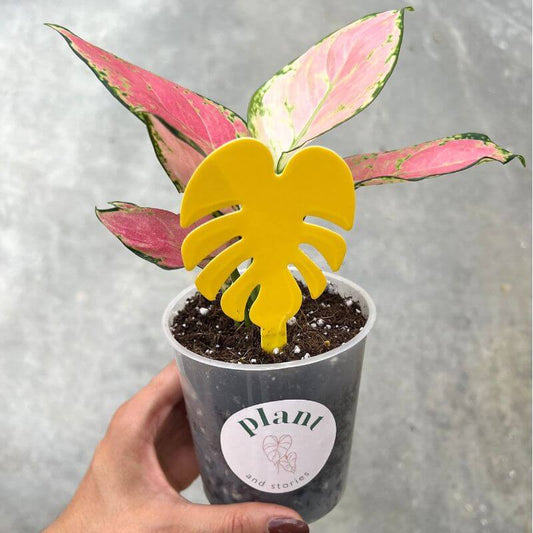
At the same time, sticky yellow traps catch any adults still flying around and stop them laying eggs. This two-pronged approach, the foundation of biological pest control, breaks the cycle at both ends: no more larvae in the soil and no more adults on the surface. Apply the nematodes in the evening to moist potting mix, then repeat once two to three weeks later if needed.
columns: 4
columns_mobile: 2
-
Felti Nematodes (SF) - Soil fly control - Fungus gnat control - Sciarid control
Regular price From 12,99 €Regular price19,50 €Sale price From 12,99 €Sale -

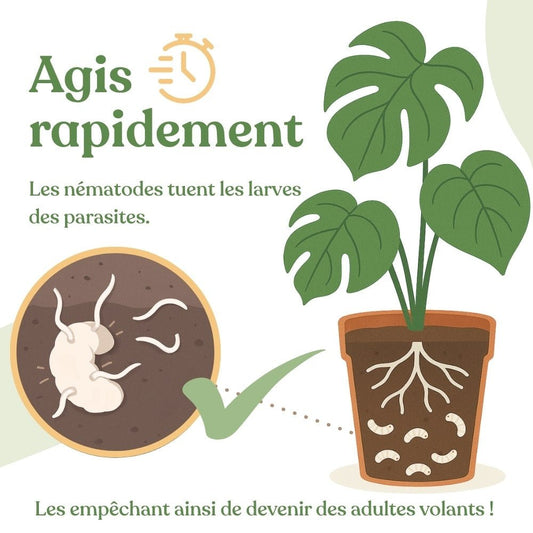
Nematode Duo for Gnat and Thrip Control + 20 Free Sticky Traps - 10 Million Nematode Pack for Each
Regular price 45,00 €Regular price62,96 €Sale price 45,00 €Sale -
Yellow Sticky Traps for Fungus Gnats - Fungus Gnats - Double-Sided
Regular price From 7,50 €Regular price7,50 €Sale price From 7,50 € -
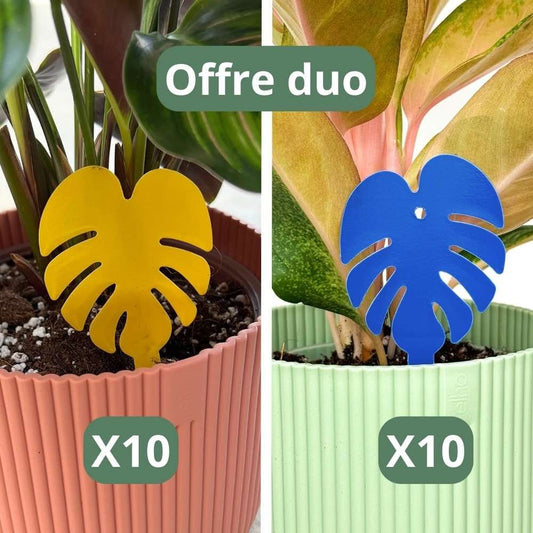
DUO OFFER - Blue Thrips Traps + Yellow Fungus Gnat Traps - Chromatic Sticky Traps
Regular price 14,00 €Regular price15,00 €Sale price 14,00 €Sale




📅 Your fungus gnat control calendar
Fungus gnats thrive in warm, moist conditions. Here’s what to do throughout the year.
📅 Seasonal care calendar
| Season | Key action |
|---|---|
| 🌸 Spring | As watering picks up again, monitor moisture and put out a trap as soon as you spot the first adults. |
| ☀️ Summer | Warm weather means faster life cycles: water less often and treat the plants if the infestation worsens. |
| 🍂 Fall | Before bringing plants indoors, inspect and treat them. |
| ❄️ Winter | In a heated home, let the surface of the potting mix dry out between waterings. |
🛡️ Prevention: get watering under control
Once the fungus gnats are gone, it all comes down to watering. The golden rule: let the top few centimeters dry out before watering again. This simple change deprives females of the moist environment they need to lay eggs and is usually enough to prevent them from returning.
Also check that the pot drains well (never leave standing water in the saucer) and keep the surface clear of decaying debris. These steps cost nothing and are far better than repeatedly applying treatments.
| Good habit | Effect |
|---|---|
| 🖐️ Check the potting mix with your finger | Only water when the top 2–3 cm are dry |
| 🪨 Add a mineral mulch layer | Prevents egg-laying and keeps the surface dry |
| 🕳️ Check the drainage | No standing water at the bottom of the pot |
| 🍂 Remove debris | Less decaying matter for the larvae |


🐛 Common mix-ups and mistakes
Correct identification prevents you from treating the wrong problem. The most common mix-up is between fungus gnats, which emerge from pots, and fruit flies, which come from the kitchen: they’re different insects and need different treatments. Here are the mistakes to watch out for.
| Situation | The problem | What to do |
|---|---|---|
| 🔎 Confusing them with fruit flies | They come from the kitchen, not the pots | Check where the insects are emerging from |
| 💧 Treating without changing watering habits | The potting mix remains a breeding ground | Let it dry out between waterings |
| 🌱 Thinking the plant is sick | It’s the larvae, not a disease | Treat the potting mix with nematodes |
| ⏱️ Stopping too soon | Another generation may still hatch | Keep going until you have no more catches |
✅ The key takeaways
If you have fungus gnats, it’s almost always because the potting mix stays too moist and is too rich. It’s neither inevitable nor a sign of plant disease, but an imbalance that’s easy to correct once you know the cause.
The solution is clear: adjust your watering, treat the larvae with Felti nematodes, and catch the adults with yellow traps. This three-part approach tackles the problem at its source, where surface treatments fall short.
After that, it all comes down to habit: let the top few centimeters dry out between waterings, and fungus gnats simply won’t have anywhere to lay their eggs.
Nine times out of ten, when someone shows me fungus gnats, the surface of the potting mix is still wet. The real breakthrough is learning to let it dry out: the nematodes finish the job, and controlled watering stops the problem from coming back.

Laura Bruneau
Jardinière & autrice