A Grandma’s Remedy for Gnats: What Works

Cinnamon, vinegar, matches, coffee grounds: grandma’s remedies for fungus gnats are everywhere online, and it’s tempting to try everything when flies are buzzing around your plants. Some methods really do help, others are pure myth, and a few can even make things worse. Let’s sort them out honestly.
You’ll find out which home remedies are worth trying, which ones you can forget without regret, and why the only truly long-lasting solution is biological control using Felti nematodes and yellow sticky traps. The point isn’t to pit home remedies against treatment, but to understand what each can do.
🌿 Grandma’s remedies: fact or fiction?
Let’s take a look at the most common tips, with a clear verdict for each. Most home remedies have one thing in common: they work on the surface, targeting adults or egg-laying, but none reaches the larvae hidden in the potting soil. That’s why they may bring relief but never really solve the problem.
Understanding this can save you a lot of disappointment: a remedy may reduce the number of visible gnats while letting the population rebuild below the surface. So home remedies are best used for prevention and as a supplement, not as a primary treatment.
| Home remedy | What it actually does | Verdict |
|---|---|---|
| Let the potting soil dry out | Removes the moisture needed for egg-laying | Effective—make this your first step |
| Layer of sand or gravel | Prevents females from laying eggs on the surface | Useful for prevention |
| Apple cider vinegar trap | Mostly attracts fruit flies | Limited effect on plant pests |
| Cinnamon on the potting soil | Mild antifungal effect; deprives larvae of fungi | Helpful as a supplement, not a solution |
| Matches stuck into the soil | Myth: the sulfur doesn’t work at this dose | Useless |
| Coffee grounds | Enriches the potting soil…and feeds the larvae | Avoid—can make things worse |
🪪 Why some methods work
| Characteristic | Fungus gnats (sciarid flies) at a glance |
|---|---|
| 📏 Adult size | 3 to 4 mm, a small dark gray-brown fly |
| 🐛 Larva | Translucent whitish maggot, up to 6 mm long, with a black head |
| 🫚 Where they develop | In moist potting soil rich in organic matter |
| 🍽️ What the larvae eat | Dead roots, decaying matter, and young seedling roots |
| 💧 What encourages them | Constantly waterlogged potting soil (overwatering) |
| 🌱 Plants at risk | Seedlings and cuttings in particular; established plants suffer little damage |
| 🎯 Long-term solution | Steinernema feltiae nematodes (biological control) |
| 🟡 Additional support | Yellow sticky traps to catch adults |
✅ Home remedies that really help
Three simple steps have a real impact because they target egg-laying and adult flies rather than relying on myths. They’re an excellent way to prepare, as long as you also treat the larvae in the soil. According to the RHS (Royal Horticultural Society), letting the potting soil dry out significantly reduces the number of gnats—it’s the best-documented home remedy.
These tips have another advantage: they cost almost nothing and pose no risk to the plant. They’re worth adopting as a routine, even after the infestation is under control, to help prevent it from returning.
| Home remedy | How to do it properly |
|---|---|
| 💧 Let the surface dry out | Wait until the top 2–3 cm are dry before watering |
| 🪨 Sand or gravel on the surface | Add a 1–2 cm layer over the entire surface of the potting soil |
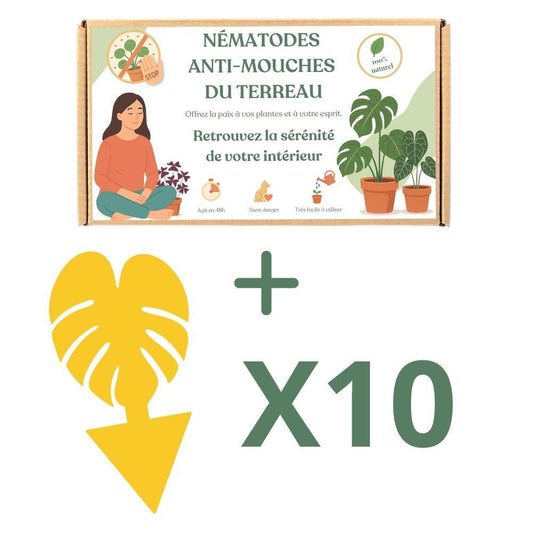
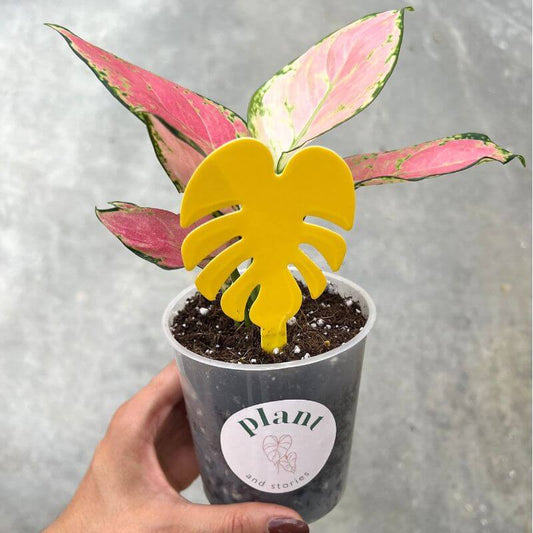
| 🟡 Yellow sticky trap | Place one per pot, close to the soil, to catch adults |
❌ Remedies that are (almost) useless
It’s worth knowing this before you waste time and damage your plants: several widely shared remedies have no proven effect on fungus gnats, and some can even be counterproductive. The worst offender is coffee grounds, often presented as a repellent even though they add organic matter—in other words, food for the larvae.
Be wary of harsh remedies too, such as spraying dish soap on the leaves: they stress the plant without ever reaching the larvae in the soil. An ineffective remedy isn’t harmless—it mainly wastes time while the infestation continues to grow.
| Remedy | Why it disappoints |
|---|---|
| 🔥 Matches stuck into the soil | Sulfur doesn’t spread at an effective dose |
| ☕ Coffee grounds | Organic matter = food for the larvae |
| 🍎 Vinegar trap on its own | Targets fruit flies, not fungus gnats |
| 🧴 Spraying dish soap | Stresses the plant and doesn’t reach the larvae |
🎯 The only truly long-lasting solution
Home remedies help reduce the problem, but as long as larvae are living in the potting soil, the gnats will return. The only way to get rid of them for good is to treat the source: the soil itself.
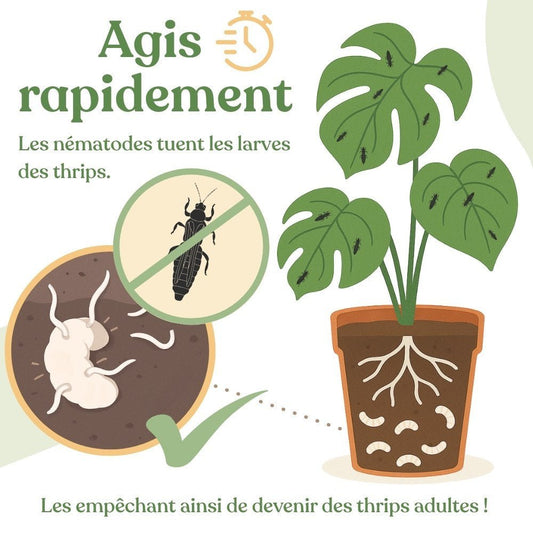
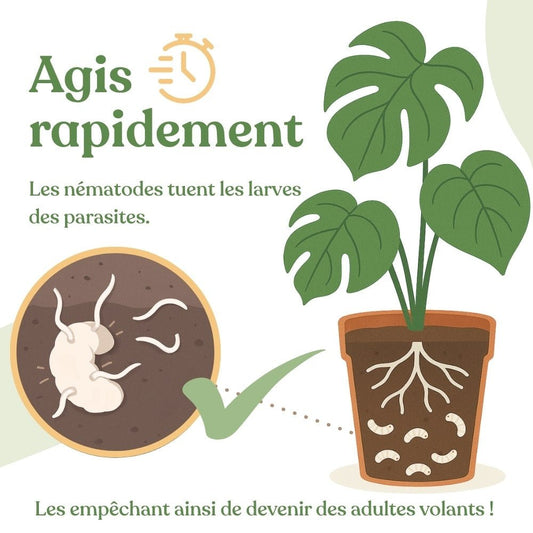
Felti nematodes (Steinernema feltiae) are microscopic worms that parasitize larvae directly in the growing medium in about 72 hours, without harming your plants or your home. Meanwhile, yellow sticky traps and the nematode duo catch any adults still flying around. This combination—not a single remedy on its own—is what keeps your pots gnat-free in the long term. A well-chosen home remedy can then help keep them that way.
columns: 4
columns_mobile: 2
-
Felti Nematodes (SF) - Soil fly control - Fungus gnat control - Sciarid control
Regular price From 12,99 €Regular price19,50 €Sale price From 12,99 €Sale -

Nematode Duo for Gnat and Thrip Control + 20 Free Sticky Traps - 10 Million Nematode Pack for Each
Regular price 45,00 €Regular price62,96 €Sale price 45,00 €Sale -
Yellow Sticky Traps for Fungus Gnats - Fungus Gnats - Double-Sided
Regular price From 7,50 €Regular price7,50 €Sale price From 7,50 € -
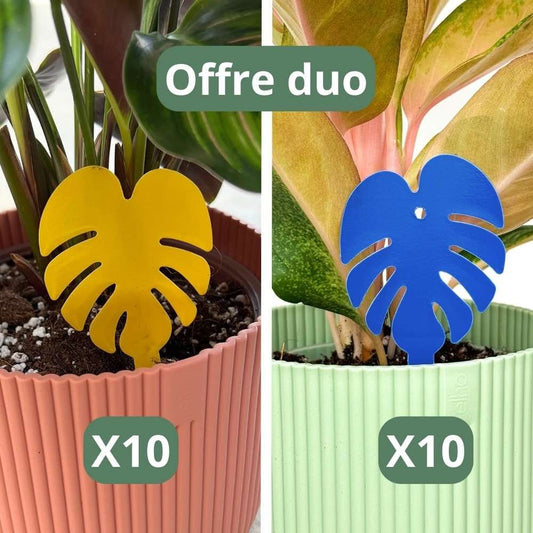
DUO OFFER - Blue Thrips Traps + Yellow Fungus Gnat Traps - Chromatic Sticky Traps
Regular price 14,00 €Regular price15,00 €Sale price 14,00 €Sale




📅 A schedule to keep them from coming back
Combine home remedies with a thorough treatment at the right time of year.
📅 Seasonal care schedule
| Season | Key step |
|---|---|
| 🌸 Spring | Let the soil dry out, put up a trap, and treat with nematodes as soon as you see the first adults. |
| ☀️ Summer | Warm weather speeds up their life cycle: water less often and repeat treatment if needed. |
| 🍂 Fall | Treat plants brought indoors before placing them inside. |
| ❄️ Winter | Keep the surface dry and leave a trap in place in heated indoor spaces. |
🛡️ Preventing fungus gnats from returning
Once the gnats are gone, prevention comes down to a few lasting habits that are far more effective than any miracle remedy. It all comes down to one simple idea: never again give fungus gnats the moist, nutrient-rich potting soil they need to lay their eggs.
This is where the best of grandma’s remedies find their true purpose: not to cure an infestation, but to prevent one. Letting the soil dry out, adding a layer of sand, and keeping a trap in place are better than trying ten recipes in a panic.
| Good habit | Why |
|---|---|
| 🖐️ Water only when the soil is dry | Deprives the larvae of moisture |
| 🪨 Mineral mulch | Creates a barrier against egg-laying |
| 🔎 Quarantine new plants | Prevents you from bringing in larvae |
| 🟡 Keep a trap in place | Alerts you as soon as the first adults appear |


🐛 Common mistakes
| Mistake | Consequence | What to do instead |
|---|---|---|
| ☕ Adding coffee grounds | Feeds the larvae | Remove them and use sand instead |
| 💧 Continuing to overwater | The potting soil remains a breeding ground | Let it dry out between waterings |
| 🌿 Relying on home remedies alone | The larvae survive | Treat the soil with nematodes |
| ⏱️ Giving up too soon | Another generation still hatches | Continue until there are no more catches |
✅ Key takeaways
Of all grandma’s remedies, only a few really matter: letting the potting soil dry out, covering it with sand, and putting up a yellow trap. The rest is often useless and sometimes counterproductive, like coffee grounds, which feed the larvae.
The reason is always the same: no home remedy reaches the larvae hidden in the growing medium. To get rid of them for good, add the one step no recipe can replace: treat the soil with Felti nematodes, and keep yellow traps in place to catch the adults.
Use home remedies for prevention and nematodes for thorough treatment: it’s this division of roles—not a miracle recipe—that will keep your pots gnat-free in the long term.
I tried half the tips I found online before realizing the key: nothing replaces letting the potting soil dry out and using nematodes to target the larvae. As for coffee grounds, I’ve banished them from my pots for good.

Laura Bruneau
Jardinière & autrice