

Hellebore (Helleborus): Christmas rose, planting and care

To grow a hellebore successfully, plant it from autumn to spring in partial shade, ideally beneath deciduous trees, in rich, moist but well-drained soil, at the same depth as in its pot, then cut back old, damaged leaves at the end of winter.
The name Christmas rose refers to Helleborus niger, an outdoor perennial with white flowers that open in midwinter; the later-flowering Lenten rose includes H. orientalis and the hybrids H. × hybridus. So it has nothing to do with the poinsettia (Euphorbia pulcherrima), the indoor Christmas star with red bracts.
Hellebores are one of the stars featured in our guide to perennials for shade and under trees.
🌿 Why plant hellebores in the garden?
Plant hellebores to bring color to the garden in the depths of winter.
According to NC State Extension, the genus includes 22 species and many hybrids, grown for their evergreen foliage and cup-shaped flowers about 2 to 3 inches (5 to 7.5 cm) across, from late winter to early spring.
The RHS (Royal Horticultural Society) hellebore growing guide describes oriental hybrids as hardy and long-lived, with white, pink, ruby or plum flowers, often speckled. Despite their name, they are not roses but members of the buttercup family, the RHS notes.
| Benefit | What it means for your garden |
|---|---|
| Winter flowering | White, pink or purple flowers from Christmas to Easter, depending on the species |
| Evergreen foliage | Dark green clumps that dress up the woodland garden all year round |
| Long-lived | Oriental hybrids live for many years in the same spot, according to the RHS |
| Few pests | Avoided by deer and rabbits, according to NC State |
🔎 Hellebore at a glance
The genus Helleborus belongs to the buttercup family (Ranunculaceae).
According to Plants of the World Online (POWO), run by the Royal Botanic Gardens, Kew, Helleborus niger L., described by Linnaeus in 1753, is native to the Alps and Apennines (Austria, Germany, Italy, the northwestern Balkans and Switzerland); the database lists it as introduced in France, Czechia-Slovakia, Sweden and New York State.
For the Lenten rose, POWO accepts the name Helleborus × hybridus Voss (1894) for an artificial hybrid, and the RHS black death page also refers to H. × hybridus as H. orientalis.
| Feature | Verified details |
|---|---|
| 🏷️ Botanical name | Helleborus niger L. (Christmas rose); H. orientalis Lam. and H. × hybridus Voss (Lenten rose) |
| 🧬 Family | Buttercup family (Ranunculaceae) |
| 🌳 Type | Clump-forming herbaceous perennial with evergreen or semi-evergreen foliage |
| 🌍 Native range | Europe, Morocco and temperate Asia for the genus (NC State); the Alps and Apennines for H. niger (POWO) |
| ❄️ Hardiness | H7 (below -4 °F) for H. niger, H6 (between 5 and -4 °F) for H. orientalis, H4 (between 23 and 41 °F) for 'Christmas Carol' (RHS) |
| 🍃 Foliage | Leathery, dark green, divided into 7 to 9 leaflets in H. niger and H. orientalis (RHS) |
| 🌸 Flowering | H. niger from midwinter to early spring; H. orientalis from late winter to early spring (RHS) |
| 📏 Mature height | 12 to 18 inches for most, up to 3 feet for H. argutifolius and H. foetidus (RHS) |
📋 Quick growing guide
Essential growing information at a glance.
| Factor | Guideline |
|---|---|
| Exposure | Light shade or dappled light with some sun (RHS); no more than 2 to 6 hours of direct sun (NC State) |
| Soil | Rich in humus, moist but well-drained, neutral to alkaline; neither very dry nor waterlogged |
| Hardiness | H7 for H. niger, H6 for H. orientalis, H4 for 'Christmas Carol' and 'Silver Dollar' (RHS) |
| Watering | Water regularly during the first growing season and when grown in pots; thereafter, only during dry spells |
| Planting | From autumn to spring, avoiding dry summer weather, at the depth of the original pot |
| Pruning | Cut back old hybrid leaves in late winter; for other species, remove diseased leaves in autumn and spent flower stems |
| Flowering | From midwinter to spring, depending on the species |
| Care | Easy for oriental hybrids, more demanding for H. niger (RHS, MBG) |
| Toxicity | Toxic to dogs, cats and horses (ASPCA); can irritate the skin (RHS) |
📍 Where and when to plant hellebores: what exposure do they need?
Plant hellebores in light shade, ideally beneath deciduous trees that let in the winter light and protect them from summer sun.
The RHS offers species-specific guidance: H. foetidus tolerates deeper shade, H. argutifolius and H. × sternii prefer a sunny spot sheltered from cold winds, the RHS Helleborus orientalis profile says it grows in sun or partial shade, while H. niger needs a cool, sheltered, lightly shaded spot and very well-drained soil.
Plant from autumn to spring, avoiding the dry summer months, advises the RHS.
🌳 Ideal: Beneath deciduous trees, in partial shade, in cool, humus-rich, well-drained soil
🧱 For H. niger: A sheltered spot; in heavy soil, use a raised bed or container, or plant by a south- or west-facing wall (RHS)
🚫 Avoid: Waterlogged soil in winter, very dry soil in summer, and scorching full sun for shade-loving species
🪴 How to plant a hellebore in the ground
Planting depth is key: the RHS says to plant at the same level as in the original pot, never deeper. Space plants 14 to 18 inches apart, 2 feet apart for H. foetidus and 2 to 4 feet apart for H. argutifolius, according to the same source. In heavy or poorly drained soil, the RHS recommends a raised bed or container for H. niger.
One last thing: be patient. The Missouri Botanical Garden (MBG) notes that H. niger is slow to establish.
| Step | What to do |
|---|---|
| 1. Choose the right time | From autumn to spring, when the soil is moist and not frozen; never in the height of a dry summer |
| 2. Prepare the soil | Loosen and enrich with compost; in heavy soil, raise the bed or improve drainage |
| 3. Rehydrate the root ball | Soak the pot in a bucket of water before removing the plant |
| 4. Plant at the right depth | Keep the crown level with the soil, at the depth of the original pot, then firm the soil |
| 5. Water and mulch | Water thoroughly and add at least 2 inches of mulch, keeping it clear of the crown (RHS) |
columns: 4
columns_mobile: 2
-
Christmas rose 'Christmas Carol' (Helleborus niger) – winter-flowering perennial
Regular price From 44,95 €Regular price -


Lenten Rose 'Double Ellen Pink' (Helleborus orientalis) - winter-flowering perennial - 14 cm pot - Height 35 cm
Regular price From 44,95 €Regular price -


Lenten Rose 'Double Ellen Red' (Helleborus orientalis) – winter-flowering perennial – 14 cm pot – 35 cm tall
Regular price From 44,95 €Regular price -


Lenten Rose 'Double Ellen White' (Helleborus orientalis) – winter-flowering perennial – 14 cm pot – height 35 cm
Regular price From 44,95 €Regular price -


Hellebore ‘Silver Dollar’ (Helleborus x sternii) – evergreen perennial with silvery foliage – 14 cm pot – height 35 cm
Regular price From 39,95 €Regular price -


Hellebore 'Diamonfire' (Helleborus × nigercors) – cream-white flowering perennial – 19 cm pot – 40 cm tall
Regular price 59,95 €Regular price -

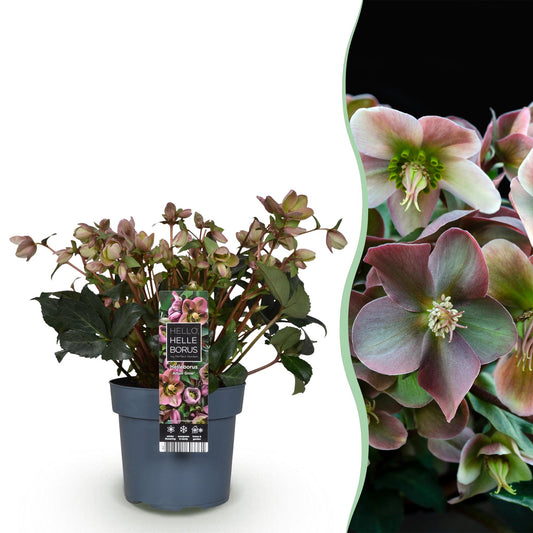
Hellebore 'Angel Glow' (Helleborus x ericsmithii) – winter-flowering perennial – 19 cm pot – height 50 cm
Regular price 59,95 €Regular price -


Hellebore ‘Dacaya’ (Helleborus × hybridus) – winter-flowering perennial – 19 cm pot – 50 cm tall
Regular price 59,95 €Regular price


✂️ Hellebore care: should you cut back old leaves?
Should you cut back hellebore leaves? Yes, but the approach varies by species. For oriental hybrids (Lenten roses), the RHS recommends cutting back old leaves in late winter: this lets the flowers stand out and helps limit leaf spot.
The RHS hellebore leaf spot page explains why: in H. × hybridus, flowers and leaves grow on separate stems, whereas in H. niger and H. argutifolius they share the same stem; before flowering, remove only spotted leaves from these species. For others, remove damaged foliage in autumn.
🔹 Cutting back leaves: Oriental hybrids: old leaves in late winter; H. niger: diseased leaves only (RHS)
🍂 Mulch: At least 2 inches of organic matter from November to February, kept clear of the crown (RHS)
💧 Watering: Water regularly during the first growing season and when grown in pots; a plant that is struggling is often getting too much or too little water (RHS)
🌱 Feeding: Rarely needed in the ground; otherwise, apply ½ to ⅔ oz/yd² of balanced fertilizer in spring (RHS)
🔹 Self-seeding: Move seedlings while young or cut off seed pods before they open (RHS)
🍂 Hellebores through the seasons, from garden bed to Christmas pot
The Christmas rose produces white flowers up to 3 inches across, from midwinter to early spring, according to the RHS Helleborus niger profile. Lenten roses follow, then spend the summer in the cool shade beneath leafy trees. And what about a flowering Christmas pot plant?
The RHS treats it as an outdoor winter container plant: for most hellebores, the pot is temporary and the plant can be moved into the ground after flowering; H. niger, H. × sternii and H. × ericsmithii are among those it recommends keeping in a permanent container, sheltered from frost and winter wet.
None of our sources specifies how long it can stay indoors: keep it cool and in a bright spot, away from radiators, then move it back outside promptly.
📅 Seasonal care calendar
| Season | Key task |
|---|---|
| 🌸 Spring | Cut back spent flower stems, divide hybrids after flowering, and watch for aphids |
| ☀️ Summer | Keep clumps cool and shaded, water potted plants, sow fresh seed |
| 🍂 Fall | Plant, divide in early fall, remove damaged leaves from non-hybrid species |
| ❄️ Winter | Flowering, mulch from November to February, cut back old hybrid leaves in late winter |
🌱 Should you divide or sow hellebores?
According to the RHS, division is the easiest way to propagate most hellebores, either in early fall or in spring just after flowering. Replant divisions with the first roots about 1 inch below the surface; they take about two years to flower well again.
However, H. argutifolius, H. foetidus, H. lividus and H. × sternii are difficult to divide and are better propagated from seed (RHS), while the MBG notes that H. niger prefers not to be disturbed. Seedlings of hybrids and cultivars may differ slightly from the parent, and germination can take up to a year, according to the RHS; NC State estimates about two years until the first flowers.
🐛 Common problems: causes and solutions
The most common disease is black spot, caused by the fungus Microsphaeropsis hellebori (syn. Coniothyrium hellebori), which affects most species and is especially prevalent on H. niger; the RHS advises against fungicides and recommends promptly removing affected leaves.
More serious is the RHS hellebore black death page, which describes an incurable disease, probably viral (Helleborus net necrosis virus) and likely transmitted by the aphid Macrosiphum hellebori.
| Symptom | Likely cause | Solution |
|---|---|---|
| Round brown spots; leaves and stems turn black | 🍄 Hellebore black spot, Microsphaeropsis hellebori (RHS) | Remove and discard affected leaves; clear away debris from around the plant |
| Black streaks along the veins; distorted, stunted shoots | ⚠️ Black death, especially on H. × hybridus, from mid-spring (RHS) | Uproot and destroy the plant; start again from seed |
| Aphids on leaves and young shoots | 🐛 Hellebore aphid, Macrosiphum hellebori (RHS) | Remove by hand (RHS); encourage ladybugs |
| Soft, rotting crown | 🍄 Crown rot, occasional according to the MBG; waterlogged soil or planting too deeply | Replant at the same level as in the pot and keep the crown clear |
| Christmas rose declining in winter | ❄️ Cold, wet soil and poor drainage (RHS) | Use a raised bed, well-drained container or sheltered spot by a wall |
| No flowers after planting or division | ⚠️ Slow to establish | Be patient and avoid moving the clump |
-

Outdoor plants that keep their foliage all year round: evergreen privacy hedges,...


🌸 Our hellebore varieties
Here are the hellebore varieties we have selected, described according to the RHS and POWO or, where information is unavailable, under the name they are sold by: RHS hardiness ratings vary from one variety to another.
| Variety | What makes it special |
|---|---|
| 'Christmas Carol' (Helleborus niger) | A Christmas rose with white, cup-shaped flowers and a pale yellow center, sometimes tinged green, from late winter to spring; H4 (23 to 41 °F) according to the RHS 'Christmas Carol' profile. Available in pots from 4 to 6.7 inches, individually or in multipacks |
| ‘Double Ellen’ series (sold as H. orientalis) | Double-flowered Lenten roses in pink, red, white or mixed; the RHS also lists H. × hybridus under the name H. orientalis, with a hardiness rating of H6 for the species |
| 'Silver Dollar' (H. × sternii) | Evergreen, silvery-green foliage with three toothed lobes, purple-tinged stems and cream-green flowers; H4 and around 40 cm according to the RHS |
| 'Dacaya' (sold as H. × hybridus) | Lenten rose hybrid; we could not find an authoritative profile for this cultivar, so follow the growing requirements of oriental hybrids |
| 'Diamonfire' (sold as H. × nigercors) | A hybrid from the × nigercors group, which the RHS describes as having grey-green leaves and white flowers tinged with blue-green |
| 'Angel Glow' (sold as H. × ericsmithii) | An artificial hybrid according to POWO; the RHS describes × ericsmithii (H. × sternii × H. niger) as having large white flowers tinged with pink and recommends growing it in a permanent container |
🎨 Which plants to pair with hellebores
Pair hellebores with shade-loving plants that share their season or prefer cool soil. In a winter planter, skimmia and its red buds make a classic combination with a white Christmas rose, set against the dark backdrop of a camellia growing in the ground.
At ground level, bergenia and a carpet of periwinkle complement the clumps; astilbe takes over in summer.
Find more ideas in our low-maintenance perennial ground covers, frost-hardy outdoor plants and our guide to what to plant in fall.
Design your border with our border perennials to pair with Helleborus, our shade and cool-loving plants, frost-hardy plants and evergreen plants.
⚠️ Are hellebores toxic to people and animals?
Yes, and this should be taken seriously.
According to the ASPCA’s “Christmas Rose” profile (American Society for the Prevention of Cruelty to Animals), Helleborus niger is toxic to dogs, cats and horses because it contains cardiac glycosides, saponins and protoanemonin; reported signs include drooling, abdominal pain, diarrhea, colic and lethargy.
For the genus, NC State indicates a high level of toxicity, identifying the leaves and sap as toxic parts: all Helleborus species, whether fresh or dried, are described as extremely toxic, containing a cardiac glycoside (helleborine) that acts directly on the heart muscle, and ingestion can cause illness and death; the plant can also cause contact dermatitis.
The RHS classifies H. niger and H. orientalis as harmful if eaten and skin irritants, and advises wearing gloves. If ingested, call a poison control center or your veterinarian.
✅ Our expert tips for success
Growing hellebores successfully comes down to a few simple rules: partial shade beneath deciduous trees, rich soil that never becomes waterlogged, planting at the same depth as in the pot, and pruning the leaves according to the species. Tell the more delicate Christmas rose apart from the Lenten rose, promptly remove spotted leaves and handle the plant with gloves.
Hellebores are the plants that make me fall in love with January again: when the garden is asleep, their nodding flowers are there beneath the bare trees. My late-winter rule is simple: I cut back the old leaves on hybrids just before the buds start to rise, and remove only spotted leaves from Christmas roses. And any potted hellebore given as a Christmas gift goes outside as soon as the holidays are over.

Laura Bruneau
Jardinière & autrice


