More than 100,00 € missing translation: "t:settings_schema.cart_progress_bar.settings.text_motivation_last.default" is not present in any of the ["en"] schema locale files
0 €
100,00 €
🚨 Calendrier de l’Avent 2026 - Édition limitée !
9.9/10 OVER 3121 REVIEWS ⭐⭐⭐⭐⭐
10% OFF YOUR FIRST ORDER WITH CODE "WELCOME10"
FREE DELIVERY TO A PICK-UP POINT ON ORDERS OVER €100
188K ON INSTAGRAM @plantandstories.shop - JOIN US ! :)
🌸 Long blooming season❄️ Frost-resistant⚡ Fast-growing
Quantity
👉 Mix & Match Offer: buy 2 eligible plants and automatically get 10% off
In stock
Direct from the grower - Delivered within 3–5 days
Secure packaging
30-day plant guarantee
You’re subscribed to alerts for this variant.
Back in stock alert
Get notified first
Glycine 'Rosea' (Wisteria) - scented climber - 14 cm pot - Height 65 cm
Une question ?Nos experts vous répondent01 89 48 03 62
About
Japanese Wisteria 'Rosea': the romantic climber with long, soft pink racemes
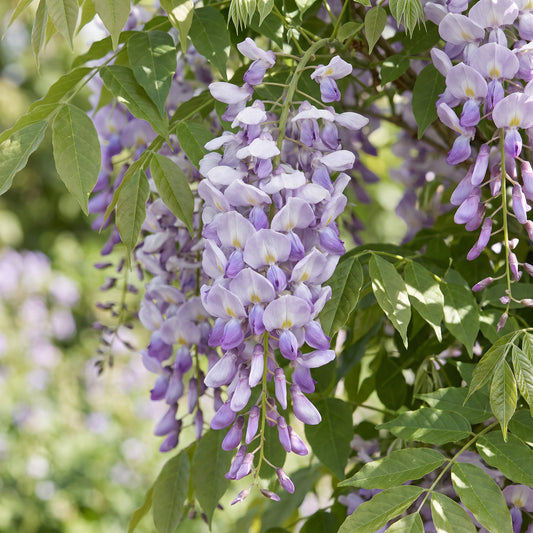
Japanese Wisteria 'Rosea' (Wisteria floribunda) is one of the most spectacular flowering climbers for covering a pergola, wall, or fence. Every spring, it produces long, intensely fragrant pale pink pendulous racemes that transform any corner of the garden into a picture-perfect setting.
Flowering: Abundant in spring, with very long, fragrant pink racemes; highly melliferous and attractive to bees and butterflies.
Foliage: Deciduous, with fresh green leaflets that provide a lovely contrast with the flowers before they fully open.
Exposure: Full sun is essential for generous flowering.
Hardiness: Hardy, withstands French winters without any special protection.
Use: Vigorous climber, ideal for covering pergolas, trellises, walls, and fences; can reach 4 to 8 metres at maturity.
Packaging: 1 plant, 14 cm pot, 65 cm tall.
Purchased directly from our partner nurseries, your Wisteria 'Rosea' is ready to take flight from its very first planting season.
Description
Care instructions
Warranty
Order with complete peace of mind 💚
At Plant and Stories, the health of our plants and the satisfaction of our customers are our top priorities.
That is why all our indoor plants come with a 30-day guarantee after delivery, so you can order with confidence.
Our plants are carefully selected, fully healthy, acclimated, and shipped with care using secure packaging designed to protect them.
Despite all our precautions, an incident during transport can sometimes weaken a plant. Don't worry: our team is here to help.
💌 How to make a claim under your guarantee?
Photograph the plant in question upon delivery.
Immediately send the photos to this address: sav@plantandstories.com, including your order reference.
We will respond promptly with a solution tailored to your situation 💚
Shipping
Your plants and accessories delivered with care.
At Plant and Stories, every order is prepared with love, whether it’s your indoor plants or your accessories.
✅ Plants selected with care.
Our plants are carefully selected, acclimated, and delicately packed in secure, recyclable packaging.
Shipping takes place from Monday to Wednesday only, to avoid any prolonged transit over the weekend and to preserve their freshness.
📦 Sustainable accessories
Your accessories are also prepared with care and shipped from Monday to Friday, to guarantee fast and secure delivery.
They are packed with the utmost care to prevent any impact or damage during transport.
🚚 Fast and reliable delivery
We partner with trusted carriers, known for their quality of service.
Once handed over to the carrier, your order is delivered within 24 to 72 hours, depending on your geographical area.
Delivery available in mainland France and Europe.
🌱 An eco-friendly commitment
All our packaging is recyclable, designed to limit environmental impact while ensuring optimal protection for your plants and accessories.
🤝 A customer service team ready to help
A question or a concern upon delivery? Our responsive customer service team is here to support you.
At Plant and Stories, every detail counts to ensure your order arrives in the best possible condition… and with a smile 🌿
If you have any questions about the delivery of your package, or if something is wrong upon its arrival, our team is here for you.
Feel free to contact us Monday through Friday, from 9 a.m. to 5 p.m., by phone at 01 89 48 03 62 or by email at sav@plantandstories.com.
We will do our utmost to find a solution quickly. 🌱
🌿 Direct from the Grower: Fresher Plants at the Best Price
No middleman between our growers and you. Superior quality, fairer prices, and a reduced carbon footprint thanks to a shorter supply chain.
💚 Your benefits
🌱 2 plants = -10%
🌱 3 plants = -15%
🌱 6 plants =-20%
The discount is automatically applied at checkout to eligible plants.
🚚 Please note
If your cart contains products shipped from multiple locations, your order may be sent in multiple packages. You will receive tracking information for each shipment.
Everything You Need to Know About Glycine 'Rosea' (Wisteria) - scented climber - 14 cm pot - Height 65 cm
When does the Japanese Wisteria 'Rosea' (Wisteria floribunda) bloom?
The Japanese Wisteria 'Rosea' (Wisteria floribunda) blooms in spring, generally between April and May depending on the region and weather conditions. The pale pink racemes often appear before or at the same time as the first leaves, making the display particularly striking. In the years following planting, the flowering gradually intensifies as the plant becomes established. Full sun exposure and regular pruning are the two most important factors for achieving abundant blooms year after year.
Is Japanese wisteria 'Rosea' hardy and frost-resistant?
Yes, the Japanese wisteria 'Rosea' (Wisteria floribunda) is a hardy plant that easily withstands the cold winters of the French regions, including fairly severe frosts. The old woody stems resist frost very well. However, the early flower buds can be sensitive to late spring frosts: if your region experiences frosts in April, a west or southwest-facing location, slightly sheltered, can delay the blooming of the flowers and protect them. Young plants in pots deserve protection of the container (felt or mulch at the base) during very severe winters.
What exposure is suitable for Japanese glycine 'Rosea'?
Japanese glycine 'Rosea' is a plant that requires full sun to reach its full flowering potential. A minimum of 6 hours of 'direct sunlight per day is necessary to produce beautiful, abundant clusters. In a partially shaded location, the plant grows adequately but produces very few flowers, if any. Ideally, plant it facing south, southeast, or southwest, against a wall or under a pergola that retains heat: the heat absorbed by a sun-warmed wall promotes flowering. Avoid shaded or north-facing locations entirely.
How should I prune Japanese wisteria 'Rosea' to encourage good flowering?
Pruning the Japanese Wisteria 'Rosea' (Wisteria floribunda) is done in two stages. In summer, usually in July-August, shorten all the young lateral shoots of the year to 5 or 6 leaves: this summer pruning limits excessive growth and directs the plant's energy towards the formation of flower buds. In winter, between January and early March, prune these same shoots to 2 or 3 buds above their base. Do not touch the long, old, woody shoots that bear the future flower clusters. This double annual pruning is the key to dense and regular flowering.
What support should be provided for planting Japanese Wisteria 'Rosea'?
Japanese Honeysuckle 'Rosea' is an extremely vigorous climbing plant that can grow 4 to 8 metres long and become very heavy when mature. It is therefore essential to provide a sturdy, well-anchored support from the time of planting: a wooden pergola made of treated timber with a good cross-section, metal trellising fixed to a load-bearing wall, or tightly tensioned guide wires are all suitable options. Avoid lightweight or temporary structures that may 'collapse under the weight of the stems after a few years. Direct the first stems towards the support at the time of planting and tie them up regularly to guide their growth.
In what soil should Japanese wisteria 'Rosea' be planted?
Japanese Wisteria 'Rosea' (Wisteria floribunda) adapts to a wide variety of soils but performs best in deep, well-drained, slightly alkaline to neutral, moderately fertile soil. Soil that is too rich in nitrogen (amended with fresh manure or nitrogen fertilizer) produces lush foliage but few flowers. Also avoid waterlogged soils in winter, which can suffocate the roots. For heavy clay soils, incorporate coarse sand and well-rotted compost at the time of planting to improve drainage. Add organic mulch around the base to retain moisture in summer.
How to use Japanese glycine 'Rosea' in a garden or for decoration?
The Japanese Glycine 'Rosea' is a leading climber for structuring and embellishing a garden. It is particularly majestic when covering a pergola or arbor, where its cascading pink clusters create a most romantic, fragrant, and flowery vaulted effect. It is also suitable for covering an old wall, a fence, or a section of a facade. In combination, it pairs very well with climbing roses, blue or mauve clematis, and spring perennials such as peonies or irises.
The essentials about Glycine 'Rosea' (Wisteria) - scented climber - 14 cm pot - Height 65 cm
Japanese Wisteria 'Rosea' (Wisteria floribunda): characteristics and benefits
The Japanese Wisteria 'Rosea' (Wisteria floribunda) is undoubtedly one of the most impressive hardy flowering climbers available. Native to Japan, this vigorous climber stands out for its extraordinary pale pink pendant flower clusters, which can exceed 30 to 40 cm in length and literally cover the plant each spring before the foliage has fully unfolded. Its delicate, sweet fragrance, carried by the slightest breeze, makes it an essential garden plant for anyone wishing to create a romantic and enchanting atmosphere.
Where to plant the Japanese Wisteria 'Rosea'? Exposure and hardiness
The Japanese Wisteria 'Rosea' requires full sun to flower profusely: choose a location that receives at least 6 hours of direct sunlight per day, preferably south or southwest-facing. This exposure ensures not only dense flowering but also better lignification of the stems, which enhances cold resistance. In terms of hardiness, the Japanese Wisteria 'Rosea' is fully hardy in France, requiring no special protection once established in the ground. To discover our full selection of full-sun garden plants, visit our dedicated collection.
How to care for the Japanese Wisteria 'Rosea'?
Soil: Deep, well-drained, slightly alkaline to neutral; avoid soils that are too rich in nitrogen, as this can inhibit flowering.
Watering: Regular watering during the first two years to establish the plant, then moderate watering; water weekly during periods of intense heat.
Pruning: Two prunings are essential: cut back the side shoots to 5 to 6 leaves in summer, then to 2 to 3 buds in January or February.
Exposure: Full sun is essential, with at least 6 hours per day; a south-facing warm wall will optimize flowering.
Japanese Wisteria 'Rosea' in the garden: flowering, foliage and plant combinations
In spring, the Japanese Wisteria 'Rosea' offers an incomparable display as its long, soft pink flower clusters unfold against the blue sky. This flowering period, which lasts several weeks, is also a celebration for wildlife: bees and butterflies flock to feed on the fragrant nectar. In summer, the deciduous foliage, composed of many fresh green leaflets, provides light and pleasant shade under a pergola. In autumn, the leaves turn yellow before falling, revealing the sinuous, graphic structure of the older stems, which remains decorative throughout winter.
Buy the Japanese Wisteria 'Rosea' from Plant and Stories
Plant and Stories offers the Japanese Wisteria 'Rosea' (Wisteria floribunda) in a 14 cm pot, with a starting height of 65 cm, ready to be planted in the ground or trained on its first support. Each plant is grown directly in the nursery and delivered to you in optimal condition, fresh and vigorous. Order your Japanese Wisteria 'Rosea' now and create the floral setting your garden or patio needs this spring.