Butterfly bush (buddleia): planting, pruning and care

The butterfly bush, or buddleia, lives up to its name: from July, its long fragrant panicles are covered with butterflies and bees. This hardy, fast-growing, and resilient shrub flowers effortlessly all summer long, provided you perform one simple task: prune it severely in late winter. Easy and spectacular, it also has a downside—its invasive nature—which this guide will teach you how to easily control.
🌿 Why plant a butterfly bush?
You plant a butterfly bush to bring life to the garden from July to October, when its panicles attract swarms of butterflies and pollinators. It is one of the easiest and fastest-growing shrubs: it grows in almost any soil, withstands the cold, and blooms again every year on new growth.
The RHS (Royal Horticultural Society) ranks it among the best shrubs for biodiversity, provided you prune it back each spring.
| Key Feature | What it brings to the garden |
|---|---|
| Butterfly magnet | Its nectar-rich panicles attract butterflies, bees, and bumblebees all summer long |
| Long flowering season | Continuous blooms from July to October if faded flowers are removed |
| Easy and fast-growing | It grows anywhere, up to 2–3 m, and blooms again every year without maintenance |
| Hardy | Once established, the butterfly bush can tolerate temperatures down to around -20°C |
🔎 Butterfly bush profile
The butterfly bush belongs to the genus Buddleja, now classified in the Scrophulariaceae family. The cultivated species is Buddleja davidii, native to China and described by Kew (POWO, Plants of the World Online). It blooms on new growth, which explains the need for severe pruning in spring. Its abundant seed production also gives it a reputation as an invasive shrub, a point we discuss in more detail below.
| Feature | Verified details |
|---|---|
| 🏷️ Botanical name | Buddleja davidii |
| 🧬 Family | Scrophulariaceae |
| 🌍 Origin | China |
| 🌳 Type | Deciduous shrub with summer flowers and fast growth |
| 📏 Height | 2–3 m (1–1.5 m for dwarf varieties) |
| 🌸 Flowers | Long fragrant panicles from July to October (from late June in southern France) |
| 🍃 Foliage | Deciduous, grey-green, lanceolate |
| ☀️ Exposure | Full sun |
| 📈 Growth | Fast: up to 2 m in one year after pruning |
| ❄️ Hardiness | Around -20°C |
📋 Quick technical sheet
The essential details, all at a glance.
| Parameter | Detail |
|---|---|
| Botanical name | Buddleja davidii |
| Family | Scrophulariaceae |
| Type | Deciduous nectar-rich shrub |
| Exposure | Full sun |
| Soil | Ordinary, well-drained, even poor or alkaline |
| Hardiness | Around -20°C |
| Height | 2–3 m (dwarfs 1–1.5 m) |
| Flowers | From July to October |
| Pruning | Severe pruning from late March to mid-April, back to 30–50 cm |
| Longevity | 15–20 years |
📍 Where and when to plant a butterfly bush: exposure and soil
Plant the butterfly bush in full sun: this is the key to generous blooms and swarms of butterflies. It is not fussy about soil and tolerates ordinary, poor, well-drained, or even alkaline soils; it simply dislikes waterlogged soils in winter. Give it plenty of space, as it grows quickly and reaches 2–3 m in all directions.
Allow 1.5–2 m between plants. Ideally, plant in autumn or spring, outside the frost period, and water thoroughly during the first year while the shrub establishes.
☀️ Exposure: Full sun
🌱 Soil: Ordinary, well-drained, even poor or alkaline
❄️ Climate: Around -20°C
🪴 How to plant a butterfly bush step by step
Planting a butterfly bush is easy, as it establishes quickly and grows in almost any conditions. The main thing is to give it plenty of sun and well-drained soil, then prune it at the end of the first winter to encourage branching.
| Step | The right technique |
|---|---|
| Soak | Submerge the root ball in a bucket of water until it is thoroughly soaked |
| Dig | Dig a hole twice as wide as the root ball in well-drained soil |
| Plant | Position the root collar at ground level, fill the hole and firm the soil |
| Water | Water thoroughly, then mulch for the first year |
| Cut back | At the end of the following winter, prune it back to create a dense shrub |
columns: 4
columns_mobile: 2
-
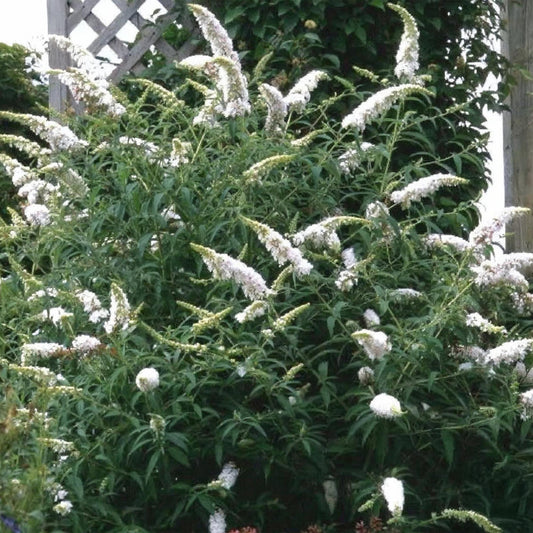

Butterfly bush 'White Profusion' (Buddleja davidii) - nectar-rich shrub - 17 cm pot - Height 45 cm
Regular price From 39,95 €Regular price39,95 €From 31,96 €Livraison offerte -


Butterfly Bush 'Royal Red' (Buddleja davidii) - nectar-rich shrub - 17 cm pot - Height 45 cm
Regular price From 39,95 €Regular price39,95 €From 31,96 €Livraison offerte -


Butterfly Bush 'Empire Blue' (Buddleja davidii) - honey-producing shrub - 17 cm pot - Height 45 cm
Regular price From 39,95 €Regular price39,95 €From 31,96 €Livraison offerte -


Butterfly bush 'Pink Delight' (Buddleja davidii) - nectar-rich shrub - 17 cm pot - Height 45 cm
Regular price From 39,95 €Regular price39,95 €From 31,96 €Livraison offerte -


Butterfly bush 'Black Knight' (Buddleja davidii) - nectar-rich shrub - 17 cm pot - Height 45 cm
Regular price From 39,95 €Regular price39,95 €From 31,96 €Livraison offerte -


Butterfly Bush 'Flower Power' (Buddleja × weyeriana) - honey-producing shrub - 17 cm pot - Height 30 cm
Regular price From 39,95 €Regular price59,95 €Sale price From 39,95 €39,95 €From 31,96 €Livraison offerte Sale -

 Livraison offerte
Butterfly bush (Buddleja davidii) - honey-producing shrub - 17 cm pot
Regular price From 39,95 €Regular price39,95 €From 31,96 €Livraison offerte


✂️ Maintenance: severe spring pruning, the key task
All butterfly bush maintenance comes down to severe pruning in late winter. As it blooms on new growth, it should be cut back thoroughly each year, from late March to mid-April, to produce vigorous stems covered in flowers. For the rest of the year, one simple task prolongs the flowering season: remove faded flowers.
✂️ Spring pruning: From late March to mid-April, cut all stems back to 30–50 cm from the ground: it will bloom even more beautifully
🔹 Faded flowers: Remove faded flowers in summer to encourage more blooms and limit seed production
💧 Watering: Water during the first year; afterwards, the shrub is very drought-tolerant
🌱 Fertilisation: No fertiliser is needed: soil that is too rich produces leaves at the expense of flowers
👀 Monitoring: Remove young volunteer seedlings around the base to prevent them from spreading
🍂 The butterfly bush through the seasons
The butterfly bush calendar is simple: severe pruning after winter, followed by long flowering all summer. Spring is the time for cutting it back. Summer brings panicles and butterflies. Autumn marks the end of the flowering season before winter dormancy.
📅 Seasonal maintenance calendar
| Season | Key task |
|---|---|
| 🌸 Spring | Severe pruning from late March to mid-April (cut stems to 30–50 cm), vigorous regrowth; planting is possible as soon as frosts have ended. |
| ☀️ Summer | Full bloom from July to the end of summer, with swarms of butterflies; remove faded flowers to encourage more blooms. |
| 🍂 Autumn | End of the flowering season; ideal for planting when the soil is still warm; remove faded panicles before they develop seeds. |
| ❄️ Winter | Dormancy: leave the shrub in place and wait until late March to prune; the framework protects the base. |
🌱 How to propagate the butterfly bush?
You can propagate the butterfly bush very easily by cuttings, which partly explains its vigour. Take cuttings from semi-hardened stems in summer, or pieces of dry wood in winter, and plant them in light soil: rooting is fast and reliable. However, avoid letting it self-seed, as young plants from seeds quickly colonise nearby vacant lots.
🐛 Common problems: diseases, pests and mistakes
The butterfly bush is extremely robust; it has almost no diseases. Its only real drawbacks are its exuberance and its tendency to self-seed. Here is how to manage them.
| Symptom | Probable cause | Solution |
|---|---|---|
| Volunteer seedlings everywhere around the base | ⚠️ Abundant seed production | Remove faded flowers before they develop seeds and pull out the young plants |
| Poor flowering and straggly shrub | ✂️ Insufficient or no pruning | Cut it back severely to 30–50 cm each year, from late March to mid-April, to produce flowering stems |
| Few flowers, lots of leaves | 🌱 Soil that is too rich or too shady | Plant in full sun and do not apply nitrogen fertiliser |
| Broken or dead branches after winter | ❄️ Frost damage to older wood | Remove damaged wood during spring pruning: the shrub will regrow from the base |


🌸 Our butterfly bush varieties
The choice is mainly based on the colour of the panicles and the size of the shrub: here are some reliable options for a butterfly-filled border.
| Variety | Key feature |
|---|---|
| Black Knight | Deep dark purple, the great classic: long, highly fragrant panicles |
| Empire Blue | Bright blue-purple with an orange eye, abundant and nectar-rich blooms |
| Royal Red | Intense red-purple, spectacular large panicles in the sun |
| White Profusion | Pure white with a yellow centre, brightens borders and attracts butterflies |
| Pink Delight | Vivid, deep pink, long dense panicles, highly floriferous |
| Buzz Series | Dwarf buddleias (1–1.5 m), perfect for pots, balconies and small gardens |
🎨 Where to plant and how to pair it
Plant the butterfly bush in the sun, at the back of a border or on its own, where its summer flowers can take over from spring shrubs. It creates superb nectar-rich displays with lavender, sage and other flowering shrubs for a flower garden. Give it plenty of space, as it spreads quickly.
Just avoid planting it in heavy, waterlogged soil, the only conditions it cannot tolerate.
🔑 Is the butterfly bush invasive?
Yes, it is important to know this: Buddleja davidii produces a huge number of seeds that are dispersed by the wind and easily colonise vacant lots, wasteland and roadsides. In several regions, it is considered an invasive species. The solution is simple and more than enough for the garden: remove faded flowers as soon as they fade, before they develop seeds, and pull out young volunteer seedlings.
This way, you can enjoy all the pleasure of the shrub without contributing to its spread.
⚠️ Is the butterfly bush toxic?
The butterfly bush is not considered toxic to humans or pets: it is not listed as a dangerous plant in standard reference databases. Its flowers are also a valuable resource for pollinators. As with any ornamental plant, prevent pets from repeatedly chewing the foliage, which could cause minor digestive upset. If in doubt, seek veterinary advice.
✅ Our expert tips for success
To succeed with the butterfly bush, it all comes down to one task: cut it back severely to 30–50 cm each year from late March to mid-April, and it will give you spectacular blooms from July to October. Plant it in full sun, remove faded flowers to prolong the display and limit seed production, and leave it to do its thing.
It is one of the most generous and vibrant shrubs in the summer garden, provided you keep its exuberance under control.
The butterfly bush is the best friend of the busy gardener who wants life in the garden. Prune it once a year, and you will have swarms of butterflies all summer long. My only real advice, and I insist: remove faded flowers. It is not just about aesthetics; it is a responsible act that prevents it from escaping into the wild. At this price, it is a shrub I love to recommend.

Laura Bruneau
Jardinière et autrice