

Hoya Mathilde: care, flowering, and where to buy it

To care for a Hoya Mathilde, give it bright light without harsh direct sun, a very free-draining potting mix, water only when the mix has dried out, and leave its flower spurs in place: this is where the flowers return. Hoya 'Mathilde' is a hybrid of Hoya carnosa and Hoya serpens, prized for its small, fleshy leaves speckled with silver and its fragrant flower clusters.
This page brings together everything you need to know about the Hoya Mathilde plant: its origins, flowers, why buds drop and leaves turn yellow, how it differs from Chouke and Mathilde Splash, and where to buy one. For the genus as a whole, see our complete guide to Hoya (wax flower).
🌿 Where to buy a Hoya Mathilde and how to choose one
At Plant and Stories, our Hoya Mathilde and its Hoya Mathilde Splash form are listed in our catalog, with plants grown in our greenhouses in Essonne.
Before buying a Hoya Mathilde, here or elsewhere, check three things: firm stems with no soft spots, fleshy leaves that are not wrinkled, and silver speckling on the young leaves. Also check the undersides of a few leaves: mealybugs, listed among Hoya carnosa pests by the RHS and Missouri Botanical Garden, hide in the leaf axils.
A well-rooted potted plant is more likely to establish successfully than an unrooted cutting. When it arrives, leave it in a bright room for a few days before repotting, and water it only if its potting mix is dry.
| Benefit | What it means for you |
|---|---|
| Silver-speckled foliage | A striking little Hoya, even without flowers |
| Trailing or climbing habit | In a hanging planter, on a shelf, or trained around an arch |
| Fragrant flowers | White to pinkish umbels with dark red centers that rebloom on the same spurs |
| Non-toxic according to its parent plant's profile | The ASPCA lists Hoya carnosa as non-toxic to dogs and cats |
🔎 Hoya Mathilde at a glance
According to the international Hoya cultivar register (HoyaCultivars.org, the registration authority for cultivar names in the genus), 'Mathilde' originated from a chance pollination in the outdoor garden of Emilio Begine in Belgium: Hoya carnosa was the seed parent and Hoya serpens the pollen donor. The name was established in the International Hoya Society's journal, Fraterna.
The register does not specify the name's origin: the often-repeated claim that it honors a princess does not appear there, so we cannot confirm it.
As for the parent species, the Missouri Botanical Garden places Hoya carnosa from eastern China and Japan to Vietnam, while POWO (Plants of the World Online, Royal Botanic Gardens, Kew) gives Hoya serpens a range stretching from the central and eastern Himalayas to the Andaman Islands.
Hoya Chouke is the only other seedling from the same seed pod: a sibling, not a parent.
| Characteristic | Verified details |
|---|---|
| 🏷️ Botanical name | Hoya 'Mathilde' (Hoya carnosa × Hoya serpens), a cultivar accepted by the Hoya cultivar register |
| 🧬 Family | Dogbane family (Apocynaceae) |
| 🌳 Type | Perennial, succulent epiphytic vine with twining stems |
| 🌍 Origin | Horticultural hybrid developed in Belgium; parent species from East Asia and the Himalayas |
| 🍃 Foliage | Small, fleshy, dark green leaves speckled with silver, larger and darker than Chouke's |
| 🌸 Flowers | Umbels of star-shaped, white to pinkish flowers with dark red centers; fragrant |
| 📏 Size | Moderately growing vine, to train on a support or let trail |
| ⚠️ Toxicity | Parent Hoya carnosa is non-toxic to dogs and cats (ASPCA); no profile for the hybrid |
📋 Quick care guide
Essential growing tips at a glance.
| Factor | Guideline |
|---|---|
| Light | Bright and indirect, near an east- or west-facing window; shade from summer sun |
| Watering | When the potting mix has dried out; water less from October to February |
| Potting mix | Equal parts orchid bark, peat-free potting mix, and perlite (RHS) |
| Humidity | Tray of moist pebbles; no misting |
| Temperature | 16–24°C in spring and summer; do not let nighttime temperatures fall below 10°C |
| Repotting | In spring, into a pot only slightly larger, when the roots fill the pot |
| Fertilizer | Orchid-type fertilizer in spring and summer; none for 5–6 weeks after repotting |
| Flowering | Never cut off the flower spurs; do not move the pot when buds appear |
| Toxicity | Hoya carnosa is non-toxic to dogs and cats (ASPCA) |
| Difficulty | Easy, provided it gets enough light and is not overwatered |
📍 Where to place a Hoya Mathilde: light and temperature
Place your Hoya Mathilde near a bright east- or west-facing window, or behind a sheer curtain on the south side. the RHS (Royal Horticultural Society) Hoya growing guide recommends a bright spot shaded from hot summer sun, which can scorch the leaves, and away from radiators and cold drafts.
According to NC State Extension (North Carolina State University's outreach service), bright, indirect light year-round is ideal for Hoya carnosa, and the University of Florida (UF/IFAS Gardening Solutions) notes that insufficient light is the usual reason a Hoya fails to flower.
For temperature, the RHS recommends 16–24°C in spring and summer, followed by a cooler, drier winter, with a nighttime minimum of 10°C for Hoya carnosa. No specific figures have been published for Mathilde, so we use those for its carnosa parent.
In winter, if the room is dark, a grow light can keep it growing.
☀️ Ideal: East- or west-facing window, or south-facing window behind a sheer curtain
🌥️ Acceptable: Bright room without direct sun: good foliage, but fewer flowers
🚫 Avoid: Summer sun through glass, a dark corner, radiators, cold window glass in winter
🪴 Repotting and potting mix for Hoya Mathilde
Repot your Hoya Mathilde in spring, only when the roots fill the pot: the RHS notes that Hoyas can stay in the same container for several years and recommends choosing a pot only slightly larger than the root ball. NC State Extension advises increasing the pot size by no more than about 5 cm.
The mix should be very free-draining and airy: the RHS suggests equal parts orchid bark, peat-free potting mix, and coarse perlite, or cactus potting mix amended with perlite.
A ready-to-use premium Hoya potting mix follows the same principle; our guide to potting mix for Hoya covers the alternatives. Avoid using ordinary potting mix on its own, as it is too dense.
| Step | What to do |
|---|---|
| 1. Choose the right time | In spring, when roots emerge from the drainage holes or line the pot |
| 2. Prepare the pot | Use a pot with drainage holes, only slightly wider than the root ball (no more than about 5 cm wider) |
| 3. Prepare the mix | Equal parts orchid bark, peat-free potting mix, and coarse perlite |
| 4. Set in the root ball | Keep the stems intact and plant at the same depth; reposition the hoop or support |
| 5. Water and wait | Water thoroughly and empty the saucer; do not fertilize for 5–6 weeks |
columns: 4
columns_mobile: 2
-
-

 Sold out
-
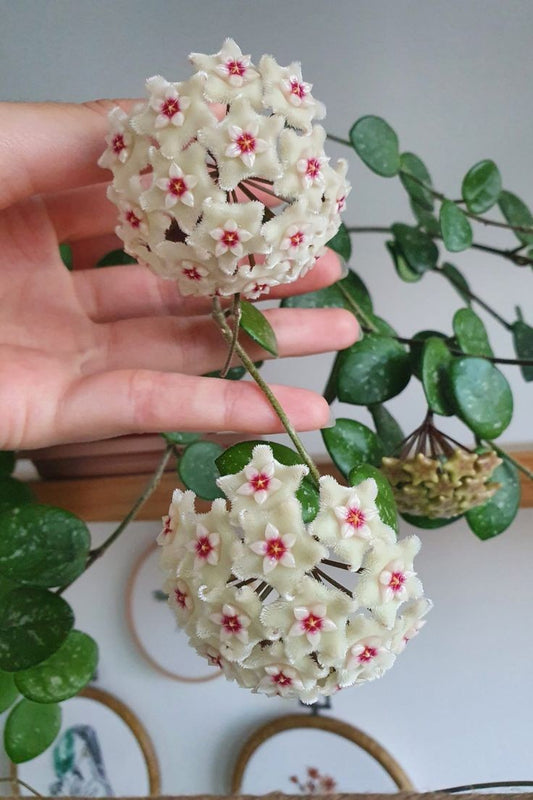
Hoya Trio | Hoya Eskimo - Hoya Mathilde - Hoya Lisa
Regular price 19,95 €Regular price21,85 €Sale price 19,95 €Sale -

 Sold out
-
-
-
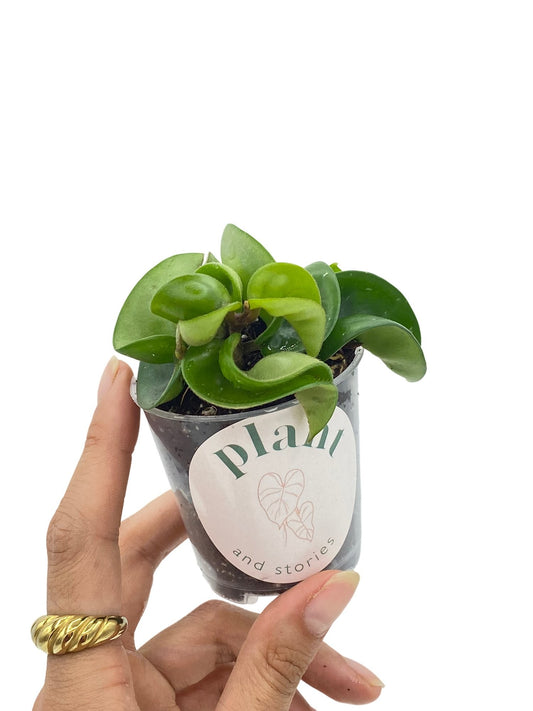
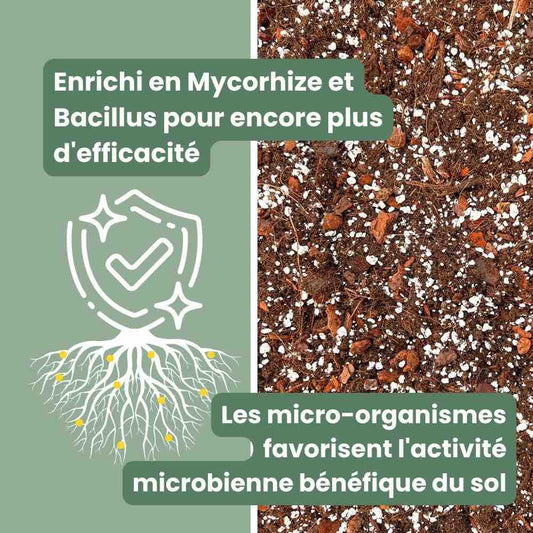
Hoya Premium Potting Soil - Enriched with Mycorrhizae and Bacillus - Made in France
Regular price 11,99 €Regular price11,99 €Sale price 11,99 € -


Duo - Hoya Premium 4L Potting Soil + Hoya Special Liquid Fertilizer 250ml + Free Graduated Pipette
Regular price 24,99 €Regular price29,99 €Sale price 24,99 €Sale






✂️ Hoya Mathilde care: watering, fertilizer, and support
Caring for Hoya Mathilde comes down to measured watering, light feeding, and providing support for its stems. The RHS recommends watering regularly from spring to autumn, keeping the mix moist but never waterlogged, then, from October to February, letting the potting mix become fairly dry without drying out completely.
NC State Extension recommends allowing the mix to dry between waterings and using room-temperature water, as cold water can shock the plant. Check the mix with your finger and feel the leaves rather than following a fixed schedule.
To increase humidity, the RHS suggests a tray of damp pebbles, with the water level below the surface; there is no need to mist (see our article on misting).
💧 Watering: When most of the potting mix has dried out; empty the saucer
🌱 Fertilizer: In spring and summer, use a liquid fertilizer formulated for Hoya or an orchid-type fertilizer; the RHS recommends flushing the pot with clean water from time to time
🪢 Support: The Missouri Botanical Garden notes that Hoya carnosa stems twine around slender supports: train them around an arch
💧 Humidity: Tray of moist pebbles or group it with other plants, away from heating
✂️ Pruning: Not needed; never cut back the flower spurs
🍂 Hoya Mathilde flowers: blooming, flower spurs, and dropping buds
Hoya Mathilde produces umbels of white to pinkish, star-shaped flowers; according to the cultivar register, the center of its corona is a deeper red and its corolla is pinker than Chouke's. For Hoya carnosa, the RHS describes fragrant, roughly 15 mm flowers that are white or pale pink with red centers and scented at night.
NC State Extension says flowering may occur in spring, summer, or fall, and that most plants do not flower until they are 2 or 3 years old. Never cut off the flower spur after blooming: NC State Extension and the Missouri Botanical Garden explain that new flowers form on this old spur, year after year.
If buds drop, look for the causes identified by the RHS: potting mix that is too dry or too wet, or a change in light; the Missouri Botanical Garden advises against turning or moving the pot after buds appear. For more, see how to get a Hoya to flower.
📅 Seasonal care calendar
| Season | Key task |
|---|---|
| 🌸 Spring | Repot if needed, resume fertilizing, take cuttings, train new stems |
| ☀️ Summer | Bright, filtered light; water when the potting mix has dried; flowering is possible, so do not move the pot |
| 🍂 Fall | Flowering is possible; reduce watering; bring indoors before nighttime temperatures fall below 10°C |
| ❄️ Winter | Maximum light, a cooler room, and potting mix kept fairly dry without drying out completely |
🌱 Propagating Hoya Mathilde
Hoya Mathilde can be propagated from stem cuttings or by layering, like its parent: the RHS Hoya carnosa profile lists semi-ripe cuttings and layering.
The RHS guide recommends taking a cutting from the previous year's stems in spring or early summer, rooting it in water for two to three weeks, then potting it into peat-free cutting compost. Keep at least two nodes on each cutting.
For layering, the RHS suggests pinning a low-growing stem onto a small pot of moist potting mix and separating it from the parent once it has rooted. The RHS notes that the sap may irritate the skin, and the University of Florida advises keeping it from dripping onto furniture: wear gloves.
Detailed methods: propagating Hoya in water or potting mix or propagating in sphagnum moss.
🐛 Hoya Mathilde problems: yellow leaves, dropping buds, and pests
Most Hoya Mathilde problems are caused by water or light. Yellow, soft, or dropping leaves most often indicate waterlogged potting mix: the Missouri Botanical Garden links overwatering to root rot, while the RHS associates leaf drop and blackening with poorly drained mix or a cold winter.
NC State Extension adds that soil that is too dry can also cause leaf drop. Watch out for mealybugs, whiteflies, and scale insects; for more, read our guide to yellow and soft Hoya leaves.
| Symptom | Likely cause | Solution |
|---|---|---|
| Yellow, soft leaves; waterlogged potting mix | 🍄 Overwatering, root rot | Let it dry out, empty the saucer, repot in a well-draining mix if the roots are brown |
| Wrinkled or falling leaves, dry potting mix | 💧 Prolonged underwatering | Water thoroughly with lukewarm water, then resume watering based on touch |
| Flower buds dropping | ☀️ Potting mix too dry or too wet, pot moved, change in light | Do not move the pot again, keep watering consistent |
| No flowers | ☀️ Not enough light, plant too young, flower spurs cut off | Move it closer to the window, be patient, keep the flower spurs |
| Blackened leaves in winter | ❄️ Cold or icy windowpane, wet potting mix | Move it away from the window, keep above 10 °C, water less |
| Cottony clusters, honeydew | 🐛 Mealybugs or scale insects | Isolate, remove with an alcohol-soaked cotton swab, treat with black soap |


🌸 Our Hoya Mathilde varieties: Splash and carnosa relatives
'Mathilde Splash' is the commercial name for heavily speckled plants; the registered description of 'Mathilde' already mentions leaves speckled with silver, and we found no separate cultivar record for Splash or for a Mathilde variegata. Chouke, a sibling from the same seed batch, has lighter, smaller, less silvery foliage according to the register. The Hoya carnosa cultivars below share its care requirements; see our Hoya collection and our comparison of Hoya varieties.
| Variety | What makes it special |
|---|---|
| Hoya 'Mathilde' | The carnosa × serpens hybrid, with small, fleshy leaves speckled with silver and fragrant flowers |
| Hoya Mathilde Splash | Commercial name for plants with dense silver speckling |
| Hoya trio (Eskimo, Mathilde, Lisa) | Mathilde accompanied by two other Hoyas, to start a collection |
| Hoya carnosa 'Compacta' | Leaves folded into a rope, trailing growth; dedicated care guide: Hoya compacta (Hindu rope) |
| Hoya carnosa 'Flamingo Dream' | Hoya carnosa cultivar with pink-marked foliage |
| Hoya carnosa 'Freckles Splash' | Speckled Hoya carnosa cultivar for splash enthusiasts |
🎨 Plants to pair with your Hoya Mathilde
Hoya Mathilde pairs well with plants that, like it, prefer bright, filtered light and a potting mix that dries between waterings. On a shelf, pair it with Hoya linearis, with its long, fine stems, or Hoya australis 'Lisa', with its variegated foliage.
In a hanging planter, create a cascade with other trailing indoor plants. To feed and repot your entire collection at once, the Hoya potting mix and fertilizer duo will last a season.
⚠️ Is Hoya Mathilde toxic to cats and dogs?
No veterinary source specifically addresses Hoya Mathilde itself.
Its parent Hoya carnosa is listed by the ASPCA (American Society for the Prevention of Cruelty to Animals) under the name Honey Plant, also known as Wax Plant, and classified as “Non-Toxic to Dogs,” “Non-Toxic to Cats” and “Non-Toxic to Horses.”
NC State Extension also lists it as non-toxic to cats, dogs and horses. Hoya serpens, the other parent, has no ASPCA listing, so we cannot present the hybrid as guaranteed safe; we can only report the classification of its Hoya carnosa parent.
Keep it out of reach of pets that like to nibble, and see our list of non-toxic plants for cats and our non-toxic plants for dogs.
✅ Our expert tips for success
A healthy Hoya Mathilde comes down to a few simple rules: bright light without harsh sun, a very well-draining potting mix, water only once the mix has dried, a cooler winter above 10 °C, and never cut the flower spurs. If the leaves turn yellow, check watering first; if flowers are slow to appear, consider the light and the plant's age. And once buds have formed, leave it exactly where it is.
Mathilde is the Hoya I recommend to anyone torn between several varieties: it fits on a shelf, is easy to train around a small hoop, and forgives a missed watering. My rule is simple: I only water when its leaves feel a little less firm to the touch. And once I see the first flower umbels forming, I don't move the pot.
| Symptom | Likely cause | Solution |
|---|---|---|
| Yellow, soft leaves; waterlogged potting mix | 🍄 Overwatering, root rot | Let it dry out, empty the saucer, repot in a well-draining mix if the roots are brown |
| Wrinkled or drooping leaves, dry potting mix | 💧 Prolonged underwatering | Water thoroughly with lukewarm water, then resume watering based on touch |
| Flower buds dropping | ☀️ Potting mix too dry or too wet, pot moved, change in light | Don't move the pot again, keep watering consistent |
| No flowers | ☀️ Not enough light, plant too young, flower spurs cut off | Move it closer to the window, be patient, keep the flower spurs |
| Blackened leaves in winter | ❄️ Cold or icy windowpane, wet potting mix | Move it away from the window, keep it above 10 °C, water less |
| Cottony clusters, honeydew | 🐛 Mealybugs or scale insects | Isolate, remove with an alcohol-soaked cotton swab, treat with black soap |
🌸 Our Hoya Mathilde varieties: Splash and carnosa relatives
'Mathilde Splash' is the commercial name for heavily speckled plants; the registered description of 'Mathilde' already mentions leaves speckled with silver, and we found no separate cultivar record for Splash or for a Mathilde variegata. Chouke, a sibling from the same seed batch, has lighter, smaller, less silvery foliage according to the register. The Hoya carnosa cultivars below share its care requirements; see our Hoya collection and our comparison of Hoya varieties.
| Variety | What makes it special |
|---|---|
| Hoya 'Mathilde' | The carnosa × serpens hybrid, with small, fleshy leaves speckled with silver and fragrant flowers |
| Hoya Mathilde Splash | Commercial name for plants with dense silver speckling |
| Hoya trio (Eskimo, Mathilde, Lisa) | Mathilde accompanied by two other Hoyas, to start a collection |
| Hoya carnosa 'Compacta' | Leaves folded into rope-like strands, trailing growth; dedicated care guide: Hoya compacta (Hindu rope) |
| Hoya carnosa 'Flamingo Dream' | Hoya carnosa cultivar with pink-marked foliage |
| Hoya carnosa 'Freckles Splash' | Speckled Hoya carnosa cultivar for splash enthusiasts |
🎨 Plants to pair with your Hoya Mathilde
Hoya Mathilde pairs well with plants that, like it, prefer bright, filtered light and a potting mix that dries between waterings. On a shelf, pair it with Hoya linearis, with its long, fine stems, or Hoya australis 'Lisa', with its variegated foliage.
In a hanging planter, create a cascade with other trailing indoor plants. To feed and repot your entire collection at once, the Hoya potting mix and fertilizer duo will last a season.
⚠️ Is Hoya Mathilde toxic to cats and dogs?
No veterinary source specifically addresses Hoya Mathilde itself.
Its parent Hoya carnosa is listed by the ASPCA (American Society for the Prevention of Cruelty to Animals) under the name Honey Plant, also known as Wax Plant, and classified as “Non-Toxic to Dogs,” “Non-Toxic to Cats” and “Non-Toxic to Horses.”
NC State Extension also lists it as non-toxic to cats, dogs and horses. Hoya serpens, the other parent, has no ASPCA listing, so we cannot present the hybrid as guaranteed safe; we can only report the classification of its Hoya carnosa parent.
Keep it out of reach of pets that like to nibble, and see our list of non-toxic plants for cats and our non-toxic plants for dogs.
✅ Our expert tips for success
A healthy Hoya Mathilde comes down to a few simple rules: bright light without harsh sun, a very well-draining potting mix, water only once the mix has dried, a cooler winter above 10 °C, and never cut the flower spurs. If the leaves turn yellow, check watering first; if flowers are slow to appear, consider the light and the plant's age. And once buds have formed, leave it exactly where it is.
Mathilde is the Hoya I recommend to anyone torn between several varieties: it fits on a shelf, is easy to train around a small hoop, and forgives a missed watering. My rule is simple: I only water when its leaves feel a little less firm to the touch. And once I see the first flower umbels forming, I don't move the pot.

Laura Bruneau
Jardinière & autrice


