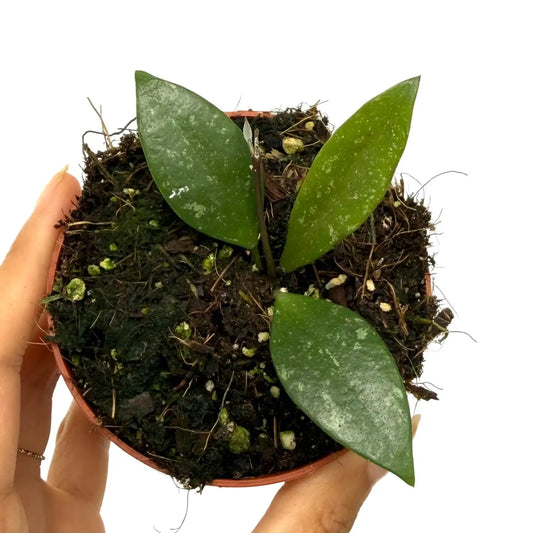
Best Potting Mix for Hoya: A Guide to Well-Draining Substrate

The best potting mix for Hoya is a light, well-draining, airy blend—never dense, standard potting soil. The reason is botanical: Hoya is an epiphyte (as classified by Kew POWO) that grows attached to trees, and its roots need air as much as water. In nature, they cling to bark and absorb moisture from the air and rain, never sitting in stagnant water in heavy soil. A substrate that is too dense suffocates the roots and causes them to rot—the leading cause of soft leaves in this plant. A simple, effective base mix is one-third potting soil, one-third pine bark, and one-third perlite. This guide explains how to make or choose the ideal substrate for healthy roots and beautiful blooms, whether you start with a homemade blend or a ready-to-use product.
Why standard potting soil is unsuitable
Dense, compact all-purpose potting soil is Hoya’s enemy: it holds too much water and deprives the roots of oxygen. The Missouri Botanical Garden recommends a well-draining substrate, while the RHS (Royal Horticultural Society) recommends an airy compost that stays moist but never waterlogged. The problem with standard potting soil is that it compacts with every watering: fine particles clump together, air disappears, and the roots eventually suffocate. This deterioration, invisible from the surface, explains why so many Hoyas slowly decline in their pots. Here are the signs that your substrate is no longer suitable and needs attention.
| Sign observed | What it indicates |
|---|---|
| Soft leaves despite watering | Roots rotting in an overly wet substrate |
| Substrate stays wet for more than 10 days | Poor drainage and risk of fungal growth |
| Water drains slowly | Compacted substrate that needs replacing |
| Growth stops in summer | Roots cramped in a compact mix |
Ingredients for a good Hoya substrate
A good mix combines ingredients that aerate, others that improve drainage, and others that retain a little moisture. The goal is a “chunky,” coarse substrate that allows air to circulate at all times while retaining just enough moisture between waterings. Each ingredient has a specific role, and the balance between them determines the quality of the mix. Here are the components to know and their approximate proportions.
| Ingredient | Purpose | Approximate proportion |
|---|---|---|
| Pine bark | Aeration and lasting structure | 30 to 40% |
| Perlite or pumice | Drainage that doesn’t compact | 20 to 30% |
| Coconut fiber or chips | Gentle water retention | 20% |
| Sphagnum moss | Moisture and robust roots | As needed |
| Activated charcoal | Helps keep the growing medium clean | A handful |
Step-by-step homemade recipe
For your first mix, a simple, tried-and-tested recipe is all you need: equal parts quality potting soil, fine pine bark, and perlite. This forgiving mix suits most varieties and tolerates slight variations in proportions. In the UK, look for small-grade maritime pine bark, between 6 and 9 mm, to avoid creating large air pockets that would dry out the roots too quickly. Once you’ve mastered this base mix, you can adjust it: add more perlite for varieties that are sensitive to excess moisture, or a little sphagnum moss for those that prefer more humidity. The flexibility to adjust the mix is what makes a homemade blend worthwhile once you’ve got the hang of it with your plants.
| Component | Proportion |
|---|---|
| Quality potting soil | 1/3 of the volume |
| 6–9 mm pine bark | 1/3 of the volume |
| Perlite or pumice | 1/3 of the volume |
| For delicate roots | Add a handful of sphagnum moss |
Homemade substrate or ready-to-use mix?
Both options work: a homemade mix gives you complete control, while a ready-to-use mix saves time and prevents measuring mistakes. The choice mostly depends on how many plants you grow. For two or three Hoyas, buying bark, perlite, coco, charcoal, and sphagnum separately can quickly become expensive and take up space, with the added risk of storing bags that absorb moisture. For a large collection, however, making your own mix in bulk is economical and rewarding. Here are the main criteria to help you decide.
| Criteria | Homemade substrate | Ready-to-use mix |
|---|---|---|
| Preparation time | Long: measuring and mixing | Immediate |
| Cost for a small collection | High: several bags to buy | Right-sized for your needs |
| Consistency | Varies depending on how carefully you measure | Consistent |
| Risk of pests | Moderate, depending on storage | Low: sealed product |
A living substrate: mycorrhizae and Bacillus
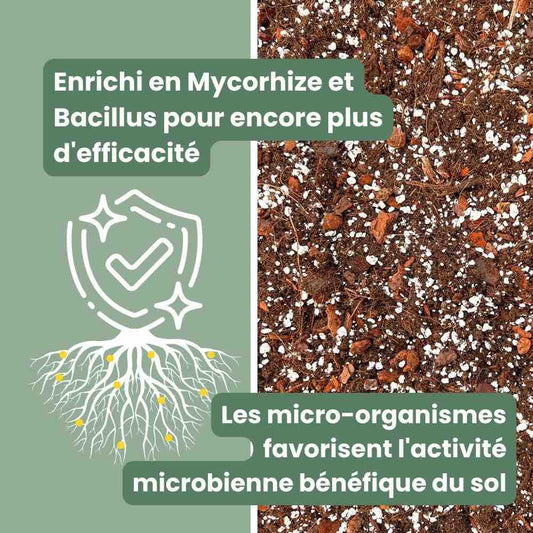
Beyond its structure, a living substrate offers a real advantage: microorganisms that protect and nourish the roots. Mycorrhizae form a symbiotic relationship with the roots and greatly increase their absorptive surface area, while Bacillus acts as a natural shield against rot-causing pathogens. Our Premium Hoya Potting Mix, enriched with mycorrhizae and Bacillus, contains bark, perlite, coco, and enriched potting soil, and is ready to use. You can also customize it by adding a handful of sphagnum moss or bark to suit the needs of each variety. A living substrate transforms a simple inert growing medium into a real ecosystem, where the plant can more easily access what it needs to grow and bloom.
columns: 4
columns_mobile: 2
-
Hoya Premium Potting Soil - Enriched with Mycorrhizae and Bacillus - Made in France
Regular price 11,99 €Regular price11,99 €Sale price 11,99 € -


Hoya Fertilizer - 250ml Liquid Fertilizer - Root and Foliar Fertilizer + Free Graduated Pipette!
Regular price 18,00 €Regular price20,00 €Sale price 18,00 €Sale -
Hoya Plant Support - Arch Support for Hoya - Transparent Acrylic Plant Support - Support for Climbing Plants
Regular price From 3,95 €Regular price3,95 €Sale price From 3,95 € -
Transparent plant clips - Transparent plant support clips - Support clips - Plant support clips
Regular price From 4,00 €Regular price4,00 €Sale price From 4,00 €



When and how to repot your Hoya
Repot a Hoya only every 2 to 3 years, when the roots fill the pot, preferably in spring. The plant blooms better when slightly root-bound, so there’s no need to repot too often or choose an oversized pot. When repotting, there’s no need to remove every bit of the old substrate if it’s still healthy: cleaning too aggressively damages the fine absorbing rootlets. Gently loosen the root ball, let whatever comes away easily fall off, then fill in with fresh mix without compacting it too much. Above all, avoid pressing the substrate down around the roots: you would destroy the air pockets you took care to create, immediately compromising drainage.
| Step | What to do |
|---|---|
| When to repot | Roots emerging from the pot, growth stalled, or every 2 to 3 years |
| Remove from pot | Loosen gently without tearing healthy rootlets |
| Repot | Use a pot only slightly larger; fill in without compacting the substrate |
| After repotting | Wait 24 to 48 hours before the first watering |
With our 100-plus varieties, I never use potting soil on its own: I always use a very airy mix based on bark and perlite. That’s the only real secret to keeping our Hoyas healthy. A substrate that dries quickly forgives the occasional overwatering, whereas compact potting soil forgives nothing.
The substrate calendar, season by season
Repotting and substrate care also follow the seasons: repot while the plant is actively growing and leave it alone during dormancy. Timing things right reduces stress and helps the plant settle in faster. Here’s a year-round guide to managing the substrate for your Hoyas.
📅 Seasonal care calendar
| Season | Key task |
|---|---|
| 🌸 Spring | Ideal time to repot into a fresh, airy, well-draining substrate |
| ☀️ Summer | Monitor drying: a good substrate dries in just a few days |
| 🍂 Autumn | Avoid repotting; let the plant slow down and the substrate dry out |
| ❄️ Winter | Don’t repot: water sparingly, as the substrate dries slowly during dormancy |
The ideal substrate at a glance
Here are the key points to keep in mind when making or choosing a substrate for your porcelain flower, ready to refer to when preparing for your next repotting.
📋 Quick reference (Hoya substrate)
Key points for a good porcelain flower substrate, at a glance.
| Parameter | Guideline |
|---|---|
| Substrate type | Well-draining and airy, never compact |
| Base | Small-grade pine bark, 6 to 9 mm |
| Drainage | Perlite or pumice, 20 to 30% of the volume |
| Water retention | Coconut fiber or chips, sphagnum moss |
| pH | Slightly acidic, 6 to 6.5 |
| Simple recipe | 1/3 potting soil, 1/3 bark, 1/3 perlite |
| Refresh | Every 2 to 3 years |
| Pot | With drainage holes, only slightly larger than the roots |
| Plant type | Tropical forest epiphyte (Kew) |
| Benefit of a living substrate | Mycorrhizae and Bacillus |
Build your porcelain flower collection
A good substrate is the foundation of a happy Hoya, but complete care makes all the difference. Well-draining substrate, bright light, and careful watering are the winning trio for a healthy, floriferous plant. Read our guides to caring for your Hoya, getting it to bloom, and diagnosing potential leaf problems, then browse our collection below.


Laura Bruneau
Jardinière & autrice