Anthurium warocqueanum (Queen Anthurium): care and cultivation

To care for an Anthurium warocqueanum, provide bright but indirect light, a highly aerated epiphyte substrate that never remains waterlogged, a stable temperature of around 18 to 29 °C, and humid air achieved by using a display cabinet, an indoor greenhouse, or grouping plants together, rather than by misting.
These guidelines draw on the Anthurium fact sheet from NC State Extension (North Carolina State University), which recommends 65 to 85 °F, or about 18 to 29 °C, and very humid conditions. Botanically, the Queen is a full-fledged species, Anthurium warocqueanum, not a cultivar.
This fact sheet focuses on what sets it apart: identification, differences from the King (Anthurium veitchii), growing an epiphyte, and the pitfalls of hybrids. For common basics for the genus, flowering, and other varieties, see our complete Anthurium guide.
🌿 How to recognize an Anthurium warocqueanum?
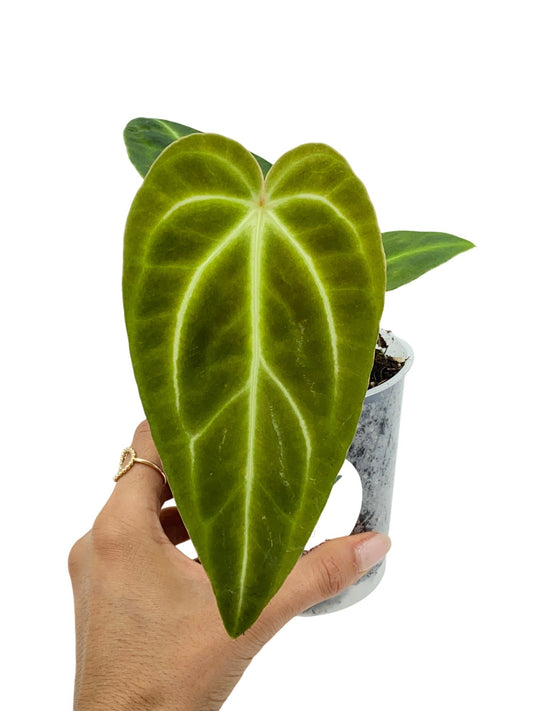
The Queen is identified by the shape of its leaf rather than its color. When young, it has fairly short oval leaves; as it matures, each new leaf elongates, narrows, and eventually hangs vertically. The surface is a very dark green with a velvety appearance, featuring lighter veins that create a graphic pattern.
Our product fact sheet states that leaves can exceed 120 cm on an adult plant: this is the result of several years of growth, not the size of a young plant. According to Plants of the World Online (POWO) by the Royal Botanic Gardens, Kew, the species was published by T. Moore in 1878 in the Florist and Pomologist, is native to Colombia, grows in the humid tropical biome, and is an epiphyte. This last point explains almost all of its care: in nature, its roots cling to bark and breathe; they do not sit in heavy soil.
| Highlight | What this means for you |
|---|---|
| Long, pendulous leaf | A unique vertical silhouette, ideal for placing high on a shelf or stand |
| Dark green velvet | A matte feel and a depth of color that no glossy leaf can match |
| Botanical species | A collector's plant with a POWO-accepted name, not just a trade name |
| Slow growth | Each leaf is an event; the plant remains a manageable size for a long time |
🔎 The ID card of the Anthurium warocqueanum
Here is the verified ID card for the species.
The accepted name, author, date, origin, and growth habit come from POWO (Kew); the growing guidelines and genus toxicity come from NC State Extension, which lists more than 1,300 species of Anthurium, terrestrial or epiphytic, native to the Caribbean, Central America, and South America, measuring 1 to 3.5 feet tall (about 30 to 105 cm) and approximately 23 to 30 cm wide.
The adult leaf length comes from our product fact sheet, not an authoritative source.
| Criterion | Verified detail |
|---|---|
| 🏷️ Botanical name | Anthurium warocqueanum T.Moore (1878); common name: Queen anthurium |
| 🧬 Family | Araceae (Araceae), like Monstera, Philodendron, and Alocasia |
| 🌳 Type | Perennial, evergreen epiphyte of the humid tropical biome (POWO) |
| 🌍 Origin | Colombia, humid tropical biome (POWO) |
| 🍃 Foliage | Long, narrow, velvety dark green leaf, lighter veins, pendulous habit |
| 🌸 Flowering | Rare indoors; the plant's main appeal is its foliage |
| 📏 Size | Leaves can exceed 120 cm at maturity (our product fact sheet, not an authoritative source), slow growth |
| ⚠️ Toxicity | Calcium oxalates: mouth irritation if ingested, irritating sap |
📋 Quick technical sheet
The essential growing guidelines, all at a glance.
| Parameter | Guideline |
|---|---|
| Light | Bright and indirect; no direct sun, which burns the leaves (NC State) |
| Watering | When the top of the substrate is dry; never allow water to pool at the bottom of the pot |
| Substrate | Highly aerated epiphyte mix: bark, perlite, sphagnum, aroid substrate |
| Humidity | High: display cabinet, indoor greenhouse, or grouped plants, without misting |
| Temperature | Around 18 to 29 °C (65 to 85 °F according to NC State), away from cold drafts |
| Repotting | In spring, when the mix has settled or roots are growing out of the pot |
| Fertilizer | Diluted houseplant fertilizer during the growing season, none in winter |
| Toxicity | Toxic if ingested by cats and dogs (calcium oxalates) |
| Difficulty | Confirmed: demanding in terms of humidity and root aeration |
📍 Where to place an Anthurium warocqueanum: room, display cabinet, or greenhouse?
The Queen needs three things at once: bright light without direct sun, stable warmth, and humid air. NC State recommends bright indirect light and notes that direct sun can burn Anthurium leaves.
It adds a valuable point for collectors: many enthusiasts grow these plants in terrariums or grow cabinets, which allows them to maintain humid air without wetting the foliage. Also consider height: a pendulous adult leaf needs space below the pot, otherwise it will touch the support and become damaged.
☀️ Exposure: near an east or west window, or set back from a bright window filtered by a sheer curtain
🏠 Display cabinet or greenhouse: a grow cabinet or ventilated indoor greenhouse, with lighting if light is insufficient
📏 Height: on a high shelf or stand, to let the long leaves hang freely
🪴 Substrate and repotting the Anthurium warocqueanum
This is where the Queen differs most from common Anthuriums. An epiphyte according to POWO, it lives clinging to bark: its thick roots need air around them. NC State recommends moist but well-drained soil for the genus, slightly acidic.
In practice, compact universal potting soil should be avoided; prefer a mix of large bark, perlite, and sphagnum, or an aroid substrate like the one presented in our Aroid potting mix guide with mycorrhizae. Repot in spring when the mix has settled or roots are overflowing, without burying the stem deeper than before.
| Step | The right approach |
|---|---|
| 1. Choose the pot | A pot with drainage holes just slightly larger than the root ball; a pot that is too large retains water around the roots |
| 2. Prepare the mix | Bark, perlite, and sphagnum, or aroid substrate: it must remain aerated and dry out quickly |
| 3. Remove gently | Untangle the roots without breaking them, remove any soft or black roots |
| 4. Replant level | Keep the stem at the same height; aerial roots can remain exposed or touch the sphagnum |
| 5. Water then drain | Water, let all excess drain out, and empty the pot |
columns: 4
columns_mobile: 2
-

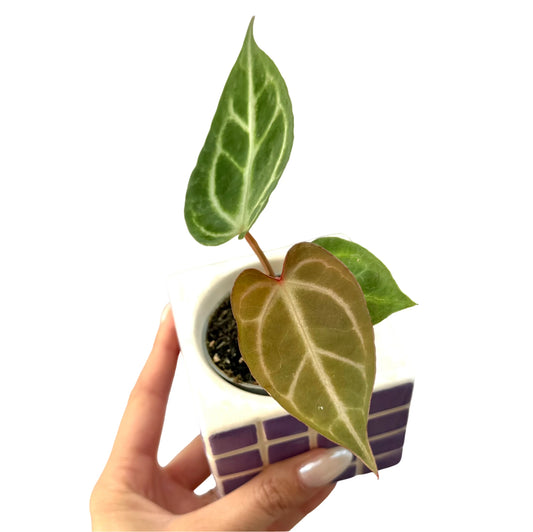
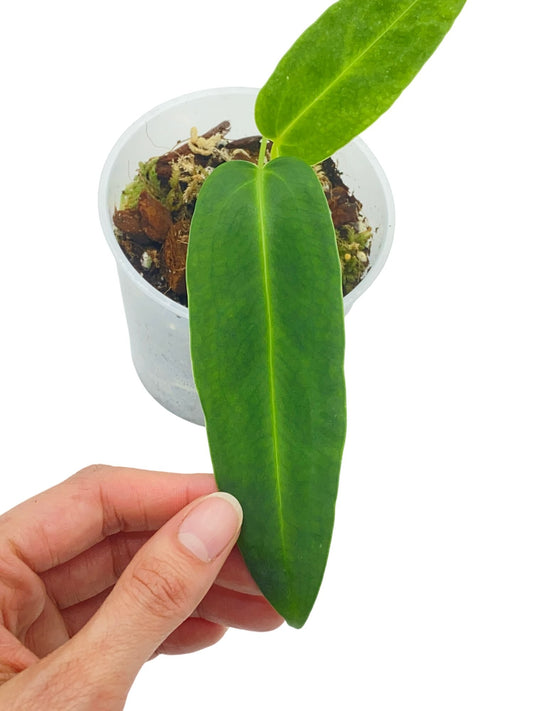 Sold out
Anthurium Warocqueanum
Regular price From 14,95 €Regular price19,95 €Sale price From 14,95 €14,95 €From 11,96 €Sold out -

 Sold out
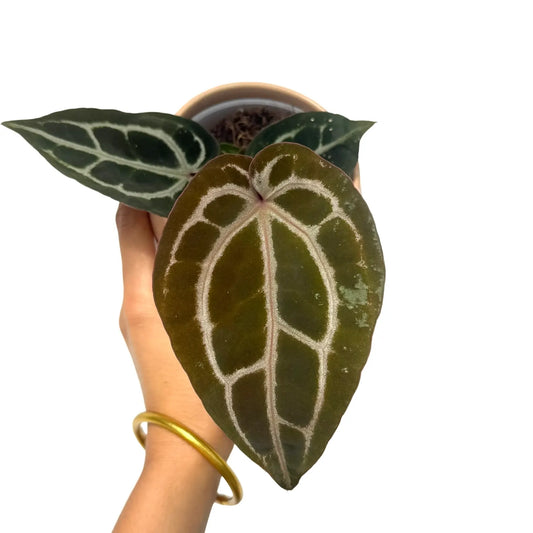
Anthurium Crystallinum
Regular price From 9,95 €Regular price9,95 €From 7,96 €Sold out -
Anthurium 'Red Crystallinum'
Regular price From 29,95 €Regular price29,95 €From 23,96 €


✂️ Routine care for the Anthurium warocqueanum
The Queen's daily care depends on a balance: aerated roots, humid air, and dry foliage. NC State notes that the tips of the leaves turn brown when humidity is too low, and that overwatering can cause root rot.
To increase humidity without wetting the leaves, follow our guide for increasing air humidity; our article "Misting: useful or not?" explains why we do not recommend it. A hygrometer helps you monitor the actual conditions rather than relying on guesswork.
💧 Watering: When the top of the substrate feels dry; use room-temperature water and always drain excess
💧 Humidity: Display cabinet, indoor greenhouse, humidity tray with wet pebbles, or grouped plants, without misting
🌱 Fertilizer: Diluted houseplant fertilizer during the growing season; no fertilizer in winter
🔹 Leaves: Do not rub the velvet; remove dust with a soft brush, and only cut off dead leaves
👀 Monitoring: Inspect the undersides and bases of the leaves every week: mealybugs, spider mites, and thrips hide there
🍂 Throughout the seasons: slow growth and warmth in winter
The Queen does not have a true dormant period, but it slows down significantly when light levels drop. From spring to summer, a new leaf slowly forms: do not touch it while it unfurls, as young velvet is very fragile. In autumn, water less frequently and stop fertilizing.
Winter is the critical season in France: heating dries out the air, and windows cool the leaves that touch them. Keep it within the range of around 18 to 29 °C recommended by NC State, away from radiators and open windows. Can it be taken outside?
NC State classifies Anthuriums in hardiness zones 11 to 12, meaning tropical climates: in France, the Queen remains an indoor plant all year round.
📅 Seasonal care calendar
| Season | Key action |
|---|---|
| 🌸 Spring | Repot if necessary, resume using diluted fertilizer, and propagate long stems |
| ☀️ Summer | Growth: water as soon as the top is dry, maintain high humidity, and avoid direct sun |
| 🍂 Autumn | Water less frequently, apply the last dose of fertilizer, and monitor the drop in light |
| ❄️ Winter | Keep warm and away from cold windows, water less frequently, and maintain humidity despite heating |
🌱 Propagating Anthurium warocqueanum by stem cutting
NC State lists two methods for Anthuriums: stem cuttings and sowing. For individuals, cuttings are the only realistic option, as sowing requires fresh seeds that are rarely available. In spring, take a stem cutting with at least one node and, ideally, one or two aerial roots.
Place it in moist sphagnum, in a warm place with high humidity: a clear box or grow cabinet works very well. Our guide for successful propagation in sphagnum details the method. Be patient: for a slow-growing species, it takes weeks to establish, and the first leaf will be small.
🐛 Common problems: causes and solutions
Most failures with the Queen are caused by dry air, a substrate that is too compact, or overwatering. NC State lists mealybugs, spider mites, whiteflies, scale insects, aphids, and thrips for the genus, as well as root rot from overwatering and stunted growth when light is insufficient.
| Symptom | Probable cause | Solution |
|---|---|---|
| Brown, dry tips | 💧 Humidity too low (NC State) | Use a display cabinet, indoor greenhouse, or group plants together; move away from the radiator |
| New leaf stuck or deformed | ⚠️ Air too dry during unfurling | Increase ambient humidity; do not force the leaf |
| Yellow leaves, soft roots | 💧 Overwatering, compact substrate causing suffocation | Remove from the pot, cut away rotten roots, and replant in an aerated mix |
| Burnt brown spots | ☀️ Direct sun on the velvet | Filter the light with a sheer curtain or move away from the window |
| Dull foliage, fine webbing | 🕷️ Spider mites favored by dry air | Shower with warm water while protecting the substrate, and increase humidity |
| Cottony white clusters | 🐛 Mealybugs | Remove them with a cotton swab dipped in alcohol, isolate the plant, and repeat |


🌸 Our warocqueanum and foliage Anthurium varieties
The Queen is often confused with other foliage Anthuriums, and the market mixes species, hybrids, and trade names. Here is how to place it. Hybrids are sold under the names of their supposed parents: without a botanical source, we cannot guarantee their parentage. Sales under the names "dark form" or "Queen of Hearts" are trade designations, to be distinguished from the species.
| Variety | Its highlight |
|---|---|
| Anthurium warocqueanum (Queen) | The species: long, narrow, pendulous leaf, dark green velvet, Colombian epiphyte |
| Anthurium veitchii (King) | Another Colombian epiphyte (Chocó, Antioquia according to POWO): leaves up to about 1.2 m (4 feet) long, either narrow with many fine veins or broad with fewer veins, according to NC State |
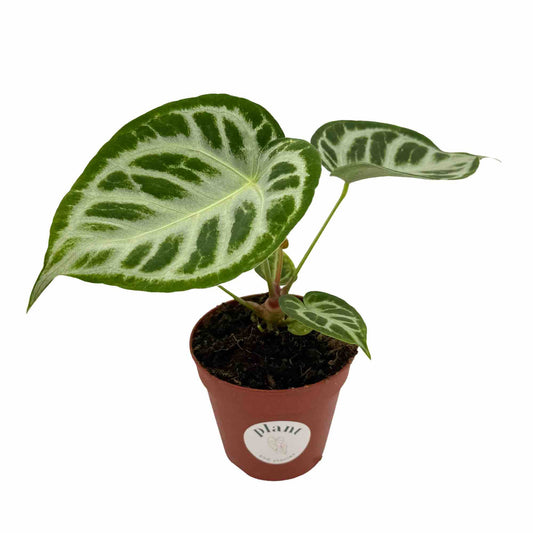
| Anthurium crystallinum | Broad heart-shaped, velvety leaf with pale green to silvery-white veins (NC State): the velvet without the length |
| Anthurium clarinervium | Dark green, glossy and velvety heart-shaped leaf with white veins (NC State) |
| Anthurium 'Silver Blush' | Silvery foliage: another entry point into Anthuriums with silvery foliage |
| Warocqueanum x waterburyanum hybrids | Sold under this name with velvety leaves; parentage cannot be verified without a botanical source |
🎨 What plants to pair with Anthurium warocqueanum?
The Queen shares its needs with other collectible aroids: indirect light, warmth, and humid air. In the same terrarium, it gets along well with an Anthurium clarinervium or an Anthurium crystallinum, whose heart-shaped leaves contrast with its long, pendulous blades.
For a jungle corner in a bright, humid room, add a Philodendron melanochrysum, another dark velvet, or use our guide to create a collector's tropical sanctuary. Grouping plants also helps maintain local humidity.
⚠️ Is Anthurium warocqueanum toxic to cats and dogs?
Yes, like all Anthuriums. According to NC State Extension, the genus contains calcium oxalate crystals, with a severity rated as low: drooling, pain and swelling of the mouth, lips and tongue, difficulty swallowing, loss of appetite and vomiting; the sap can also irritate the skin and eyes.
The ASPCA (American Society for the Prevention of Cruelty to Animals) does not have a dedicated page for Anthurium warocqueanum; its "Flamingo Flower" page (Anthurium scherzeranum), a species in the same genus, lists the class as toxic to dogs, cats, and horses due to its insoluble calcium oxalates.
Keep the Queen out of reach, wear gloves when pruning it, and contact a veterinarian if ingested.
✅ Our expert tips for success
Remember three key practices to successfully grow your Anthurium warocqueanum. First, an airy epiphyte substrate that never stays waterlogged: this is what saves the roots. Next, humid air achieved with a terrarium, indoor greenhouse, or by grouping plants, without misting the velvet. Finally, a bright spot without direct sunlight, between approximately 18 and 29°C, elevated to let the leaves hang.
Before buying, read our guide to buying a rare Anthurium online, and find the basics of the genus in our Anthurium guide.
The Queen is the plant you watch grow more than any other: each leaf takes time to unfurl, and that's part of the pleasure. What I find most often is that it is lost by trying too hard, with too much water in soil that is too dense. I recommend first taking care of its roots and the humidity of the air, then leaving it alone. An adult leaf hanging in a well-adjusted terrarium remains, for me, one of the most beautiful sights in a collection.

Laura Bruneau
Jardinière et autrice