Caladium (Caladium bicolor): care, tubers, indoors and outdoors

To care for a caladium, plant its tuber in a warm spot when the growing medium reaches about 21 °C, place it in bright light away from hot sun, keep the soil moist but never waterlogged, then let it go dormant when its leaves fade and store the bulb dry at around 13 to 16 °C until spring.
These guidelines come from the University of Wisconsin horticultural extension and Clemson University (HGIC).
Caladium, botanically named Caladium bicolor, is not a foliage plant to keep year-round: it is a tuberous plant with a well-defined life cycle, grown just as readily in a pot indoors as outdoors in summer. This guide covers everything you need to know: bulbs, growing medium, watering, indoors or outdoors, winter dormancy, pink, red or white caladiums, and toxicity.
🌿 Caladium bicolor, hybrid or hortulanum: what is its real name?
The currently accepted name is Caladium bicolor (Aiton) Vent., published in 1800, according to Plants of the World Online (POWO) from the Royal Botanic Gardens, Kew. POWO describes it as a tuberous geophyte from humid tropical forests, found from Central America to northern Argentina.
Caladiums sold by garden centers are horticultural hybrids long sold under the name Caladium × hortulanum: NC State Extension (North Carolina State University) presents it as the former name for Caladium bicolor, and POWO lists Caladium × hortulanum Birdsey (1951) among the species’ synonyms; the ASPCA still uses “Caladium hortulanum.”
So when you read “hybrid caladium,” these are the same plants. According to the University of Wisconsin, the species has been cultivated in Europe since the late 18th century. It is nicknamed “angel wings,” a name cited by NC State.
| Advantage | What this means for you |
|---|---|
| Painted foliage | Pink, red, white and green on the same leaf, with no flowers to wait for |
| Indoors and outdoors | In a pot indoors, or outside in summer in partial shade, in a flower bed or planter |
| Predictable cycle | Grows in spring and summer, rests in winter: a well-stored tuber will grow again year after year |
| Wide selection | More than 75 cultivars sold commercially, according to UF/IFAS, with broad or lance-shaped leaves |
🔎 Caladium at a glance
Here is the verified profile of the caladium. The name, author and origin come from POWO; size, soil and toxicity from NC State and UF/IFAS (University of Florida).
UF/IFAS indicates that the leaves are most often 15 to 30 cm long and that the plant reaches 30 to 75 cm, depending on the cultivar; NC State gives a wider range, of about 18 to 44 cm long.
| Feature | Verified details |
|---|---|
| 🏷️ Botanical name | Caladium bicolor (Aiton) Vent., formerly Caladium × hortulanum; nickname: angel wings |
| 🧬 Family | Araceae, like Alocasia, Colocasia and Aglaonema |
| 🌳 Type | Tropical tuberous perennial (geophyte), with annual dormancy |
| 🌍 Origin | Central and South America, as far as northern Argentina (POWO) |
| 🍃 Foliage | Heart- or arrow-shaped leaves (fancy type) or narrow leaves (lance type), most often 15 to 30 cm long (UF/IFAS), up to about 44 cm according to NC State |
| 🌸 Flowering | Inconspicuous: a green or pinkish spathe around a short white spadix (Wisconsin) |
| 📏 Size | 30 to 75 cm for broad-leaved types, under 30 cm for lance-leaved types (Wisconsin) |
| ⚠️ Toxicity | Toxic to dogs, cats and horses: insoluble calcium oxalates (ASPCA) |
📋 Quick care facts
The essential growing guidelines, all in one place.
| Factor | Guideline |
|---|---|
| Light | Bright, indirect light indoors; partial shade outdoors: 2 to 4 hours of direct sun a day is enough (UF/IFAS) |
| Watering | Growing medium moist to the touch but never saturated while growing; almost none during dormancy |
| Growing medium | Rich in organic matter, well-draining, and rather acidic (pH below 6 according to NC State) |
| Humidity | Appreciates humid air indoors (Wisconsin): use a humidity tray or group plants together |
| Temperature | Soil around 21 °C for planting; store tubers at 13–16 °C, never below 10 °C |
| Repotting | No conventional repotting: replant the tuber in fresh growing medium each spring |
| Fertilizer | For potted plants, apply liquid fertilizer every two weeks while growing (Clemson), never on the leaves |
| Toxicity | Toxic if ingested by animals and humans; gloves are recommended when handling |
| Difficulty | Moderate: easy in summer; success depends on dormancy and bulb storage |
📍 Where should you place a caladium, indoors or outdoors?
Place the caladium in bright light, but never in hot midday sun, which scorches its delicate leaves. Indoors, the University of Wisconsin recommends a warm, bright spot out of direct sunlight, with plenty of humidity.
Outdoors, Clemson reminds growers to protect it from hot, full sun; UF/IFAS says most caladiums thrive in partial shade and need only 2 to 4 hours of direct sun a day, while NC State rates it for dense to partial shade.
As for timing, the rule is the same everywhere: do not plant anything until the soil reaches about 21 °C (70 °F; Wisconsin and Clemson).
☀️ Caladium indoors: near an east- or west-facing window, or set back from a south-facing glass door behind a sheer curtain, away from cold drafts
🌳 Caladium outdoors: partial shade, under a light-canopied tree or beside an east-facing wall, sheltered from wind and hail that can tear the leaves (NC State)
📅 Timing: start tubers in pots in a warm spot 4 to 6 weeks before the last frost (Wisconsin), and move them into the garden when the soil reaches 21 °C
🪴 Planting a caladium bulb: growing medium, pot and depth
A caladium “bulb” is actually a tuber, which should be planted shallowly in warm, well-draining growing medium. Clemson recommends a depth of 4 to 5 cm (1.5 to 2 inches) and spacing of about 20 to 35 cm when planting in the ground, in a pot with a drainage hole, because caladiums rot if they stay too wet.
NC State recommends soil that is rich in organic matter, well-drained and rather acidic. A lightened houseplant potting mix will work, as will an aroid mix such as our Aroid potting mix with mycorrhizae.
Clemson adds a pro tip: remove the tuber’s large central bud so it produces more shoots and leaves, without damaging the small buds around it; Wisconsin specifies making a cut about 3 to 6 mm deep to remove it.
| Step | What to do |
|---|---|
| 1. Choose the tuber | Firm, with no soft spots or mold; Clemson recommends healthy tubers to prevent rot |
| 2. Prepare the pot | Pot with drainage holes, and rich, well-draining growing medium; no layer of clay pebbles at the bottom—the mix itself should drain well |
| 3. Remove the central bud (optional) | Lift out the large central bud with the tip of a clean knife, without touching nearby smaller buds, for fuller foliage (Clemson) |
| 4. Plant | With buds facing up, 4 to 5 cm deep (Clemson, Wisconsin), then water lightly |
| 5. Keep warm while waiting | Keep the growing medium around 21 °C and barely moist until the first leaves appear |
columns: 4
columns_mobile: 2
-
Alocasia Dragon Scale Marble Mint
Regular price From 19,95 €Regular price49,95 €Sale price From 19,95 €Sale -
-
-

 Sold out
-

 Sold out
-





✂️ Caladium care: watering, fertilizer and humidity
While it is growing, caladium care comes down to one rule: keep the soil moist, never waterlogged. Clemson recommends watering often and thoroughly, keeping the soil “uniformly moist to the touch but not saturated”; the University of Wisconsin says the same.
Humidity matters indoors: see our solutions for increasing air humidity without misting. If you are unsure when to water, a soil moisture meter can help prevent overwatering.
💧 Watering caladiums: Water thoroughly when the surface starts to dry, then empty the saucer: the tuber must never sit in water
💧 Humidity: Place a tray of damp pebbles under the pot or group plants together; do not mist the leaves
🌱 Fertilizer: For potted plants, use a soluble liquid fertilizer every two weeks while growing (Clemson); stop as soon as the leaves begin to decline
🔹 Leaves: Cut spotted or dry leaves off at the base; Clemson recommends removing leaves affected by leaf spot
🔹 Flowers: A green or pinkish spathe sometimes appears (Wisconsin); it is not very decorative, so feel free to cut it off
🍂 Caladium dormancy: what to do with the bulb in winter
In fall, caladiums lose their leaves: this is normal, as they are entering dormancy. The University of Wisconsin notes that even indoors, they rest after a few months in leaf. Reduce watering as the leaves turn yellow, then stop altogether. Outdoors, dig up the tubers before the soil drops below about 13 °C (55 °F; Wisconsin).
Let them dry in a warm, shaded spot—one week according to Wisconsin, one to two according to Clemson—then cut off the leaves and store them in dry sphagnum moss or a mesh bag at around 13 to 16 °C for up to five months (Wisconsin). Clemson sets a minimum: never below 10 °C, and never in the refrigerator.
For potted plants, the easiest option is to leave the tuber in its dry growing medium, protected in a temperate room. To compare with other tuberous plants that are brought indoors for winter, see our guide to dahlias and overwintering them.
📅 Seasonal care calendar
| Season | Key task |
|---|---|
| 🌸 Spring | Start tubers in pots in a warm spot, remove the central bud, divide tubers |
| ☀️ Summer | Peak growth: keep the soil moist, fertilize potted plants every two weeks, move outdoors into partial shade once the soil reaches 21 °C |
| 🍂 Fall | Leaves turn yellow: reduce watering, then stop; dig up tubers before the soil drops below 13 °C |
| ❄️ Winter | Dormancy: keep tubers dry at 13 to 16 °C, never below 10 °C, for up to five months |
🌱 Propagating caladiums by dividing the tuber
Caladiums are propagated by dividing the tuber in spring, just before repotting. The University of Wisconsin recommends cutting the tuber into pieces, each with at least one eye (bud), then leaving the cuts to dry for a few days and callus over before planting. Wisconsin recommends dividing in spring, before potting, not in fall.
Wear gloves: according to NC State, all parts of the plant contain irritating calcium oxalate crystals.
🐛 Common problems: causes and solutions
Most caladium problems are caused by too much water, soil that is too cold, or excessive sun. Clemson lists tuber rot, leaf spot and leaf scorch; NC State also mentions slugs and snails, wind and hail. Our guide to root rot explains how to save your plant.
| Symptom | Likely cause | Solution |
|---|---|---|
| Leaves yellow at the end of summer | ⚠️ Normal entry into dormancy | Reduce and then stop watering, and prepare the tuber for storage |
| Leaves yellow during the growing season | 💧 Too much water or cold soil stressing the tuber | Let the surface dry, empty the saucer and move the plant somewhere warm |
| Soft tuber, odor | 🍄 Tuber rot (Clemson), growing medium too wet | Cut away soft areas, let the tuber dry, then replant in a well-draining mix |
| Scorched or discolored leaves | ☀️ Hot, direct sun or fertilizer spilled on the leaves (Clemson) | Filter the light and apply fertilizer only to the soil |
| Light brown spots on lower leaves | 🍄 Leaf spot (Clemson) | Remove and discard affected leaves as soon as they appear |
| Holes or tears in leaves | 🐌 Slugs, snails, wind or hail (NC State) | Pick off slugs in the evening and move the plant to a sheltered spot |


🌸 Our Caladium varieties: pink, red and white
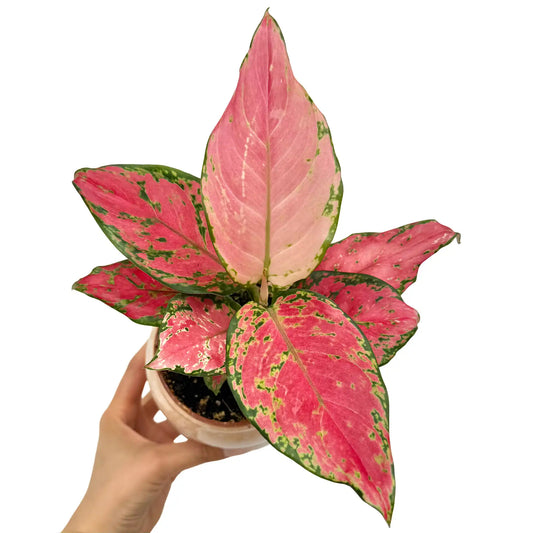
Pink caladium, red caladium and white caladium are cultivars of the same species. UF/IFAS, whose breeding program has developed 51 cultivars, distinguishes fancy-leaved types, with broad heart-shaped leaves, from lance-leaved types, with narrow leaves. Sun tolerance varies by cultivar (Clemson). “Urban Caladium” is not a variety but a label used by the Vreugdenhil Bulbs & Plants nursery, according to Dutch horticultural media outlet BP Nieuws. As no university source is available, “Lucia” is not described here.
| Variety | What makes it stand out |
|---|---|
| Caladium Carolyn Whorton | Pink caladium with large leaves: pink with red veins and a green margin, 45 to 75 cm (Wisconsin) |
| Caladium Florida Sweetheart | Compact lance-leaved type with small reddish-pink leaves edged in green, 15 to 30 cm (Wisconsin); the most widely adopted cultivar from the UF program, according to the UF/IFAS publication EP223, recommended for both shade and sun |
| Caladium Miss Muffet | Dwarf caladium with green leaves, white veins and red spots, with no sun tolerance (Clemson); keep it in the shade or indoors. Sources differ on the shape of its leaves: Clemson classifies it as lance-leaved, while UF/IFAS uses it as a reference when comparing fancy-leaved cultivars |
| Caladium Red Flash | Red caladium with large leaves: dark red with pink spots and a broad, dark green margin, 45 to 75 cm (Wisconsin); good sun tolerance according to Clemson |
| Caladium White Christmas | White caladium with bright white leaves, dark green veins and margins, 30 to 60 cm (Wisconsin) |
| Caladium White Delight | White caladium with pearly white heart-shaped leaves patterned with veins, 30 to 50 cm tall, according to our product listing; goes completely dormant in fall, like all caladiums |
🎨 Which plants pair well with caladium?
Caladium has the same needs as other tropical Araceae: warmth, filtered light and evenly moist soil. Indoors, pair it with an Alocasia with large, dark leaves, which also goes dormant in winter, or with an Aglaonema, which keeps its leaves while the caladium is dormant.
A Calathea complements the display beautifully with its patterned leaves. For another indoor bulb with a distinct growth cycle, an amaryllis takes over in winter. Outdoors, in partial shade, pair it with shade perennials such as ferns or heucheras.
⚠️ Is caladium toxic to cats and dogs?
Yes. The ASPCA’s “Caladium” profile, which lists it as Caladium hortulanum, classifies it as toxic to dogs, cats and horses because of its insoluble calcium oxalates.
Reported signs include oral irritation, pain and swelling of the mouth, tongue and lips, excessive drooling, vomiting (except in horses) and difficulty swallowing. NC State describes burns and swelling of the lips, mouth and tongue in humans, with possible nausea, vomiting and diarrhea, and rates the severity as moderate.
Keep it out of reach of pets and children, wear gloves when cutting or dividing the tuber, and contact a veterinarian if it is ingested. For a cat-friendly home, see our list of non-toxic plants for cats.
✅ Our expert tips for success
Keep these four tips in mind to grow caladium successfully. Plant the tuber 4 to 5 cm deep in a well-draining potting mix, only once the soil reaches around 21 °C. Give it bright light without hot direct sun, indoors or outdoors in partial shade. Keep the soil moist but not waterlogged, and feed potted plants with liquid fertilizer every two weeks.
Finally, support it through dormancy: stop watering, keep the tuber dry at 13 to 16 °C, and your caladium will regrow in spring. Explore our Caladiums and other tropical houseplants.
We get lots of worried messages about caladiums at the end of summer, when their leaves droop one by one. I always reassure people: it’s not a failure, it’s part of the plant’s natural cycle. My advice is to stop watering at this point rather than water more, and to store the pot somewhere warm and dry. Watching the first pink leaves unfurl the following spring remains one of my favorite joys as an indoor gardener.

Laura Bruneau
Jardinière & autrice