Perlite or vermiculite: what’s the difference and which should you choose?

Perlite or vermiculite? Perlite aerates and drains (it holds little water), while vermiculite retains water and nutrients. The rule is simple: use perlite for a well-draining potting mix, vermiculite to retain moisture. Find horticultural perlite in our store to create your own mixes.
This guide explains what these two soil amendments are, how they differ, when to use one or the other, and how to combine them to create a custom potting mix.
Perlite and vermiculite: what are they?
Perlite and vermiculite are two lightweight, sterile mineral amendments with a neutral pH, used to improve potting mixes. Despite their apparent similarity, they have opposite effects on water.
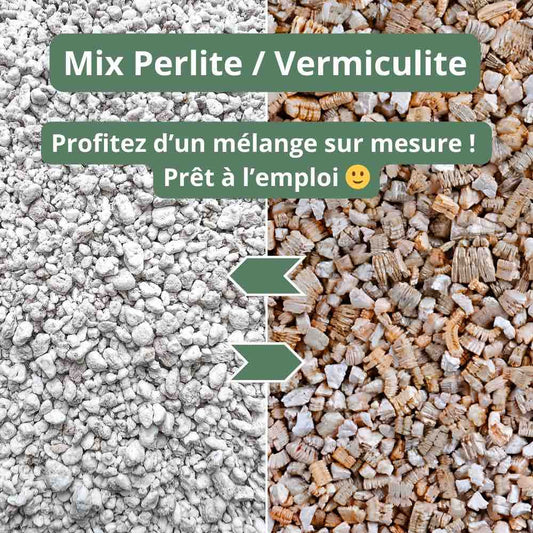
Perlite is volcanic rock that is heated until it expands into small, porous, very lightweight white granules. Vermiculite is a mineral (mica) that is heated until it expands into spongy, gray-brown flakes capable of absorbing a lot of water. Both lighten potting soil and improve conditions for roots, but in different ways.
The key thing to remember is that they are not interchangeable. Their properties in relation to water are very different, and confusing them can result in a potting mix that is too dry or waterlogged. Many commercial potting mixes actually contain both, in proportions designed to provide a general balance; but as soon as you make your own mix, knowing which one to choose can make all the difference between a plant that thrives and one that suffers from chronic overwatering or underwatering.
Perlite: aeration and drainage
Perlite is the ultimate drainage and aeration amendment. These little white granules create air pockets in the potting mix, prevent compaction, and let excess water drain away.
As the University of Maryland Extension points out, a good growing medium should remain light and airy to allow air and water to circulate around the roots. Perlite helps directly: it holds little water, so the potting soil dries faster, protecting roots from excess moisture. However, it provides few nutrients and can float to the surface when watering. Another benefit: because it is heated to a very high temperature during production, perlite is completely sterile, with no weed seeds or pathogens, and its neutral pH does not disrupt the potting mix's balance. That's what makes it the most widely used drainage amendment, by hobbyists and professionals alike.
| Perlite characteristic | Details |
|---|---|
| Appearance | Lightweight white granules |
| Main purpose | Drainage and aeration |
| Water retention | Low: potting soil dries quickly |
| Nutrients | Virtually none |
The question of perlite or vermiculite comes up all the time, and my answer boils down to one image: perlite helps the mix breathe and drain; vermiculite is a sponge. For most indoor plants, which are sensitive to excess water, I start with perlite. I save vermiculite for seedlings and plants that like to stay moist. After years of experience, I can confirm it: nine times out of ten, indoors, perlite is the way to go.
Vermiculite: water and nutrient retention
Vermiculite, by contrast, is the go-to amendment for water retention. Its accordion-like structure acts like a sponge, storing water and releasing it slowly to the roots.
According to the University of Connecticut (CAHNR), vermiculite is used to increase moisture and nutrient retention in mixes, and even contains some potassium, magnesium, and calcium that are released slowly. It can hold several times its weight in water, keeping the potting mix moist for longer. Its downside: it tends to compact over time, reducing aeration.
| Vermiculite characteristic | Details |
|---|---|
| Appearance | Spongy, gray-brown flakes |
| Main purpose | Water and nutrient retention |
| Water retention | High: keeps the potting mix moist |
| Nutrients | Some K, Mg, Ca |
columns: 4
columns_mobile: 2
-
Horticultural Perlite - Perlite for plants
Regular price From 9,50 €Regular price8,50 €Sale price From 9,50 €9,50 €From 7,60 € -
Vermiculite for Plants - Horticultural Grade
Regular price From 8,50 €Regular price8,50 €Sale price From 8,50 €8,50 €From 6,80 € -
Perlite / Vermiculite Mix for Plants - Perlite Vermiculite for Seedlings 4L
Regular price 11,95 €Regular price11,95 €Sale price 11,95 €11,95 €9,56 € -
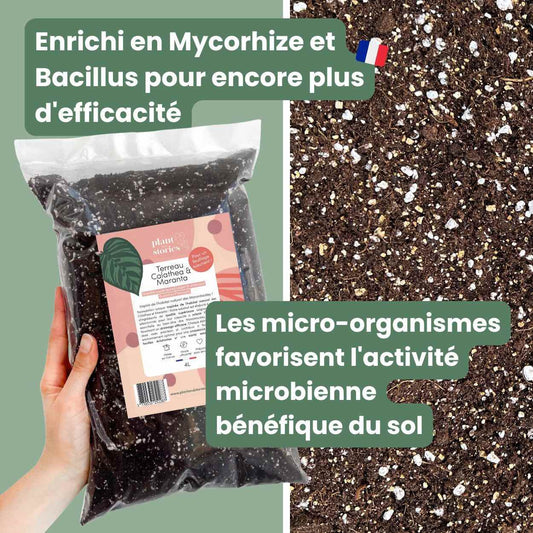
Premium Calathea & Maranta Potting Soil - Enriched with Mycorrhizae and Bacillus - Made in France
Regular price 11,99 €Regular price11,99 €Sale price 11,99 €11,99 €9,60 €



Perlite or vermiculite: how do you choose?
The choice comes down to one question: does your plant and situation call for better drainage or more moisture? The answer points you directly to one or the other.
Choose perlite to improve drainage: for plants that are sensitive to excess water, succulents, cacti, aroids, or whenever you tend to overwater. Choose vermiculite to retain moisture: for seedlings, young cuttings, ferns, and plants that like consistently moist potting mix. Both improve the structure of potting soil, but in opposite ways, balancing air and water.
| Your need | Amendment |
|---|---|
| Better drainage | Perlite |
| More moisture | Vermiculite |
| Succulents, cacti | Perlite |
| Seedlings, moisture-loving plants | Vermiculite |
Handling perlite and vermiculite safely
Both materials are easy to handle, but a few precautions can make the process more comfortable and improve the results. Dust is the main thing to watch out for.
Dry perlite is very dusty: lightly dampen it before mixing to avoid breathing in fine particles. Vermiculite, which is heavier once wet, is easy to mix. In both cases, blend the amendment evenly into the potting soil rather than leaving it in a layer, to ensure a consistent effect. Since perlite tends to float to the surface, a light stir of the top layer of the pot is enough to redistribute it if needed.
| Task | Good practice |
|---|---|
| Dusty perlite | Dampen before handling |
| Mixing | Blend evenly into the potting soil |
| Perlite rising to the surface | Gently stir the surface |
| Storage | Keep dry, with the bag sealed |
Are there any alternatives?
Perlite and vermiculite aren't the only mineral amendments: other materials serve similar purposes and can replace them in some cases. It's useful to know what they are.
For drainage and aeration, volcanic rock, pumice, or coarse sand provide effects similar to perlite, but with more weight and stability. Clay pebbles can also serve this purpose in some setups. For water retention, coconut coir is an eco-friendly alternative to vermiculite in many mixes. The choice depends on availability, budget, and the effect you're looking for.
📋 Quick reference guide (for experienced gardeners)
At a glance, here's how to choose between perlite and vermiculite.
| Criteria | Perlite / Vermiculite |
|---|---|
| Appearance | White granules / gray-brown flakes |
| Source | Volcanic rock / mica |
| Purpose | Drainage / water retention |
| Water retention | Low / high |
| Nutrients | Virtually none / some (K, Mg, Ca) |
| Durability | Stable / compacts over time |
| Best for | Succulents / seedlings |
| pH | Neutral for both |
Can you use them together?
Yes, and sometimes it's the best option: combining perlite and vermiculite lets you balance drainage and water retention to suit the plant's needs. It all comes down to the proportions.
In a seed-starting mix, a little vermiculite retains moisture while perlite prevents waterlogging. For a typical indoor plant, perlite is often the priority, with perhaps a touch of vermiculite if the mix dries too quickly. By adjusting the proportions, you can create a custom potting mix suited to each plant.
| Use | Suggested combination |
|---|---|
| Seedlings, cuttings | Vermiculite + a little perlite |
| Typical indoor plants | Perlite as the main amendment |
| Succulents, cacti | Plenty of perlite |
| Moisture-loving plants | Mostly vermiculite |


Troubleshooting: avoid common mistakes
Once you know what to look out for, it's easy to avoid a few common mistakes. Here are the main ones.
| Mistake | Consequence and fix |
|---|---|
| Using vermiculite for a succulent | Potting mix stays too wet: use perlite instead |
| Using perlite for a delicate seedling | Dries too quickly: add vermiculite |
| Too much vermiculite | Compaction: lighten the mix with perlite |
| Assuming they're the same | Water balance is off: learn to tell them apart |
To make your own potting mixes, find our horticultural perlite and potting soils, carefully selected in France.
The right potting mix with Plant and Stories
Perlite and vermiculite aren't really opposites: they complement each other, each in its own way. Perlite drains and aerates, while vermiculite retains water and nutrients. Once you understand their roles, you can create the ideal potting mix for each of your plants.
To learn more, explore our potting mixes and amendments and our plants, carefully selected in France. With these two allies understood, creating the ideal mix becomes child's play.

Laura Bruneau
Jardinière et autrice