

Hedge planting distances: boundary rules

Before planting a hedge along your property line, one question always comes up: how far from the neighbor’s property am I allowed to plant it? The answer comes down to two figures. A hedge that will grow taller than 2 meters must be planted at least 2 meters from the boundary; a hedge that will stay 2 meters tall or less must be planted at least 0.5 meters away. This is the basic rule under the French Civil Code, applicable throughout France unless specific local regulations say otherwise.
This guide explains everything in plain English: the exact distances, how to measure them, what to know about utility lines and roads, your rights regarding overhanging branches and encroaching roots, and—most importantly—how to plant your hedge properly so it looks great and avoids disputes with your neighbors.
📏 Legal distances at a glance
The rule comes from Article 671 of the French Civil Code: it all depends on the mature height of your hedge. For a hedge under 2 meters tall, allow 0.5 meters of clearance; for one over 2 meters, allow 2 meters. According to Légifrance (Article 671 of the French Civil Code), these distances apply “in the absence of local regulations and customs.” Here’s what you need to know.
📋 Quick reference: distances to remember
The key legal guidelines for a boundary hedge, at a glance.
| Parameter | Guideline |
|---|---|
| Hedge ≤ 2 m tall | At least 0.5 m from the boundary |
| Hedge > 2 m tall | At least 2 m from the boundary |
| Distance measured | From the center of the trunk to the property boundary |
| Height measured | From ground level to the top of the plant |
| Underground utilities | 1 m (shrubs) to 2 m (trees) from the utility |
| Municipal or county road | 0.5 m (≤ 2 m) or 2 m (> 2 m) |
| Limitation period | 30 years: a planting that has been tolerated too close to the boundary for 30 years can no longer be challenged |
| Overhanging branches | You can require your neighbor to trim them (the right is not subject to a limitation period) |
| Encroaching roots | You can cut them yourself at the boundary line |
| Priority | Local planning rules and customs take precedence over the general rule |
📐 0.5 m or 2 m? The rule depends on height
It all comes down to the height your hedge will reach when mature, not its size when planted. A low border hedge and a 3-meter privacy hedge are therefore subject to different distance requirements.
| Mature hedge height | Minimum distance from boundary | Example |
|---|---|---|
| 2 m or less | 0.5 m | Boxwood border, low clipped privet hedge |
| Over 2 m | 2 m | Laurel hedge, thuja, informal photinia |
| Tall-growing tree | 2 m (and pruning back to the boundary) | Large conifer, specimen tree |
Please note: the actual height is what counts. A hedge planted 0.5 m from the boundary but allowed to grow taller than 2 m is no longer compliant, and your neighbor can require you to cut it back.
🔌 Utilities and roads: other distance requirements
Your neighbor’s property line isn’t the only constraint: underground utilities and public roads have their own clearance requirements. According to the government services (Bocage and Hedgerow Information Point), keep these general guidelines in mind (source: Sarthe Prefecture).
| Situation | Recommended clearance | Why |
|---|---|---|
| Underground utility (water, gas, telecom) | 1 m (shrubs) to 2 m (trees) | Prevent roots from damaging the utility |
| Municipal or county road | 0.5 m (≤ 2 m) / 2 m (> 2 m) | Road visibility and maintenance |
| Railway | At least 2 m | Railway safety |
Before digging, a works declaration (DT-DICT) can help locate utility lines—a useful precaution near a shared fence.
🪴 How to plant your boundary hedge (step by step)
Once you know the required distance, success comes down to a few simple steps and the right spacing between plants.
📏 Distance from the boundary: First measure the required clearance (0.5 m or 2 m) from the fence, then mark your planting line.
🌱 Spacing between plants: This determines how quickly the hedge fills in.
🍂 Timing: Fall is still the best season for planting a bare-root or root-ball hedge.
Planting then takes five steps:
- Mark your planting line the correct distance from the boundary.
- Dig a trench twice as wide as the root balls.
- Work in compost and loosen the soil at the bottom of the trench.
- Position the plants at the right spacing, with the root collar level with the soil.
- Backfill, firm the soil, water thoroughly, and mulch.
Here are the most common planting densities for a boundary hedge.
| Goal | Recommended density |
|---|---|
| Dense privacy hedge (fast-growing) | 2 to 3 plants / meter |
| Classic evergreen hedge | 1.5 to 2 plants / meter |
| Low clipped border | 4 to 5 plants / meter |
| Informal country hedge | 1 plant / meter |
Choose species whose mature height is compatible with the clearance you have: this is the best way to avoid disputes. If you only have 0.5 meters of clearance, opt for a manageable low hedge (boxwood, clipped privet) rather than a tall evergreen that would need constant trimming to stay under 2 meters.
columns: 4
columns_mobile: 2
-

 Livraison offerte Sold out
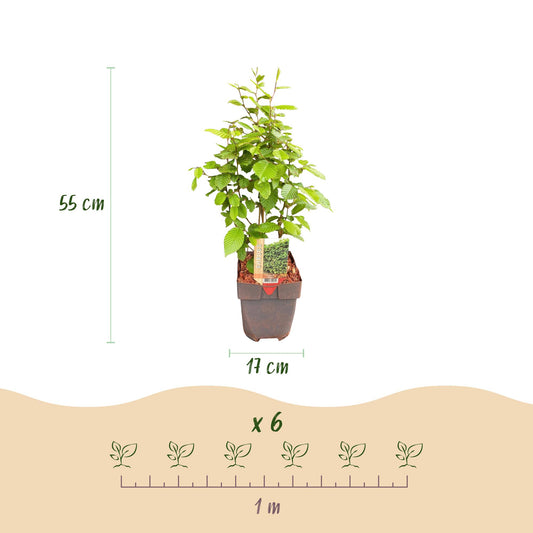
Hornbeam (Carpinus betulus), hardy hedging plant, 17 cm pot, Height 55 cm - Pack of 6
Regular price 89,95 €Regular price -


Compacta Oleaster (Elaeagnus x ebbingei), evergreen hedging plant, 9 cm pot, Height 25–35 cm
Regular price From 54,95 €Regular price -

 Livraison offerte Sale
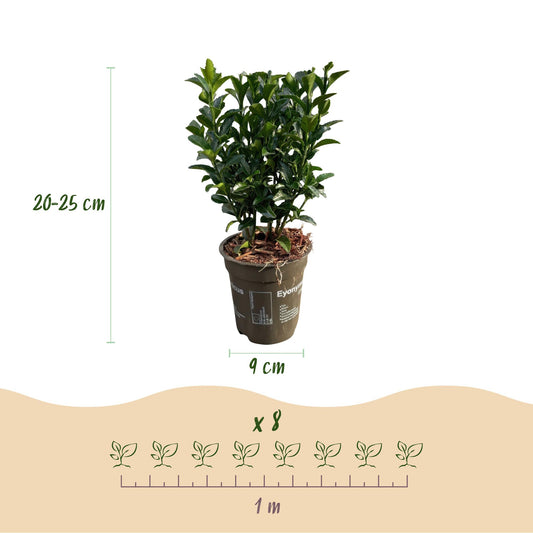
Green Spire Euonymus, evergreen hedging plant, 9 cm pot, Height 20–25 cm
Regular price From 49,95 €Regular price54,95 €Sale price From 49,95 €Livraison offerte Sale -

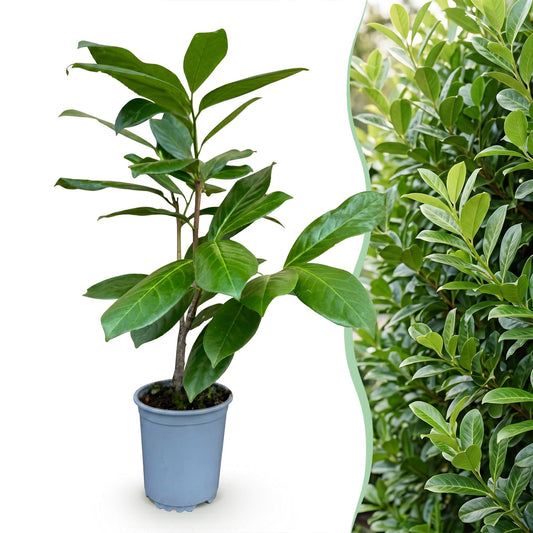
Cherry laurel Rotundifolia (Prunus laurocerasus), evergreen hedging plant, 9 cm pot, Height 25-35 cm
Regular price From 54,95 €Regular price -

 Livraison offerte Sold out
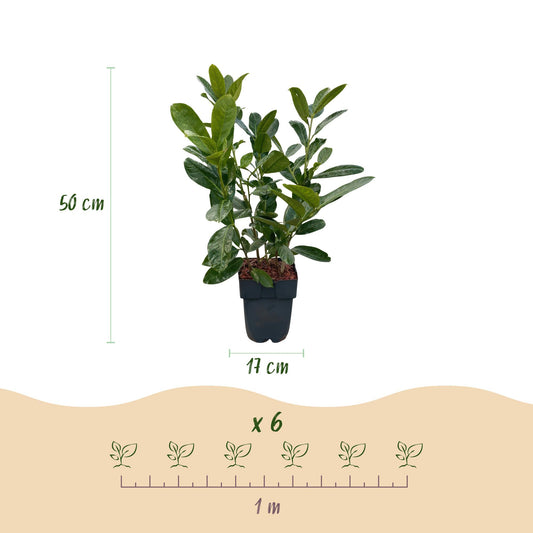
Cherry laurel Rotundifolia (Prunus laurocerasus), evergreen hedge plant, 17 cm pot, Height 50 cm - Pack of 6
Regular price 99,95 €Regular price -

 Livraison offerte Sold out
Photinia Carré Rouge (Photinia x fraseri), evergreen hedge plant - Set of 6
Regular price 109,95 €Regular price -

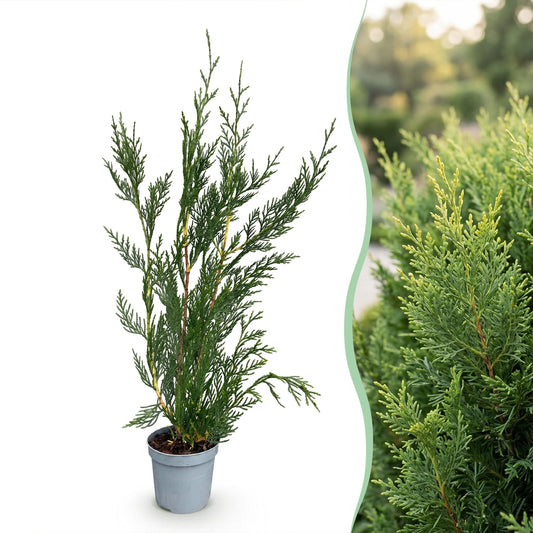
Leyland Cypress 2001 (Cupressocyparis leylandii), evergreen hedging plant, 9 cm pot, Height 30-40 cm
Regular price From 59,95 €Regular price -

 Livraison offerte
Privet (Ligustrum), hardy hedging plant, 9 cm pot, Height 35–45 cm
Regular price From 54,95 €Regular price -

 Livraison offerte Sale
Common yew (Taxus baccata), evergreen hedging plant, 9 cm pot, Height 20–30 cm
Regular price From 59,95 €Regular price179,95 €Sale price From 59,95 €Livraison offerte Sale -

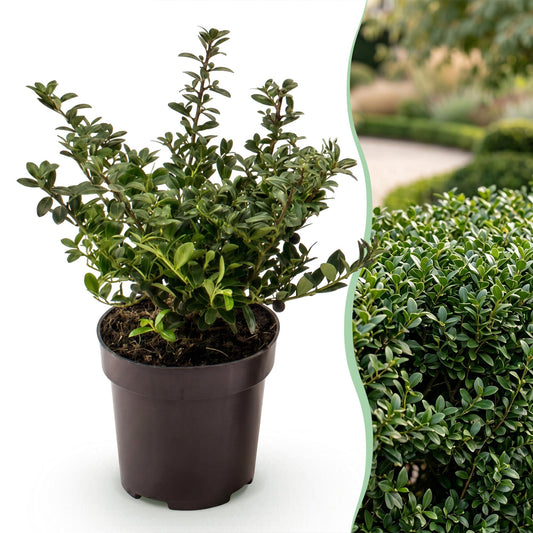
Stokes' Crenate Holly (Ilex crenata), evergreen hedging plant, 9 cm pot, Height 20-30 cm
Regular price From 59,95 €Regular price


🗓️ Boundary hedge calendar
Planting, trimming, maintenance: every task has its season, and some are governed by law (trimming is discouraged in the heart of spring, during peak nesting season).
📅 Seasonal maintenance calendar
| Season | Key task |
|---|---|
| 🌸 Spring | New growth; formative pruning before mid-March; check clearances |
| ☀️ Summer | Water during the first year; avoid trimming during peak nesting season |
| 🍂 Fall | IDEAL PLANTING SEASON (at the required distance from the boundary) |
| ❄️ Winter | Structural pruning of deciduous plants when it’s not freezing; no pruning for evergreens |
🌿 Branches and roots: your rights (and responsibilities)
What should you do if your neighbor’s hedge encroaches on your property—or vice versa? The law is clear and treats these two situations differently, as the government services (planting and pruning) explain.
🌳 Overhanging branches: You cannot cut them yourself, but you can require your neighbor to trim them, and this right never expires (it is not subject to a limitation period).
🌱 Roots and brambles: You can, however, cut back any that encroach onto your property, exactly along the boundary line.
In all cases, it’s best to notify your neighbor in writing before taking action: talking things through resolves the vast majority of situations.
⚖️ Neighbor dispute: what should you do?
A hedge that’s too close or too tall can almost always be dealt with amicably. If talking things through doesn’t work, here are the steps to take and the remedy available in each case.
| Situation | What the rule says | What to do |
|---|---|---|
| Hedge planted too close (less than 30 years ago) | Does not comply with Article 671 | Request an amicable solution, then send a registered letter, then contact a justice conciliator |
| Hedge tolerated for over 30 years | Limitation period has expired (Article 672) | The distance can no longer be challenged |
| Overhanging branches | Right to require pruning (Article 673) | Make a written request to your neighbor; go to court if they refuse |
A justice conciliator, whose services are free, is often the key: they can help avoid a long and costly trial over a few dozen centimeters. In practice, a polite letter reminding your neighbor of the 0.5-meter or 2-meter rule is usually enough to resolve the issue without ever going to court.
🏛️ Special cases: local planning rules, customs, limitation period
The 0.5 m / 2 m rule is the default: several local provisions can modify it. Check them before planting.
| Special case | What applies |
|---|---|
| Local urban plan (PLU) | It may impose different distances or heights and takes precedence |
| Established local customs | If recognized by the local authority, they replace the general rule |
| Housing development / easement | The development regulations or a written agreement take precedence |
| 30-year limitation period | After 30 years, the existing situation is legally established |
🤝 Our advice for a hedge without disputes
The best boundary hedge is one you plant with a clear plan: the right distance, the right species, and the right target height.
How to create a privacy hedge · How to plant a hedge in fall · When should you trim a hedge?
Before I even choose the plants, my first step is to decide how tall the hedge should be when mature: everything else follows from that. If you’re aiming for under 2 meters, plant 50 cm from the boundary and you’ll have more flexibility; for a taller hedge, allow 2 meters, even if that means choosing narrower species. I’ve seen too many beautiful hedges have to be removed because they were 30 centimeters too close: a quick calculation at the start is better than a long dispute later.
In short: 0.5 meters for a hedge under 2 meters tall, 2 meters for anything taller; measure from the center of the trunk, and always check the local urban plan. The rest is just good neighborly relations. Discover our selection below to create a hedge suited to your available clearance.


Laura Bruneau
Jardinière & autrice


