

When should you trim a hedge? Timing, method and schedule

When should you trim a hedge? The answer fits in one sentence: once to three times a year, depending on the species, while strictly avoiding the bird nesting season, from March 15 to July 31. For most formal hedges, two trims (one right at the beginning of spring (before mid-March) and one in late summer) are enough to keep the lines neat and the foliage dense.
This guide gives you the right schedule, a step-by-step method, the specifics of evergreens, conifers and deciduous hedges, and the rules to follow to protect wildlife. With practical guidelines and reliable sources, so you can trim at the right time without ever damaging your hedge or the birds that shelter in it.
⏱️ When to trim: the short answer
The right schedule depends on your hedge: a precisely clipped hedge needs more trims than an informal one. But two guidelines apply to all hedges: trim outside the nesting season, and preferably on a cloudy day. Here are the essentials.
📋 Quick facts: hedge trimming at a glance
The essential guidelines for trimming your hedge at the right time, at a glance.
| Parameter | Guideline |
|---|---|
| Frequency | 1 to 3 trims per year, depending on the species and style |
| Ideal timing | Before mid-March, then from August onward (formal hedges) |
| Period to avoid | March 15–July 31 (bird nesting season) |
| Formative pruning | For 2 years, to thicken the base from a height of 30 cm |
| Conifers | In late summer and autumn; never into old wood |
| Deciduous hedges (hornbeam, beech) | One trim in late summer is enough |
| Weather | On a cloudy day, never in strong, direct sunlight |
| Tools | Clean, disinfected shears or hedge trimmers |
| Cutting angle | Base about 10 cm wider than the top (trapezoid shape) |
| Wildlife protection | Check for nests before every cut |
🐦 The period to avoid: nesting season (March 15–July 31)
This is the golden rule: don't trim a hedge during nesting season. The OFB (French Biodiversity Agency) recommends avoiding all trimming from March 15 to July 31, as hedges provide shelter for nesting birds during this period. Destroying or disturbing an occupied nest belonging to a protected species is an offense at any time of year.
The dates vary slightly depending on who the guidance applies to, as the government services (DREAL) point out.
| Who? | What applies |
|---|---|
| Home gardeners | OFB recommendation: avoid trimming from March 15 to July 31 |
| Farmers (receiving CAP subsidies) | Trimming prohibited from March 16 to August 15 |
| Everyone, all year round | Destroying an occupied nest belonging to a protected species is prohibited |
In practice, remember one simple rule: leave hedges alone in spring and early summer.
📅 The right time, depending on the type of hedge
Each type of hedge has its own schedule. The RHS (Royal Horticultural Society) notes that the number of trims depends on the species; here, we've adapted its guidance to France's nesting-season restrictions. Here's a summary for the most common hedges.
| Type of hedge | Number of trims | When |
|---|---|---|
| Box, privet (formal) | 1 to 2 / year | Before mid-March, then in late summer |
| Holly, elaeagnus | 1 / year | Late summer (August) |
| Yew (conifer) | 2 / year | Late summer and autumn |
| Hornbeam, beech (deciduous) | 1 / year | Late summer |
| Laurel, photinia (informal) | 1 to 2 / year | After flowering (outside nesting season), then in late summer |
Conifers such as thuja and cypress should never be cut back into old wood: they won't regrow from a bare branch, unlike yew, which can produce new shoots even from older branches. Box and privet, by contrast, can easily handle three trims in a season: always adjust the schedule to the species' growth rate.
✂️ How to trim: a step-by-step guide
A beautiful hedge depends as much on technique as on timing. The goal is to make the base about 10 cm wider than the top so light reaches all the foliage right down to the bottom. Choose a target height (for example, 1.50 m to 2 m) and maintain it year after year.
🔺 Shape: trim into a trapezoid (wide at the base, narrower at the top) to prevent the bottom from becoming sparse.
🌤️ Weather: work on a cloudy day, never in direct sunlight, to reduce browning on cut leaves.
🧰 Tools: clean, disinfected blades between hedges help prevent the spread of disease.
Then follow these steps in order:
- Check that there are no occupied nests in the hedge.
- Stretch a line to keep the top level.
- Trim the sides from bottom to top, shaping them like a trapezoid.
- Level the top last, using the line as a guide.
- Collect the clippings and compost them.
| Factor | Tip |
|---|---|
| Amount to remove | Make regular, light trims of 5 to 10 cm rather than one heavy cut |
| Target height | Set it and maintain it: a hedge > 2 m requires a 2 m setback from the neighbor's property |
| Frequency | More trims = sharper lines (formal hedges) |
| After trimming | Watering helps the hedge recover in summer, especially in the first year |
columns: 4
columns_mobile: 2
-

 Livraison offerte Sold out
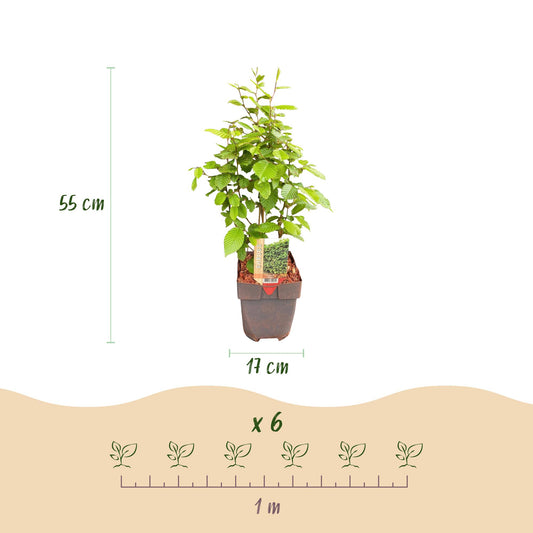
Hornbeam (Carpinus betulus), hardy hedging plant, 17 cm pot, Height 55 cm - Pack of 6
Regular price 89,95 €Regular price -


Compacta Oleaster (Elaeagnus x ebbingei), evergreen hedging plant, 9 cm pot, Height 25–35 cm
Regular price From 54,95 €Regular price -

 Livraison offerte Sale
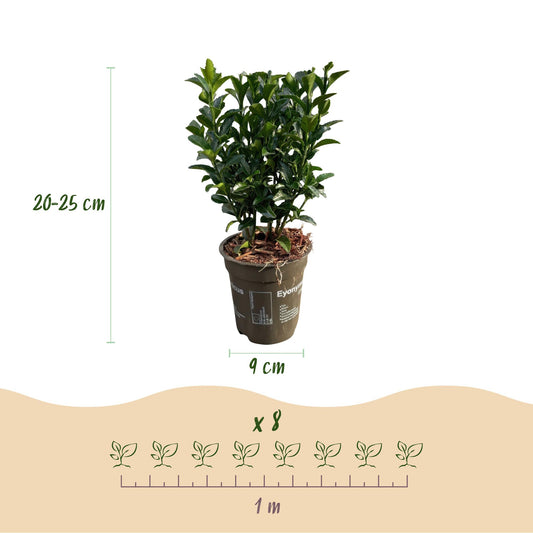
Green Spire Euonymus, evergreen hedging plant, 9 cm pot, Height 20–25 cm
Regular price From 49,95 €Regular price54,95 €Sale price From 49,95 €Livraison offerte Sale -

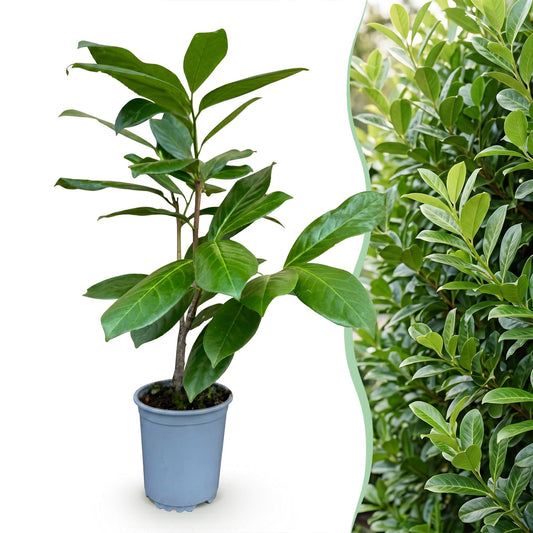
Cherry laurel Rotundifolia (Prunus laurocerasus), evergreen hedging plant, 9 cm pot, Height 25-35 cm
Regular price From 54,95 €Regular price -

 Livraison offerte Sold out
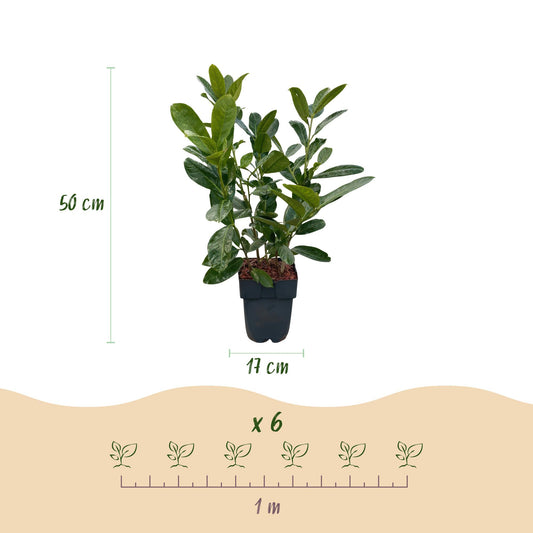
Cherry laurel Rotundifolia (Prunus laurocerasus), evergreen hedge plant, 17 cm pot, Height 50 cm - Pack of 6
Regular price 99,95 €Regular price -

 Livraison offerte Sold out
Photinia Carré Rouge (Photinia x fraseri), evergreen hedge plant - Set of 6
Regular price 109,95 €Regular price -

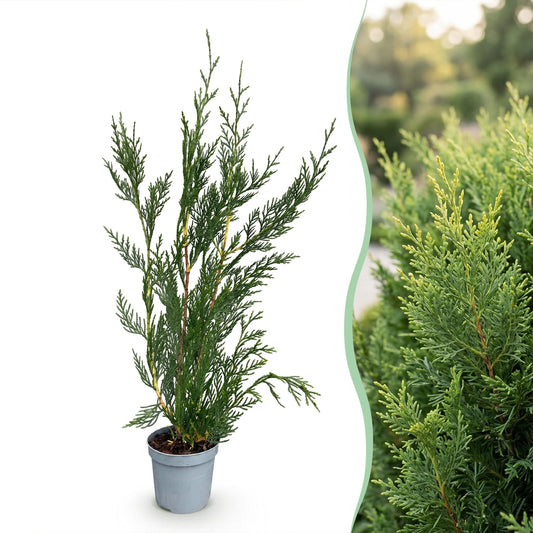
Leyland Cypress 2001 (Cupressocyparis leylandii), evergreen hedging plant, 9 cm pot, Height 30-40 cm
Regular price From 59,95 €Regular price -

 Livraison offerte
Privet (Ligustrum), hardy hedging plant, 9 cm pot, Height 35–45 cm
Regular price From 54,95 €Regular price -

 Livraison offerte Sale
Common yew (Taxus baccata), evergreen hedging plant, 9 cm pot, Height 20–30 cm
Regular price From 59,95 €Regular price179,95 €Sale price From 59,95 €Livraison offerte Sale -

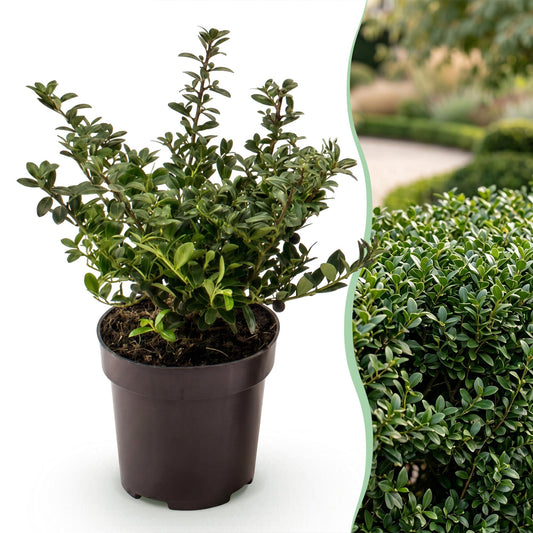
Stokes' Crenate Holly (Ilex crenata), evergreen hedging plant, 9 cm pot, Height 20-30 cm
Regular price From 59,95 €Regular price


🗓️ Hedge-trimming calendar, season by season
Here's a quick overview of what to do each season, always keeping the nesting-season pause in mind.
📅 Seasonal maintenance calendar
| Season | Key task |
|---|---|
| 🌸 Spring | Formative trim right at the beginning of spring (before mid-March) |
| ☀️ Summer | Avoid trimming during nesting season; light maintenance in late summer (hornbeam, beech, evergreens) |
| 🍂 Autumn | Second trim for conifers (yew); final shaping before winter |
| ❄️ Winter | Structural pruning for deciduous hedges in frost-free weather; sharpen tools |
🦔 Trimming with biodiversity in mind
A hedge is more than a green wall: it's a refuge for birds, hedgehogs and beneficial insects. A few precautions are all it takes to keep your hedge neat while maintaining a wildlife-friendly garden.
🐦 Nests: postpone all trimming while birds are nesting in the hedge.
🌸 Flowering: for informal hedges, trimming after flowering (outside nesting season) preserves nectar and berries.
🍂 Clippings: a pile of branches in a corner provides shelter for small wildlife.
A hedge trimmed at the right time stays dense, flowers and bears fruit—and feeds a whole little ecosystem. A mixed hedge combining evergreens and berry-producing species also attracts far more birds than a single-species screen: biodiversity starts with plant diversity.
🚫 Common mistakes to avoid
Most hedges that become sparse or turn yellow suffer from the same mistakes. Here they are, along with how to avoid them.
| Mistake | Consequence | Solution |
|---|---|---|
| Trimming during nesting season | Destroyed nests; potential offense | Wait until after July 31 |
| Top wider than the base | The bottom becomes sparse and bare | Trim into a trapezoid |
| Cutting a conifer into old wood | Permanent bare patch; no regrowth | Never cut past the green foliage |
| Trimming in direct sunlight | Leaves turn brown | Work on a cloudy day |
🌲 Evergreens, conifers and deciduous hedges: what sets them apart
A thuja shouldn't be trimmed like a hornbeam. This table summarizes the key characteristics of each major group to help you avoid mistakes.
| Group | Key points |
|---|---|
| Evergreens (laurel, photinia, elaeagnus) | Grow 20 to 40 cm per year; trim 1 to 2 times after flowering |
| Conifers (thuja, cypress, yew) | Grow 30 to 45 cm per year; never cut into old wood (except yew, which can regrow) |
| Deciduous (hornbeam, beech) | One late-summer trim preserves their winter leaves |
| Informal country hedges | Light trim after flowering (outside nesting season) to preserve flowers and berries |
If you're unsure about a particular species, light, frequent trimming is better than a severe cut. Fast-growing species such as laurel and cypress, which can grow 40 cm a year, soon need attention: two regular trims are better than a single harsh cut at the end of the season.
🤝 Our advice for a successful trim
Trimming a hedge well is mostly about timing and shape: everything else follows.
How to create a privacy hedge · Hedge planting distances · Planting a hedge in autumn
My rule comes down to two dates and one image: I leave the hedge alone between March 15 and July 31, and always trim it into a trapezoid, wider at the base than at the top. That's what makes the difference between a hedge that stays dense right down to the ground and one that becomes sparse at the bottom over the years. And I always prefer two gentle trims to one harsh cut: the hedge rewards you with denser growth.
In short: one to three trims a year, never during nesting season, shaped like a trapezoid and on a cloudy day. Follow these guidelines and your hedge will stay neat and vigorous. Browse our selection below to create or renew your hedge.


Laura Bruneau
Jardinière & autrice


