Climbing honeysuckle: planting, pruning and care

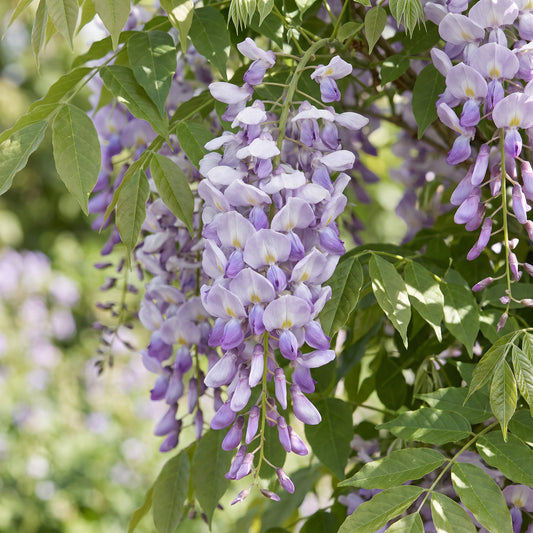
Climbing honeysuckle is the fragrant climber: its tubular, white flowers washed with purple perfume summer evenings and attract butterflies. Easy to grow and twining by nature, it covers a fence, pergola or trellis within a few years, then produces decorative red berries. Success comes down to one simple principle: keep its roots cool and in partial shade, while its top reaches for the light. Here’s the complete guide, backed by horticultural data from the RHS and Kew.
🌿 Why plant climbing honeysuckle?
Climbing honeysuckle twines around a support on its own, grows quickly (4 to 8 m), thrives in partial shade and perfumes a whole corner of the garden come evening. Hardy and undemanding, it is one of the easiest climbing plants to grow. In a cool spot, it flowers and fruits generously, much to the delight of pollinators.
| Benefit | What it brings to the garden |
|---|---|
| Unmatched fragrance | Highly scented flowers, especially in the evening, ideal near a patio or entrance. |
| Easy to grow and hardy | A twining, undemanding climber that tolerates partial shade and withstands cold well (H6). |
| Generous growth | Reaches 4 to 8 m within a few years, covering a fence or pergola. |
| Good for wildlife | Nectar-rich flowers for butterflies and decorative berries for birds. |
🔎 Honeysuckle at a glance
According to Kew POWO (Plants of the World Online), common honeysuckle (Lonicera periclymenum L., family Caprifoliaceae) is a deciduous climber native to Europe. The RHS (Royal Horticultural Society) says it flowers best in light partial shade: a south-facing wall can scorch its foliage and encourage powdery mildew.
| Feature | Verified details |
|---|---|
| 🏷️ Botanical name | Lonicera periclymenum L. (Caprifoliaceae) |
| 🌍 Origin | Europe (including France); deciduous climber |
| 🧗 Climbing habit | Twining stems wrap around a support |
| 📏 Height | 4 to 8 m, spread 2.5 to 4 m, in 5 to 10 years |
| 🌸 Flowering | Mid- to late summer; highly scented tubular flowers |
| 🔎 Berries | Decorative, bright red berries; not edible |
📋 Quick reference guide
The essentials at a glance.
| Feature | Details |
|---|---|
| Hardiness | Very hardy (RHS rating H6, down to around -20°C) |
| Position | Light partial shade is ideal; roots cool, top in the light |
| Soil | Moist but well drained; any soil type, pH not important |
| Planting | In spring or autumn |
| Climbing habit | Twining stems; provide a support (wires, trellis) to twine around |
| Height | 4 to 8 m, spread 2.5 to 4 m |
| Training | Space wires about 45 cm apart; leave at least 5 cm between the wall and support |
| Flowering | Mid- to late summer; fragrance is strongest in the evening |
| Pruning | After flowering for early-flowering types |
| Toxicity | Ornamental red berries; not edible |
📍 Where and when to plant: position, soil and support
Climbing honeysuckle does best in light partial shade: follow the rule “cool roots, head in the sun.” Its base likes shade and cool conditions, while its top reaches for the light. Avoid a scorching south-facing position, which can scorch the foliage and encourage powdery mildew.
It will grow in almost any soil, provided it stays moist but well drained: neither waterlogged nor dry.
☀️ Position: Light partial shade is ideal; roots cool, top in the light
🌱 Soil: Moist but well drained; any soil type, pH not important
🧗 Support: Twining stems; provide a support (wires, trellis) to twine around
🪴 Planting: partial shade, support and cool roots
Plant in spring or autumn in moist but well-drained soil, preferably in partial shade. Provide a support for the stems to twine around (taut wires or a trellis), as honeysuckle is a twining climber and cannot cling to a smooth wall on its own. If using wires, space them about 45 cm apart and leave at least 5 cm between the wall and support. Guide the first stems, water and mulch the base generously.
| Step | What to do |
|---|---|
| When | In spring or autumn |
| Position | Light partial shade; avoid scorching south-facing sites |
| Support | Wires or trellis for the stems to twine around |
| Training | Space wires 45 cm apart; leave at least 5 cm between wall and support |
| After planting | Guide the stems, water and mulch the base |
columns: 4
columns_mobile: 2
-

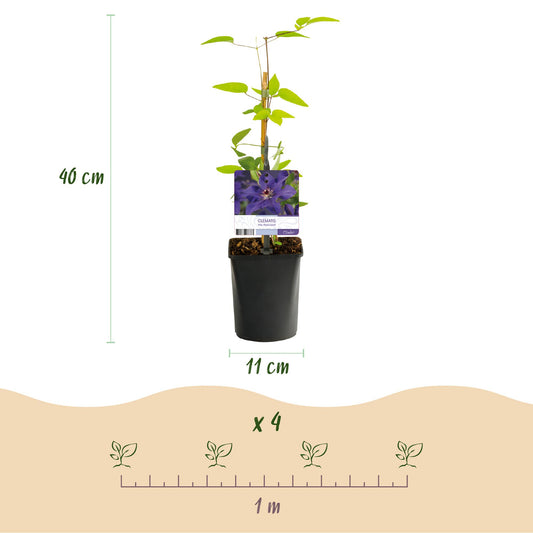
Clematis 'The President' (Clematis) - flowering climber - 9 cm pot - Height 35 cm - Set of 2
Regular price 44,95 €Regular price44,95 €35,96 €Livraison offerte -

 Livraison offerte
Chinese wisteria in a mix of blue, white, and pink (Wisteria sinensis)
Regular price From 79,95 €Regular price79,95 €From 63,96 €Livraison offerte -

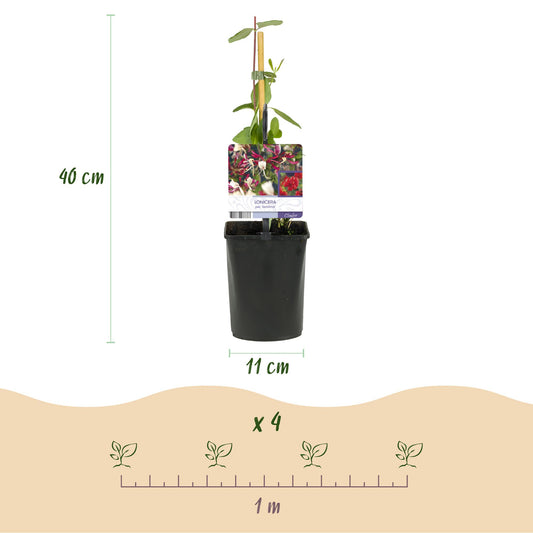
Honeysuckle 'Serotina' (Lonicera) - fragrant climber - 9 cm pot - Height 35 cm - Pack of 2
Regular price 39,95 €Regular price39,95 €31,96 €Livraison offerte -

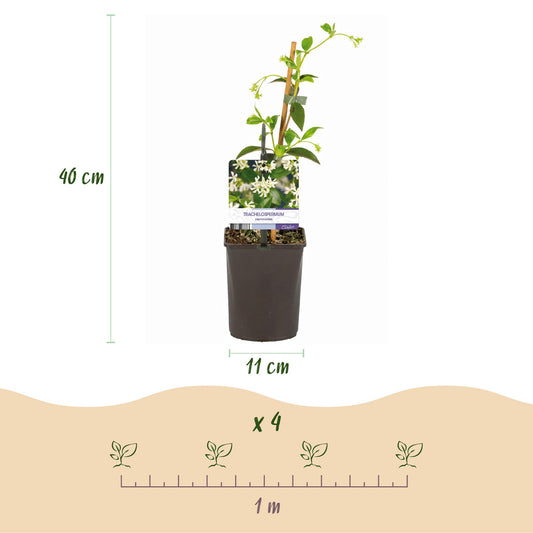
Star Jasmine (Trachelospermum jasminoides) - fragrant evergreen climber - 9 cm pot - Height 35 cm - Pack of 2
Regular price 39,95 €Regular price39,95 €31,96 €Livraison offerte -


‘New Dawn’ Climbing Rose (Rosa) – Flowering Climber – 11 cm Pot – 40 cm Tall – Pack of 2
Regular price 39,95 €Regular price39,95 €31,96 €Livraison offerte


✂️ Care: watering, training and looking after it over the years
Climbing honeysuckle needs little care: keep the base moist and mulched, water during dry spells (it dislikes dry conditions), guide the stems while young, and prune after flowering for early-flowering types. As it ages, it can become bare at the base; a rejuvenation prune, cutting it back more severely, will restore its vigour. Watch out for powdery mildew and aphids, its two usual minor problems.
💧 Watering: Water regularly; honeysuckle is sensitive to drought around the roots
🍂 Mulching: Apply a thick, permanent mulch to keep the roots cool
✂️ Pruning: After flowering for early-flowering types
🔹 Rejuvenation: Cut back more severely if the base has become bare
👀 Keep an eye out for: Powdery mildew (in hot, dry weather) and aphids on young shoots
🍂 Flowering, berries and the gardening calendar
Honeysuckle flowers in mid- to late summer, then produces red berries in autumn. Plant it in spring or autumn, prune after flowering and keep the base cool all summer. Here are the key tasks for each season.
📅 Seasonal care calendar
| Season | Key task |
|---|---|
| 🌸 Spring | New growth; guide young stems; mulch the base before hot weather. |
| ☀️ Summer | Fragrant flowers (mid- to late summer); water regularly; prune early-flowering types after flowering. |
| 🍂 Autumn | Decorative red berries; suitable time to plant; watch for powdery mildew late in the season. |
| ❄️ Winter | Dormant period; rejuvenation pruning is possible if the base has become bare; keep the mulch in place. |
🌱 How do you propagate climbing honeysuckle?
Climbing honeysuckle is very easy to propagate, making it ideal for covering several supports at little cost. Take cuttings from spring to summer; shoots with short internodes, about 10 cm long, root well. Layering in spring—bending a long, flexible stem down to the ground—is even easier and often produces a flowering plant within three years. Propagate only from healthy plants with a good fragrance.
🐛 Common problems: diseases, pests and mistakes
Climbing honeysuckle is easy to grow, with just two main weaknesses, both linked to heat and drought. Here are common problems and how to solve them.
| Symptom | Likely cause | Solution |
|---|---|---|
| White coating on the leaves | 🍄 Powdery mildew, encouraged by heat, drought and full southern exposure | Mulch, keep the base cool, water and plant in partial shade |
| Clusters of aphids on young shoots | 🐛 Aphids in spring | Squash or rub off small colonies; check plants as growth starts |
| Plant looking unhealthy | 🌱 Soil is too heavy and wet, or too dry | Improve the soil and adjust watering; honeysuckle likes moist but well-drained conditions |
| Bare base | ⚠️ Natural ageing of the climber | Cut back more severely to rejuvenate it |
-

Clematis, wisteria, passionflowers, climbing roses and star jasmine to adorn walls, pergolas...


🌸 Honeysuckle varieties
Choose primarily according to how you plan to use it. Here’s a reliable selection to help you make an informed choice.
| Variety | What makes it special |
|---|---|
| Lonicera periclymenum Serotina | Late-flowering common honeysuckle; highly scented, with purple and cream flowers |
| Graham Thomas | Scented, creamy-yellow flowers; long summer flowering period |
| Lonicera japonica Halliana | Semi-evergreen, intensely fragrant and very vigorous (needs to be kept in check) |
| Lonicera x heckrottii Gold Flame | Pink and yellow bicoloured flowers; repeat-flowering |
| Lonicera henryi | Evergreen, dense foliage; ideal for year-round green screening (flowers are inconspicuous) |
🎨 Where to grow it and what to pair it with
Climbing honeysuckle is at home wherever you want fragrance: over a pergola above a patio, along a boundary fence as light screening, or growing through a large shrub. It pairs well with a climbing rose or clematis, whose flowering periods follow one another.
Its nectar-rich flowers and berries also make it a valuable addition to a wildlife-friendly garden, whether in an informal hedge or a wild corner.
🔑 Should you plant honeysuckle in shade or sun?
This is the question that determines its health. Contrary to popular belief, climbing honeysuckle is not a full-sun plant: the RHS says it flowers best in light partial shade, and that a south-facing wall can scorch its foliage and make it more susceptible to powdery mildew.
The right formula is the same for many climbing plants: keep the roots cool and shaded, with the top reaching for the light. In practice, give it a position where the base stays cool and shaded (with mulch and a few low-growing plants around it), while its stems climb towards the sun on their support.
This arrangement encourages abundant, fragrant flowers while protecting it from its main weakness: powdery mildew.
⚠️ Are honeysuckle berries poisonous?
Take care not to confuse the two: the bright red berries of climbing honeysuckle are ornamental and should not be eaten. The RHS explicitly describes them as “ornamental berries, not to be eaten”; the berries of many honeysuckles are considered toxic if swallowed and can cause digestive upset. The foliage and flowers are safe to touch, and the flowers are also rich in nectar.
In a family garden, simply teach children not to put these pretty berries in their mouths.
✅ Our expert tips for success
Climbing honeysuckle is one of the easiest and most rewarding climbers to grow, provided you follow its golden rule: keep the roots cool and in partial shade, with the top in the light. Give it a support to twine around, mulch its base and prune it after flowering, and it will perfume your summer evenings for years, much to the delight of butterflies.
When honeysuckle develops powdery mildew, it’s almost always because the roots are too dry or the plant is in scorching sun. My go-to solution: partial shade, a thick layer of mulch and watering at the base during dry summers. In the right spot, it’s astonishingly easy to grow and perfumes the whole patio at nightfall. For me, it’s a climber that’s all about enjoyment.

Laura Bruneau
Jardinière et autrice