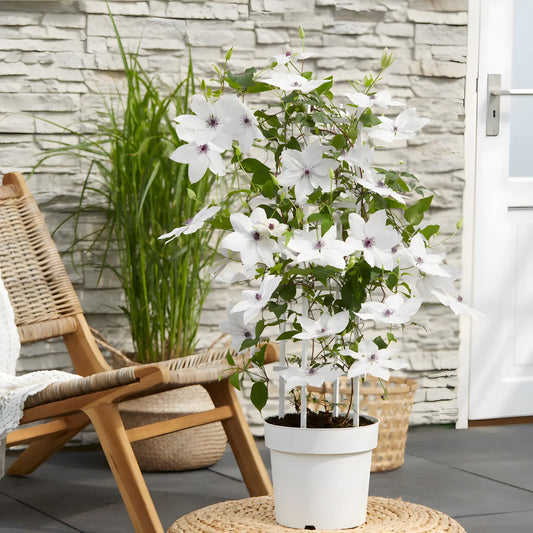
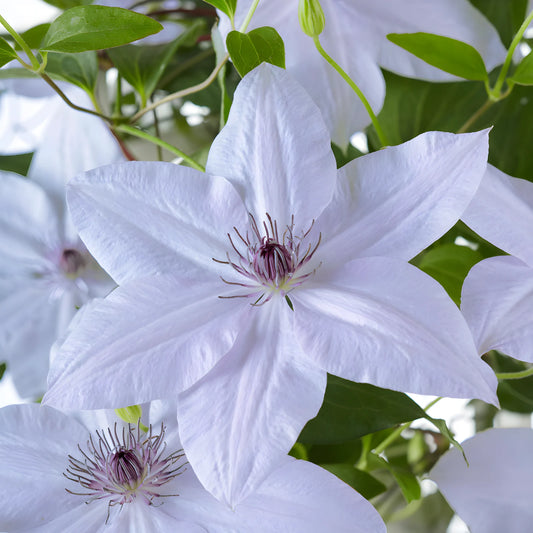
Clematis: planting, pruning (the 3 groups) and care

The clematis is probably the most floriferous of the climbers: depending on the variety, it covers a trellis with flowers from spring to autumn, in almost every colour. Its success depends on two simple but crucial rules: keep its roots in the shade and its flowers in the sun, and prune it according to its flowering group.
Understanding these three groups will ensure a generous display of clematis every year. Here is the complete guide, supported by RHS and Kew horticultural data.
🌿 Why plant clematis?
Clematis climbs on its own on a fine trellis, tolerates both sun and partial shade, and comes in hundreds of varieties with staggered flowering. Few plants offer so many flowers in so little space. The only key thing not to miss is pruning, which depends on the flowering time: when done correctly, it transforms a struggling clematis into a cascade of flowers.
| Strength | What it means for the garden |
|---|---|
| Spectacular display | Abundant flowers from spring to autumn, depending on the variety, in every colour. |
| Small footprint | It climbs up a fine trellis and covers a wall, pergola or shrub. |
| Sun or partial shade | Most clematis varieties flower in both sun and light partial shade. |
| Hardy | Most are frost-hardy (down to around -20°C, depending on the species). |
🔎 Clematis at a glance
According to Kew POWO (Plants of the World Online), the genus Clematis (Ranunculaceae family) includes nearly 400 species in temperate regions. The RHS (Royal Horticultural Society) explains that it climbs using the petioles of its leaves (hence the need for a fine support) and likes deep, moist but well-drained soil, with its roots kept cool.
| Feature | Verified detail |
|---|---|
| 🏷️ Botanical name | Clematis L. (Ranunculaceae) |
| 🌍 Origin | Temperate regions of the Old World, nearly 400 species |
| 🧗 Climbing | By the leaf petioles; fine support required (trellis, wires) |
| 📏 Height | From 1 to 3 m for compact varieties, up to 7 m or more for vigorous ones |
| 🌸 Flowering | Depending on the variety: winter, spring, early or late summer |
| ⭐ Golden rule | Roots in the shade and cool, flowers in the sun |
📋 Quick technical sheet
The essential pointers, all at a glance.
| Parameter | Pointer |
|---|---|
| Hardiness | Hardy, often down to around -20°C depending on the species |
| Exposure | Sun or partial shade; base in the shade, top in the light |
| Soil | Deep, fertile, moist but well-drained |
| Planting | In spring or early autumn |
| Climbing | By the petioles; fine trellis or wires |
| Pruning | According to the flowering group (1, 2 or 3) |
| Group 1 | Flowers on last year's wood: light pruning after flowering |
| Group 2 | Large early summer flowers: light pruning in late winter |
| Group 3 | Flowers on this year's shoots: cut back to 20 to 30 cm in February |
| Toxic | Irritating sap; handle with gloves |
📍 Where and when to plant it: exposure, soil, support
Clematis likes its flowers in the sun and its roots in the shade, kept cool. This is the golden rule: its roots hate heat and drought. Give it deep, fertile, moist but well-drained soil, and shade the base: with mulch, a paving slab or a low plant at the foot.
Most varieties flower equally well in sun or light partial shade; only evergreen clematis varieties require a sheltered position.
☀️ Exposure: Sun or partial shade; base in the shade, top in the light
🌱 Soil: Deep, fertile, moist but well-drained
🧗 Support: By the petioles; fine trellis or wires
🪴 Planting: depth, support and cool roots
Plant in spring or early autumn, in a deep hole enriched with compost. A clematis peculiarity: it is planted deeper than the root ball (the crown 5 to 8 cm below the surface), which encourages new shoots to grow from the base in case of wilting.
Install a fine trellis or wires, lean the plant towards the support, water and shade the base immediately.
| Step | The right action |
|---|---|
| When | In spring or early autumn |
| Depth | Crown planted 5 to 8 cm below the surface (root base renewal) |
| Soil | Deep, fertile, moist but drained; amend if heavy or sandy |
| Support | Fine trellis or wires to attach the petioles |
| After planting | Water, mulch and shade the base immediately |
columns: 4
columns_mobile: 2
-

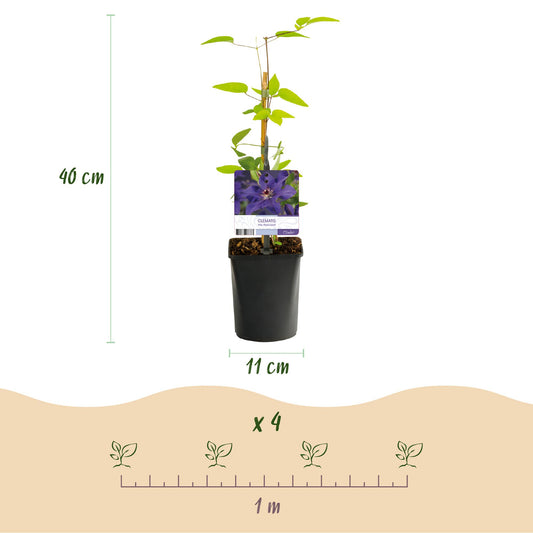
Clematis 'The President' (Clematis) - flowering climber - 9 cm pot - Height 35 cm - Set of 2
Regular price 44,95 €Regular price44,95 €35,96 €Livraison offerte -

 Livraison offerte
Chinese wisteria in a mix of blue, white, and pink (Wisteria sinensis)
Regular price From 79,95 €Regular price79,95 €From 63,96 €Livraison offerte -

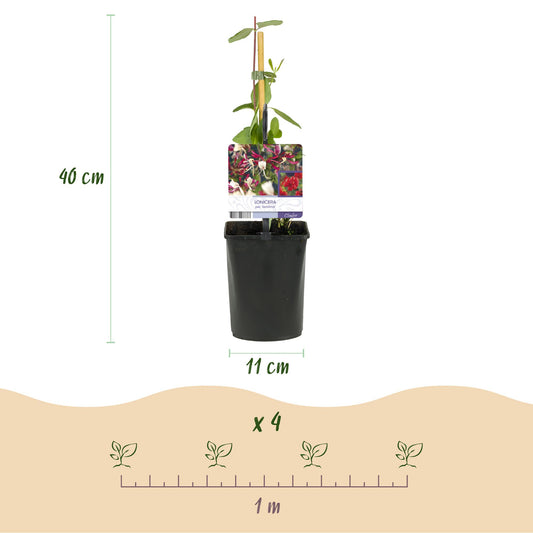
Honeysuckle 'Serotina' (Lonicera) - fragrant climber - 9 cm pot - Height 35 cm - Pack of 2
Regular price 39,95 €Regular price39,95 €31,96 €Livraison offerte -

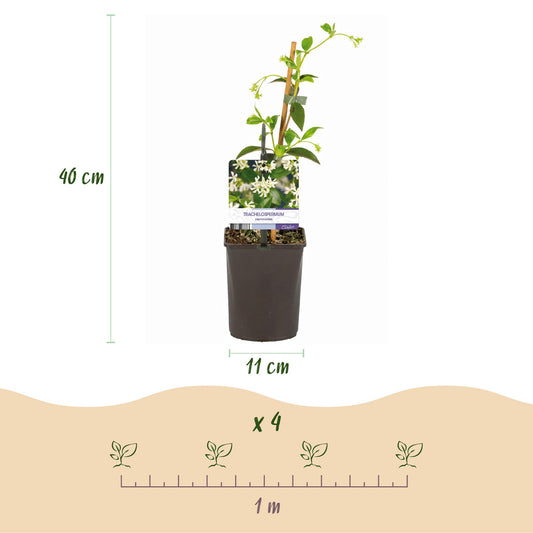
Star Jasmine (Trachelospermum jasminoides) - fragrant evergreen climber - 9 cm pot - Height 35 cm - Pack of 2
Regular price 39,95 €Regular price39,95 €31,96 €Livraison offerte -


‘New Dawn’ Climbing Rose (Rosa) – Flowering Climber – 11 cm Pot – 40 cm Tall – Pack of 2
Regular price 39,95 €Regular price39,95 €31,96 €Livraison offerte


✂️ Maintenance: watering, tying up and care over the years
Clematis maintenance mainly depends on two things: keeping the roots cool and pruning according to the right group. Water during dry periods, mulch generously, and add a little compost in spring.
As for pruning, it all depends on the flowering time: group 1 (flowering on old wood) lightly pruned after flowering, group 2 (large early summer flowers) lightly pruned in late winter, group 3 (summer flowering on this year's shoots) cut back severely in February.
💧 Watering: Regularly in summer, especially in the first year and in pots
🍂 Mulching: Thickly at the base, to keep the roots cool
🌱 Fertilisation: Compost in spring; clematis is a heavy feeder
✂️ Group 1 pruning: After flowering, light pruning to tidy the plant
✂️ Groups 2 and 3 pruning: Late winter: light (group 2) or severe to 20-30 cm (group 3)
🍂 Pruning and seasonal calendar season by season
The clematis calendar is dictated by its pruning group and flowering. If in doubt about the group, the rule is simple: observe when it flowers in the first year, and prune accordingly. Here are the key actions throughout the seasons.
📅 Maintenance calendar by season
| Season | Key action |
|---|---|
| 🌸 Spring | Renewal; flowering of groups 1 and 2; shade the base before the heat. |
| ☀️ Summer | Flowering of large flowers and late varieties; continued watering and mulching. |
| 🍂 Autumn | Ideal planting time; flowering of late varieties; light pruning of group 1 after flowering. |
| ❄️ Winter | Dormancy; late winter pruning: light (group 2), severe to 20-30 cm (group 3). |
🌱 How to propagate clematis?
Clematis is mainly propagated by cuttings, using the node cutting technique (a stem fragment bearing a pair of buds) in early summer. Layering, by laying a flexible stem in a pot of compost until it roots, also works very well and requires less care. Sowing is reserved only for botanical species and takes a long time. Reserve propagation for healthy, well-identified plants.
🐛 Common problems: diseases, pests and mistakes
Robust once established, clematis experiences two emblematic problems: wilting and powdery mildew. Here are the common cases and their solutions.
| Symptom | Probable cause | Solution |
|---|---|---|
| Stems that wilt suddenly | 🍄 Clematis wilt (disease), especially large flowers | Cut the affected stems flush with the ground: the plant will grow back from the base if it is planted deep |
| White powdery coating on leaves | 🍄 Powdery mildew, encouraged by dryness at the base | Water regularly, mulch, ventilate, remove affected parts |
| Few flowers | ✂️ Incorrect pruning or base too hot | Identify the group and prune correctly; shade and mulch the base |
| Nibbled young shoots | 🐌 Slugs and snails in spring | Protect young shoots at the start of vegetation |
-

Clematis, wisteria, passionflowers, climbing roses and star jasmine to adorn walls, pergolas...


🌸 Our clematis varieties
The choice is made above all by use: here is a reliable selection to choose with knowledge.
| Variety | Its strength |
|---|---|
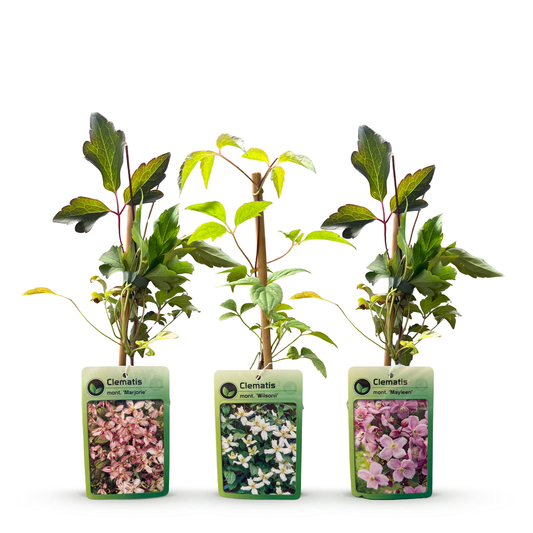
| Clematis montana | Group 1: very vigorous, cloud of flowers in spring, covers quickly |
| Clematis armandii | Group 1: evergreen and fragrant, rare late winter flowering, to be sheltered |
| Nelly Moser | Group 2: large pink-striped flowers, holds up well in light partial shade |
| The President | Group 2: large intense purple flowers, repeat flowering |
| Jackmanii | Group 3: the classic purple, generous and easy |
| Clematis viticella | Group 3: small very abundant flowers, robust and healthy |
🎨 Where to plant it and how to associate it
Clematis pairs ideally with a climbing rose or a shrub, in which it is left to climb to extend the flowering. On a trellis, it covers a wall or hides a neighbour; on a pergola, it creates a flowery ceiling. Plant low perennials or a small shrub at its foot: they shade the roots while decorating the base, which is often bare.
🔑 How to identify the pruning group of your clematis?
This is the question that decides everything, and it is simpler than it seems. The RHS distinguishes three groups according to the flowering time. Group 1 brings together clematis that flower early, in winter or spring, on last year's wood (such as Clematis montana and armandii): they are pruned only after flowering, to tidy them.
Group 2 brings together large early summer-flowering cultivars, often repeat flowering: light pruning in late winter, removing dead wood and shortening above a healthy pair of buds. Group 3 brings together clematis that flower from mid-summer on this year's shoots: they are cut back severely to 20 to 30 cm from the ground in February. In case of doubt, the flowering of the first year decides.
⚠️ Is clematis toxic?
Yes, it is important to know: all parts of the clematis contain an irritating substance (protoanemonin), released when the plant is crushed or cut. On contact, the sap can irritate the skin; if ingested, it causes a burning sensation and digestive problems, but its very bitter taste quickly deters.
Wear gloves when pruning, avoid contact with the eyes, and plant it out of reach of very young children. The foliage in place presents no danger to the touch.
✅ Our expert tips for success
Clematis generously rewards two simple actions: keeping its roots in the shade and cool, and pruning it according to its flowering group. Plant it deep so that it always grows back from the base, shade its roots, identify its group, and it will offer you hundreds of flowers, year after year.
The classic panic is when the clematis suddenly wilts: it is almost never fatal. If it has been planted deep, it is enough to cut the affected stems flush with the ground and it will grow back from the base. My reflex at planting: bury the crown several centimetres and shade the base. With that, a clematis well set on its pruning group becomes unbeatable in its generosity.
The 3 pruning groups of clematis
Clematis pruning depends on its flowering time. We distinguish three groups, and knowing which one yours belongs to avoids mistakes that remove the flowers of the year.
Group 1: late winter to spring flowering (clematis montana, alpina, armandii): almost no pruning. Remove only dead wood and faded flowers, just after flowering. To rejuvenate an overgrown plant, it can be cut back to 15 cm from the ground, but no more than once every three years.
Group 2: large May-June flowers (large-flowered hybrids): light pruning in February, above a beautiful pair of buds, then cleaning up faded flowers after the first wave to encourage repeat flowering in late summer.
Group 3: summer to autumn flowering (clematis viticella, 'Jackmanii', texensis): severe pruning every year in February, to 30-45 cm from the ground, above the lowest pair of buds. This frank pruning avoids a bare base and a mass of tangled stems.

Laura Bruneau
Jardinière et autrice