Ginkgo biloba (maidenhair tree): planting and care

To grow a Ginkgo biloba successfully, plant a named male cultivar in full sun, in well-drained soil, between October and April, then let it get on with things: it needs almost no pruning or treatment. Nicknamed the maidenhair tree, the ginkgo is the only living member of the Ginkgoaceae family, a deciduous tree whose fan-shaped leaves turn golden yellow in autumn.
It therefore ranks among the best shrubs for autumn color, and adds height to a garden of flowering shrubs. Here are the details, verified against the RHS, Kew Gardens and two American university extension services (NC State and UF/IFAS).
🌿 Why plant a ginkgo: a living fossil in the garden
The ginkgo is a tree apart. According to the Kew Gardens profile, ginkgo leaf fossils more than 200 million years old have been found, and the oldest recorded tree is thought to be 3,500 years old.
In the garden, it can withstand conditions few trees tolerate: North Carolina State University Extension (NC State Extension) describes it as tolerant of drought, heat and air pollution, and moderately salt-tolerant, which explains its use in cities.
It is also generally free of pests, according to the RHS (Royal Horticultural Society).
| Benefit | What this means for you |
|---|---|
| Spectacular autumn foliage | Fan-shaped leaves turn a uniform golden yellow before falling |
| Very hardy | H6 according to the RHS, or -20 to -15°C, with no protection needed in the ground |
| Tough in urban settings | Tolerates pollution, heat, drought once established, and compacted soil |
| No treatment needed | Generally free of pests and diseases, with no obligatory pruning |
🔎 Ginkgo biloba at a glance
According to Plants of the World Online (POWO), the Royal Botanic Gardens, Kew database, the accepted name is Ginkgo biloba L., in the Ginkgoaceae family, and its stated native range is China (Zhejiang Province); NC State Extension gives a broader range across central-southern and southeastern China.
POWO notes that the species is classified as Endangered (EN) on the IUCN (International Union for Conservation of Nature) Red List and ranks second on the gymnosperm EDGE list. It is a deciduous gymnosperm, distinct from conifers: each tree is male or female, and only female trees bear seeds with yellowish, foul-smelling flesh.
| Feature | Verified details |
|---|---|
| 🏷️ Botanical name | Ginkgo biloba L. (POWO) |
| 🧬 Family | Ginkgoaceae, the only living species in its genus |
| 🌳 Type | Deciduous tree, a gymnosperm (neither a conifer nor a broadleaf tree); male and female trees are separate |
| 🌍 Origin | China (Zhejiang according to POWO); Endangered in the wild (IUCN) |
| ❄️ Hardiness | H6 according to the RHS: -20 to -15°C; USDA zones 3a to 9b according to NC State |
| 🍃 Foliage | Fan-shaped, often bilobed leaves, up to 12 cm wide; golden yellow in autumn (RHS) |
| 🌸 Flowers | No true flowers: pollen-bearing catkins on male trees, fleshy yellow seeds on female trees |
| 📏 Mature size | More than 12 m tall in 20 to 50 years, with a spread of 4 to 8 m (RHS); up to 40 m in the wild (POWO) |
📋 Quick growing guide
The key growing details, all in one place.
| Factor | Guideline |
|---|---|
| Position | Full sun, at least 6 hours a day (NC State); all aspects, in an exposed or sheltered spot (RHS) |
| Soil | Chalky, clay, loamy or sandy, acidic to alkaline, but well-drained; avoid waterlogged soil |
| Hardiness | H6, -20 to -15°C (RHS) |
| Watering | 30 to 50 litres per m² per week in dry weather while establishing (RHS); drought-tolerant thereafter |
| Planting | October to April; container-grown trees can be planted year-round, but establish more easily in autumn and winter (RHS) |
| Pruning | No pruning needed (RHS); train young trees to a single central leader (UF/IFAS) |
| Foliage | Deciduous, golden yellow in autumn, with a rapid, brief leaf drop (UF/IFAS) |
| Care | Easy: no treatment; remove the stake after 2 growing seasons |
| Toxicity | Seeds are harmful if ingested and toxic to animals; wear gloves when handling them (RHS) |
📍 Where and when to plant a Ginkgo biloba
Plant the ginkgo in full sun, as a specimen tree or in a row, where it will have room for its crown. According to the RHS Ginkgo biloba profile, it tolerates all aspects, exposed or sheltered sites, and chalky, clay, loamy or sandy soils, provided they are well-drained.
As for timing, the RHS tree-planting guide recommends planting from October to April: container-grown trees can be planted year-round, but establish more easily in autumn or winter. Keep its mature size in mind: the species grows over 12 m tall and spreads 4 to 8 m.
☀️ Ideal: Full sun, deep, well-drained soil: lawn, large garden, avenue planting
⛅ Suitable: Small garden or large container with a compact or columnar cultivar (Mariken, Menhir)
🚫 Avoid: Waterlogged soil, dense shade, or planting the standard species right next to walls
🪴 Planting a ginkgo in the ground or in a container
Plant it as you would other ornamental trees. The same RHS guide recommends digging a hole at least 3 times wider than the root ball, but no deeper than the roots, with the root flare at soil level. Do not add organic matter to the hole: as it decomposes, it can hinder establishment.
A small tree does not need staking; stake a tall or heavy specimen, then remove the stake after 2 growing seasons.
For container growing, the RHS guide to trees in containers recommends potting it on in stages to a final container at least 45 cm wide, using a loam-based potting mix such as John Innes No. 3.
| Step | What to do |
|---|---|
| 1. Choose the plant | A named, grafted male cultivar (UF/IFAS) suited to the available space |
| 2. Dig the hole | Make it 3 times wider than the root ball, but no deeper than the roots (RHS) |
| 3. Set the tree in place | Keep the root flare at soil level without burying the crown; do not add organic amendments to the hole |
| 4. Stake if needed | Only for tall or heavy specimens; remove the stake after 2 growing seasons |
| 5. Water and mulch | 30 to 50 litres per m² per week in dry weather; leave a 10 cm gap around the trunk when mulching |
columns: 4
columns_mobile: 2
-


'Golden Spirit' smoke tree (Cotinus coggygria) - golden-foliaged shrub - 12 cm pot - Height 35 cm
Regular price From 39,95 €Regular price59,95 €Sale price From 39,95 €39,95 €From 31,96 €Livraison offerte Sale -


'Young Lady' smoke tree (Cotinus coggygria) - shrub with fluffy pink flowers - 12 cm pot - Height 35 cm
Regular price From 39,95 €Regular price59,95 €Sale price From 39,95 €39,95 €From 31,96 €Livraison offerte Sale -
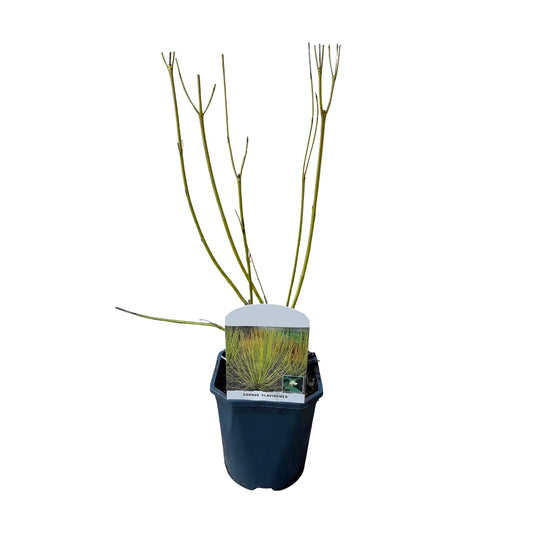
Dogwood 'Flaviramea' (Cornus) - ornamental stem shrub - 17 cm pot - Height 45 cm
Regular price 39,95 €Regular price39,95 €31,96 €Livraison offerte -

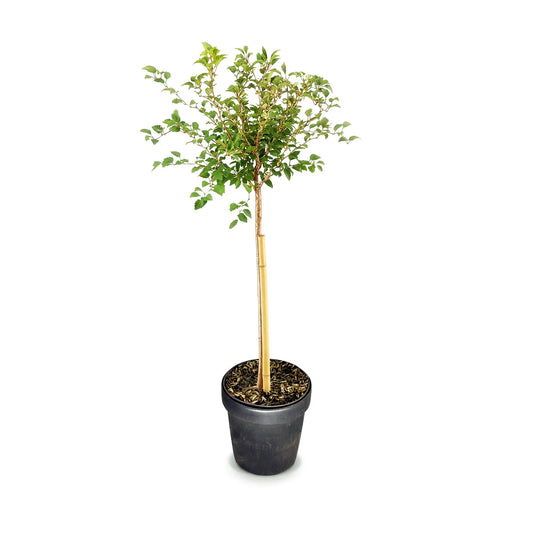
Japanese Flowering Cherry 'Kojo-no-mai' (Prunus incisa) - ornamental flowering cherry - 19 cm pot - Height 90 cm
Regular price 69,95 €Regular price69,95 €55,96 €Livraison offerte -

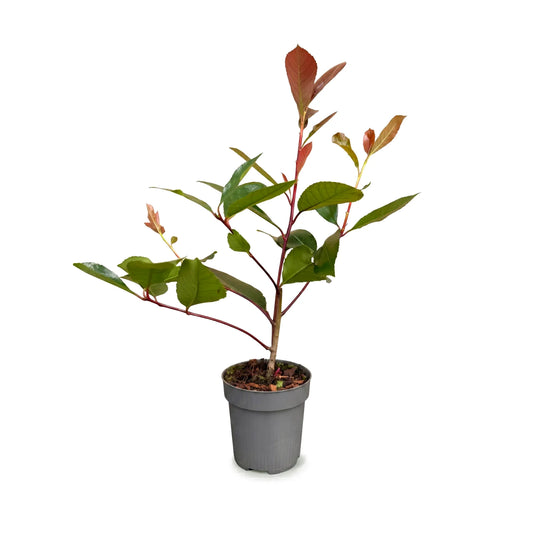
Photinia 'Red Robin' (Photinia × fraseri) – evergreen hedge shrub – 9 cm pot – 25 cm tall
Regular price From 64,95 €Regular price64,95 €From 51,96 €Livraison offerte -

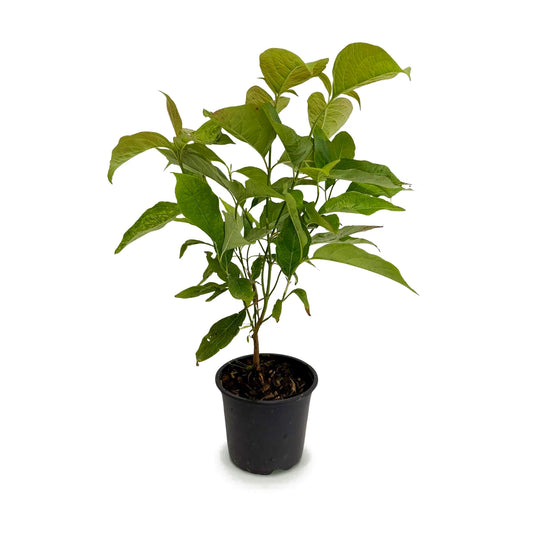
Male dogwood (Cornus mas) - winter-flowering yellow shrub - 12 cm pot - Height 35 cm
Regular price From 34,95 €Regular price34,95 €From 27,96 €Livraison offerte




✂️ Ginkgo care and pruning: almost nothing to do
Once established, the ginkgo takes care of itself. The RHS says no pruning is needed; the University of Florida profile (UF/IFAS), however, notes that early training is essential to establish a single central leader.
In the first few years, focus mainly on watering: the RHS recommends checking moisture by digging beside the root ball before watering. Container-grown trees need more attention: the RHS advises replacing the top 5 cm of potting mix each spring, applying a slow-release fertilizer and repotting every few years.
✂️ Formative pruning: On a young tree, keep one central leader and remove competing leaders (UF/IFAS)
✂️ Pruning mature trees: None needed (RHS); remove dead wood only
💧 Watering while establishing: In dry weather, after checking the soil beside the root ball (RHS)
🔹 Container: top-dressing: Replace 5 cm of potting mix each spring and add a slow-release fertilizer (RHS)
🧣 Container: winter: Wrap the pot in burlap or bubble wrap in exposed locations (RHS)
🍂 The ginkgo through the seasons
The ginkgo is understated in spring and summer, with its medium-green foliage, then puts on a show in autumn. For 'Autumn Gold', 'Autumn Gold' is described as having leaves that turn a uniform golden yellow.
The display is brief: according to UF/IFAS, the leaves fall quickly and the autumn color lasts only a short time, leaving a golden carpet beneath the tree. As for growth, patience is needed: the same source notes that growth is extremely slow for several years after planting, before becoming moderate. In winter, the bare tree is unfazed by cold, tolerating temperatures down to -20°C in H6.
📅 Seasonal care calendar
| Season | Key task |
|---|---|
| 🌸 Spring | Plant until April; formative pruning for young trees; top-dress and fertilize container-grown trees |
| ☀️ Summer | Water young trees and container plants in dry weather; foliage is medium green |
| 🍂 Autumn | Leaves turn golden yellow, then fall quickly; gather seeds from female trees while wearing gloves; ideal time to plant from October |
| ❄️ Winter | Dormant; plant container-grown trees when the ground is not frozen; protect the pot in exposed locations |
🌱 Propagating a ginkgo: seed, cuttings, grafting
The RHS lists seed sowing and semi-ripe cuttings; NC State Extension mentions grafting, which is the method nurseries use to reproduce a cultivar. According to Kew, seeds generally germinate in 8 to 10 weeks in a cool greenhouse.
Seed sowing has one major drawback: you cannot know the plant's sex until it matures, which takes 20 to 35 years according to POWO. That is why UF/IFAS states that the only way to obtain a male tree is to buy a named cultivar.
🐛 Common problems: causes and solutions
The ginkgo has few enemies: UF/IFAS considers it free of pests, and the RHS reports only occasional attacks by honey fungus. Most disappointments are therefore due to a poor choice of planting site, soil that is too wet, or understandable impatience with its slow growth.
| Symptom | Likely cause | Solution |
|---|---|---|
| Rancid-butter smell in autumn | ⚠️ Female tree: flesh of fallen seeds (Kew) | Gather the seeds while wearing gloves; choose a named male cultivar when planting |
| Tree barely growing | ⚠️ Normal establishment phase; very slow for several years (UF/IFAS) | Water in dry weather, mulch and be patient; do not move it |
| Leaves fall within a few days | ⚠️ Typical rapid leaf drop for the species (UF/IFAS) | No treatment needed: gather the leaves or leave them as mulch |
| Decline, fungi at the base | ⚠️ Honey fungus, rare (RHS) | Remove the affected tree and its roots; do not replant in the same spot |
| Multiple leaders, unbalanced shape | ✂️ Young tree not given formative pruning (UF/IFAS) | Select one central leader and remove competing leaders early |
| Skin irritation while gathering seeds | ⚠️ Contact with seed flesh; possible dermatitis (NC State) | Wear gloves; wash your hands after handling |
-

Our flowering outdoor shrubs: buddleias, dogwoods, deutzias, hibiscus, mock oranges and more...


🌸 Ginkgo varieties
We do not stock ginkgo trees. Here are cultivars documented by the RHS, with their sex where specified, to help you choose according to the space available.
| Variety | What makes it special |
|---|---|
| 'Mariken' | Male, dwarf and bushy: 1.5 to 2.5 m tall and wide in 10 to 20 years, ideal in a large container, AGM (RHS) |
| 'Autumn Gold' | Male, rounded crown: 8 to 12 m tall, 4 to 8 m wide, uniform golden yellow in autumn, AGM (RHS) |
| 'Fastigiata' | Male, narrowly columnar: over 12 m tall, 4 to 8 m wide (RHS) |
| 'Fastigiata Blagon' | Narrow-crowned and columnar: around 15 m tall and 2.5 to 4 m wide; sex not specified by the RHS |
| 'Menhir' | Very narrow and compact: 4 to 8 m tall, 1 to 1.5 m wide, with wavy blue-gray leaves; sex not specified by the RHS |
🎨 Ginkgo in the garden: companions and neighbors
Planted as a specimen tree, the ginkgo makes a stunning focal point in an autumn scene. Pair it with red or purple foliage to make its golden leaves stand out: Cotinus, or smoke bush and Japanese maples are natural companions.
In winter, the colorful stems of dogwood take over at the foot of the bare tree. By the patio, a 'Mariken' in a pot can join our selection of plants for balconies and patios.
Browse our ornamental trees and shrubs to pair with Ginkgo, our flowering shrubs, our plants for balconies and patios, and all our outdoor plants.
⚠️ Is Ginkgo biloba toxic?
Only the seeds of female trees pose a problem. The RHS states that the seeds are harmful if swallowed and toxic to pets, and advises wearing gloves when handling them.
NC State Extension classifies the plant as having low-severity toxicity: the seed pulp can irritate the skin and, if eaten in large quantities, cause mouth irritation, stomachache, nausea, and diarrhea.
The NCCIH notes that fresh seeds are toxic when taken orally. The ASPCA's (American Society for the Prevention of Cruelty to Animals) list for dogs does not include Ginkgo, so the RHS warning is the one to follow for your pets.
As for leaves used in dietary supplements, this is a health matter: the NCCIH (National Center for Complementary and Integrative Health, part of the U.S. National Institutes of Health) recommends discussing their use with a healthcare professional; ask your doctor or pharmacist for advice.
✅ Our expert tips for success
Growing a successful ginkgo comes down to three decisions: choose a named male cultivar, plant it in full sun with enough room for its mature size, and provide well-drained soil. Plant it between October and April, water it during dry spells for the first few years, train a central leader while it is young, then let it grow.
In a small garden or in a pot, 'Mariken' and 'Menhir' offer the same golden foliage on a smaller scale. And you’ll be growing a species classified as Endangered in the wild on the IUCN Red List. To plan your planting, our guide what to plant in autumn gives you the right timing.
The ginkgo is the tree I recommend to patient gardeners. In the first few years, it can feel as though nothing is happening, then one autumn all the foliage lights up at once and falls within a few days. I always remind people to check the label: choosing a named male tree can save a lot of regret twenty years later. And I love slipping a fan-shaped leaf into a book.

Laura Bruneau
Jardinière et autrice